
Repeated Russian incompetence – or – provocative war fever?
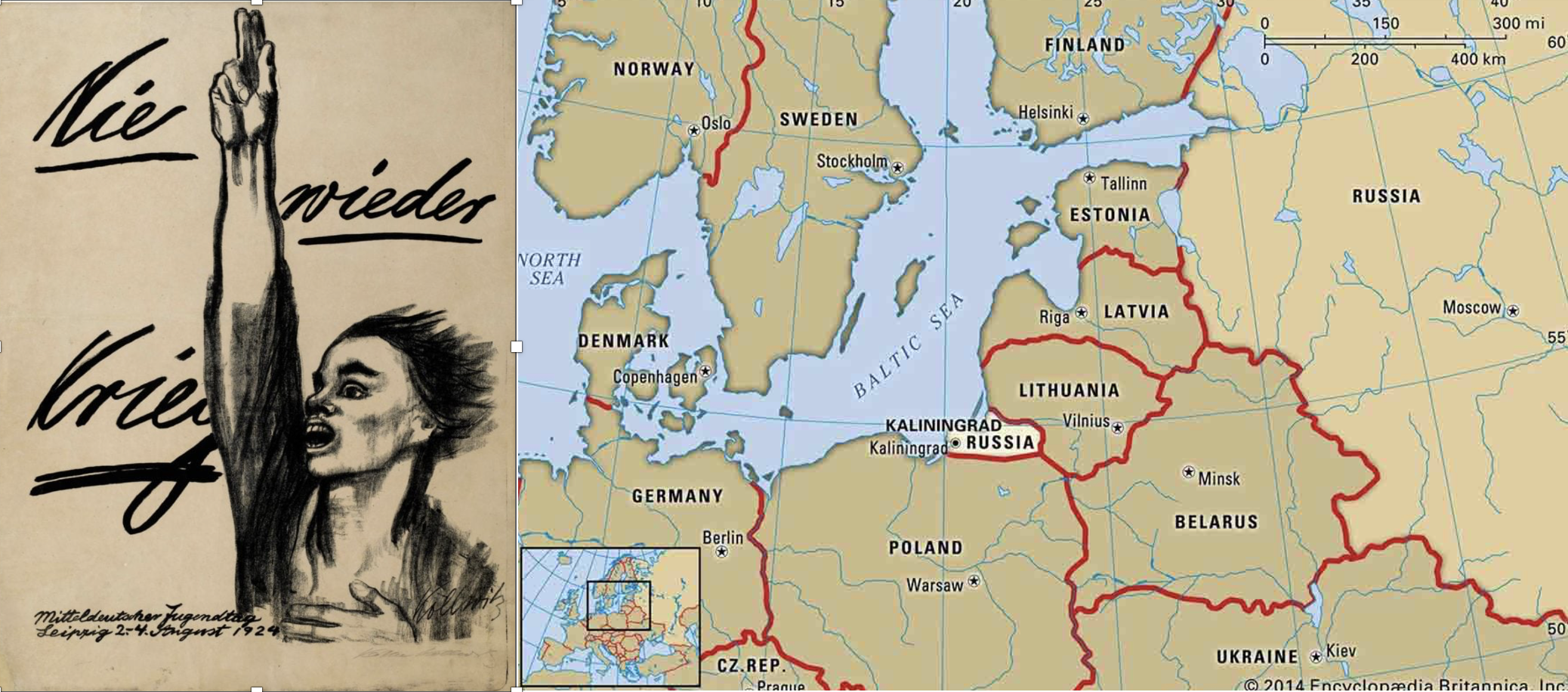
Composite Image: On left is “Nie Wieder Krieg!” (Never Again War’) by Käthe Kollwitz (See also ” Käthe Kollwitz – New Gallery and Exhibition”; MLRG.online March 2024; On the right is a map is from Greg Bayer; “How (& Why) Is Kaliningrad Part of Russia?”; August 24, 2024; accessed 1 October 2026
Introduction MLRG.online October 2, 2026
Käthe Kollowitz (1867-1945) justly raged against war as in the above image. She is not being heard in today’s Europe. Nor will she be heard without a massive mobilisation of workers. But the lack of influential Marxist-Leninist parties is a huge handicap to such mobilisation. Meanwhile, we all rapidly march towards a new war, pulled by the state leaders.
In Europe these leaders hurl new provocations against each other – the NATO powers and Russia. Currently, war games are mooted to surround the current Russian possession of the city of Kaliningrad, formerly Königsberg, until 1946. These plans are being enthusiastically pushed by NATO.
At the same time, USA President Trump sends more troops – another 7,000 and 2,000 Marines – to Iran. They are on board “USS Theodore Roosevelt carrier strike group and the USS Makin Island amphibious readiness group, with its two amphibious landing ships”. In total there will be “more than 20,000 sailors and Marines as well as hundreds of aircraft” – of the USA threatening Iran. (AP; “US sends third aircraft carrier to Middle East as Trump weighs new Iran strikes”; October 2, 2026 Guardian ).
Here we only look at the European theatre and the somewhat convenient escalation of unproven “Russian assaults” on aspects of European infrastructure.
An overall picture
The European Union and the UK have very loudly signalled as NATO members, that they will provoke Putinite Russia into an open war. While this has escalated over the last two years, it reached a new crescendo this week.
To any objective observer, it seems the timing of new events is motivated, by an increasingly evident failure of Ukraine in its just war of defence against Russia. Ukraine’s Zelesnky faces down further consequences of ongoing internal corruption (See “Trump and Putin Squeeze Zelensky and European leaders”; MLRG November 26, 2025 ). Ukraine’s people endure intensified Russian assaults. While the Western press and NATO leaders continually advertise that Russia is losing, or has lost this war – that is far from clear.
We wrote previously that the invasion of Ukraine by the belligerent Russia was itself, precipitated by NATO and the European Union and the USA. The latter, and in particular the USA tore up the “promise” that President Reagan had given to keep the borders of the Southern flank of Russia intact. Naturally, this in no way absolves Russia under Putin of a flagrant and unjust aggressive invasion of independent Ukraine. But the fact of the deliberate provocation by NATO remains. (See “Imperialist Danse Macabre over the Peoples of Ukraine”; MLRG.online February 10, 2022; Republished August 15, 2025).
It thus should not be surprising that a new series of fronts are being flagrantly opened up since end 2024, using as a cover a series of events.
But these events cover a torrent of incidents apparently with no clear victims. Are the Russians that hapless that when they set out to do damage they somehow never manage? It strains incredulity to think so. It is frankly difficult to say from the outside how real the involvement of Russia has been. However, legitimate queries arise.
When clear evidence has been present, it is quickly shared publicly. As in the Novichok poison attack in Salisbury of the former Russian-British ‘double agent’ Sergei Skripal and his daughter Yulia Skripal, on 4 March 2018 Sergei and his daughter, Yulia Skripal. (Steven Morris; “Paramedic gave Sergei Skripal novichok antidote by chance, inquiry hears”; The Guardian 30 October 2024; BBC Salisbury Novichok poisoning: Russian nationals named as suspects” 5 September 2018 BBC).
Also there was a murder in Berlin, Germany, of a Georgian Chechen man by a Russian agent in Tiergarten. This was well publicised and then tested in court:
“On 15 December 2021, the Higher Regional Court of Berlin sentenced Russian national Vadim Krasikov (Vadim K.), alias Vadim Sokolov (Vadim S.), to life imprisonment for the murder of Tornike Khangoshvili (T. Ka.), a Georgian citizen of Chechen ethnicity, in central Berlin’s Kleiner Tiergarten park on 23 August 2019. The Court determined that Krasikov ‘had been commissioned by State authorities of the central government of the Russian Federation to eliminate the victim, among other things because of his role in the second Chechen war between 2000 and 2004 and as the leader of a Chechen militia.’ In an unprecedented act, the Court stated explicitly in its ruling that the murder ‘was an act of State terrorism.’”
Rohan Sinha and Stefan Talmon; German Practice in International Law; 17 September 2024
But the recent chain of events seems far more staged, and the “evidence” – if any – is not publicly shared. They have been vociferously claimed as examples of “Russian aggression.” Such loud claims are largely unproven.
Cumulatively all these events have built up a war fever. A strategy seems to have emerged. That is to deny that any proof is needed to substantiate allegations of “Russian attacks”. Indeed in 2025, Konstantin von Notz – the former chair of a German parliamentary committee supervising intelligence agencies displayed the strategy to be followed:
“There is always this demand for a smoking gun, which is understandable, and legally of course also correct. [But] does the logic of in ‘dubio pro reo‘ [let doubt favour the accused] have to be suspended somehow when we’re dealing with hybrid warfare? Do we need to have the courage to name what we’re dealing with without being able to prove it down to the very last legal detail?”
Sam Jones; “Russia’s hybrid warfare puts Europe to the test”; Financial Times; December 9, 2025.
The EU leaders in such accusations of “Russian attacks”, frequently invoke the term “hybrid war”.
What does “hybrid war” mean exactly?
“Hybrid wars” appears to mean any form of sabotage that cannot be clearly traceable, or clearly proven to come from Russia. The term began to be thrown around, it seems in July 2024.
A characteristic feature of these hybrid war attacks is that they – most curiously – seem usually to be a “near-miss incident” – as was the initial July 2024 “incident“. All this becomes ripe for unfounded allegations. No attempt at proof is made available.
In the absence of publicly made available actual evidence, claims escalate rapidly. For example, about a new September 11 as “the next stage of the plan: to attack flights to the US, (like) the World Trade Center attacks“.
Alleged attack of parcel explosions 2024 in three countries
As for example, in 2024 after some odd “explosions in logistic centres” of DHL packages:
“In July 2024, DHL parcels exploded in logistics centres in the UK, Poland and Germany. Each of them was powerful enough to have brought down a cargo plane had they detonated onboard.
Security services would eventually trace the plot back to a group of Russian-directed saboteurs who had a further 6kg of explosive material in their possession. That was enough to give them the capability for what security officials told the Financial Times was the next stage of the plan: to attack flights to the US, and cause more disruption to the airline industry than any act of terror since the World Trade Center attacks.
It was just one near-miss incident in a co-ordinated and covert campaign of sabotage led by Moscow, officials believe, that has sown bewilderment across the continent and is steadily posing more of a risk to human lives.
Intelligence chiefs and police forces have foiled plots to derail crowded trains, burn down shopping centres, discharge a dam and poison water supplies. And these are just the ones we know about.
“The first important thing to consider is that we still don’t really appreciate everything which is going on,” says Keir Giles, Russia expert at Chatham House. “What is publicly understood about this is just the tip [of an iceberg] . . . there’s still a lot that governments have chosen not to talk about.”
What was, as recently as a year ago, still being characterised as a nuisance of “pin prick”, low-level attacks against soft European targets is now being interpreted as a far more serious threat.”
Sam Jones; “Russia’s hybrid warfare puts Europe to the test”; Financial Times; December 9, 2025.
Not only tame experts such as Keir Giles at Chatham House, but high military commanders talk up the “Russian covert violence” – as it was put. The signal to blame and attack Russia – was lit by NATO Admiral Giuseppe Cavo Dragone:
“the chair of NATO’s military committee, Admiral Giuseppe Cavo Dragone, told the FT that the alliance was looking at far more muscular responses to Russian covert violence, including pre-emptive strikes as a deterrent.
It amounts to a test of Europe’s mettle, says Chatham House’s Keir Giles. “The capacity of victim states to deal with these attacks, identify the perpetrators and politically respond . . . is very valuable intelligence” for Russia, he says. “And if the answer is that they don’t… if a country just writes this off as ‘hybrid warfare’ with stern words, then Russia will just continue to do more of the same.”
Sam Jones; “Russia’s hybrid warfare puts Europe to the test”; Financial Times; December 9, 2025.
Luck? Failure of Russian intelligence? Or orchestrated propaganda attacks?
What makes the many recent allegations even more suspect is that, somehow, and thus far – they have largely not evolved into actual detonations. Or have not caused significant damage. When there is true evidence, this is openly shared pretty quickly with the public.
In marked contrast, the DHL attacks noted above did not lead to any loss of life and did not down any aircraft. Somehow conveniently, they occurred in “logistics centres in the UK, Poland and Germany .” Three sites at least then, all with no casualties.
Such a pattern is repeatedly described. As for example, a bomb on a railway line in Poland which was “averted at the last instance” in 2025, causing again, no harm:
“A bomb placed on the Warsaw-Lublin railway line in Poland was, in the words of the country’s prime minister, Donald Tusk, “an unprecedented act of sabotage” designed to cause a train derailment and mass casualties.
Disaster was averted at the last minute, when a train conductor managed to make an emergency stop.”
Sam Jones; “Russia’s hybrid warfare puts Europe to the test”; Financial Times; December 9, 2025.
We simply list below further such alleged attacks with some bare details. Again, no proof seems to be ever offered. But ringing incitements against Russian “perpetrators” are willingly and loudly proclaimed.
Alleged attack of balloons in Lithuania 2025
Another accusation has been of drones or balloons posing a “State of emergency“. But posing any apparent danger – has not seemingly translated thus far into more than “smuggling” of cigarettes into Lithuania:
“Lithuania has declared a state of emergency after hundreds of smuggler balloons from neighbouring Belarus forced the repeated closure of its airports in recent weeks and threatened national security.
The move by the government on Tuesday follows multiple appeals to the EU to take more action against what Vilnius has said is the latest stage in Russia and Belarus’s hybrid war against Nato member states.
The giant balloons are used by smugglers to bring contraband such as cigarettes into Lithuania. Vilnius airport has been closed for 60 hours in recent weeks, affecting more than 350 flights and 50,000 passengers. The airport in the city of Kaunas has also been forced to close several times.
“In combating the Belarusian hybrid attack, we must take the strictest measures and defend the areas most affected by this attack . . . The public will not experience any inconvenience due to the state of emergency,” said Prime Minister Inga Ruginienė.
… Since 2021, Lithuania, Latvia and Poland have all faced significant numbers of migrants pushed across the border from Belarus, which all three have called a hybrid attack. Lithuania and Poland have blamed a number of arson attacks on Russia, while there have also been several incidents of lower-level violence or vandalism such as attacks on ministerial cars in Estonia and Poland.
Lithuania has several times called on the EU to impose sanctions on Belarusian officials and help the Baltic country combat the smuggler balloons.”
Richard Milne; Lithuania declares state of emergency over smuggler balloons from Belarus”; Financial Times December 9, 2025
Leipzig, Germany 2026
In August 2026, a drone was “by chance discovered” before it could damage anything at an airport in Leipzig. Fortunately, it was “malfunctioning“. It led to a rupture of diplomatic relations with Russia, after a month’s delay:
“Germany has blamed Russia for orchestrating an explosives-laden drone attack at a key logistics airport last month as part of Moscow’s intensifying “hybrid warfare” against western targets.
German interior minister Alexander Dobrindt said on Tuesday that a drone packed with explosives and found near a Ukrainian cargo plane at Leipzig/Halle airport on August 4 bore all the hallmarks of a Russian attack.
“We are not at war, but we are a daily target of hybrid warfare,” he said…
The chance discovery of the drone, which appeared to have malfunctioned, shocked Germany…”
Anne-Sylvaine Chassany; “Germany blames Russia for Leipzig drone attack”; Financial Times 1 September 2026
The top European Union officials have piled on to attack Russian officials:
“The EU’s top diplomat, Kaja Kallas… said the incident bore “all the hallmarks of state-sponsored terrorism”. Speaking ahead of an informal meeting of EU foreign ministers in Ireland, she said the EU had summoned the Russian ambassador. Several member states, including Germany and France, have also called in representatives or ambassadors.
Ursula von der Leyen, president of the European Commission, said it was an attack “using military-grade material carried out by Russian operatives on European Union soil” that would have caused “enormous damage” had it been successful. “We will not tolerate it,” she said…”
Anne-Sylvaine Chassany; “Germany blames Russia for Leipzig drone attack”; Financial Times 1 September 2026
Fires in arms factory in Estonia September 2026
In Estonia, officials including the Prime Minister blamed Russia for fires in a factory for automated warfare:
“A fire broke out at a site used by Milrem Robotics, a defence contractor, in the Estonian capital Tallinn on August 15. Three suspects were subsequently arrested in Latvia and deported to Estonia.
Estonia’s domestic intelligence agency Kapo on Tuesday said it was “a deliberate and pre-planned act commissioned by Russian security services”. Prime Minister Kristen Michal called the attack “absolutely unacceptable and irresponsible”…”
Richard Milne, “Russia behind arson attack on defence company, says Estonia”; Financial Times September 29, 2026
Such “victimless” attacks led to state demands for “action” against Russia
Numerous state warnings have now been issued, including the ones we note above. In addition is the noteworthy terminology of Estonia’s Foreign Minister Margus Tsahkna – while explicitly acknowledging that Russia had “no evidence that Russia was preparing a traditional military attack“:
“Margus Tsahkna, Estonia’s foreign minister, told the FT that it was essential for Nato members to attribute what he called “terror attacks” to Russia to deter Moscow from stepping up its campaign of sabotage and arson aimed at dividing the alliance and stemming members’ support for Ukraine.
“Russia is boiling Western democracies like a frog — turning on the heat step by step, and testing our responses. Our main goal is to show [Russian President Vladimir] Putin that we attribute, we react, and we prepare for any kind of provocations,” he added…..
Tsahkna said Estonia and other frontline Nato countries had no evidence that Russia was preparing a traditional military attack on them, sufficient to trigger the military alliance’s collective defence clause, Article 5.
But he said sub-article 5 attacks, such as a foiled drone bombing of an aircraft at Leipzig in Germany or fighter jet incursions into Nato airspace, were designed to undermine the alliance’s unity.”
Richard Milne, “Russia behind arson attack on defence company, says Estonia”; Financial Times September 29, 2026
The state warnings by Denmark mounted even higher the threat:
“Russia could launch a limited military attack against a Nato country in the coming months, according to Danish intelligence, in the bluntest warning by western security services.
The Danish Defence Intelligence Service (DDIS) on Thursday said there was a “low but growing risk” that Moscow could move a small number of troops, possibly without insignia, into a neighbouring country or use long-range weapons on infrastructure used to support Ukraine.
“It could involve the deployment of military forces into a limited area inside Nato countries bordering Russia — for instance, under the pretext of protecting local Russian minorities,” Thomas Ahrenkiel, head of the DDIS, told a news conference. “The aim would be to divide the alliance.”
Richard Milne “Russia could attack Nato country within months, Denmark warns”; Financial Times September 24, 2026
Again – what concretely happened to trigger such warnings?
“a foiled drone strike on Leipzig airport in Germany and a Russian ship firing flares at a Danish helicopter over the Baltic Sea.
Poland on Thursday said Moscow was probably behind an arson attack on a Starlink ground station intended to disrupt internet service in Ukraine.”
Richard Milne “Russia could attack Nato country within months, Denmark warns”; Financial Times September 24, 2026
But at the same time, the Danish sources state this ‘threat from Russia’ has “no prospect” of reality within the next 6 months:
“Danish intelligence said Moscow was under more pressure than at any other time since it launched its full-scale invasion of Ukraine in February 2022. The intelligence service added there was “no prospect” of Russia making a major breakthrough in the next six months.”
Richard Milne “Russia could attack Nato country within months, Denmark warns”; Financial Times September 24, 2026
NATO manouevres around Kaliningrad, Putin’s response and Chancellor Merz’s counter
Perhaps it is true that fiction mirrors reality. The experts such as Keir Giles at Chatham House certainly seem to think so – at least for the purposes of drum-rolling:
“Sky’s ‘The Wargame’ series, broadcast last week, is fiction — but the messages the TV show tries to deliver to the British public and its government are real and urgent. Sunday’s news of a foiled plot against the Fairford RAF base underlines how attacks within the country are no longer just the stuff of TV drama.”
Keir Giles; “A TV series shows Britain is woefully unprepared for war”; Financial Times; September 28, 2026
The UK media has participated in the general “alarm”, and all this has been noticed, it seems, by Putin. Recent statements by Putin, it is said were prompted to the UK publicity:
“… Russian statements were in part a response to recent coverage of Kaliningrad in the UK media, including a documentary on Sky News about a fictional war-gaming exercise.”
Henry Foy and Max Seddon “Russia makes extreme threats against Nato countries over Kaliningrad”; Financial Times September 30, 2026.
And indeed there has been a lot of military activity around Kaliningrad – which, as the map above shows – is a Russian-occupied city thrust into a small piece of Europe. It represents for Russia its’ only warm water port. It has a large naval fleet there with missiles capable of striking European capitals with “nuclear-capable Iskander missiles“:
“”Kaliningrad has long been a source of tension between Russia and NATO, given its strategic location on the Baltic Sea, and the potential for Russia to cut off the three Baltic states from the rest of their Nato allies if they were to annex a land corridor between the exclave and its military ally Belarus.”
Henry Foy and Max Seddon “Russia makes extreme threats against Nato countries over Kaliningrad”; Financial Times September 30, 2026.
That the USA most up-to-date hardware was involved in the NATO exercises is significant:
“The United States is leading a large-scale NATO air exercise this week along the alliance’s northeastern flank, drawing the attention of defense experts and flight-tracking analysts because of the size and combination of assets involved…
Col. Martin O’Donnell, spokesman for Supreme Headquarters Allied Powers Europe, said the training Tuesday included U.S. and Norwegian fighter aircraft, Polish ground forces and a NATO E-3A AWACS plane…
Observer estimates of the number of aircraft involved in the exercise Wednesday ranged from 25 to 50 but those numbers could not be verified.”
“Flurry of NATO activity in Baltic region aimed at deterrence, US officials say”; at “Stars and Stripes” – 2 October 2026
“A U.S. Air Force EA-37B Compass Call II electronic warfare aircraft spent approximately two hours orbiting west of Russia’s Kaliningrad exclave on August 18, part of a large, unannounced NATO air exercise that massed between 25 and 50 aircraft over northeastern Poland and the Baltic states.
The United States led the exercise, which involved American and Norwegian fighter jets, Polish ground units, two NATO E-3A Sentry airborne warning and control system (AWACS) aircraft, and at least five aerial refueling tankers, Poland’s Operational Command confirmed…
The most operationally distinctive element of the package was the EA-37B Compass Call II, the U.S. Air Force’s newest dedicated electronic warfare platform, designed to disrupt enemy communications, radar systems, and command-and-control networks…
OSINTdefender, an open-source intelligence analyst, noted that while NATO AWACS flights near Kaliningrad occur regularly, the combination of electronic warfare, reconnaissance, and fighter assets in a single unannounced package was operationally unusual.”
“U.S. Deploys Newest Electronic Warfare Jet to Map Russian Defenses in Rare NATO Drill – SOFX”; Europe Says – August 20, 2026
Naturally, this also confirms that the alleged ‘rift’ between the EU and the USA over NATO is far from a reality when it comes to war planning. A Polish expert unequivocally asserts this after the show of force around Kaliningrad:
“Artur Kacprzyk, an expert from the Polish Institute of International Affairs (PISM)… Artur Kacprzyk points out, choosing the Kaliningrad Oblast as one of the main targets should also be seen as a clear signal, indicating to the Kremlin “how vulnerable this part of its territory would be in the event of a conflict”… “This is a significant manifestation of US commitment to protecting allies at a time when American involvement in NATO is becoming smaller and more uncertain…”
Michał Górski; “NATO exercises near Kaliningrad. The US plays a key role”;
Defence 24.com 20 August 2026
The Russian state has responded as follows, warning explicitly of nuclear deployment:
“Russia has threatened to use nuclear weapons against Nato countries if the Western military alliance were to hinder access to its Baltic Sea exclave of Kaliningrad.
In a document sent to Nato this week, Moscow accused the alliance of taking a “dangerous and reckless course” towards Russia and its exclave, according to two officials familiar with the matter. The officials said it included a warning about “high risks of the outbreak of a direct armed conflict”.
Nato responded by accusing Moscow of “irresponsible nuclear rhetoric” and said it posed no threat to Russia.
Moscow claimed Nato was preparing for potential military operations to blockade Kaliningrad, the Russian exclave bordering Poland and Lithuania, citing the defence alliance’s exercises in the region and the Baltic Sentry mission to protect undersea infrastructure.
“Russia will be ready to use the entire arsenal of forces and capabilities at its disposal, including nuclear weapons, in order to defend its territory should Nato countries undertake any attempt aimed at isolating the Kaliningrad Region from the rest of the country,” the document stated.
Such moves could result in “Russian strikes against decision-making centres in the alliance’s member states right from the outset of the conflict”, it warned.”
Henry Foy and Max Seddon “Russia makes extreme threats against Nato countries over Kaliningrad”; Financial Times, September 30, 2026.
Of course NATO representatives “strongly denounce the … irresponsible.. threat of nuclear force“:
“I can confirm that Russia sent a non-paper to NATO and that we have sent a response, noting that NATO is a defensive alliance and none of our activities or exercises pose a risk to any part of Russia,” said alliance spokesperson Allison Hart. “We strongly denounce the threat of force, including any irresponsible nuclear rhetoric.”
Henry Foy and Max Seddon “Russia makes extreme threats against Nato countries over Kaliningrad”; Financial Times, September 30, 2026.
““Russia’s use of hybrid tactics is a sign of desperation. But we will not be dissuaded from our support to Ukraine,” Hart added. “We have what it takes to defend every inch of Allied territory and remain strong, ready and able to counter any threat.”
Henry Foy and Max Seddon “Russia makes extreme threats against Nato countries over Kaliningrad”; Financial Times, September 30, 2026.
On top of all this on October 1, 2026 – German Chancellor Merz made the following bellicose remarks. These took place ironically – at a ceremony to award NATO the Westphalian Peace Prize (!):
“Europe is preparing for “severe” Russian hybrid attacks, said German Chancellor Friedrich Merz as Vladimir Putin threatened that his conflict with the West could reach a “fatal point of no return”…
Moscow’s escalation was a “sign of Russia’s desperation in the face of its unsuccessful war in Ukraine”, Merz said on Thursday.
“We are preparing for further hybrid attacks, including severe ones,” he said in a speech marking the award of the Westphalian Peace Prize to NATO. “Should they occur, we would respond quickly and very clearly.”
… in Moscow on Thursday, Putin confirmed that Russia’s foreign ministry had sent warnings to several countries and said …
“If it comes to a direct attack on the Russian Federation — in this case, [the Baltic Sea exclave of] Kaliningrad, although other territories could also be involved — the question of Russia using every weapon at its disposal will inevitably and immediately be put on the agenda.”
Anne-Sylvaine Chassany and Katya Arenina “Europe braces for ‘severe hybrid attacks’ from Russia, says Friedrich Merz”; Financial Times October 1, 2026
Conclusions
For now it is certainly impossible to prove what really underlies the allegations of Russian-led “hybrid war”. The historical weave strongly suggests the allegations are part of a war-mongering. Of course, the very expensive and rapidly progressing re-engineering of European (and especially of German and British) defence industries plays into this.
Of course there are several other political factors at play. These include the up-coming mid term elections in the USA. We have written separately on this (“USA Midterms – strategies to “fix a win”” MLRG.online October 5, 2026). However, a manufactured casus belli would be very convenient indeed for President Trump.
How all this will play out is, of course, quite open right now.
One thing is clear, however: the working class of the world has a legitimate fear that they will be the ones to suffer in the case of war. They have nothing to gain from a new inter-imperialist war. The only way they can stop this is by a widespread anti-war movement that moves towards a new socialist revolution.
MLRG.online 2 October 2026


