Marxist-Leninists and the 2026 Spanish General Elections
“Los marxistas-leninistas ante las elecciones generales de 2026″ –
” Marxist-Leninists and the 2026 General Elections”
Resolution of the Central Committee of the PCE (m-l)
15 November 2026
Introduction
We are re-publishing three articles by the PCE(ML). This is the final of these and comes from the Central Committee. It consists of a resolution on the imminent elections in Spain.
MLRG.online; 18 November, 2026
Resolution of the Central Committee of the PCE (m-l)
Demanding that the progressive coalition government fulfill its promises has enabled the working classes to take their first steps toward an independent popular movement – a movement that has already succeeded in forcing an early election and the first general strike in 14 years. These gains are now threatened by the prospect of a far-right coalition government. For this reason, our rallying cry for these elections is:
“ON NOVEMBER 29, NOT A SINGLE VOTE FOR THE RIGHT!”
and
“EVERY DAY: ORGANIZE AND FIGHT – WORKERS AND THE PEOPLE, REGARDLESS OF WHO IS IN POWER!”
The snap election announced by Pedro Sánchez on the afternoon of October 5th brings us once again to a familiar dilemma: how should we – communists, Marxists-Leninists – act in the face of the primary mechanism used to legitimize the bourgeois dictatorship?
At first glance, the answer seems straightforward, as no candidate or party challenges the economic and political foundations of the “1978 Regime.” Furthermore, the governments led by Pedro Sánchez since 2018 – first in coalition with Unidas Podemos, and subsequently with SUMAR – have either sidelined or outright abandoned many of the promises they once made to secure votes from the working class.
Given this situation, there is no shortage of arguments for calling for abstention – or even a boycott – of these elections, a course of action that some leftist organizations will undoubtedly pursue. Indeed, one can expect to see – decontextualized – quotations from Lenin himself, invoked to justify the non-participation of communists in elections organized by the bourgeoisie. However, if there is one defining characteristic of those of us who view communism as a science – the science of scientific and revolutionary socialism – it is that we never make decisions without first weighing the potential pros and cons regarding their impact on the ever-shifting balance of forces within the class struggle.
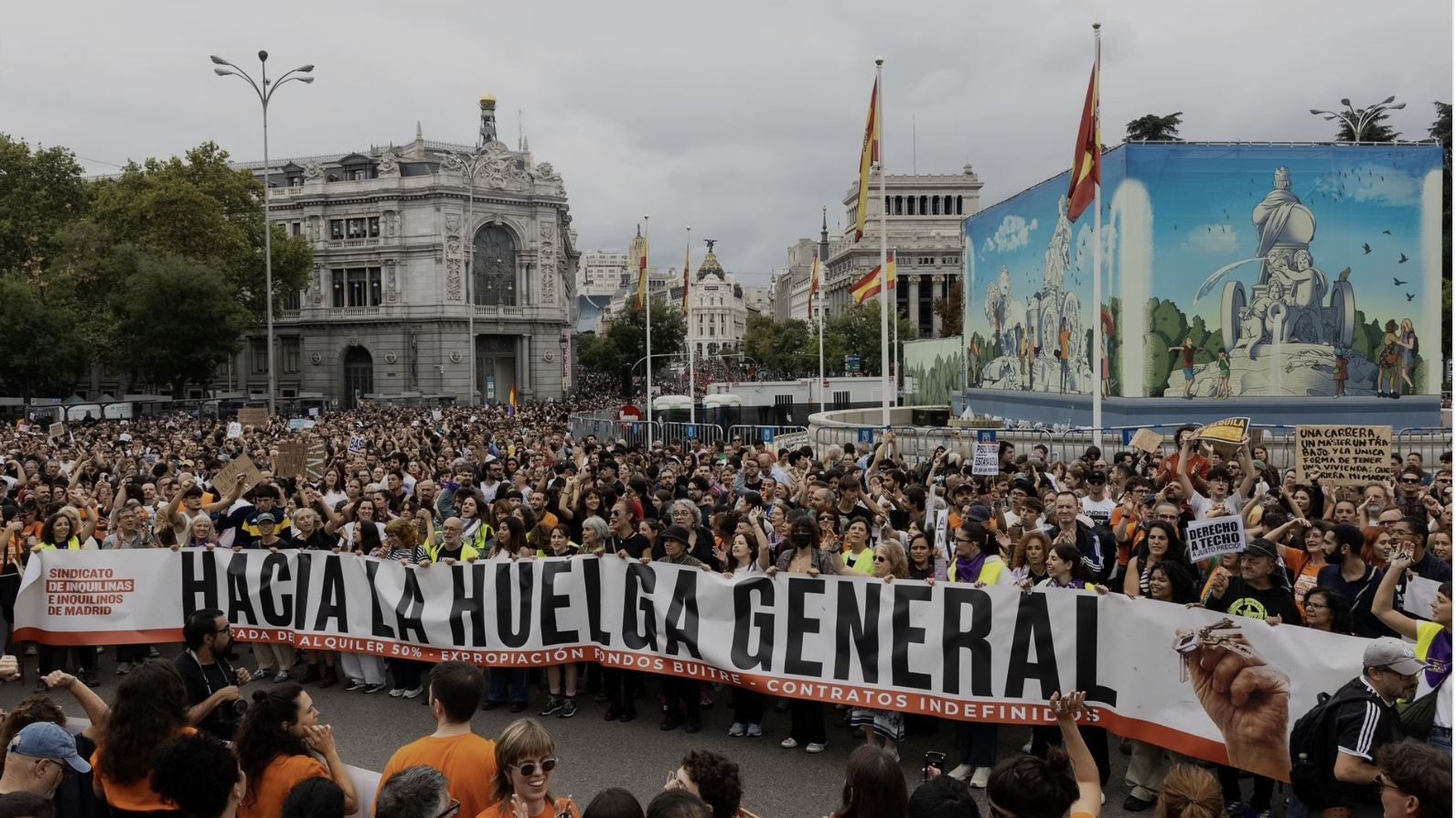
Following this principle, it must be noted that this early election was brought about, first and foremost, by the popular pressure exerted by the housing movement. This movement succeeded in organizing a sustained, large-scale mobilization – involving hundreds of thousands of working people of all ages across the entire country – through demonstrations, rallies, and encampments in major public squares throughout Spain. In doing so, they highlighted the responsibility of all state authorities – and the central government in particular – for the systematic violation of the right to housing for the working classes.
This, however, does not contradict the fact that Pedro Sánchez chose to end the legislative term precisely when he sensed an electoral advantage to be gained from the parliamentary rejection – led by “Junts per Catalunya” (See below) of the government’s proposed decrees on the matter. At the same time, it cannot be denied that the government’s own self-characterization as “the most progressive in history” is precisely what encouraged thousands of people to demand measures that would live up to such a claim.
This dynamic – where the perception of a degree of class-based sympathy within the government fosters mobilization and demands for policies aligned with the interests of the working classes – is a recurring theme in our political history. The explanation is simple: when “progressive” governments commit to maintaining a baseline of social development, the working classes are free to devote their time and energy to expanding existing rights, or to organizing and developing a political project of their own. Conversely, when right-wing governments undermine rights and freedoms, popular mobilization is forced to prioritize the defense of gains that were previously thought to be secure. This hinders the organization and struggle of the working class and the broader public, effectively ceding the initiative to the most regressive forces.
If we add to this the authoritarian tendency of the Spanish right – including those factions that label themselves “peripheral nationalist” rights – which are already unabashedly announcing a future full of “sacrifices” (for the working class, never for the bourgeoisie), the “deregulation” of public services, and the repeal of basic rights and freedoms (abortion, for instance, has already been called into question even by the PP), not to mention the threat of outlawing political and trade union organizations, then the infantile principle that “the worse things get, the better” for the awakening of the masses is thoroughly refuted.
This explains why it is precisely now – at a time when the most damaging effects of the lingering hangover from the Great Crisis of 2008 seem to be subsiding, and under governments that style themselves “progressive” – that a new generation of the working class has been able to organize and mobilize on a mass scale, moving toward the attainment and expansion of their rights and freedoms. In contrast, the preceding political generation – the one that spearheaded the idealized 15M movement (See below) – was barely able to resist or defend even the most fundamental protections against the tsunami of economic and social cuts unleashed by the PP’s absolute majority in 2011.
To risk a repeat of that wave of repression and liberalization -now reinforced by the neo-fascism of VOX – at the very moment when a new working-class generation is taking its first, still tentative steps, by advocating for abstention or an electoral boycott in the name of a supposed “revolutionary purity” that ignores real-world circumstances, would not only be falling into what Lenin termed the “infantile disorder” of immature communists; it would also be a strategic error with unimaginable consequences for the years to come.
If there is one defining characteristic of this new popular movement – which is beginning to struggle, and to learn how to do so, across fronts such as public education and healthcare, the right to housing, and the cause of an exploited and ignored youth – it is that, for the time being, it has not fallen into the uncritical, naive trust in parliamentary “allies” that afflicted the preceding political generation. Instead, it organizes specifically to exert pressure on political representatives from the streets, wringing from them commitments and progressive improvements that strengthen the living, working, and fighting conditions of the popular movement, all in preparation for further and greater victories.
For all these reasons, our position as communists – as Marxist-Leninists – regarding the general elections on November 29th must be:
1) to confront head-on any advance by reactionary and quasi-fascist right-wing forces in all spheres, including the institutional;
2) to continue calling for the permanent organization of the proletariat as the vanguard of the popular classes:
3) to sustain popular mobilization toward the securing and deepening of social rights and democratic freedoms; and
4) to continue building permanent organization in workplaces, educational institutions, streets, and public squares—an organization capable of forcing the adoption of laws and measures favorable to the popular classes, regardless of who is in power, and of advancing toward the construction of a political alternative that breaks once and for all with the “Regime of ’78” and gives birth to the Third Republic.
This stance is encapsulated in these two slogans:
ON NOVEMBER 29TH, NOT A SINGLE VOTE FOR THE RIGHT!!!
EVERY SINGLE DAY, ORGANIZATION AND STRUGGLE BY THE WORKING CLASS AND THE PEOPLE!!!
November 2026 PCE(ML)
Note 1: “Junts per Catalunya” is in English ‘Together for Catalonia”. It is often referred to as “Junts”. It is a Catalan pro-independence and populist political party “on the centre-right of the political spectrum. It is the second-largest party in the Parliament of Catalonia, holding 35 of the 135 seats. The current party president since 2024 is Carles Puigdemont.” (Wikipedia )
Note 2: 15-M Movement “Movimiento 15-M” – was the anti-austerity movement in Spain, of 2011-2012. It is sometimes known as the Indignados Movement. It organised around local and regional elections (Wikipedia).
Re-published MLRG.online 18 November 2026