
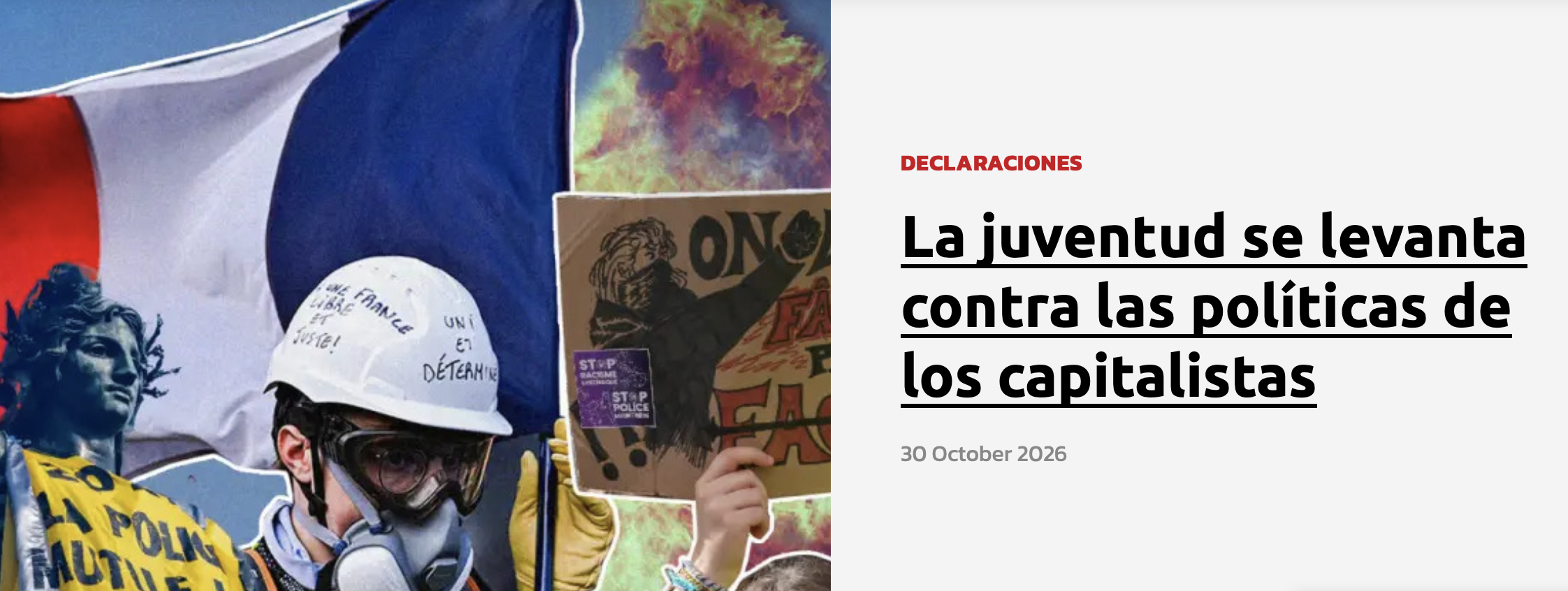
“Youth rise up against the policies of the capitalists” – Statement of CIPOML
“La juventud se levanta contra las políticas de los capitalistas” – “Youth rise up against the policies of the capitalists” Statement 28 De Octubre De 2026
Conferencia Internacional de Partidos y Organizaciones Marxista-Leninistas (CIPOML)
From the website of CIPOML at: 28 October Statement
and also at the sites of its 25 member organizations, including Partido Comunista de España (Marxista-Leninista).
Introduction
The Conferencia Internacional de Partidos y Organizaciones Marxista-Leninistas (CIPOML) was first announced in 1994 in Ecuador, in the Quito Declaration. It has grown very much since then. Many of its national-based parties have been immersed in the youth rebellions taking place currently. Thus the CIPOML statement that we re-publish here is born of that international participation.
MLRG.online 16 November 2026
The streets and squares of Europe and other continents are the setting for a wave of youth protests. In recent weeks, demonstrations have taken place in more than 25 countries – an expression of discontent that, while rooted in specific material demands, reflects deep-seated social contradictions inherent to the nature of the prevailing capitalist-imperialist system.
Young people have once again moved to the forefront of the struggle. In France, student protests against the deterioration of the education system, teacher shortages, and budget cuts have evolved into broader mobilizations, drawing in university students, educators, workers, and other segments of the population. The slogan “Budget for education, not for weapons!” encapsulates a stark reality: while governments increase military spending, they slash the resources intended to meet the needs of the people. Young people in other countries are raising these same demands.
The high cost of living, low wages, unemployment, job insecurity, and the difficulty of accessing housing and public services affect young people in particular—but they also impact their families and the working class as a whole. These are not isolated issues or mere accidental policy errors by governments; rather, they are the consequences of a system designed to prioritize the accumulation of capital and profit over human needs.
The scale and militancy of these protests carry a political significance that extends well beyond their immediate demands. Young people are doing more than just expressing discontent; through their own lived experience, they are beginning to recognize that their problems are rooted in government policies and the social conditions imposed by capitalism. When students take to the streets to challenge educational cuts and find allies among workers to confront the rising cost of living, the conditions are created for specific grievances to converge into a broader struggle against inequality and exploitation.
This does not mean that all participants have developed an anti-capitalist consciousness, nor that a common political orientation already exists. Mass consciousness is transformed in the midst of struggle – through experience, confrontation with power, and an understanding of the root causes of one’s problems. Precisely for this reason, these mobilizations serve as an important arena for the work of our parties and revolutionary organizations: to link immediate demands with an explanation of their structural causes, and to help transform indignation into consciousness and organization.
In Albania, the protests are also highly combative, with the students’ immediate demands expanding to center on a call for the Prime Minister’s resignation. In Italy, Belgium, Serbia, Portugal, and Greece—among other places – the mobilizations challenge low wages, rising energy costs, and inadequate public services. In Spain, the difficulty of accessing decent housing has driven thousands to protest against real estate monopolies and the authorities responsible for the policies that enable them. In Chile and Argentina, the student movement has backed their respective governments into a corner.
Students are learning how to fight, and they are also coming to recognize the coercive nature of the State. Governments and mainstream media outlets have not only sought to discredit the protests; they have also unleashed brutal repression—which, despite its intensity, has failed to extinguish the struggle.
The hundreds of thousands of students in the streets challenge – in practice – the notion that the advance of the right necessarily implies an irreversible setback for the popular struggle. The fact that conservative forces may gain institutional ground does not mean they have won over the consciousness of workers and the youth. Accumulated discontent can manifest as resistance, organization, and mobilization – even in contexts where the right appears to have grown stronger.
Of course, such dissatisfaction does not automatically lead to revolutionary positions; it could also be channeled by reformist or reactionary forces if leftist organizations fail to offer a clear political alternative.
Therefore, the task is not merely to support the protests, but to contribute to their political development, strengthen the ties between students and workers, and promote the independent organization of the masses. It is a matter of defending immediate demands while simultaneously demonstrating that education, employment, housing, and a dignified life cannot be guaranteed as long as the interests of the majority remain subordinate to the profits of a minority.
The youth rising up today demonstrate that the contradictions of capitalism inevitably generate resistance. The challenge for our parties is to ensure that this combative energy is not exhausted in sporadic protests, but is instead transformed into political consciousness, organization, and a force capable of challenging the ruling classes for power.”
International Conference of Marxist-Leninist Parties and Organizations (CIPOML)
28 October 2026.
Posted MLRG.online 16 November 2026


