M.N. Roy and the Colonial Question, Part Two – Republication from 1977
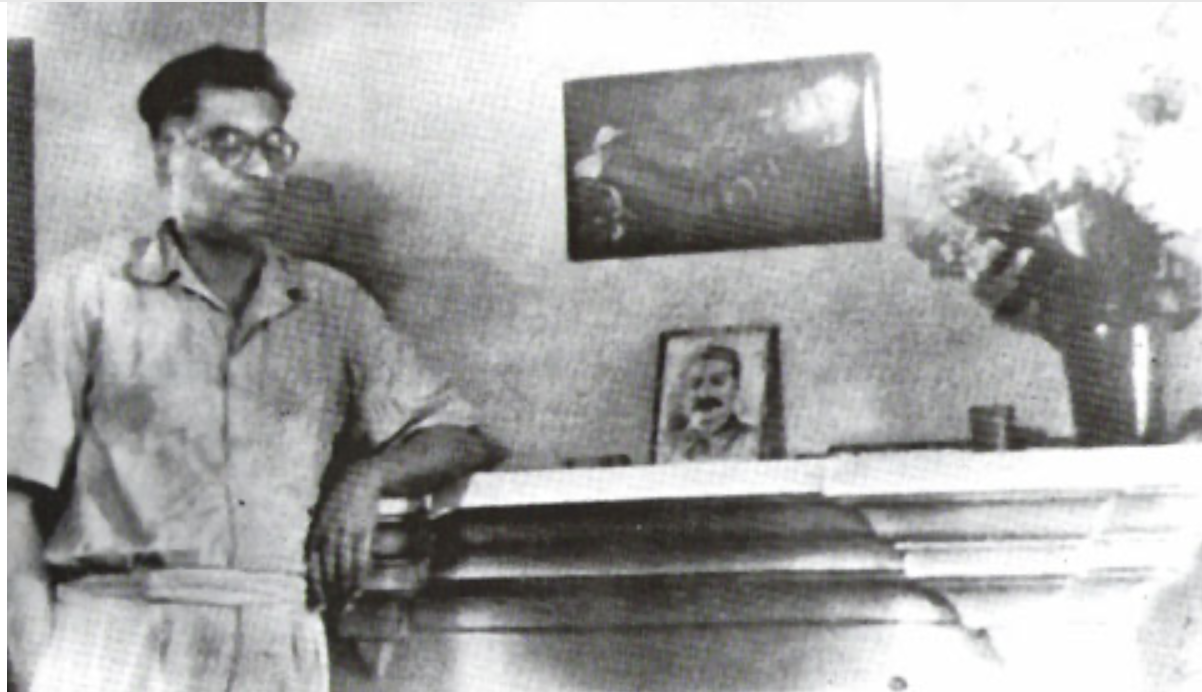
Image from Marxists Internet Archive of M.N.Roy here (From Bland’s work: “Stalin’s photograph continued to decorate Roy’s mantelpiece for the rest of his life, and on Stalin’s death in 1953, Roy described him as: ‘the most maligned man of our time.'”
(M. N. Roy: “The Death of Stalin”, in: “The Radical Humanist”, Volume 17; 1953; p. 121).
Introduction MLRG.online 2026
COMPASS: Theoretical Journal of the Communist League. December 1977
M.N.Roy and the Colonial Question
PART 2
This is the second part of a study of the role of the national bourgeoisies in colonial-type countries, in relation to the successive attitudes of the Communist International and the position taken up by the Indian Communist M. N. Roy.
The 7th. Plenum of the ECCI
The 7th. Plenum of the ECCI was held in Moscow from November 22nd to December 16th, 1926. Roy attended as a delegate from India.
A main item on the agenda was the situation in China, and Roy was elected to the Chinese Commission of the plenum, which in turn elected him its joint secretary.
The “Resolution on the Chinese Situation” adopted by the Plenum on December 16th followed closely the political line expressed in Stalin’s speech to the Chinese Commission of November 30th.
It declared that the revolution in China was in transition to a new stage as a result of the national bourgeoisie being about to desert the national-democratic revolution, so that the revolutionary forces in this new stage would be the working class, the peasantry and the urban petty bourgeoisie:
“Now the movement is on the threshold of the third stage, on the eve of a new realignment of classes. this stage the driving force of the movement will be a bloc of an even more revolutionary nature — of the proletariat, the peasantry and the urban petty bourgeoisie, to the exclusion of the majority of the capitalist bourgeoisie”.
(Resolution on the Chinese Situation, 7th. Plenum ECCI, in: R. C. North & X. J. Eudin: “M. N. Roy’s Mission to China: The Communist-Kuomintang Split-of 1927”; Berkeley; 1963; p. 135).
In this new revolutionary bloc, the working class must become the leading force:
“When the bourgeoisie desert the revolution and conspire against it… the proletariat is the dominating factor of this bloc”
(Ibid.; p. 137).
The peasant millions can be won and retained as a member of this revolutionary bloc, and can be led to accept the leadership of the working class, only if the working class and its party support the agrarian revolution, which is now the central question of the Chinese revolution:
“In the present transitional stage of the development of the revolution, the agrarian question becomes the central question. The class which… succeeds in giving
a radical answer to it will be the leader of the revolution”.
(Ibid.; p. 137).
The working class must choose between attempting to maintain the alliance with the national bourgeoisie, which is now on the point of deserting the national-democratic revolution, and cementing an alliance with the peasantry by fostering the agrarian revolution; to fail to make this choice in favour of the latter course would be highly dangerous to the revolution:
“The fear that the aggravation of the class struggle in the countryside will weaken the united anti-imperialist front is baseless… Not to approach the agrarian question boldly by supporting all the economic demands of the peasant masses is positively dangerous for the revolution. To refuse to assign to the agrarian revolution a prominent place in the national-liberation movement for fear of offending the dubious and disloyal cooperation of a section of the capitalist class is wrong. This is not the revolutionary policy of the proletariat. The Communist Party must be free of such mistakes.
The present situation is characterised by its transitional nature when the proletariat must choose between allying itself with a considerable section of the bourgeoisie or further consolidating its own alliance with the peasantry. If the proletariat does not put forward a radical agrarian programme, it will fail to attract the peasantry into the revolutionary struggle and will lose its hegemony in the national-liberation movement. Under direct or indirect imperialist influence, the ̈ bourgeoisie will regain the leadership of the movement once more ”
(Ibid.; p. 138).
The urban petty bourgeoisie, which follows either the bourgeoisie or the working class, will follow the working class if the latter pursues the above revolutionary policy and establishes its leadership over the peasantry:
“The petty bourgeoisie has played an important role in the past and will do so in the future. But they are not able to act independently; they must either march with the bourgeoisie or with the proletariat. When the bourgeoisie desert the revolution and conspire against it, the exploited middle classes come under the revolutionary influence of the proletariat…
The class which succeeds in giving a radical answer to it (ie., the agrarian question Ed.) will be the leader of the revolution”.
(Ibid.; p. 137).
It is essential also to strengthen the organisation, and raise the living conditions and legal status, of the working class:
“The working class organisations must be further strengthened and developed on the following lines:
Greater attention to the economic struggle of the workers, which should grow into a political struggle, elaboration of tactics for the strike movement…
The Chinese Communist Party should agitate for complete freedom of activity of the revolutionary peasants and workers’ organisations, legalisation of the trade unions… and the right to strike;… abolition of the system of fines and corporal punishment”.
(Ibid., p. 113-44)
This programme should be striven for by the Communist Party both by direct work among the masses, and through the Kuomintang government and the revolutionary army:
“The revolutionary armies will strike root in the peasant masses as the standard bearer of agrarian revolution…
The machinery of the national-revolutionary government provides a very effective way to reach the peasantry. The Communist Party must use this machinery.
The Communists and their revolutionary allies must penetrate the new government, so as to give practical expression to their agrarian programme by using the government machinery to confiscate land, reduce taxes and invest real power in the peasant committees, thus carrying on progressive reforms on the basis of a revolutionary programme…
The Communists must enter the Canton government in order to support the revolutionary Left Wing in its struggle against the weak and vacillating policy of the Right. The extension of the Canton government’s authority to new areas makes the question of the participation of the Communists in it still more imperative.”
(Ibid.; p. 140-1).
The Communist Party must remain within the Kuomintang, must intensify its work in it, must lead a determined struggle against the Right Wing (representing the national bourgeoisie, which is on the verge of deserting the revolution) and must strive to transform it into a broad party genuinely representing the interests of the working class, the peasantry and the urban petty bourgeoisie:
“The Communists must stay in the Kuomintang and intensify their work in it…
The Communist Party of China must strive to develop the Kuomintang into a real people’s party – a solid revolutionary bloc of the proletariat peasantry, the urban petty bourgeoisie and the other oppressed and exploited strata of the population…
For this the Communist Party must work along the following lines:
a) systematic and determined struggle against the Right Wing attempting to convert the Kuomintang into a bourgeois party;
b) definite formation of a Left Wing in the Kuomintang and establishment of close cooperation with it”.
(Ibid., p. 141).
Writing on the 7th. Plenum Resolution on the Chinese Situation some years later, Roy correctly notes the increased emphasis placed on the necessity of intensifying the agrarian revolution the class struggle of the peasantry to seize land from the landlord class as the key point of the theses:
“The meeting of the Executive Committee of the Communist International in November 1926 adopted a new thesis on the Chinese question, the central point of which was that the Chinese revolution must from time be developed as an agrarian revolution.”
(M. N. Roy: “Revolution and Counter-Revolution in China “; Calcutta; 1946; p. 538).
He correctly says that the leadership of the Communist Party of China, together with the CI representative in China Grigori Voitinsky and the leader of the CPSU mission in China Mikhail Borodin were all opposed to intensification of the agrarian revolution:
“The leadership of the Chinese Communist Party as well as the representatives of the CI in China were of a different view. They still maintained that…
class struggle should not be accentuated for the sake of national unity”.
(M. N. Roy: ibid.; p. 538)
But it would appear that he is exaggerating his role in the formulation of the theses when he says:
“I was alone to advocate the different point of view that the Chinese Revolution had reached a critical moment in which it must strike out on a new course and a fetish should not be made of the alliance with the Kuomintang. The Executive of the CI adopted my point of view, which was opposed in the beginning by Stalin himself. But Stalin was brought around to my view and the Thesis adopted by the ECCI was drafted by me.”
(MN Roy ibid. p. 538)
As joint secretary of the Chinese Commission of the Plenum, it is indeed likely that Roy drafted the Theses. But his statement that he was “alone” in advocating the policy of intensifying agrarian revolution and that Stalin was at first opposed to this policy is contrary to the known facts.
In May 1925 Stalin had already warned of the danger of right deviation in relation to the national front in colonial-type countries, the danger of damping down the revolutionary movement and relinquishing the independence of the Communist Party in the name of preserving such “national unity”:
“The first deviation lies… in an over-estimation of the idea of a united, all-embracing national front in the colonies and dependent countries, irrespective, of the state and degree of development of those countries. That is a deviation to the Right, and it is fraught with the danger of the revolutionary movement being debased and of the voices of the communist elements becoming drowned in the general chorus of the bourgeois nationalists. It is the direct duty of the University of the Peoples of the East to wage a determined struggle against that deviation.”
(J. V. Stalin: “The Political Tasks of the University of the Peoples of the East”, in: “Works”, Volume 7; P. 153-4).
In February 1926, the ECCI had, on Stalin’s initiative, sent a directive to the Communist Party of China which stated:
“It is necessary to adopt the course of arming the workers and peasants and converting the peasant committees in the localities into actual organs of governmental authority equipped with armed self-defence, etc.
The Communist Party must not come forward as a brake on the mass movement; the Communist Party should not cover up the treacherous and reactionary policy of the Kuomintang Rights, and should mobilise the masses around the Kuomintang and the Chinese Communist Party on the basis of exposing the Rights.
The Chinese revolution is passing through a critical period, and it can achieve further victories only by resolutely adopting the course of developing the mass movement. Otherwise a tremendous danger threatens the revolution. The fulfilment of directives is therefore more necessary than ever before.”
(ECCI: Directive to the CPC, February 1926, cited in: J. V. Stalin: “Works‘ Volume 10; Moscow; 1954; p. 21):
And in his speech to the Chinese Commission of the 7th Plenum of the ECCI on November 30th., 1926, Stalin said:
“I know that there are Kuomintangists and even Chinese Communists who do not consider it possible to unleash revolution in the countryside, since they fear that if the peasantry were drawn into the revolution it would disrupt the united anti-imperialist front. That is a profound error, comrades. The more quickly and thoroughly the Chinese peasantry is drawn into the revolution, the stronger and more powerful the anti- imperialist front in China will be…
I know that among the Chinese Communists there are comrades who do not approve of workers going on strike for an improvement of their material conditions and legal status, and who try to dissuade the workers from striking. (A voice: That happened in Canton and Shanghai) That is a great mistake, comrades. It is a very serious under-estimation of the role and importance of the Chinese
proletariat. This fact should be noted in the theses as something decidedly objectionable. It would be a great mistake if the Chinese Communists failed to take advantage of the present favourable situation to assist the workers to improve their material conditions and legal status, even through strikes. Otherwise, what purpose does the revolution in China serve? The proletariat cannot be a leading force if during strikes its sons are flogged and tortured by agents of imperialism. These medieval outrages must be stopped at all costs, in order to heighten the sense of power and dignity among the Chinese proletarians, and to make them capable of leading the revolutionary movement. Without this, the victory of the revolution in China is inconceivable…
It is necessary also to give prominence to the peasant question, linking it with the prospects of the revolution in China. I think that what has to be worked for in the long run is the confiscation of the landlords’ land for the benefit of the peasants and the nationalisation of the land”.
(J. V. Stalin: “The Prospects of the Revolution in China” in: “Works” Volume 8; Moscow; 1954; p. 385, 389, 391).
At the end of the Plenum, Roy was elected to the Presidium of the ECCI and to its newly-formed Political Secretariat.
Roy’s Mission to China
In January 1927, Roy was sent by the ECCI as its special representative to supervise the implementation of the theses of the 7th Plenum of the ECCI by the Communist Party of China.
He arrived in China at the end of February 1927 and in Wuhan – the seat of the Kuomintang government since November 1926 at the beginning of April.
A few days later, the Chinese national bourgeoisie deserted the national-democratic revolution in the coup led by Chiang Kai-shek of April 12th., 1927.
The political developments in China at this period are analysed in “The Thought of Mao Tse-tung: Part One”, as republished in COMpass; then as a book in 2025 published by MLRG.online).
Roy had fully supported the line of the Communist International in recognising the Chinese national bourgeoisie, until this coup, as a revolutionary force in the national-democratic revolution in that country. For he regarded the social relations in China, unlike those in India, as “essentially feudal”:
“By studying the history of China, we discover that social relations constituting the essence of Feudalism did develop in that country”.
(M. N. Roy: Introduction to “Revolution and Counter- Revolution in China”; Calcutta; 1946; p. 4).
Therefore, because the Chinese national bourgeoisie had the historical task of destroying “the remnants of feudalism”, it could, according to Roy’s theoretical propositions, play a revolutionary role.
Strictly speaking, the social relations in China (and, indeed, those in India) were not those of feudalism, but of the Asiatic mode of production associated with oriental despotism.
These questions are analysed in “The Development of Society”, to be published shortly in COMpass (note, this was published in June 1977. But it has not yet been made fully available except for a small section at Alliance ML January 2002).
Roy also fully supported the basic policy of the CI after the April 1927 coup, that of forming a bloc with the Left Kuomintang, led by Wang Ching-wei.
The Conflict over the “Northern Expedition”
Roy rejected completely, therefore, the basic policy of the leadership of the Communist Party of China, headed by Chen Tu-hsiu – a policy strongly supported by the head of the CPSU delegation to China, Mikhail Borodin – that in order to preserve a united front with the leadership of the Left Kuomintang, the workers and peasants movement should be restrained.
Roy’s first conflict came at a meeting of the Central Committee of the CPC on April 13-15th., 1927, when Chen and Borodin favoured supporting the so-called “Northern Expedition” by the national revolutionary army to link up with the “friendly” warlord Feng Yu-hsiang:
“The fundamental meaning of my proposal is that it is necessary for us to establish a firm base before advancing any further…
I am not against a Northern Expedition in general, but I am against an immediate campaign…
An immediate campaign against the North is fraught with grave danger.
An immediate campaign against the North means that we are leaving a territory where we have at our disposal the powerful organisations of the Kuomintang, the Communist Party and the workers and peasants’ organisations, for an unknown land where we have no organised forces apart from the armies of Feng and Yen. There are no guarantees that these forces will always remain friendly towards us…
The fundamental objection to an immediate campaign against the North… is that the campaign would reinforce the position of the militarist elements and have harmful consequences for the basic forces of the revolution, that is, the workers and peasants…
An immediate campaign against the North means that the petty bourgeoisie, under the pressure of certain military leaders, will turn to flight and abandon the masses. It is tantamount to betrayal of the peasantry, of the proletariat…
Borodin says that the leadership of the national movement has definitely been seized by the bourgeoisie. The revolutionary forces must therefore retreat somewhere in the hills, or to the Mongolian desert…
Comrade Borodin… proposes that the revolution withdraw from the provinces where there exists an organised proletariat with political experience, that it withdraw from the territories where the revolution has been partly achieved and go where reaction is stronger…
Comrade Borodin thinks that the principal factor in the revolution is not the masses, but the ability to manoeuvre… with various military elements…
The fundamental task of the revolution at the present moment is the consolidation of the social and territorial base of the revolution…
To think that we will be able, simultaneously, to move to the north and to consolidate our base in the south is sheer illusion…
We must develop the forces of the workers and peasants – this is the only measure that will assure the future of the revolution.”
(M. N. Roy: Speech to the CC, CPC, April 14th., 1927, in R.C. North & J. Eudin: op. cit.; p. 160, 161, 162, 163, 164, 165-6, 170, 171).
On April 16th., 1927 the Central Committee adopted a resolution on this question in accordance with the views expressed by Roy:
“In order to be able to conduct a successful struggle against imperialism, against native militarism which is a tool of imperialism, and against the counter- revolutionary bourgeoisie, the national government must possess a solid base.
Under existing conditions, an immediate military advance to the north with the aim of capturing Peking, Tientsin and so forth is not only undesirable, but will be harmful to the revolution. Military operations. aimed at territorial expansion to the north must be preceded by a consolidation of the base of the revolution in those regions which are already under the control of the Kuomintang or in which the revolution has already been partially accomplished… in accordance with the suggestions made in Comrade Roy’s speech”,
(CC, CPC: Resolution on the Continuation of the Northern Campaign, cited in: ibid.; p. 176-7).
Two days later, on April 18th, a special meeting of the CC rescinded the above resolution.
(M. N. Roy: Note cited in: ibid.; 177)
Following this decision, the national revolutionary army, commanded by Tang Sheng-chih, was immediately ordered to begin the Northern Expedition. As soon as this order had been given, the Left Kuomintang Central Government in Wuhan, on the pretext of strengthening the rear of the army, issued decrees banning strikes and extending working hours. As Roy himself expressed it later:
“The Nationalist Government called upon the masses to suspend all activities on the pretext that these would weaken the rear of the army fighting against northern militarism…
While industrial workers were prohibited from striking to improve their economic conditions, they were obliged to labour for longer hours to keep the army well supplied”.
(M. N. Roy: “Revolution and Counter-Revolution in China”; Calcutta; 1946; p. 472-3).
The right opportunist leadership of the Communist Party gave full support to these government measures and, on the same pretext, called for the setting up of a joint government/trade union commission to impose “revolutionary discipline on workers (especially those in foreign-owned enterprises!), with the power to penalise workers guilty of “breaches” of “revolutionary discipline It called for:
“The immediate creation by the government and the labour unions of a commission for strengthening revolutionary discipline among workers, especially among workers in foreign firms. The creation by trade unions of a revolutionary tribunal for investigating actions and for penalising all workers guilty of a breach of revolutionary discipline.
The government must immediately reach an agreement with the principal foreign enterprises and banks to enable them to conduct business in Hupeh, Hunan, Kiangsi, Southern Anhwei, Southern Honan, and in the West right up to Wanhsien.
A commission must be created composed of representatives from the government and the trade unions with the aim of implementing the agreement concluded with the foreign enterprises and banks…
Not a single strike can take place in foreign enterprises or firms without the consent of the commission.”
(CC, CPC, and Communist leaders of the Hupeh Federation of Labour: Measures. Whose Immediate Implementation is Necessary for Strengthening the Base and the Rear of the Northern Expedition: cited in ibid. p. 186-7).
The 5th. Congress of the CPC
Under pressure from Roy, the 5th Congress of the CPC was convoked in Wuhan from April 27th to May 9th., 1927.
General Secretary Chen Tu-hsiu put forward in his report to the congress a new version of support for the “Northern Expedition – the “north-western theory.” He proposed that the entire revolutionary base should be moved from the region around Wuhan to a secure area “under the protection” of warlord Feng Yu-hsiang, saying:
“The revolution cannot develop… in any of the regions where industry is most developed, because there imperialism and the Chinese bourgeoisie hold the stronger positions…
The revolution should retire to the north-west provinces, where the influence of imperialism is weaker and where the revolution can more easily concentrate its forces for a later attack on the imperialist strongholds”.
(Chen Tu-hsiu: Report of Central Committee to the 5th. Congress of the CPC, cited in: P. Mif: “Kitaiskaia Kommunisticheskaia Partiia v Kriticheskie dni” (The Chinese Communist Party in Critical Days); Moscow; 1928; p. 45-46).
Roy, on the other hand, strongly opposed this viewpoint:
“The plan according to which it is necessary… to withdraw somewhere to the North-West, further removed from the places where the revolution might be attacked by imperialism, and to build a movement on a combination of various militarists’ forces, can only be advanced by those who have no faith in the masses”.
(M. N. Roy: Speech at 5th. Congress CPC, April 30th., 1927, cited in: R.C. North & X.J. Eudin; op. cit; p. 200-1).
The ‘North-western theory’ was rejected by the congress, in spite of being supported by Borodin:
“The Communist Party must fight against this tendency to abandon or weaken the existing base under the pretext of expansion.
The rich and economically developed south-eastern and central regions must not be left to the complete disposal of the bourgeoisie”.
(Theses on the Political Situation and the Tasks of the Chinese Communist Party, 5th. Congress CPC, cited in: ibid.; p. 248).
Chen also proposed that the agrarian revolution and the development of the working class struggle for improved economic conditions and for the leadership of the revolution should be postponed until the Northern Expedition, in conjunction with the forces of Feng Yu-hsiang, had captured Peking, saying:
“The only correct solution is to deepen the revolution after it has first been spread.”
(Chen Tu-hsiu: Report to 5th. Congress CPC, in: ibid.; p. 77).
Roy also expressed strong opposition to this view:
“In the class coalition which now forms the base of the revolution, the peasantry constitutes the overwhelming majority. Therefore the basic question of the moment is one of unleashing the revolutionary energies of the peasantry. The very course of the development of the revolution has demonstrated… the necessity of an agrarian revolution…
The Northern Expedition does not exist. What has been depicted as the Northern Expedition really amounts to the dispatch of troops to the north to assist Feng Yu-hsiang in occupying the Lunghai railway…
At present we already have occasion to hear the argument that, while we are in a period of revolutionary war, we must not begin a class struggle in the village. No agrarian reforms. We must wait for the occupation of Peking. Then we will carry out an agrarian reform. But the Northern Expedition, after all, does not exist and Peking will never be occupied. The point here is not the Northern Expedition, but the intensification of the social base of the revolution.”
(M. N. Roy: Speech at 5th. Congress CPC, April 30th, 1927, in: ibid.; p. 192, 203, 204-5).
He pointed out that, already before the desertion of the national bourgeoisie from the national-democratic revolution, the leadership of the Communist Party had been guilty of a rightist deviation on the question of a united front with the Kuomintang, in that it had sought to damp down the class struggle of the workers and peasants and to surrender the independent class policy of the Party in the name of preserving this united front:
“During the period of reaction starting from March 20th. until the beginning of the Northern Expedition, our Party pursued a policy of a united front and ignored its basic task: that of developing the class struggle. A united front is, of course, very necessary. But while the Communist Party was creating it, it should not have overlooked the necessity of developing the energies of the working class as an independent force.
It was obvious that the bourgeoisie was mobilising its forces against the proletariat; yet the Communist Party was participating in the united front without simultaneously preparing the working class organisations for becoming an independent political force.
This, precisely, is what constituted the basic error…
For the sake of preserving a united front with the bourgeoisie… the Communist Party did not intensify the class struggle; it did not destroy the roots of reaction…
The Communist Party usually acted as an appendage (of the Kuomintang Ed.), and not as an independent force”
(M. N. Roy: Speech to 5th. Congress CPC, April 30th., 1927, in: ibid.; p. 190-1, 202, 205).
He warned that this rightist deviation was continuing in the new period of the united front with the Left Kuomintang:
“It is necessary to sound the alarm…
Some of the resolutions and circulars issued by various working-class organisations with the aim of introducing so-called self-discipline in the working class are simply disgraceful. Workers are being dragged to the revolutionary tribunal and sentenced to imprisonment for demanding higher wages”.
(M. N. Roy: ibid.; p. 207).
The argument of the rightist leaders of the CPC that this policy was necessary “in order not to alienate the petty bourgeoisie” was wrong. On the contrary, the petty bourgeoisie could only be kept in alliance with the working class and peasantry if the latter classes conducted a determined struggle:
“Now the time has come when the proletariat must establish hegemony on a national scale in the entire national revolution… If the Communist Party leads the proletariat to hegemony, the petty bourgeoisie will be on our side. It will follow the path of revolution…
We will strive for the establishment… of a democratic dictatorship of the proletariat, the peasantry and the urban petty-bourgeoisie on the following basis: – first of all – and at the basis of all the -agrarian revolution;
second, the arming of the peasants for defending the gains of the revolution;
third, the organisation of rural self-government for destroying the power of the feudal lords in the village;
fourth, the creation of a state machinery through which the democratic dictatorship will be realised;
fifth, the creation of a revolutionary army on a firm social basis…
By following this path, we will not weaken our revolutionary alliance with the petty bourgeoisie. On the contrary, we will strengthen this alliance… If we do not spur it on, it will begin to waver; it will liquidate the revolution and desert to the side of reaction”.
(M. N. Roy: Speech to the 5th. Congress CPC, April 30th., 1927, in: ibid.; p. 194, 207-8).
“It is a well-known fact that the petty bourgeoisie never represents an independent political force. It joins either the bourgeoisie or the proletariat…
The principal argument of Chang Tai-lei is that our proposed agrarian programme of the national revolution is much too Left. The petty bourgeoisie will not accept it and, as a result, the revolutionary bloc will fall apart… The proletariat cannot betray the peasantry for the sake of buying an alliance with the petty bourgeoisie. Moreover, the agrarian revolution corresponds to the interests not only of the peasantry, but of the petty bourgeoisie as well. The proletariat will win the support of the petty bourgeoisie in the revolutionary-democratic struggle by explaining to it its real interests…
But this can be done only in the process of a genuine revolutionary struggle…
When the proletariat tries to convince the petty bourgeoisie that the agrarian problem is an objective necessity of the given period of the revolution, it is merely trying to evoke in it an awareness of its own class interests. This in itself means exercising hegemony in the revolutionary democratic bloc”.
(M. N. Roy: Speech at 5th. Congress CPC, May 3rd., 1927, in: ibid. p. 210-11)
Under Roy’s pressure, the congress adopted on May 9th. “Theses on the Political Situation and the Tasks of the Chinese Communist Party,” which were broadly in line with his viewpoint:
“If radical agrarian reform… is postponed until the final conclusion of the Northern Expedition, the bourgeoisie, screened behind a false banner of nationalism, will consolidate its power in the occupied regions…
Without underestimating in the least the necessity of the further territorial expansion of the revolution… the Fifth Congress, at the same time, sets before the Communist Party as its principal task in the immediate future the ruthless struggle against reaction in those provinces where the revolution has been partially achieved, namely, in Kwangtung, Fukien, Chekiang, Kiangsi, Hunan, Hupeh and Kwangsi…
The radical solution of the agrarian problem is the basic task at the present stage of the revolution. This agrarian revolution, necessary for the consolidation of the revolutionary alliance of the proletariat, the peasantry and the petty bourgeoisie, is to be led by the proletariat”
(Theses on the Political Situation and the Tasks of the Chinese Communist Party, 5th. Congress CPC, in: ibid.; p. 248, 249, 250).
The theses also endorsed Roy’s demand for full support for the struggle of the urban working class for an improvement in its economic situation:
“The proletariat will not be able to fulfil this important political task, the realisation of hegemony, if its economic interests are not ensured…
Therefore, the Communist Party must struggle vigorously to raise the living standards of the proletariat”.
(Ibid., p. 250)
The “Resolution on the Agrarian Question”, adopted by the congress on the same day, taking into account the further development of the spontaneous movement among the peasantry to take over land from the landlords, was somewhat more radical than that adopted at the 7th. Plenum of the ECCI in November/December 1926. Whereas this had called on the CPC to:
“Confiscate the monasterial and church lands, and the lands belonging to the reactionary militarists, compradors, landlords and gentry who are waging civil war against the Kuomintang national government.”
(Resolution on the Chinese Situation, 7th. Plenum ECCI, in: ibid.; p. 139).
the “Resolution on the Agrarian Question” adopted by the 5th Congress of the CPC, however, called for:
“a) Confiscation of all communal, ancestral, temple and school lands, and lands belonging to the Christian Church, as well as company-owned real estate, and the transfer of such lands to the peasants who till them. The management of all confiscated lands must be assigned to land committees which will decide whether to cultivate the confiscated lands on communal principles or to divide them among the labouring peasants;
b) landlord estates which have been rented to tenants shall be confiscated without redemption, and transferred, through the land committees, to the peasants who cultivate them.
Land belonging to small owners shall not be confiscated. Land belonging, as of this date, to officers of the revolutionary army is likewise not subject to confiscation”.
(Resolution on the Agrarian Question, 5th. Congress CPC, in: ibid.; p. 262).
Speaking to the Political Bureau of the CC of the CPC on May 24th, Roy summed up the basic decisions of the 5th Congress of the CPC as follows:
“The Fifth Congress set three basic tasks before the Party:
1) to develop the agrarian revolution;
2) to intensify the workers’ movement;
3) to win over the petty bourgeoisie”.
(M. N. Roy Speech to PB, CC, CPC, May 24th., 1927, in: ibid.; p. 301).
The Treacherous Role of the CPC Leaders
The leadership of the Communist Party of China, however, refused to carry out either the directives of the Communist International or the decisions of its own 5th Congress.
On May 13th, 1927, the Political Bureau of the Central Committee (professing to interpret the term “petty bourgeois” not as “self-employed” but as “small capitalist”) adopted a resolution which stated:
“Proceeding from the Resolution of the 5th Congress, the Politburo of the Central Committee adopts the following practical measures for removing any possible difficulties in the sphere of the relations between the Communist Party and the Kuomintang on the question of the urban petty bourgeoisie:
The exorbitant demands of commercial employees shall be restricted…
A special committee… shall examine all demands laid down by commercial employees and shall set reasonable limits for them…
There must be no obstacles to the commercial activity of imperialists at the present time”
(PB, CC, CPC: Resolution of May 24th., 1927, cited in: ibid.; p. 284-5).
On May 21st., 1927, Colonel Hsu Ke-hsiang, commanding the 33rd Regiment of the 35th Army stationed at Changsha, suddenly ordered the troops under his command to seize control of the city. Leading members of the Communist Party in the city were arrested, and the provincial trade unions and peasants’ associations were dissolved. A white terror was then instituted in the city, in which more than 20,000 workers and peasants were slaughtered.
Local Communist leaders immediately mobilised a peasant army of 20,000 to recapture the city, but the leaders of the CPC, supported by Borodin, ordered the planned assault to be called off in favour of an “investigation” of the events by Tang Sheng-chih, the Commander-in-Chief of the Wuhan government’s army.
As Roy described it some years later:
“Nearly at the gates of the city, they were ordered to go back and dissolve their military formations. The instruction came from the Communist headquarters at Wuhan… The counter-revolutionary insurgents availed themselves of the opportunity. They attacked the retreating peasants and massacred them ruthlessly.”
(M. N. Roy: “Revolution and Counter-Revolution in China”; Calcutta; 1946; p. 551-2).
The Political Bureau Meeting of May 24th.
At the meeting of the Political Bureau of the Central Committee of the CPC held on May 24th, 1927, Borodin put forward a series of proposals in direct contradiction with the line of the Comintern and of the recent 5th. Congress of the CPC:
“Comrade B. (orodin–Ed.) put forward the following proposals:
1) to satisfy the trading and industrial petty bourgeoisie (i.e., in fact, the small capitalists- Ed.) we should curtail the demands of the shop assistants and others;
2) in regard to the village petty bourgeoisie (i.e., in fact, the small landlords –Ed.), we should defend the small-scale landlords; and
3) we should take measures against the practice of arrest and shooting of counter-revolutionaries directly by the populace.
He also mentioned, in passing, the problem of the dictatorship of the workers’ unions!”
(Tsai Ho-chen: “Istoriia opportunizma v Kommunisticheskoi Partii Kitaia” (An Account of Opportunism in the Chinese Communist Party), in: “Problemy Kitaia” (Chinese Problems), No. 1, 1929; p. 34-5).
Opposing Borodin’s proposals, Roy argued that the leaders of the Left Kuomintang were, in fact, drawn from “feudal- bourgeois reaction”:
“When the feudal lords and the bourgeoisie, as a class, turned against the revolution, their agents still remained in the ranks of the Kuomintang and continued to occupy leading posts. The majority of the Central Committee of the Kuomintang (Wuhan) consists of these agents of feudal-bourgeois reaction who took a frankly hostile position towards the national revolution. The leadership of the (Left – Ed.) Kuomintang, at the present time, is comprised primarily of feudal-bourgeois leaders…
The present Central Committee of the (Left – Ed.) Kuomintang is making preparations… to betray the national revolution.”
(M. N. Roy: Speech at PB, CC, CPC, May 24th., 1927, cited in: R.C. North & X. J. Eudin: op. cit.; p. 294, 295).
On the other hand, declared Roy, the rank-and-file membership of the Left Kuomintang is drawn from the petty bourgeoisie and working class:
“Its ranks (of the Left Kuomintang – Ed.) consist chiefly of petty bourgeois and proletarian elements. Its basis and its sphere of activities are the democratic
masses…
The present Central Committee (of the Left Kuomintang – Ed.) does not represent the petty bourgeoisie which, at the given stage, constitutes the social base of the Kuomintang.”
(M. N. Röy: ibid.; p. 294, 296).
But the petty bourgeoisie, he argued, will not be alienated but won over by the intensification of the class struggle in town and country:
“The difficulties which the Communist Party is experiencing are rooted in its relations not with the Kuomintang per se, but with the leadership of the Kuomintang…
The Communist programme of the national revolution does actually defend the interests of the petty bourgeoisie…
If the Communist Party acts in conformity with the resolution which I am going to propose, the support of the Kuomintang masses will be assured”.
(M. N. Roy: ibid.; p. 294, 302).
Therefore, Roy declared, the intensification of the class struggle of the workers and peasants, combined with a campaign of exposure of the leadership of the Kuomintang will result in the removal of the present leadership from the Left Kuomintang and its democratisation:
“At the given stage of the national revolution, the Communist Party must remain in the Kuomintang for the “purpose of consolidating the Left Wing in order to assist
it, in order to arouse it to struggle against feudal-bourgeois reaction…
One of the aims which the Communist Party should have pursued while remaining in the Kuomintang after the split was to intensify the differentiation between feudal-bourgeois reaction and petty-bourgeois radicalism. The Communists did not appreciate the importance of this tactical aim; for this very reason, our relations with the Kuomintang now appear to be fraught with such overwhelming difficulties…
The Communist Party must help the Kuomintang to rid itself of reactionary leaders: This can be done by assisting and strengthening the reliable elements of the Left… The Kuomintang needs to be democratised…
The task of the Communist Party in the present situation is… to expose to the masses the counter-revolutionary tendencies of the leaders…
The Communist Party entered the Kuomintang preserving the right of political independence, but owing to an erroneous conception of the united front, this right was not realised. As a result, the Party committed grave errors. A repetition of such errors at the critical moment of the present will prove fatal to our Party and to the revolution…
By entering the Kuomintang and working within it, the Communist Party does not cease to be an independent political party of the proletariat. The Communist Party will cease to be an independent political party only in the event that it ignores the interests of the proletariat for the sake of easing frictions with the Kuomintang…
If the Communist Party acts in conformity with the resolution which I am going to propose… the antagonism between the feudal-bourgeois leaders and the petty-bourgeois members (of the Kuomintang Ed.) will be intensified. In consequence, the Kuomintang will be freed from the dominance of the agents of feudal- bourgeois reaction, and it will become a militant organ of a revolutionary-democratic alliance of the proletariat, the peasantry and the petty bourgeoisie.”
(M. N. Roy: ibid., p. 293-4, 295, 296, 297, 299, 302).
Borodin strongly opposed the political line proposed by Roy, a political line in conformity with the directives of the CI and the decisions of the 5th. Congress of the CPC.
He put forward counter-proposals:
“1. The present position of the Left Kuomintang is entirely acceptable. They do not display any deviationist tendencies or shortcomings. The mistakes in the past were due to the extreme nature of the workers’ and peasants’ movement…
2. We must yield to the Kuomintang in order to be able to continue collaboration with it; if we break with the Kuomintang, the Chinese revolution will suffer
defeat.
3. Collaboration with the Kuomintang means collaboration with its CC, since the present composition of the CC is quite acceptable to us. Withdrawal from it, or its overthrow, would be equivalent to a break or a political coup.
4. Reduction of rent, elimination of usury and the introduction of local self-government in the countryside – these measures represent the agrarian revolution.
5. The CC of the CPC must issue jointly with the workers’ and peasants’ organisations an appeal to the masses urging them to follow the orders of the CC of the Kuomintang and of the Nationalist government, which require the discontinuation of the excesses in the workers and peasants’ movement, as well as the recently issued orders.”
(M. Borodin: Speech at PB, CC, CPC, May 24th., 1927, in: Tsai Ho-sen: op. cit.; p.
cit.; p. 40).
Borodin’s views were endorsed by General Secretary Chen Tu-hsiu:
“The basic point in all Chen Tu-hsiu’s speeches has been the demand that general leadership in the movement be handed over to “the Kuomintang”. (Tsai Ho-sen: op. cit; p. 35).
Roy’s resolution was not put to the meeting of the Political Bureau, which endorsed the line put forward by Chen Tu-hs iu and Borodin.
The 8th. Plenum of the ECCI
The 8th. Plenum of the ECCI was held in Moscow from May 18th to 30th, 1927. Roy, being in China, did not attend.
A vigorous attack was made at the plenum by the Opposition leaders, headed by Leon Trotsky and Vuyo Vuyovich, on the policy of the Communist International;
and the counter- attack was led by Stalin.
On May 30th. the Plenum adopted a “Resolution on the Chinese Question”, which reaffirmed and developed the political line of the 7th. Plenum in relation to China, the line for which Roy was fighting in Wuhan.
The resolution called for the drawing of the masses into the national-democratic revolution by intensifying the agrarian revolution in the countryside and the struggle of the working class for improved conditions and status in the towns:
“Only by drawing these masses (of the toilers — Ed.) into the active struggle can the forces be created which will break the international counter-revolution and the imperialist interventionists…
It is possible to draw the masses into the struggle only on the basis of the agrarian revolution in the rural districts and by satisfying the needs and the political requirements of the urban workers…
Agrarian revolution – such is the fundamental inner social-economic content of the new stage of the revolution. The most important thing at the present time is to secure the ‘plebeian’ revolutionary solution of the agrarian problem from below, by the tens and hundreds of millions of the peasants themselves. And in this the Communist Party must take the lead of the movement…
In the towns, efforts must be made to raise the standard of living of the working class, to improve radically their juridical position in the factories as in social life generally, to repeal all laws which place the workers in the position of a disfranchised ‘order’, and to… carry out the slogan of the 8-hour day, to raise wages and recognise the rights of workers’ organisations, etc.”
(Resolution on the Chinese Question, 8th. Plenum ECCI, in: “International Press Correspondence”, Volume 7, No. 35; June 16th, 1927; p. 738-9).
It called for “rapid, bold and determined” efforts to bring about the mass arming of the workers and peasants:
“Simultaneously, rapid, bold and determined efforts must be made to carry out the policy of the mass arming of the workers and peasants”,
(Ibid.; p. 739).
It called for the Party to work, from within the Kuomintang, for the latter’s democratisation:
“The ECCI resolutely rejects all demands for the Communist Party to leave the Kuomintang…
The Communist Party of China must… strive to convert the Kuomintang into a genuine mass organisation embracing the toiling population of town and country’
(Ibid., p. 735).
It criticised the leaders of the Party for “lack of firmness in maintaining the party’s independent role and in exposing the leaders of the Kuomintang, and for having held back the mass movement, particularly that of the peasantry:
“The ECCI notes that waverings have been observed in the Communist Party of China precisely on this point (that of the independent role of the party – Ed.) and that the Party has not always with adequate firmness criticised the leaders of the Kuomintang, and that within the Party there was at times expressed the fear of the development of a mass movement, especially the movement of the peasants to capture land and evict the gentry and landlords, etc. These waverings, particularly harmful at this stage of the revolution, show that not all the comrades in the Communist Party of China have sufficiently clearly understood the line of policy of the Comintern in the Chinese Revolution”,
(Ibid.; p. 739-40).
Roy reported later in the year to the CI that the decisions of the 8th. Plenum were at first ignored by the leaders of the CPC and later actually rejected:
“The resolutions of the 8th. Plenum of the ECCI had no influence upon the Central Committee, and finally they were rejected”.
(M. N. Roy: “The Situation of the Communist Party of China at the 5th. Congress” in: “Communist International”, Volume 4, No. 16; November 15th., 1927; p. 317).
The CI Telegram of May 30th.
Following the meeting of the Political Bureau of the CC of the CPC on May 24th, Roy radioed the CI asking for authoritative support for the line for which he was pressing in opposition to the line of Chen Tu-hsiu and Borodin.
The CI’s cabled reply, dated March 30th, was received in Wuhan on June 1st. It read:
“Without an agrarian revolution, victory is impossible. Without it the Central Committee of the Kuomintang will be converted into a wretched plaything of unreliable generals. Excesses must be combatted not, however, by means of troops, but through the peasant associations. We are decidedly in favour of the actual seizure of the land by the masses…
You must not sever yourselves from the working class and peasant movement, but must assist it in every way. Otherwise you will ruin the work.
Some of the old leaders of the Central Committee of the Kuomintang are frightened by events; they are vacillating and compromising. An increased number of new peasant and working-class leaders must be drawn from the masses into the Central Committee of the Kuomintang. Their bold voices will either stiffen the backs of the old leaders or result in their removal. The present structure of the Kuomintang must be changed.
Dependence upon unreliable generals must be eliminated. Mobilise about 20,000 Communists, add about 50,000 revolutionary workers and peasants from Hunan and Hupeh, form several new army corps, use the students at the officers’ school as commanders, and organise your own reliable army before it is too late. If this is not done, there is no guarantee against failure. It is a difficult matter, but there is no alternative. It is a difficult matter, but there is no alternative.
Organise a Revolutionary Military Tribunal headed by prominent non- Communist Kuomintangists. Punish officers who maintain contact with Chiang Kai-shek or who incite the soldiers against the people, the workers and peasants”….
(ECCI: Directive to CPC, May 30th., 1927, cited in: J. V. Stalin: “Works”, Volume 10; Moscow; 1954; p. 34-35).
This cable from the Communist International, backing up the political line being pressed by Roy in opposition to that of Borodin and the leaders. of the CPC, had, however, no effect on the situation in China. As Roy expressed the situation later:
“All power was centred in the hands of Borodin. Moscow had backed me up politically as against his opportunism. Nevertheless, in other respects he was still left in the controlling position and consequently functioned as the dictator of the Communist Party. Being mostly his disciples and ideologically akin to his way, the top leaders of the CP of China followed him, disregarding repeatedly the instructions of the International and in defiance of its representative on the spot”
(M. N. Roy: “Revolution and Counter-Revolution in China”; Calcutta; 1946; p. 552-3).
The Party leaders seized upon the sentence in this directive which said: “Excesses must be combatted,” professing to interpret this to mean opposition to the seizure of the landlords’ land by the peasants and to efforts to remove the reactionary leaders of the Left Kuomintang. This interpretation is, of course, contradicted by the rest of the directive.
Albert Treint (who participated, along with Nikolai Bukharin and Palmiro Togliatti, in a Sub-Committee of the 8th Plenum of the ECCI which drafted the above directive and who alleges that Stalin, called in to a meeting of this Sub-Committee, favoured “curbing the agrarian movement”) in fact makes it clear that Stalin meant by “excesses” the confiscation of land belonging to officers in the national army (which had been exempted from confiscation by the agrarian resolution of the 5th. Congress of the CPC) and the confiscation of land belonging to members of the Left Kuomintang.
He himself quotes Stalin as saying to the Sub-Committee:
“The agrarian revolution terrifies the Kuomintang only to the extent that it directly harms the interests of its members and the officers of its armies. I propose to send instructions to Borodin directing him to oppose the confiscation and the dividing-up of land belonging to members of the Kuomintang or to officers in the national army…
We have sufficient authority over the Chinese masses to get them to accept our decisions.”
(J. V. Stalin: Statement to Sub-Committee of ECCI on China, cited in: A. Treint: “Eighth Plenum of the ECCI Sub-Committee on China, May 1927: Summary of Discussion”, in: H. Gruber (Ed.): “Soviet Russia Masters the Comintern”; New York; 1974; p. 493).
Some ten days later, about the middle of June, Roy showed a copy of the above cabled directive to the leader of the Left Kuomintang, Wang Ching-wei. He stated later that his motives in doing so were to seek to reassure Wang that if he remained loyal to the national-democratic revolution, the Communist Party (if it followed the CI directive) would arm the masses in support of the Left Kuomintang:
“On his way back to China, he (i.e., Wang Ching-wei – Ed.) had passed through Moscow. There he was promised full support of the Soviet Government as well as of the Communist International… I managed to send a radio message to Moscow demanding the reassurance…
A few days later, a telegram came from Moscow with the desired reassurance… Meanwhile… Wang Ching-wei had entered into negotiations with the right wing which was clamouring for the blood of the Communists to propitiate Chiang Kai-shek… I thought at that juncture a final effort must be made to regain the confidence of Wang Ching-wei. I communicated to him the message from Moscow.”
(M. N. Roy: “Revolution and Counter-Revolution in China”; Calcutta; 1946; p. 520).
Wang, however, had justifiably no confidence that the leaders of the Communist Party of China would raise an armed force from the masses, and his response was to say cynically:
“The communists propose to us to go together with the masses. But where are the masses? Where are the highly praised forces of the Shanghai workers or the Kwangtung or Hunan peasants? There are no such forces…
To go with the masses means to go against the army. No, we had better go without the masses but together with the army”.
(Wang Ching-wei, cited in: P. Mif: “Kitaiskaia Revolutsia”; (The Chinese Revolution); Moscow; 1932; p. 139).
Thus, on June 12th, 1927 Wang Ching-wei and other members of the Wuhan government met with warlord Feng Yu-hsiang and reached agreement to join with the forces of the national bourgeoisie, led by Chiang Kai-shek, against the revolution.
The Political Bureau Meeting of June 9th.
On June 9th, 1927, Roy warned the Political Bureau of the CC of the CPC that the leaders of the Left Kuomintang were planning a counter-revolutionary coup against the national- democratic revolutionary forces:
“The return of Tang Sheng-chih’s army to Hankow and the decision to remain here for one month in order to make preparations is a highly dangerous sign…
It would be a mistake to call the present Central Committee of the Kuomintang Leftist. A general attack on the workers and peasants is now the basic feature of its policy. It is preparing for an open struggle against the Communists”
(M. N. Roy: Speech to PB, CC, CPC, June 9th., 1927, in: R.C. North & X. J. Eudin: op. cit.; p. 322, 323).
Roy declared that there was no possibility of retreat from the situation without accepting the liquidation of the revolutionary movement and of the Communist Party:
“The Wuhan Kuomintang cannot win the graces of the Shanghai bourgeoisie, nor can it come to an agreement with imperialism, unless it opposes the workers’ and peasants’ movement and severs its relations with the Communist Party…
The situation is indeed such that a decision cannot be postponed.
Two courses are open to the Communist Party: defence or offence, retreat or attack.
Can we retreat in the present position? Can we adopt a defensive posture policy? …
The, Kuomintang demands nothing more and nothing less than the virtual liquidation of the Communist Party and of the workers and peasants movement. It demands the ‘correction’ of excesses…
In order to preserve friendly relations with the Kuomintang, which has become an instrument of the counter-revolution… the Communist Party is agreeing to liquidate the mass movement. Our Party is undertaking the task of ‘correcting’ the excesses without even clarifying whether or not the excesses have, in fact, occurred…
All these stories about excesses are usually deceitful fabrications. If the Communists begin to cooperate with the Kuomintang in correcting the non- existent ‘excesses’, they will only assist the counter-revolutionaries in liquidating the peasant movement…
There exists a theory that there is nothing we can do at the present moment; that our Party is incapable of counteracting and destroying the counter-revolution; that the Party must go underground for a few years… This is a pernicious theory.”
(M. N. Roy: ibid.; p. 324, 325, 327).
Roy issued a call for “determined resistance” to the counter-revolution, for international as well as purely Chinese reasons:
“Under the present conditions, Communists must encourage and develop these excesses and not ‘correct’ them. What do these demonstrations represent which the Kuomintang brands as ‘excesses’ of the workers’ and peasants’ movement and which Comrade Chen Tu-hsiu condemns as ‘an infantile disorder’? They are, in fact, revolutionary actions of the working class and peasant masses…
Must the Communist Party betray the workers and peasants in the heat of the revolutionary struggle and seek to preserve the alliance with the Left Kuomintang leaders who have become open counter-revolutionaries? No, comrades, the Communist Party cannot do this… The challenge must be accepted…
A determined resistance to the counter-revolution will strengthen the Party, both politically and organisationally…
If the Communist Party now becomes a victim of the theory of retreat and if it adopts defensive tactics, this will result in… a temporary defeat of the national revolution. The defeat of the national revolution will be an event of international importance… Therefore, the decision of the Communist Party at the critical moment of the present has international significance.”
(M. N. Roy: ibid.; p. 325, 327).
He concluded by calling for immediate, unconditional acceptance of the directives of the Communist International:
“The Communist International is a world proletariat party… In a critical situation such as this, the directives of the International must be followed strictly. No time can be lost on discussion”.
(M. N. Roy: ibid.; p. 332)
The Political Bureau Meeting of June 15th.
On June 15th., 1927 Roy attended a further meeting of the Political Bureau of the CC of the CPC, and proposed that a”Platform on the National Revolution” should be adopted and sent to the leadership of the Left Kuomintang with an Open Letter demanding their acceptance of the Platform or the Communist Party would launch a general revolutionary offensive under its independent leadership.
As he expressed it later:
“It was no longer possible for the Communists to continue playing the second fiddle. It was no longer mere opportunism. It would be a criminal and rank betrayal of the revolution. I proposed that the Central Committee of the CP should address an Open Letter to the Kuomintang, exposing the latter’s counter- revolutionary crimes of commission and omission. The Open Letter should be an ultimatum and the signal for a general revolutionary offensive under the independent leadership of the CP.”
(M. N. Roy: “Revolution and Counter-Revolution in China”; Calcutta; 1946; p. 552).
Thus, at the PB meeting Roy said:
“The time has come to separate the to separate the goats from the sheep…
The platform of the national revolution which I am proposing can serve as such a criterion. The classes, parties or individual persons who will not accept this platform, who will not wage a decisive struggle on its basis, can no longer be considered adherents of the national revolution…
If the Communist Party does not insist that the Kuomintang adopt this platform, it will betray the working class; it will commit political suicide.”
(M. N. Roy: Speech at PB, CC, CPC, June 15th, 1927, cited in: R. C. North & X. J. Eudin: op. cit.; p. 348).
Borodin put forward counter-proposals:
“1) That the agrarian question be withdrawn from the general programme;
2) that there be no more insistence on the arming of the workers’ and peasants’ pickets;
3) that ‘something’ ought to be said, in defence of the interests of the merchants and industrialists…
and
4) that earlier decisions to restrain the shop assistants’ movement, the workers’ and peasants’ organisations and ‘the mass movement in general’ should be reasserted”.
(M. Borodin: Speech at PB, CC, CPC, June 15th., 1927, cited in: Tsai Ho-sen: “Istoriia opportunizma v Kommunisticheskoi Partii Kitaia” (An Account of Opportunism in the Chinese Communist Party); in “Problemy Kitaia” (Chinese Problems), No. 1, 1929; p. 52).
The PB adopted, nominally, the Platform on the National Revolution, but rejected Roy’s proposal for an ultimatum to the leaders of the Kuomintang in the form of an Open Letter.
As Roy commented later:
“The plan of action appeared fantastic to the Communist leaders, trained in the school of systematic opportunism. Instead of listening to my arguments in favour of determined offensive…
they yielded to all the counter-revolutionary demands of the ‘Left. Kuomintang”…
(M. N. Roy: “Revolution and Counter-Revolution in China”; Calcutta; 1946; p. 552).
Roy attempted to have a meeting of the Central Committee called so that he might appeal to it against the decision of the PB, but the leaders refused:
“In despair, I tried to act over the head of the impossible Political Bureau of the Communist Party. I demanded a plenary meeting of the Central Committee, to be attended by local leaders. The demand was opposed…
The top leaders were against the plenary session, because local workers were impatient for decisive action and would have surely endorsed my plan.”
(M. N. Roy: ibid.; p. 552).
After the meeting, General Secretary Chen Tu-hsiu, on the instructions of the Political Bureau, sent a telegram to the Communist International which stated:
“90% of the National Army are… opposed to excesses in the peasants movement. In such a situation, not only the Kuomintang but also the Communist Party is obliged to adopt a policy of concessions. It is necessary to correct excesses and to moderate the activities about the confiscation of land.”
(Chen Tu-hsiu: Telegram to CI, June 15th, 1927, cited in: M. N. Roy: ibid.; p. 482).
The Political Bureau Meeting of June 23rd.
On June 23rd., 1927, the Secretariat of the CC of the CPC sent a letter to the Shanghai Committee of the Party which said:
“A militant anti-imperialist movement in Shanghai must be prepared in the course of one month… This movement will force the imperialists to occupy Nanking and Shanghai. Such an action on the part of the imperialist powers can once again lead to a big wave of and to
agitation against imperialism all over China… and to the smashing of the danger from the Right in the Wuhan government…
From the point of view of the petty bourgeoisie, the peasant-worker movement has become too red. In addition, the slogans ‘Arm the peasants and workers’, ‘Confiscate the land’, ‘Non-capitalist development’ and so forth arouse the suspicion of the petty bourgeoisie…
If we continue to insist on the confiscation of land and on the arming of workers and peasants, the result will be an immediate break with the Kuomintang, and an immediate break with the Kuomintang will mean the immediate liquidation of our party
The outright seizure of Shanghai, Fuchow, Nanking and so on by the imperialists is…
advantageous.”
(Secretariat, CC, CPC: Letter to the Shanghai Committee of the CPC, June 23rd, 1927, cited in: R.C. North & X. J. Eudin: op. cit.; p. 361, 363, 364).
At the Political Bureau meeting later the same day, Roy strongly criticised the letter, saying:
“The document submitted by the Secretariat is extremely dangerous…
The document advances the following two theses:
1) Such slogans as ‘Arm the workers and peasants!’; ‘Confiscate the land’; ‘Non-capitalist development’, and so on only push the petty bourgeoisie into the camp
of the counter-revolution. The conclusions that are drawn…
are completely erroneous, capitulationist, liquidationist. The conclusion is drawn that these slogans must be discarded, and the old, worn-out slogan of agitation “Down with imperialism” be advanced in their place…
2) The second fundamental idea of the theses is that if the Communist Party will adopt an independent political line, a split with the Kuomintang is inevitable… Proceeding from this assumption, the suggestion is made that the Communist Party has no independent line of its own. The idea of collaboration with the Kuomintang is being converted into a real fetish before which everything must be sacrificed. If the class struggle carries the threat of a split with the Kuomintang, the Communist Party must put an end to the class struggle – that is what the Secretariat is proposing.
Next, the proposed plan for developing a new wave of anti-imperialist struggle is, mildly speaking, quite dangerous. Essentially, this is provocation. Strictly speaking, it is proposed that we provoke the imperialists into occupying Shanghai, Nanking, Canton and other parts! This is really unheard of… This is a highly complicated tactic of sheerest opportunism. Such a tactic is absolutely inadmissible for the Communist Party.
You refuse to lead the proletariat into a revolutionary struggle against reaction in an area where there are considerable chances for success. You refuse to head a revolt of the Hunan peasantry against the decaying feudal reaction. Yet you make plans for sending the Shanghai proletariat, debilitated by three revolts, tortured by the White terror, to certain defeat at the hands of the imperialists, who are considerably stronger than our enemies here.”
(M. N. Roy: Speech at PB, CC, CPF, June 23rd., 1927, in ibid. p. 366, 367, 368).
The Central Committee Meeting of July 3rd.
On July 3rd., 1927, the Central Committee of the CPC met in extraordinary session and adopted the so-called “Programme of Retreat” to the effect that, for the sake of maintaining a united front with the leaders of the “Left” Kuomintang, the Party should agree to any terms proposed by these leaders.
As Roy described it later:
“On July 3, the Communist Party performed its last tragic act in an atmosphere of triumphant counter- revolution. An extraordinary meeting of the Central Committee adopted the so-called ‘programme of retreat’, which practically nullified all the resolutions of the Fifth Congress of the party held only two months ago…
I did not attend the meeting, having declined to act any longer as the representative of the CI.”
(M. N. Roy: “Revolution and Counter-Revolution in China;” Calcutta; 1946; p. 554).
The Split with the “Left” Kuomintang
Meanwhile, Feng Yu-hsiang, having met Chiang Kai-shek in Hsuchow, sent a telegram to the Wuhan government “proposing” unification of all Kuomintang förces “to fight the northern warlords,” demanding the suppression of the Communist Party and the expulsion of the CPSU and CI delegates from the country – making a veiled threat to attack Wuhan if his “proposals” were not accepted.
The Wuhan government replied, accepting the ultimatum.
On July 13th, 1927, the two Communist Ministers withdrew from the “Left” Kuomintang government.
This action was taken, however, not as a protest at the counter-revolutionary policy of the “Left” Kuomintang leaders, but on the opportunist protext that this would help the government to appear “more respectable”.
At the 6th Congress of the CI in the following year, Chinese delegate Tsiu Vito reported:
“We decided to withdraw from the Wuhan government. But even then we still thought this to be a manoeuvre, a move to improve our relations with Wang Ching-wei. The fact that the Communists are in the Wuhan government, we thought, gives the reactionaries the opportunity to say that the Wuhan government is Red; therefore, we argued, we must withdraw so as to make it clear that the Wuhan
government is a national and not a communist Government.
All these were disastrous mistakes committed in the Chinese revolution”
(Tsiu Vito (“Strakhov”): Speech at 6th. Congress CI, in: “International Press Correspondence”, Volume 8, No. 68; October 4th., 1928; p. 1252).
Two days later, on July 15th, 1927, the Central Executive Committee of the Kuomintang (Wuhan), resolved to expel all members of the Communist Party from the Kuomintang and from the army, and to expel the CPSU and CI delegates from the country.
At the end of July 1927, Roy left China by road through the Mongolian desert, arriving back in Moscow at the beginning of September.
The ECCI Resolution of July 14th.
On July 14th., 1927, the day before Wang Ching-wei’s coup, the Executive Committee of the International issued a “Resolution on the Present Situation of the Chinese Revolution”.
The resolution declared that the Wuhan government was now becoming a counter-revolutionary force:
“The revolutionary role of the Wuhan government is played out; it is becoming a counter-revolutionary force.”
(ECCI: Resolution on the Present Situation of the Chinese Revolution, in: “International Press Correspondence”, Volume 7, No. 44; July 28th., 1927; p. 984).
At the same time it reaffirmed the principle, put forward by Lenin and Stalin, of the necessity for the working class to form a bloc with the national bourgeoisie of a colonial-type country provided that this was carrying on a revolutionary role in relation to the national-democratic revolution:
“In accordance with Lenin’s teachings, the Communist International considered, and continues to consider, blocs and alliances with the national-colonial bourgeoisie to be necessary. and to the purpose at certain stages, provided this bourgeoisie is carrying on a revolutionary struggle against imperialism.”
(Ibid., p. 983).
Most of the resolution was devoted to a strong criticism of the serious opportunist errors that had been committed by the leadership of the Communist Party of China in the recent period:
“The present leaders of the CP of China have lately committed a number of grave political errors. The CP of China should have, according to the instructions of the Comintern, developed and led the agrarian revolution, openly criticised and exposed the half-hearted and cowardly attitude of the ‘radical’ leaders of the Wuhan government and the CC of the Kuomintang, warned the masses of the possibility of their betrayal by the generals, armed an ever greater number of workers and peasants, and pushed the Kuomintang and the national government determinedly on to the real revolutionary path. Instead of leading the agrarian revolution, the CC, in many cases, the CC, in many cases, came forward as a hindrance. Some leaders of the Party issued openly opportunist slogans, such as ‘The revolution must first be broadened before it is deepened’ and ‘First Peking, then agrarian revolution’. These slogans were very rightly rejected by the Party Congress, which gave expression to the feeling of the masses of the Party…
The leaders of the CP of China have pursued a policy of damming back the masses. The revolutionary instructions of the ECCI were rejected by the leaders of the CP of China. Matters even went so far that the Political Bureau of the CC of the Chinese CP ‘agreed’ to the disarming of workers!”
(Ibid.; p. 984).
The resolution concluded by an open appeal to the members of the Communist Party of China to fight the opportunism of their Central Committee:
“The CI has frequently sent private instructions criticising severely the leadership of the CP of China, and has warned the Chinese Party that this criticism will be expressed in public unless the errors are made good. At present, the CC of the Party having rejected the instructions of the CI, the ECCI considers it its revolutionary duty to call upon the members of the CP of China openly to fight against the opportunism of the CC.”
(Ibid.; p. 984).
Roy’s Analysis of the Events in China
Despite his agreement with the general line put forward by Trotsky in relation to colonial-type, countries, Roy decisively rejected his attacks on Communist International policy in relation to China and fully supported the line in relation to China which had been put forward by the CI.
In the introduction to his book “Kitaiskaia revoliutsiia i Kommunisticheskii Internatsional” (The Chinese Revolution in the Communist International), published in Moscow in 1929, he wrote:
“The Comintern foresaw that the bourgeoisie would betray the national revolution and it advanced the policy of mobilising the revolutionary democratic forces as bases of the revolution in its new stage of development…
However, it is not enough to have a clear perspective and a correct policy. It is equally important to possess the instrument for putting this policy into effect…
The defeat was promoted to a considerable extent by the defects of the instrument through which the Communist International was forced to act in China…
The Chinese Communist Party did not understand the full meaning of the resolutions of the Communist International and was unable to act in accordance with them.
Furthermore, at the crucial moment its leaders refused to accept the instructions of the Communist International…
A perfectly correct policy, conforming fully to the successive changes in the situation, could not be implemented due to stubborn opposition from the opportunist leaders of the Party…
Was the policy of supporting the Kuomintang correct?…
All the results of this policy demonstrate the necessity of a categorical answer in the affirmative…
Support of the Left-Wing Kuomintang as an organ of struggle against imperialism and national reaction, including the traitorous bourgeoisie, became all the more necessary when the feudal bourgeois elements turned against the revolution…
The purpose of collaboration with the Kuomintang during the Wuhan period was to free it once and for all from the influence of the feudal-bourgeois elements that had turned against the revolution and to convert it into an organ of democratic dictatorship under the hegemony of the proletariat. The leaders of the Communist Party could not understand this. For collaboration they substituted capitulation. Their opportunism hampered the development of mass revolutionary action and, especially, the agrarian revolution which could crush the forces of reaction. In this case… the revolution would have continued to develop uninterruptedly until it achieved final victory.”
(M. N. Roy: Introduction to: “Kitaiskaia revoliutsiia i Kommunisticheskii Internatsional” (The Chinese Revolution and the Communist International); Moscow; 1929; cited in: R. C. North & X. J. Eudin: op. cit.; p. 371, 372, 373, 375-6).
Thus, despite his general agreement with Trotsky’s views on the role of the bourgeoisie in colonial-type countries, Roy sharply differed with him on the question of the role of the national bourgeoisie in China and on the correctness of Comintern policy in China:
“Ultimately I had to disappoint Trotsky by refusing to support him in the most crucial moment of his life. It was not a personal choice for me. The issue was political, and I had to make the choice on principle”.
(M. N. Roy: “Memoirs”; Bombay; 1964; p. 516).
Roy’s characterisation of Mao Tse-tung, made in 1930 in his book “Revolution und Konterrevolution in China” (Revolution and Counter-Revolution in China) is perceptive:
“Mao Tse-tung, in the critical days of 1927, represented the extreme right-wing view in the leadership of the Communist Party.”
(M. N. Roy: “Revolution and Counter-Revolution in China”; Calcutta; 1946; p. 615)
Some of his later comments on the policy of the Communist Party under the leadership of the faction headed by Mao Tse-tung – comments written in an epilogue added to the English edition of the same book in 1946 – are equally shrewd:
“The swing of the pendulum of Communist politics in China… did lead to a new orgy of opportunism… It degenerated into nationalism. An all-embracing national front against Japanese Imperialism became the new slogan of the Communist Party. The cruel history of ten years’ civil war was brushed aside, and Chiang Kai-shek was fervently invited to assume the leadership of the National Front…
The neo-nationalism of the Communists only enabled the Kuomintang to regain its prestige and Chiang Kai-shek to play the popular hero, and consequently hindered the growth of a revolutionary democratic movement instead of helping it…
The so-called Communist Party has ceased to be the political organisation of the working class…
For all practical purposes, in form as well as content, the Communist Party of China has become… a Radical Democratic Party…
The Communists in China today are Communists only in name.”
(M. N. Roy: ibid.; p. 660, 662, 665-6, 672)
The CPI Conference in May 1927
From May 29th to 31st, 1927, a conference of the Communist Party of India had been held in Bombay.
The conference adopted a new Party Constitution, which recognised officially the Foreign Bureau; it adopted a minimum programme (the main points of which were complete independence, the establishment of a democratic republic, the abolition of landlordism, the nationalisation of public utilities and the establishment of an 8-hour day and a minimum wage); it called upon members of the Party to work within the All-India Trade Union Congress and the Indian National Congress and to organise workers’ and peasants’ parties where these did not exist.
It elected a new Central Committee, with Sachidanand Ghate as General Secretary (Bagerhatta had meanwhile been exposed as a police agent).
The “Charges” Against Roy
In June 1927, while Roy was still in China, Saumyendranath Tagore, the leader of the Peasants and Workers’ Party of Bengal, had arrived in Moscow and made contact with the Communist International.
In an interview, the Treasurer of the CI, Ossip Piatnitsky, Tagore charged Roy with having “exaggerated” the situation of the CPI and with having embezzled CI funds intended for the CPI.
As Tagore himself, writing in the third person, describes it:
“When Tagore told him about the actual number of communists in India in those days, which did not exceed more than a dozen, Piatnitsky was quite taken aback. He said that it seemed unbelievable, as Roy had reported the existence of hundreds of communists in India…
It was also evident from the talk with Piatnitsky that the Comintern had given enormous sums to M. N. Roy for financing the Communist movement in India. Tagore informed Piatnitsky that hardly any money had been received in India and the growth of the Communist movement was tremendously handicapped due to the lack of money and literature.”
(S. Tagore: “Historical Development of the Communist Movement in India”; Calcutta; 1944; p. 10-11).
No such charges were after made by the Communist International against Roy, even after his expulsion.
Tagore himself did not return to India until 1934 and then did not resume political activity with the Communist Party of India, but formed the Trotskyite “Communist League”, later renamed “The Revolutionary Communist Party of India”.
Roy’s Resolution on “Decolonisation”
In the summer of 1927, while Roy was still in China, the Political Secretariat of the ECCI, after hearing a report from Savmyendranath Tagore, had set up on the proposal of Nikolai Bukharin a special commission to examine the economic and political situation in India, including the process of ‘decolonisation ‘.
As Ghulam Luhani told the 6th Congress of the CI the following year:
“The term ‘decolonisation’ was included in what I may call the terms of reference of the commission. So far as I am aware, it was the first occasion of the use of the term ‘decolonisation’ with reference to India.”
(G. Luhani: Speech at 6th. Congress CI, in: “International Press Correspondence”, Volume 8, No. 78; November 8th., 1928; p. 1472).
On his return from China, Roy was charged with drafting a resolution summing up the findings of the commission so far as these had been formulated.
The resolution (of September 1927) developed the political line which Roy had been putting forward for many years and, despite its continuing confusion of the emerging national bourgeoisies of India with the counter-revolutionary comprador bourgeoisie, forecast with remarkable accuracy the transition of India from a colony to a neo-colonial Dominion:
“The new imperialist policy implies a gradual ‘decolonisation of India which must be allowed to take its course so that India might develop from a ‘Dependency’ into a ‘Dominion’. The Indian bourgeoisie, instead of being kept down as a powerful rival, will be conceded participation in the economic development under the hegemony of imperialism. From a backward agrarian colonial possession, India will have become a modern industrial country – ‘ a member of the British Commonwealth of free nations.’ India is in a state of ‘decolonisation’.
(M. N. Roy: Resolution of ‘Decolonisation’ Commission, Political Secretariat, ECCI, cited by: O. Kuusinen: Report on the Revolutionary Movement in the Colonies, 6th. Congress CI, in: “International Press Correspondence”, Volume 8, No. 68; October 4th., 1928; p. 1226).
At the 6th. Congress of the CI in the following year, this resolution became, as Roy expressed it later, a main weapon” against him:
“On my return (from China – Ed.) I was charged to draft a resolution on the preparatory work accomplished by the Commission. The resolution drafted by me, which was never formally accepted (not because there was any serious objection to it, but because of waning interest in the subject) subsequently became the main weapon against me. It was in that document that all my heresies were discovered”.
(M. N. Roy & V. B. Karnik: “Our Differences”; Calcutta; 1938; p. 31).
On October 3rd, 1927, Roy left Moscow for Berlin, where he began work on his political history of modern China: “Revolution und Kunterrevolution in China” (Revolution and Counter-Revolution in China)
“The Lessons of the Chinese Revolution
In November 1927 Roy wrote an article entitled “The Lessons of the Chinese Revolution” in which he drew the “conclusion” from the recent history of China that the national bourgeoisies in all colonial-type countries (now including China) were essentially counter-revolutionary:
“The lessons of these revolutionary and counter- revolutionary events in China are that the nationalist bourgeoisie in the colonial and semi-colonial countries are essentially counter-revolutionary.”
(M. N. Roy: “The Lessons of the Chinese Revolution” in: “Labour Monthly”, Volume 9, No. 11; November 1927; p. 668).
In another article in the same month (November 1927) he applied these “lessons” to support his long-held view of “the counter-revolutionary character of the entire Indian bourgeoisie”:
“It (i.e., the Indian bourgeoisie — Ed.) is no longer a revolutionary force…
The Indian bourgeoisie is rallied on the side of the counter-revolution. It cannot and does not lead or participate in the struggle for national freedom.”
(M. N. Roy: “The Role of the Bourgeoisie in the National Revolution” in: “Masses of India”, Volume 3; November 1927; p. 5-8).
And he reiterated his former Trotskyite “conclusion” from this: that since the national-democratic revolution in India was now a revolutionary struggle of the working class and peasantry against the bourgeoisie (and other reactionary classes) it had become, in essence, a socialist revolution:
“The Indian National Revolution… is no longer a bourgeois revolution, because it can and will succeed only by breaking the bounds of capitalist society.”
(M. N. Roy: ibid.; p. 8)
Crypto-Revisionists in the Leadership of the CI
As has been said, the open revisionists, headed by Leon Trotsky, launched a strong attack upon the leadership of the Communist International, and above all against Stalin personally, in connection with the defeat of the Chinese Revolution. This attack may be summarised in Trotsky’s words:
“The cruel massacre of the Chinese proletariat the party owes and the Chinese Revolution… principally and above all to Stalin”
(L. Trotsky: “The Stalin School of Falsification”; New York; 1971; p. 87-88).
A counter-offensive led by Stalin resulted in the rout of the open revisionists.
But within the leading circles of the Communist International there existed also an influential group of (as yet) concealed revisionists, headed by Dmitri Manuilsky and Otto Kuusinen, whose political manoeuvres in the objective service of imperialism were more subtle.
Their plan of campaign, which was carried out in 1928-29, was as follows:
Firstly, to defend the policy of the Communist International in relation to China in public, to oppose the attacks of the open revisionists on this policy and to support their expulsion from the leadership of the Communist International, thus presenting themselves as “anti-revisionists”.
A joint session of the Presidium of the ECCI and the International Control Commission of the CI expelled Leon Trotsky and Vuyo Vuyovich from the ECCI in September 1927.
Secondly, to utilise the defeat of the Chinese Revolution as a pretext for the removal of Stalin from effective influence within the Communist International;
This was effected by December 1928, when Stalin made his last intervention in CI affairs.
Thirdly, to build up a “cult of personality“ around Stalin to the effect that future decisions of the leadership of the CI, which were in fact decisions taken on the initiative of the crypto-revisionists, were decisions “by Stalin”; relying on Stalin’s adherence to democratic centralism. This tactic could then be used to appear to give Stalin’s authority to policies diametrically opposed to his former publicly expressed views.
Fourthly, to utilise the defeat of the Chinese Revolution as a pretext for repudiating, for the future, the principle of Lenin and Stalin that the national bourgeoisie in a colonial-type country could play a revolutionary role during certain stages of the national-democratic revolution and that, during these stages, the working class should seek to form an alliance with the national bourgeoisie.
This revisionist line, essentially identical with that put forward by Trotsky and Roy, was adopted with some loopholes at the 6th Congress of the CI in July/September 1928 and completely by the ECCI in 1929-30.
Fifthly, to bring about, as demanded by Trotsky, the dissolution of the “workers’ and peasants’ parties” in India, which had been formed on Stalin’s advocacy and which had proved so successful there;
This decision was adopted by the 6th Congress of the CI in July/September 1928 and pressed by the 10th Plenum of the ECCI in July 1929, but ignored by the Communist Party of India. These parties were then destroyed by repressive action on the part of the British imperialists in the “Meerut Conspiracy Case in March 1929.
Sixthly, to impose on the Communist Party of India a left-sectarian policy isolating the party from the masses, by instructing its members to withdraw from the organisations of the “national movement” and by instructing the party to eschew all contact with these organisations on the grounds that “bourgeois nationalism” – and particularly the petty- bourgeois intelligentsia constituting the left-wing of “bourgeois nationalism” – constituted “the greatest danger” to the revolutionary movement.
This was brought about partially by the theses of the 6th Congress of the CI in July/September 1928 and completely by the ECCI in 1928-30.
Seventhly, to bring the Communist Party of India formally under the direction of the Communist Party of Great Britain (it had already been so in practice since the Amsterdam meeting of July 1925).
The attempt to do this was made at the 6th Congress of the CI in July/September 1928, but the draft programme was modified in this respect in the face of strong objections from some of the Indian delegates.
Eighthly, to bring about a change in the leadership of the CPGB in the shape of the replacement of the existing recalcitrant leaders. (The British delegation was the only one to vote, by a majority, against the Colonial Theses adopted by the 6th Congress of the CI) by crypto-revisionists prepared to follow whatever deviations, to right or pseudo-left, from Marxist-Leninist strategy and tactics were put forward by the crypto-revisionists in the leadership of the CI – whatever deviations, that is, which objectively served imperialism during a particular period;
This was brought about at the 11th Congress of the CPGB in December 1929 when, as a result of the intervention of the ECCI, the crypto-revisionist Harry Pollitt became General Secretary.
Ninthly, to eliminate Roy from the Communist International and so from influence in the Communist Party of India, since, although he was in agreement with the line of the 6th. Congress of the CI on the question of the “non-revolutionary role of the national bourgeoisie” in colonial-type, countries, he was strongly opposed to the winding up of the workers’ and peasants’ parties in India and to the subordination of the CPI to the CPGB.
This was effectively brought about at the 9th Plenum of the ECCI in February 1928, when Roy felt compelled to flee from Moscow under an assumed name, and was completed with his expulsion from the CI in September 1929.
The plan described above relates particularly to the sabotage of the revolutionary movement in colonial-type countries; that part of the overall plan of the crypto- revisionists which relates particularly to the sabotage of the revolutionary movement in the developed capitalist countries, and particularly Germany, will be dealt with in “Revisionism in Germany: Part Two“, to be published shortly in COMpass. (Note by MLRG.online editors, to our knowledge, Bland never completed this work).
“The Assembly Letter”
On December 30th., 1927 Roy wrote a letter to the Central Committee of the Communist Party of India (CPI). Intercepted by the police, the letter was read into the record of the Legislative Assembly on September 10th, 1928 and so became known as “The Assembly Letter”.
In this letter Roy emphasised the importance of members of the CI and CPI working in, and playing a leading role in the “workers and peasants parties”. He advised that the CPI should affiliate to the Communist International, and the “workers and peasants’ parties” to the League against Imperialism (established at the ‘Congress of Oppressed Nationalities’ held in Brussels from February 10th to 15th, 1927).
His letter also warned the CPI against accepting the directing role of members of the CPGB (i.e., Philip Spratt and Benjamin Bradley):
“The centres in Berlin and Paris are the agencies of the CI to look after Indian affairs. The CP of India will have its relations with the CI through these centres and not through London. Any British. comrade that may come to India comes to work there under the supervision and in accord with the CC of the CPI. He has no superior right, unless he comes with a mandate from the CI as its representative. No such representative has yet been sent to India. So you know the position”.
(M. N. Roy: Letter to CC of CPI December 30th, 1927, in: G. D. Overstreet & M. Windmiller: “Communism in India”; Bombay; 1960; p. 105).
The Development of Workers’ and Peasants’ Parties in India
In January 1927, a Workers’ and Peasants’ Party led by Communists had been set up in Bombay on the initiative of the British Communists Philip Spratt and George Allison.
When the 8th session of the All-India Trade Union Congress met in Cawnpore from November 26-28th., 1927, the left-wing were strong enough to secure the election of a number of Communists to high office and to secure the passage of a number of progressive resolutions:
to boycott the Simon Commission; to congratulate the Soviet Union on its 10th anniversary; to support the workers and peasants of China in their struggle against imperialism; and to set up a Council of Action for the purpose of organising “a mass movement of the workers and peasants of India.
In November 1927 the British government announced that an (all-British) commission would be set up to visit India and make recommendations on a new Constitution for the colony.
In December 1927, the workers and peasants’ parties issued a manifesto calling on the Indian National Congress to boycott the commission (headed by Sir John Simon) and to mobilise the Indian people to struggle for independence. This manifesto, and the activities of the workers’ and peasants! parties within the INC, assisted in bringing about the adoption of this programme by the Madras session of the INC in that month:
“The Congress session under left-wing pressure not only adopted the complete independence resolution, but also a directive to its branches to organise mass demonstrations all over the country to demonstrate the nation’s will to boycott the Simon Commission.”
(Central Party Education Dept., CPI: “Guidelines of the History of the Communist Party of India”; New Delhi; 1974; p. 19)
1928 opened with mass demonstrations throughout the country against the Simon Commission. In April began the six-month- long textile strike in Bombay, led by the communist leaders of the Workers’ and Peasants Party (Bombay). In May, during the strike, the famous Girni Kamgar (Mill Workers’) Union (GKU) came into being with a membership of 80,000. In Calcutta also large-scale strikes of jute and railway workers took place, led by the communist leaders of the Peasants’ and Workers’ Party of Bengal, and here too militant trade unions came into being.
“The workers came to recognise the red flag as the symbol of their class solidarity… They also came to recognise the red flag as the symbol of their solidarity with the working class of the world, which was fighting for similar aims, and with the first socialist state – the Soviet Union… A new red-flag working class movement had emerged… The peak that the strike upsurge reached in 1928 can be seen from the following official strike figures:
No. of Man-days Lost (million)
1921: 7.0
1924: 8.7
1925: 12.6
1928: 31.6
This strike upsurge was, and the mass activities were led by the workers’ and peasants’ parties which the communists “had set up.”(Ibid., p. 20).
A British intelligence report confirmed this picture:
“By the end of 1928… there was hardly a single public utility service or industry which had not been affected, in whole or in part, by the wave of Communism which swept the country during the year.”
(Government of India, Home Department: “India and Communism”; Simla; 1935; p. 126).
In September 1928, a new workers’ and peasants party, the Kirti-Kisan (i.e., Worker- Peasant – Ed.) Party was set up in Punjab at a conference in Lyallpur on the initiative of British Communist Philip Spratt, with Puran Joshi as General Secretary. It published a weekly journal in Punjabi called “Kirti” (Worker).
In October 1928, a Workers’ and Peasants’ Party was established in the United Provinces at a conference in Meerut; it published a weekly journal in Hindi called “Krantikari“.
Thus, by the autumn of 1928 it was abundantly clear that, in the conditions of colonial India, the development of such broad, legal mass workers and peasants’ parties under Communist leadership, as advocated by Stalin, had been successful in enabling a tiny handful of Communists to influence and lead masses of workers and peasants along paths of militant struggle:
“To sum up, the workers’ and peasants’ parties in four provinces succeeded in effecting a break-through and in unleashing mass activities, in building militant red-flag unions, in holding peasant demonstrations and conferences under the red flag. They formed a left wing inside the AITUC and also a nucleus in the Indian National Congress.”
(Ibid.; p. 22).
It was at this moment that severe blows were struck at the developing mass movement in India.
The first blow was struck by the 6th Congress of the Communist International in July/September 1928, when the crypto-revisionists now dominating the leadership of the CI repudiated Stalin’s policy on this question and reversed the line of the 5th. Plenum by declaring the formation of workers! and peasants’ parties to have been a mistake” which had to be
rectified.”
When, in spite of this decision and of continued pressure from the ECCI during the winter of 1928-29, the Communist Party of India resisted the directives to wind up the workers’ and peasants’ parties, a second blow was struck this time by British imperialism directly with the launching in March 1929 of the “Meerut Conspiracy Case” which effectively destroyed these parties.
The “Decolonisation” Issue
As has been shown, in September 1927 Roy had given to his theory of the counter-revolutionary role of the entire bourgeoisie of a colonial-type country the name of the “decolonisation” theory.
In January 1928, his then disciple Ghulam Luhani developed Roy’s theme in an article in “Communist International” entitled “Developments in the Political Situation in India.” The article said:
“There are two factors to be noted… namely, the decline of capitalism in England and the development of capitalism in India…
It is to be noted that the processes in England and India are parallel and counteracting. The result of their parallelism and counteraction is a third and distinct process, namely, the relative ‘decolonisation’ of India. It is a new and startling phenomenon in the history of colonial countries…
The collaboration of British and Indian capital… is responsible for the present rapid industrialisation of India…
The political consequences of the ‘decolonising’ process thus resolve themselves into:
a) the ‘decolonisation’ of a considerable section of the bourgeoisie and its withdrawal to the other side of the barricade; and
b) the transfer of the hegemony of the national revolutionary struggle to the proletariat and the oppressed peasantry”.
(G. A. K. Luhani: “Developments in the Political Situation in India”, in: “Communist International”, Volume 5, No. 2; January 15th., 1928; p. 43, 44, 46).
Luhani expressed his agreement with Roy and Trotsky that, because the national liberation struggle in a colonial-type country now involved a class struggle of the workers and peasants against the bourgeoisie (and other reactionary classes) it was in essence a socialist revolution:
“The process of ‘decolonisation develops the preconditions for an immediate merging of the national- democratic revolution into a proletarian revolution.”
(G. A. K. Luhani: ibid.; p. 46).
In March 1928 the conclusion of Roy and Luhani that British imperialism had adopted a policy of encouraging the industrialisation of India was repudiated in an article by the Soviet economist Evgenii Varga:
“So far, industrialisation has changed nothing in the fundamental character of India as a pronouncedly agrarian country… The British bourgeoisie is by no means pursuing
a consistent policy in support of industrialisation.”
(E. Varga: “Economics and Economic Policy in the Fourth Quarter of 1927”, in: “International Press Correspondence”, Volume 8, No. 15; March 14th., 1928; p. 292,293).
In June 1928, Rajani Palme Dutt in turn challenged Varga’s conclusions in his “Notes of the Month” in “Labour Monthly“:
“From every sign of what is going on at present
we can build with confidence on our diagnosis of the continued capitalist and industrial evolution of India, with the accompanying political revolutionising consequences”.
(R. P. Dutt: “Notes of the Month”, in: “Labour Monthly”, Volume 10, No. 6; June 1928; p. 334).
And he reiterated his support for Roy’s view that the entire Indian bourgeoisie was clearly a counter-revolutionary force:
“In general and on all fundamental questions, the role of the Indian bourgeoisię since the collapse of the Non-Cooperation movement has evolved in the direction of becoming more and more clearly counter-revolutionary”,
(R. P. Dutt: ibid.; p. 334-5).
These were, however, mere preliminary skirmishes on the issue of the “decolonisation” theory, before the main battle was joined at the 6th. Congress of the CI in July/September 1928.
The 9th. Plenum of the ECCI
Roy arrived in Moscow on February 4th, 1928, to attend the 9th Plenum of the ECCI, which was held from February 9th to 25th.
He found the atmosphere in CI circles, as he wrote to Louise Gessler.
“somewhat strange’
(M. N. Roy: Letter to L. Gessler, February 5th, 1928, cited in: J. P. Haithcox: “Communism and Nationalism in India: M. N. Roy and Comintern Policy: 1929-1939”; Princeton; 1971; p. 84).
At the Plenum, although China was a main item on the agenda, he was not invited to report as the CL special representative in China.
Later he was taken ill during the Plenum with severe mastoiditis. Instead of being taken, as was usual with members of the ECCI and Comintern officials, to the Kremlin hospital, he was taken to a small hospital outside Moscow.
Louise Gessler, concluding from Roy’s letters that he was in some difficult situation in Moscow, flew there and assisted him to leave the hospital and travel, at the beginning of April, to Berlin by air under an assumed name.
In spite of these events, he was once again elected by the Plenum to the Presidium of the ECCI.
The 6th. Congress of the CI
The 6th. Congress of the Communist International took place in Moscow from July 17th. to September 1st., 1928.
Roy was not present at the congress, but there was an Indian delegation of eight persons, consisting of:
1. Ghulam Luhani (“Spencer”);
2. Shaukat Usmani (“Sikandar Sur”) ;
3. Mohammed Shafiq (“Raza”);
4. Clemens Dutt;
5. Mohammad Sipassi (“Mahmud “);
6. Saumyendranath Tagore (“Narayan”)
7. Habil Ahmed Naseem; and
8. Masood Ali Shah.
None of these “delegates” were, however, accredited by the Communist Party of India. Usmani, Shafiq, Naseem and Ali Shah had forged credentials (Ali Shah was detained in the Soviet Union and executed as a British spy, a fact later confirmed by British official records). Luhani (deputising for Roy), Dutt (a member of the CPGB) and Sipassi attended on behalf of the Foreign Bureau of the CPI, but without credentials from the party. Tagore attended with credentials from the Workers’ and Peasants’ Party of Bengal, of which he was General Secretary.
Usmani gave unqualified support to the line of the crypto-revisionists who dominated the congress; and was elected to its Presidium.
Stalin was elected to the Presidium of the congress, to the commission to draft the “Theses on the International Situation and the Tasks of the Communist International” and to that to draft the Programme of the CI. He attended only the opening session of the congress and took no part in its proceedings.
The leading role at the congress was taken by the revisionist Nikolai Bukharin, who delivered the main report on “The International Situation and the Tasks of the Communist International” and also presented the draft Programme of the CI.
The “Theses on the Revolutionary Movement in the Colonies and Semi-Colonies” were drafted and presented by the concealed revisionist Otto Kuusinen.
The debate on the colonial question at the congress centred upon Roy’s “theory of decolonisation”, which Kuusinen described as
“… our main question”.
(O.Kuusinen: Concluding Remarks on the Colonial Question, 6th. Congress CI, in: “International Press Correspondence”, Volume. 8, No. 81; November 21st., 1928; p. 1520).
It was strongly attacked in the theses, in which its proponents were denounced as “lackeys of imperialism”:
“All the chatter of the imperialists and their lackeys about the policy of decolonisation being carried through by the imperialist powers, about promotion of the ‘free development of the colonies’ reveals itself as nothing but an imperialist lie. It is of the utmost importance that Communists both in the imperialist and in the colonial countries should completely expose this lie.”
(Theses on the Revolutionary Movement in Colonies and Semi-Colonies, 6th. Congress CI, in: “International Press Correspondence”, Volume 8, No. 88; December 12th., 1928; p. 1664).
But the criticisms of the leadership were concentrated on the economic basis of Roy’s theories on his view that imperialism had in recent years changed its policy to one of encouragement of industrialisation in the colonial-type countries, especially in India:
“The industrial development of India has progressed rapidly in the last 20 years. But if even several Communist comrades have been induced, on the strength of this fact, to assume that British policy is following an entirely new course in regard to industrial development in India, I must say that they have gone too far…
Actually, no change has taken place in the course of British colonial policy. Some of these comrades went even to the length of holding out the prospect of a decolonisation of India by British imperialism.
This was a dangerous term. The comrades who have represented, and partly still represent, this – in my opinion false – theory are… Comrades Palme Dutt, Roy and Rathbone…
If it were really true that British imperialism has adopted the course of the industrialisation of India, which leads to decolonisation, we would have to revise our entire conception of imperialist colonial policy. I think that facts show that this is not the case
(O. Kuusinen: Report on the Revolutionary Movement in the Colonies and Semi-Colonies, 6th. Congress CI, in: “International Press. Correspondence”, Volume 8, No. 68; October 4th., 1928; p. 1226).
“In India, the policy of British imperialism retarded the development of native industry…
Inasmuch, however, as colonial exploitation presupposes a certain acceleration of the development of production in the colonies, this development… is directed on such lines and accelerated only in such a degree as corresponds to the interests of the metropolis and, in particular, to the interests of the preservation of its colonial monopoly…
The specific colonial forms of capitalist exploitation put into operation by the same British, French or any other bourgeoisie in the final analysis hinder the development of the productive forces of the colonies concerned…
Industrialisation of the colonial country, in particular the building up of a flourishing engineering industry which might make possible the independent development of the productive forces of the country, is not accelerated but, on the contrary, hindered by the metropolis. This is the essence of its function of colonial enslavement: the colonial country is compelled to sacrifice the interests of its independent development and to play the part of an economic (agrarian raw material) appendage to foreign capitalism.
The export of capital to the colonies accelerates the development of capitalist relations in them. A portion of the exported capital dispatched to the colonies for productive purposes does in part conduce to an acceleration of industrial development; by no means, however, in the direction of independence, but rather in a direction which strengthens the dependence of the colonial economy on the finance capital of the imperialist country…
The entire economic policy of imperialism in relation to the colonies is determined by its endeavour to preserve and increase their dependence, to deepen their exploitation and, as far as possible, to impede their independent development…
The all-round independent development of their industry can only be realised by the strongest opposition to the policy of imperialism”.
(Theses on the Revolutionary Movement in the Colonies and Semi-Colonies, 6th. Congress CI, in: “International Press Correspondence”, Volume 8, No. 88; December 12th.”,” 1928; p. 1660, 1661, 1662, 1663, 1664).
“Is it correct that the main tendency of the imperialist colonial policy… checks… the industrialisation of the colonies? Or is it right what these comrades say, that the imperialist colonial policy furthers the industrialisation of the colonies?…
The theory that imperialism industrialises the colonies, and in this way decolonises them, is a wrong theory and this must be distinctly stated…
The reality… is that imperialism does in fact restrict the industrialisation of the colonies”.
(O. Kuusinen: Concluding Remarks on the Colonial Question, 7th. Congress CI, in: “International Press Correspondence Volume 8, No. 81; November 21st., 1928; p. 1521, 1524, 1525).
Several members of the “Indian delegation“, however, in opposition to the leadership, defended Roy’s theory that British imperialism had embarked on a policy of the industrialisation of India:
“Comrade Bukharin puts it that the policy of British imperialism hampers the industrial development of India by the Indian capitalists, but nevertheless he totally ignores mentioning the new industrialisation policy of the British government”.
(M. Shafiq (“Raza”): Speech at 6th. Congress CI, in: “International Press Correspondence”, Volume 8, No. 44; August 3rd., 1928; p. 783).
“For the stabilisation of British industries during this period of decay, it was absolutely necessary that India should be industrialised.”
(S. Tagore (“Narayan”): Speech at 6th Congress CI, in: “International Press Correspondence”, Volume 8, No. 76 October 30th, 1928; p. 13.90).
This line was also stoutly defended by the whole of the British delegation except John Murphy:
“Industrialisation in India is a fact.”
M. Petrovsky (“A. J. Bennett”): Speech at 6th. Congress CI, in: “International Press Correspondence”, Volume 8, No. 72; October 17th., 1928; p. 1321).
“The bourgeoisie objectively carries out a process of industrialisation, which does not adapt these colonies to the requirements of the home countries of imperialism, but on the contrary… transforms them into serious competitors.”
(A. Rothstein: Speech at 6th Congress, CI, in: “International Press Correspondence”, Volume 8, No.. 72; October 17th., 1928: p. 1323).
At the same time the members of the British delegation (except for Petrovsky, the CI representative in Britain) repudiated support for the “theory of decolonisation” by that
name:
“The British delegation have been assailed as villains of the deepest dye, as ‘revisionists’, ‘non-Marxists’, and so on and so on; and there has been ascribed to them in particular that they are in favour of this bogey decolonisation’.
Now with regard to decolonisation’, the British delegation are not partisans of it.”
(R. P. Arnot: Speech at 6th. Congress CI, in: “International Press Correspondence”, Volume 8, No. 76; October 30th., 1928; p. 121).
Petrovsky, however, declared:
“Those who used this word (i.e., decolonisation – Ed.) rightly or wrongly, did so with the sole object of emphasising the industrialisation of India… I am prepared also to become a target for any possible attacks. I prefer to speak about ‘decolonisation!”,
(M. Petrovsky: Speech at 6th. Congress CI, in: “International Press Correspondence”, Volume 8, No. 72; October 17th., 1928; p. 1321).
The British delegation, in fact, moved an amendment to the Colonial Theses on this point, which read:
“The inflow of capital (into a colonial-type country Ed.)… at once gives a new impetus to the rise of capitalist industry… This is a general law of. capitalist development. This is the process of industrialisation
(British Delegation: Amendment to Draft Theses on the Revolutionary Movement in the Colonies and Semi-Colonies, 6th. Congress CI, in: “International Press Correspondence”, Volume 8, No. 76; October 30th., 1928; p. 1423).
When this amendment was rejected, the British delegation announced that it would vote against the Colonial Theses:
“The British delegation has decided to vote against the acceptance of the theses moved by Comrade Kuusinen.”
(A. Rothstein: Speech at 6th. Congress, CI, in: “International Press Correspondence”, Volume 8, No. 81; November 21st., 1928; p. 1529).
Having rejected the economic basis upon which Roy had erected his “theory of decolonisation”, the congress, on the initiative of the crypto-revisionists, proceeded to accept the political conclusions of the theory: except in improbable circumstances, the whole of the bourgeoisie of a colonial- type country is counter-revolutionary in relation to the national-democratic revolution.
views:
This political conclusion was directly opposed to Lenin’s view
“We Communists should, and will, support bourgeois liberation movements in the colonial countries… when these movements are really revolutionary.”
(V. I. Lenin: Report of the Commission on the National and Colonial Questions, 2nd. Congress CI, in: “Selected Works”, Volume 10; London; 1946; p. 241).
and to the views of Stalin:
“The national (i.e., native Ed.) bourgeoisie (in colonial-type countries Ed.) has split into a revolutionary and an anti-revolutionary wing…
Hence the task of the communist elements in the colonial countries is to link up with the revolutionary elements of the bourgeoisie.”
(J. V. Stalin: “The Results of the Work of the 14th Conference of the RCP (B) “, in: “Works”, Volume 7; Moscow; 1954; p. 108-9).
“In countries like Egypt and China… the national (i.e., native Ed.) bourgeoisie has already split up into a revolutionary party and a compromising party…
In countries like India… the national (i.e., native Ed.) bourgeoisie has split up into a revolutionary party and a compromising party.”
(J. V. Stalin: “The Political Tasks of the University of the Peoples of the East”, in: “Works”, Volume 7; Moscow; 1954; p. 149, 150).
This political conclusion (adopted by the 6th Congress of the CI) was, however, completely in line with that put forward by Trotsky in documents written in June 1928 and addressed to the congress:
“To present matters as if there must inevitably flow from the fact of colonial oppression the revolutionary character of a national bourgeoisie (in a colonial-type country Ed.) is to reproduce inside out the fundamental error of Menshevism…
The lessons of the second Chinese revolution are lessons for the entire Comintern, but primarily for all the countries of the Orient…
The methods which, applied in China, undermined the revolution must result in India in even more fatal consequences…
One can, therefore, hope that the lessons of the Chinese events will permit of a more timely rectification of the line of the leading policy in India and in other countries of the Orient.”
(L. Trotsky: “Summary and Perspectives of the Chinese Revolution”, in: “The Third International after Lenin”; London; 1974; p. 130, 162).
True, the theses paid lip service to the “validity” of Lenin’s theses of 1920:
“The 6th congress of the Communist International declares that the ‘Theses on the National and Colonial Question’ drawn up by Lenin and adopted at the 2nd Congress still have full validity, and should serve as a guiding line for the further work of the Communist Parties.”
(Theses on the Revolutionary Movement in the Colonies and Semi-Colonies, 6th. Congress CI, in: “International Press Correspondence”, Volume 8,. No. 88; December 12th., 1928; p. 1659).
True, the theses paid lip service to the “permissibility” of “temporary cooperation” between the working class and its party on the one hand and “genuine national-revolutionary movements” in the colonial-type countries on the other hand:
“In so far as the needs of the revolutionary struggle demand it, a temporary agreement on cooperation is permissible, and in certain circumstances even a temporary union, between the Communist Party and the national revolutionary movement, provided that the latter is a genuine revolutionary movement… and that its representatives do not put obstacles in the way of the Communists educating and organising in a revolutionary sense the peasants and broad masses of the exploited.”
(Ibid.; p. 1668).
True, the theses recognised the division of the bourgeoisie of a colonial-type country into two sections, and gave a more or less correct analysis of the comprador section of the bourgeoisie:
“The national (i.e., native Ed.) bourgeoisie in these colonial countries does not adopt a uniform attitude in relation to imperialism. A part of this bourgeoisie, more especially the trading bourgeoisie, directly serves the interests of imperialist capital (the so-called comprador bourgeoisie). In general, it more or less consistently defends the anti-national imperialist point of view directed against the whole nationalist movement, in common with the feudal allies of imperialism and the more highly paid native officials.
Various native capitalists, it is true, are by their immediate interests to a great extent bound by numerous threads to imperialist capital; imperialism is able directly to bribe a considerable portion of them… and to create a definite comprador position, a position of intermediary, trader, sub-exploiter or overseer over the enslaved population”
(Ibid., p. 1665, 1666).
True, the theses speak incorrectly, as is obvious of independence being “to the advantage of the whole colonial people”, of which the national bourgeoisie forms part:
“The independence of the country in relation to imperialism being to the advantage of the whole colonial people, corresponds also to the interests of the national bourgeoisie ”
(Ibid.; p. 1665-66).
and even speak of a “radical, profound objective contradiction of interest” between the national bourgeoisie and imperialism:
“In this respect (i.e., in respect of independence Ed.) the contradiction of interests between the national bourgeoisie of the colonial country and imperialism is objectively of a radical character.”
(Ibid.; p. 1666).
“It is self-evident that there exists an objective, and even profound, contradiction between the class interests of the national bourgeoisie and imperialism.”
(O. Kuusinen: Concluding Remarks on the Colonial Question, 6th. Congress CI; in: “International Press Correspondence.” Volume 8, No. 81 November 21st., 1928; p. 1525).
But, despite this, said the theses, in full agreement with Roy, no section of the native bourgeoisie is a significant revolutionary force in the national-democratic revolution:
“The national bourgeoisie is incapable of offering any serious resistance (to imperialism
Ed.)… The national bourgeoisie has not the significance of a force in the struggle against imperialism.”
(Ibid.; p. 1666, 1667).
In line with Roy, therefore, the 6th. Congress theses regard the hegemony of the working class in the national-democratic revolution not merely as highly desirable (in order that this revolution may be transformed uninterruptedly into a socialist revolution) but as essential if the national- democratic revolution itself is to be victorious, since the national bourgeoisie is incapable of leading this revolution:
“Without the hegemony of the proletariat,… the bourgeois-democratic revolution (in a colonial-type country Ed.) cannot be carried through to the end”.
(Ibid., p. 1666).
Having rejected Roy’s theory that the economic basis for this identical political conclusion lies in colonial industrialisation, the theses are compelled to put forward an alternative economic basis: this economic basis, declared the theses, were that the entire bourgeoisie of a colonial- type country is “closely bound up with” pro-imperialist landlordism, and so is opposed not merely to agrarian revolution but even to agrarian reform:
“The bourgeoisie… is by its immediate interests so closely bound up with landlordism, with usury capital and with the exploitation of the peasant masses in general that it takes its stand not only against the agrarian revolution but also against every decisive agrarian reform.”
(Ibid.; p. 1666).
Therefore, according to the theses, the national bourgeoisie, although they may profess to support the national-liberation movement, represent “a vacillating, compromising tendency”,
“reformist” and not a revolutionary force in relation to the national-democratic revolution:
“The remaining portions of the native bourgeoisie (i.e., other than the comprador bourgeoisie -Ed.) especially the portion reflecting the interests of native industry, support the national movement and represent a special vacillating, compromising tendency which may be designated as national reformism (or, in the terminology of the theses of the Second Congress of the Communist International, a ‘bourgeois-democratic tendency’).”(Ibid., p. 1665).
But at the 2nd Congress of the CI in 1920, Lenin did not equate the “bourgeois-democratic” tendency in colonial-type countries with “national-reformism.” On the contrary, he asserted that there were two types of “bourgeois-democratic tendency in colonial-type countries: a national-reformist” tendency and a “national-revolutionary tendency”:
“It was argued that if we speak about the bourgeois-democratic movement all distinction between reformist and revolutionary movements will be obliterated; whereas in recent times this distinction has been fully and clearly revealed in the backward and colonial countries, for the imperialist bourgeoisie is trying with all its might to implant the reformist movement also among the oppressed nations…
“We Communists should, and will, support bourgeois liberation movements in the colonial countries only when these movements are really revolutionary”.
(V. I. Lenin:. Report of the Commission on the National and Colonial Questions, 2nd. Congress CI, in: ibid.; p. 241).
Stalin, too, sharply differentiated between the “compromising” wing of the bourgeoisie of a colonial-type country (i.e., the comprador bourgeoisie) and the “revolutionary” wing (i.e the national bourgeoisie):
“In countries like Egypt and China,… the national (i.e., native – Ed.) bourgeoisie has already split up into a revolutionary party and a compromising party.
In countries like India… the national (i.e. native Ed.) bourgeoisie has split up into a revolutionary party and a compromising party.”
(J. V. Stalin: “The Political Tasks of the University of the Peoples of the East”, in: “Works”, Volume 7; Moscow; 1954; 149 150).
The 6th. Congress theses thus present that political trend representing the interests of the pro-imperialist forces which seeks to hold back the national-revolutionary movement of the masses by drawing them into a programme of “peaceful constitutional reform” as a political trend representing the interests of “the national bourgeoisie”.
“The interests of the struggle for the class rule of the national bourgeoisie compel the most important bourgeois parties… still to demonstrate their opposition to the ruling imperialist-feudal bloc… This opposition has not a revolutionary but a reformist and class collaborationist character .”
(Theses on the Revolutionary Movement in the Colonies and Semi-Colonies, 6th. Congress CI, in: “International Press Correspondence”, Volume 8, No. Volume 8, No. 88; December 12th, 1928;. p. 1667).
Thus, the political conclusion of the theses is the same as those of Roy: that the national bourgeoisie in colonial-type Countries is fundamentally a counter-revolutionary force in relation to the national-democratic revolution:
“Its chief feature (i.e., of this “bourgeois-reformist opposition” of the national bourgeoisie – Ed.) is that it exerts a braking, retarding influence on the development of the (national Ed.) revolutionary movement.”
(Ibid.; p. 1667).
This political conclusion was strongly supported by most of the “Indian delegation”:
“The bourgeoisie… (of a colonial-type country – Ed.) are not revolutionary but counter-revolutionary.”
(S. Usmani (“Sikandar Sur”): Speech at 6th. Congress CI, in: “International Press Correspondence”, Volume 8, No. 78; November 8th., 1928; p. 1473).
“So long, as imperialism was obstructing the capitalist development in India, the Indian bourgeois was a driving force (i.e in the national-democratic revolution Ed.). The change of policy has already led to a corresponding change in the attitude of the Indian bourgeoisie towards British imperialism. We find that to the same degree as the hindrance in the way of the capitalist development of India has been removed by British imperialism, the bourgeoisie is sliding more and more towards cooperation and one group after another is capitulating to imperialism.”
(S. Tagore (“Narayan”): Speech at 6th. Congress CI, in: “International Press Correspondence”, Volume 8, No. 76; October 30th., 1928; p. 1390).
In line with the political conclusions of Roy, therefore, the theses of the 6th Congress of the CI presented the bourgeoisie of a colonial-type country as a single entity characterised by “ambiguity” and “vacillations” in relation to the national-democratic revolution:
“The position of the colonial bourgeoisie in the bourgeois-democratic revolution is… for the most part an ambiguous one and its vacillations in accordance with the course of the revolution are even more considerable than in the bourgeoisie of an independent country”. (Ibid.; p. 1665).
While, therefore, paying lip service to Lenin’s 1920 theses that the working class of the colonial-type countries should ally itself with a genuine national-revolutionary movement led by the national bourgeoisie, the conclusion of the theses is that there is, in fact, no such movement.
In consequence, declared the theses, it is impermissible for a bloc to be formed between the working class and its party on the one hand and the national bourgeoisie and its party on the other hand (the latter having already been described, incorrectly, in the theses as a party of “national-reformism”):
“It is necessary to reject the formation of any kind of bloc between the Communist Party and the national- reformist opposition (in a colonial-type country – Ed.).”
(Theses on the Revolutionary Movement in the Colonies and Semi-Colonies, 6th. Congress CI, in: ibid.; p. 1668).
In an effort to cover up the contradiction between the line of the theses on the national bourgeoisie and that put forward by Lenin, Kuusinen argued that the theses did not say that it was “impossible” for a national bourgeoisie “temporarily” to adopt a revolutionary role in the national-democratic revolution; the theses simply stated that this was only “improbable“:
“Will the national bourgeoisie of one or another colony, for instance, a part of the Indian bourgeoisie, join up, even if only temporarily, with the national revolutionary camp? In the draft theses this answer has been given: in all probability, not”.
(O. Kuusinen: Concluding Remarks on the Colonial Question, 6th., Congress CI, in: “International Press Correspondence”, Volume 8, No. Volume 8, No. 81; November 21st., 1928; p. 1526).
The British delegation, however, were dissatisfied with this loophole (especially in relation to India) and demanded that the theses should declare it to be “impossible” for the national bourgeoisie of a colonial-type country to play a revolutionary role in the national-democratic revolution:
“It is now impossible for the Indian bourgeoisie to enter the national-revolutionary camp”
(C. Dutt: Speech at 6th Congress, CI, in: “International Press Correspondence”, Volume 8, No. 76; October 30th, 1928; p. 1424).
“Everyone who speaks about any shadow of a possibility of the national bourgeoisie playing any positive active part in the national revolution is spreading illusions.”
(D. Petrovsky (“A. J. Bennett”): Speech at 6th. Congress, CI, in: “International Press Correspondence”, Volume 8, No. 72; October 17th., 1928; p. 1321).
Accordingly, the British delegation moved an amendment to the draft theses on the colonial question, which read:
“In India the bourgeois revolution has already reached the stage where it is no longer possible for the Indian bourgeoisie to enter the national-revolutionary camp.”
(British Delegation: Amendment to Draft Theses on the Revolutionary Movement in the Colonies and Semi-Colonies, 6th. Congress CI, in: “International Press Correspondence” Volume. 8, No. 81; November 21st., 1928; p. 1423).
Replying to the British delegation, Kuusinen insisted on leaving the loophole intact for the moment:
“Could we assert with certainty, in general theses of the CI, that in all colonial countries the possibility is excluded that a part of the national bourgeoisie, even if for a very short period only, would join up with the national-revolutionary camp? No, we cannot do this…
We can, however, say that it is very improbable.”
(O. Kuusinen: Concluding Remarks on the Colonial Question, 6th. Congress, CI, in: “International Press Correspondence”, Volume 8, No. 81; November 21st., 1928; p. 1526).
The British delegation’s amendment was rejected and, as has been said, the delegation voted against acceptance of the Colonial Theses.
The comment of Overstreet and Windmiller on the line of the 6th. Congress of the CI on this question is a valid one:
“The denunciation of the theory of decolonisation, with which M. N. Roy’s name had become associated, tended to obscure the fact that in essence the new line was that which Roy had advocated so vigorously since 1920.”
(G. D. Overstreet & M. Windmiller: “Communism in India”; Bombay; 1960; p. 120).
The crypto-revisionists inserted into the draft Programme of the CI a clause designed to formalise the control of the Communist Party of India by the Communist Party of Great Britain. This clause read:
“The colonial movement of the proletariat should march under the leadership of the revolutionary proletarian movement in the imperialist home countries.”
(Draft Programme of the CI, 6th. Congress CI, cited by: S. Tagore (“Narayan”): Speech at 6th. Congress CI, in: “International Press Correspondence”, Volume 8, No. 66; September 25th., 1928; p. 1203).
Tagore strongly objected to this clause:
“This means that the proletarian movement in India should march under the leadership of the British Communist Party…
Nobody will deny that in the organic structure of British imperialism India and England are closely connected with each other,
but this on no account means the subordination of the colonial party to the leadership of the party of the imperialist home country”.
(S. Tagore (“Narayan”): ibid.; p. 1203).
In face of this opposition, the offending clause was removed.
However, a modified version was inserted in the Colonial Theses, which declared that the CPGB should “assist” the CPI “in the matter of working out the correct political line”:
“An especially great responsibility in this connection (i.e. in connection with building the Communist Party in the colonial-type countries – Ed.) lies with the Communist Parties of the imperialist countries. This demands not only assistance in the matter of working out the correct political line, accurate analysis of experiences in the sphere of organisation and agitation, but also systematic education of the Party ranks, the publication of a certain minimum of Marxist-Leninist literature and its translation into the languages of the different colonial countries, most active assistance in the matter of study and Marxist analysis of the economic and social problems of the colonies and semi-colonies, and in the creation of a Party press, etc.”
(Theses on the Revolutionary Movement in the Colonies and Semi-Colonies”, 6th. Congress CI, in: “International Press Correspondence”, Volume 8, No. 88; December 12th, 1928; p. 1670).
In his report, Kuusinen opened an attack upon the Workers’ and Peasants’ Parties that had been operating so successfully in India:
“For a time some comrades considered the advisability of labour and peasant parties’… It is now clearer than before that this form is not to be recommended, especially in colonial and semi-colonial countries. It would be an easy matter for the labour and peasant parties to transform themselves into petty-bourgeois parties, to get away from the Communists, thereby failing to help them to come in contact with the masses.”
(O. Kuusinen: Report on the Revolutionary Movement in the Colonies and Semi-Colonies, 6th. Congress CI, in: “International Press Correspondence”, Volume 8, No. 70; October 4th., 1928; p. 1230-1).
The some comrades” who favoured the formation of such parties in the colonial-type countries included, of course, Stalin:
“In countries like Egypt and China… a revolutionary bloc of the workers and the petty bourgeoisie… can assume the form of a single party, a workers’ and peasants’ party, provided, however, that this distinctive party actually represents a bloc of two forces – the Communist Party and the party of the revolutionary petty bourgeoisie…
In countries like India… a revolutionary anti- imperialist bloc… can assume, although it need not always necessarily do so, the form of a single workers’ and peasants’ party, formally bound by a single platform”.
(J. V. Stalin: “The Political Tasks of the University of the Peoples of the East”, in: “Works”, Volume 7; Moscow; 1954; p. 149, 150-1).
The attack on the workers’ and peasants’ parties was, however, entirely in line with the documents written by Trotsky in June 1928 and submitted to the congress:
“The cardinal question for us here, as everywhere and always, is the question of the communist party, its complete independence, its irreconcilable class character. The greatest danger on this path is the organisation of so-called ‘workers’ and peasants’ parties’ in the countries of the Orient…
Stalin advanced the formula of the “two-class workers’ and peasants’ parties” for the Eastern countries’…
It is a question here of an absolutely new, entirely false, and thoroughly anti-Marxist formulation of the fundamental question of the party and of its relation to its own class and other classes…
Without a relentless condemnation of the very idea of workers’ and peasants’ parties for the East, there is not and cannot be a programme of the Comintern.”
(L. Trotsky: “Summary and Perspectives of the Chinese Revolution” in: “The Third International after Lenin”; London; 1974; p. 162, 163, 171).
The attack on the workers’ and peasants’ parties was opposed by several members of the “Indian delegation”:
“The characteristic feature of the Workers’ and Peasants’ Parties in the present stage of development in India is that they are forming an important route through which the Communists are finding their way to the masses.”
(C. Dutt: Speech at 6th Congress CI, in: “International Press Correspondence”, Volume 8; No. 76; October 30th., 1928; p. 1425)
“It seems to me that some of the comrades are scared with the nightmare which is the result of their own irrational fantasy, that the Workers’ and Peasants’ Party is a substitute of the Communist Party. Nobody has ever put forward that the Workers’ and Peasants’ Party would be a substitute for the Communist Party.
Under the leadership of the Communist Party of India, the workers’ and peasants’ parties are a valuable help for the propagation of Communist ideas in India. There has been no other revolutionary orientation in the Indian nationalist movement before the Workers’ and Peasants’ Party appeared in the field. And today all the Left elements in the country are orientating towards these organisations, a certain crystallisation of the Left forces has been taking place through these workers’ and peasants’ parties.
And therefore I think that this formulation is absolutely wrong, both in principle and tactically…
Loose organisational forms are admitted, and such organisations can be formed between the peasants and workers. But when the concrete party comes in the field as a Left party which gives an orientation to the whole nationalist movement in India, it is to be liquidated. I do not understand the logic of this whole argument, and I consider it is a very weak and unrealistic attitude towards the Workers and Peasants’ Party.”
(S. Tagore (“Narayan”): Speech at 6th. Congress CI, in: “International Press Correspondence”, Volume 8, No. 76; October 30th., 1928; p. 1391).
Usmani, however, defended the allegation that the formation of workers! and peasants’ parties had been “a mistake”:
“The workers and peasants’ parties exist owing to the wrong tactics and instructions of the Comintern.”
(S. Usmani (“Sikandar Sur”): Speech at 6th. Congress ci, in: “International Press Correspondence”, Volume 8, No. 78; November 8th., 1928; p. 1473).
The theses, adopted against the vote of the British delegation, declared:
“Special Workers’ and Peasants Parties’, whatever revolutionary character they may possess, can too easily, at particular periods, be converted into ordinary petty bourgeois parties and, accordingly, Communists are not recommended to organise such parties. The Communist Party can never build its organisation on the basis of a fusion of two classes, and in the same way also it cannot make it its task to organise other parties on this basis, which is characteristic of petty bourgeois groups.”
(Theses on the Revolutionary Movement in the Colonies and Semi-Colonies, 6th. Congress CI, in: “International Press Correspondence”, Volume 8, No. 88; December 12th., 1928; p. 1671).
The maximum organisational unity which was permissible between workers and peasants in colonial-type countries was to take the form of periodic joint conferences or, “in certain circumstances”, joint committees of action:
“The fighting bloc of the masses of workers and peasants can find expression in carefully prepared and periodically convened joint conferences and congresses of representatives of revolutionary peasant unions (or their committees) and of trade unions; in certain circumstances it may be found expedient to create revolutionary committees of action, coordinating the activity of the organisations of the workers and peasants, conducting various mass activities, etc.”
(Ibid.; p. 1671).
Roy was not re-elected to the ECCI at the 6th Congress.
Subsequently, at the 20th Congress of the Communist Party of the Soviet Union in February 1956, Otto Kuusinen, the author of the Colonial Theses adopted at the 6th. Congress, admitted that the theses:
“bore a definite shade of sectarianism.”
(“Outline History of the Communist International Moscow; 1971; p. 286).
To sum up, THE 6th. CONGRESS OF THE COMMUNIST INTERNATIONAL REPRESENTED THE USURPATION OF THE LEADERSHIP OF THE CI BY (as yet) CONCEALED REVISIONISTS AND THE ELIMINATION OF THE LEADING MARXIST-LENINIST, JOSEF STALIN, FROM EFFECTIVE INFLUENCE IN IT. IT REPRESENTED THE TURNING AWAY OF THE COMMUNIST INTERNATIONAL FROM THE STRATEGY AND TACTICS FOUGHT FOR BY LENIN AND STALIN INTO LEFT-SECTARIAN CHANNELS WHICH ASSISTED. WORLD IMPERIALISM BY CAUSING GREAT DAMAGE TO THE COMMUNIST MOVEMENT IN THE COLONIAL-TYPE COUNTRIES OVER THE NEXT FEW YEARS.
As will be shown, these left-sectarian deviations were accentuated in the years following the Congress.
The Formation of the “Independence League”.
In February 1928, as the Indian Statutory Commission headed by Sir John Simon arrived in India, the Indian National Congress convened an All-Party Conference to draft a Constitution for India.
In May, the conference set up a Drafting Sub-Committee headed by Motilal Nehru, and this submitted its report (the “Nehru Report”) in August, recommending that the constitution be
based, not on independence, but on dominion status within the British Empire. The reconvened All-Party Conference approved the report later the same month.
In November, a group of Congress members formed the Independence for India League, headed by Jawaharlal Nehru and Subhas Chandra Bose, to work within the Indian National Congress (INC) with the declared aim of:
“… the achievement of complete independence for India and the reconstruction of Indian society on a basis of social and economic equality”.
(Constitution of Independence for India League, cited in: G.D. Overstreet & M. Windmiller: “Communism in India”; Bombay; 1960; p. 126).
The League resolved to affiliate to the League against Imperialism.
At the Calcutta session of the INC in December 1928, the Nehru Report was adopted. But the left-wing succeeded in securing the adoption of a proviso: that if dominion status had not been obtained within twelve months, Congress would revert to its claim for complete independence and would organise a country-wide civil disobedience campaign in support of this demand.
The Trade Union Congress in December 1928
The 9th. session of the All-India Trade Union Congress opened at Jharia (in Bihar) on December 17th, 1928. As the Communist Party of India expresses it:
“With the massive GKU . and other red unions formed by the WPP members in Calcutta and elsewhere, the strength of the left-wing was enhanced.”
(Central Party Education Dept., CPI; “Guidelines of the History of the Communist Party of India”; New Delhi; 1974; p. 22).
As a result, the Congress decided to affiliate to the League against Imperialism, to rescind the decision taken at the previous year’s congress to make the General Council of the British Trades Union Congress its representative in Britain, and restored that representation to the more progressive Workers’ Welfare League:
The “moderates” felt compelled to put up Jawaharlal Nehru as President, but he was elected only by a narrow majority.
The All-India Conference of Workers’ and Peasants’ Parties
The All-India Conference of Workers’ and Peasants’ Parties, held to unite the four provincial workers’ and peasants’ parties into a single country-wide party, took place in Calcutta from December 21st to 24th, 1928, presided over by Sohan Singh Josh of the Kirti-Kisan Party of Punjab.
As the Communist Party of India recently expressed it succinctly:
“The criticism of the workers’ and peasants’ parties at the 6th Congress of the CI (July/September 1928) was known, but no decision was taken to discontinue the workers and peasants’ parties as an open forum for the Communist Party of India”.
(Central Education Department, CPI: “Guidelines of the History of the Communist Party of India”; New Delhi; 1974; p. 26).
In these circumstances the ECCI sent a letter to the conference instructing it to split the proposed country-wide party into separate organisations for workers and peasants the former to be an enlarged Communist Party:
“The victorious progress of this struggle (against imperialist oppression and feudal reaction Ed.) demands, in our opinion, above all the creation of an independent class party of the proletariat, and the formation of a real revolutionary bloc of workers and peasants, under the leadership of the proletariat, not in the form of a united workers and peasants’ party, but on the basis of cooperation between the mass organisations of the proletariat on the one hand, and peasant leagues and committees on the other…
The organisation of the workers’ and peasants’ bloc does not imply by any means the fusion of the workers and peasants into one PARTY…
The Indian proletariat will be the champion of the national revolutionary fight and lead to victory… all of the toilers, if it organises and consolidates its vanguard – the Communist Party, which will educate. the working masses in the spirit of a clear-cut and unmistakable class policy…
Concerning organisational forms, your Conference will have to discuss the question of separating the workers’ organisations from the peasants’ organisations.”
(ECCI: Letter to All-India Conference of Workers’ and Peasants Parties, December 2nd., 1928, in: J. Degras (Ed.): “The Communist International: 1919-1943: Documents”, Volume 2; London; 1971; p. 559, 562, 563).
The letter went somewhat beyond the Colonial Theses of the 6th. Congress of the CI in its characterisation of the entire Indian bourgeoisie as “counter-revolutionary”:
“Each day brings and will bring fresh proof of the treachery of the bourgeoisie, of its cringing before imperialism,. of its intention to bargain and to come to terms with the latter behind the backs of the toilers of India and at their expense.”
(Ibid. p. 560).
And it went considerably to the pseudo-left of these theses in declaring that “bourgeois nationalism“, and particularly the “petty-bourgeois intellectuals” organised in the Independence League, constituted “the greatest danger” to the revolutionary movement in India:
“The greatest danger to the organisation of the masses, to the creation of a revolutionary bloc of the proletariat and the peasantry and to the proletarian leadership in this bloc, consists not only in bourgeois nationalism as such, but comes from the organisations and groups of ‘prominent’ petty-bourgeois intellectuals actually influenced by the former, the ‘Independence League
(Ibid.; p. 560-1)
This left-sectarian deviation in relation to the colonial-type countries had its counterpart in relation to Germany in the ECCI’s. assertion that social-democracy, and not fascism, constituted “the main enemy of the German working class in those years. This will be dealt with in “Revisionism in Germany: Part 3; 1928-1935” to be published. (MLRG.online editors – This was never completed as far as we know by Bland. It is being written now by MLRG.online.)
The conference resolved to unite the provincial Workers’ and Peasants’ Party into a country-wide Workers’ and Peasants’ Party on a federal basis.
Although the ECCI letter to the Conference declared:
“The ‘Independence League’… assists official Swarajism in its nefarious play with the slogans of ‘independence’ and ‘dominion status’…
Your Conference… cannot fail to dissociate itself from the confusion and twaddle which characterises the advertised League platform with its lavish promises.”
(Ibid. p. 561).
The resolution on this question adopted by the conference took a somewhat more positive line towards the Independence League:
“Workers’ and Peasants’ Party members cannot enter the Independence League as members… The Workers’ and Peasants’ Party can only work with the Independence League in a united front on the basis of its propaganda for independence, which… has objectively some value.”
(Resolution of All-India Conference of Workers’ and Peasants’ Parties, cited by: P: Shubin: “The Conference of the Workers’ and Peasants’ Party in India”, in: “International Press Correspondence”, Volume 9, No. 16; April 5th., 1929; p. 348).
The conference resolved that members of the Workers’ and Peasants’ Party should continue to work within the Indian National Congress, but, as a concession to the new line of the Communist International, it declared that this would only be “temporary” and that they could not accept office in the INC (except with special permission):
“While the Workers’ and Peasants’ Party remains relatively weak and unorganised in the country, it will be necessary to follow the traditional policy of forming fractions within Congress organisations for the purpose of agitation, of exposing its reactionary leadership, and of drawing the revolutionary sections towards the Workers and Peasants’ Party. This policy, however, is only temporary…
The function of its members within the Congress is a purely critical one. Party members cannot, therefore, be allowed to take office in the Congress organisation (except with the special permission of the NEC). The object of the Workers’ and Peasants’ Party can only be to build up its own independent organisation so that it can as soon as possible dispense with the necessity of agitation within the Congress.”
(Resolution of the All-India Conference of Workers’ and Peasants’ Party, cited in: “Labour Monthly, Volume 11; March 1929; p. 160).
The leadership of the Communist Party of Great Britain, supporting that of the Communist Party of India in defying the 6th. Congress directive to liquidate the workers’ and peasants’ parties, continued during 1929 to give favourable publicity to these parties. In “Labour Monthly” of March 1929, it reported the proceedings of the All-India Conference of Workers’ and Peasants’ Parties, prefacing the report with the following introduction:
“This resolution will be found of great interest, not only for its estimate of the situation in India but also for its authoritative statement of the political tasks and policy of the Party. It would be easy to criticise some of the features of their view, which has clearly not taken into account the important discussions of the Sixth Congress of the Communist International on the Indian question…
This fact makes it all the more important for us in Great Britain to pay adequate attention to the important movement now developing in India.”
(“The Political Situation in India”, in: “Labour Monthly”, Volume 11, No. 3; March 1929; p. 159).
And in a pamphlet published later in the same year entitled “How Britain Rules India“, Robin Page Arnot declared:
“This (i.e., the WPP Ed.) is a two-class party…
As a form of organisation it was expressly condemned in the Colonial Theses of the Sixth Congress of the Communist International as one which Communists should not attempt to build. But this Workers’ and Peasants’ Congress, the speeches at it, and its decisions its resolutions, all give an unmistakable feeling of a real conscious mass movement for the first time in India, a real proletarian awakening.”
(R. P. Arnot: “How Britain Rules India”; London; 1929; p. 30).
The CPI Conference of December 1928
Immediately following the All-India Conference of Workers’ and Peasants’ Parties, the Communist leaders of these parties met as the Communist Party of India in Calcutta from December 27-29th..,. 1928. The conference elected a new Central Committee, with Sachidanand Ghate continuing as General Secretary, and resolved to apply for affiliation to the Communist International (this was granted in 1930).
The conference, however, continued to defy the CI line on the question of workers’ and peasants’ parties:
“The interpretation (of the Colonial Theses of the 6th. Congress of the CI – Ed.) is that this should be taken as a basis and changed according to the conditions in India. Possibilities of an open party should be tested”.
(Notes on Communist CPI Conference, December 1928, cited in: G. D. Overstreet & M. Windmiller: Communism in India”; Bombay; 1960; p. 134).
The CPI Conference of March 1929
A further conference of the Communist Party of India was held in Bombay on March 17-19th., 1929. This conference decided to continue to defy the Communist International by maintaining the Workers’ and Peasants’ Party as a legal framework for Communist Party activity.
On the day after this conference, that is, on March 20th, 1929, the British imperialists, drawing the conclusion that the crypto-revisionists in the leadership of the Communist International were unable to enforce the decisions of the 6th. Congress upon the Communist Party of India, struck themselves both at the Workers’ and Peasants’ Party and at the Communist Party itself.
The “Meerut Conspiracy Case”
In September 1928, the Government introduced into the Legislative Assembly the Public Safety (Removal from India) Bill, providing for the expulsion from India of non-Indians considered to be working for the overthrow of the government by force. The Bill was aimed specifically at CPGB members Philip Spratt and Benjamin Bradley, who were working in leading positions in the Communist Party of India.
The Bill was defeated in the assembly, but promulgated in April 1929 as the Public Safety Ordinance.
As the Communist Party of India expresses it:
“By the end of 1928 the British rulers were in a panic before the massive working-class upsurge…
Thus in the beginning of 1929, the British government came to the conclusion that a big conspiracy case must be launched.”
(Central Party Education Dept., CPI: “Guidelines of the History of the Communist Party of India”; New Delhi; 1974; p. 24, 25).
On March 20th., 1929, therefore, the British colonial government arrested 31 working-class leaders, including the leaders of the Workers’ and Peasants’ Parties and of the Communist Party. Those arrested included:
Muzaffar Ahmad, (Secretary of the Workers’ and Peasants’ Party of Bengal, Vice-President of the AITUC);
Sachidanand Ghate (General Secretary of the CPI, Assistant Secretary of the AITUC, Vice-President of the Bombay Municipal Workers’ Union);
Puran Joshi (Secretary of the Workers’ and Peasants’ Party of the United Provinces);
R. S. Nimbkar (General Secretary of the All-India Workers’ and Peasants’ Party, Secretary of the Workers and Peasants’ Party (Bombay), Secretary of the Bombay Trades Council);
Abdul Majid (Secretary of the Kirti- Kisan Party of Punjab);
Sripad Dange (General Secretary of the Girni Kamgar Union, Assistant Secretary of the AITUC);
Benjamin Bradley;
Philip Spratt;
Shaukat Usmani.
and
The thirty-second, subsequently arrested, was a British journalist Lester Hutchison.
As Rajani Palme Dutt comments:
“The arrested men included the Vice-President, a former President and two Assistant Secretaries of the Trade Union Congress; the Secretaries of the Bombay and of the Bengal Provincial Trade Union Federations; all the officials of the Girni Kamgar Union, most of those of the GIP Railwaymen’s Union, as well as those of a number of other unions; and the Secretaries and other officials of the Workers and Peasants’ Parties…
Three members of the All-India Congress Committee were arrested, including the Bombay Provincial Secretary of the Congress. Three of the four sentenced at Cawnpore were again on trial.
Three Englishmen were included”.
(R. P. Dutt: “India Today”; London; 1940; p. 378-9).
The arrested men were charged with “conspiracy to deprive the (British) king-emperor of the sovereignty of British India”, the detailed indictment including:
“The creation of Workers’ and Peasants’ Parties.”
(“International Press Correspondence”, Volume 9, No. 21; May 3rd., 1929; p. 449).
The accused were moved to Meerut (in United Provinces), where their trial began in January 1930 and dragged on for 3 years.
2 of the accused had died during the trial. In January 1933, 3 (who belonged neither to the CPI nor to the WPPs) were acquitted, and the remaining 27 were sentenced to long periods of transportation or imprisonment (Ahmad to transportation for life).
An international campaign against the sentences resulted in their reduction on appeal in August 1933 and by the end of 1933 all but Ahmad, Dange, Spratt and Usmani had been released.
By this time, however, the Workers’ and Peasants’ Parties, deprived of their leadership, had died:
“The Workers and Peasants Parties… passed out of the picture after Meerut”.
(R. P. Dutt: ibid.; p. 383).
“With its leaders in jail, the WPP virtually disintegrated”.
(G. D. Overstreet & M. Windmiller: “Communism in India” Bombay; 1960; p. 137).
Furthermore, as a result of the arrests, a new leadership came into existence in the Communist Party of India which attempted to follow the left- sectarian policy put forward by the crypto-revisionists in the leadership of the Communist International. The Communist Party of India sums up the effects of this:
“The new leadership… committed a number of serious mistakes which had a negative effect on the party as well as on the broader working class and national movements. For they pursued a policy which disrupted the trade union movement, for a while even split the party and reduced it to small warring circles, and finally kept it more or less away from the third great wave of our national struggle.”
(Central Party Education Dept., CPI: “Guidelines of the History of the Communist Party of India”; New Delhi; 1974; p. 32).
Roy was:
in sharp disagreement with this new line of the Comintern on the Indian as well as on many other issues”
(V. B. Karnik: Epilogue, in: M. N. Roy: “Memoirs”; Bombay; 1964; p. 582).
Now, however, Roy, who had always been to the “left” of the Communist International, found himself to its right.
True, the congress had, to all intents and purposes, endorsed his long-held view that the whole of the bourgeoisie in colonial-type countries was a counter-revolutionary force. But he was strongly opposed to the implied decision to place the Communist Party of India under the direction of the Communist Party of Great Britain, and particularly to the decision to liquidate the workers’ and peasants’ parties.
And as, during 1929, CI policy moved still further in a left-sectarian direction – ordering the parties in colonial- type countries to withdraw from all nationalist or pseudo-nationalist organisations and to cease all contact with them this opposition grew.
In an article published in the CI’s “International Press Correspondence” in December 1928, he urged the Communist Party of India to work within and strive to lead the “left wing” of the Indian National Congress and not isolate itself from it:
“The revolt of the petty bourgeois nationalist ranks against the compromising reformist policy of the bourgeois leaders is the characteristic feature of the situation…
If the revolt of the petty bourgeois nationalist masses does not receive the leadership of a more revolutionary class, the right wing leaders will recover their control of the nationalist movement and temporarily obstruct the process of its radicalisation.”
(M. N. Roy “The Indian National Congress”, in: International Press Correspondence”, Volume 8, No. 91; December 27th, 1928; p. 1733).
In an article in the same journal in February 1929, he criticised the All-India Workers’ and Peasants’ Conference of December 1928 for having denounced the “left-wing” of the Indian National Congress (mobilised around the “Independence League”, which stood on a platform of independence for India) in virtually the same terms as it condemned the right-wing leaders of the INC, who stood on a platform of Dominion Status:
“In the main political resolution of the Conference… an attitude of hostile intention is also taken towards the Independence League, representing the opposition to the bourgeois right-wing of the Congress. Indeed, no distinction is made between the two factions inside the Congress. When the petty-bourgeois left radicals are trying to oust the bourgeois leaders from the leadership of the national movement, they are not supported; on the contrary, they also were condemned as the enemies of the workers and peasants in the same breath with the representatives of big capital and landlordism. The criticism levelled against the programme of the Independence League was essentially correct; but the well-merited criticism should have been accompanied by a positive attitude – an offer of a united front on the common platform of anti-imperialist struggle.”
(M. N. Roy: “The Conference of the Workers’ and Peasants’ Party of India”, in: “International Press Correspondence”, Volume 9, No. 6; February 1st., 1929; p. 94).
In the following month, Pavel Shubin disputed Roy’s claim that the conference had adopted the same policy towards the Independence League as to the openly right-wing leaders of the INC, pointing out that the resolution adopted at the conference had decided “not to renounce the application of united front tactics” with the Independence League in certain cases:
“On the question of the relation to the Independence League,…
the conference, after an exhaustive discussion, decided not to join the League, but at the same time not to renounce the application of united front tactics in those cases in which it really conducts a fight for independence”,
(P. Shubin (“P. Sch.”): “The Conference of the Workers’ and Peasants’ Party of India”, in: ‘International Press Correspondence ‘”, Volume 9, No. 16; March 29th., 1929; p.319)
Roy Writes for “Volksrecht’
In April 1929, now barred from contributing to the journals of the Communist International, Roy began to write articles in “Volksrecht” (People’s Justice), now an organ of the newly-founded “Communist Party of Germany (Opposition)” (CPG (O) led by the German ex-Communists Heinrich Brandler and August Thalheimer, who had been expelled from the Communist Party of the Soviet Union in January 1929 for right-wing factional activity.
As Roy’s principal lieutenant Vasant Karnik wrote:
“Roy had particularly close relations with them (ie., Brandler and Thalheimer, Ed.). They were his friends and also his guides and advisers… He worked in close collaboration with them until his return to India.”
(V. B. Karnik: Epilogue, in: M. N. Roy: “Memoirs”; Bombay; 1964; p. 586).
Roy explained his action in writing for the CPG (O) press as follows:
“The duty of a revolutionary sometimes transgresses the narrow limits of arbitrary discipline.”
(M. N. Roy & V. B. Karnik: “Our Differences”; Calcutta; 1938; p. 42-3).
In September 1929 Roy began a series of articles on “The Crisis in the Comintern” in another journal of the CPG (O) “Gegen den Strom” (Against the Stream), and continue d writing in the journals of this organisation until 1937.
It was in these circles that he met, in 1929, Ellen Gottschalk – born in Paris on August 5th, 1904 – who later became his second wife.
The 10th. Plenum of the ECCI
The 10th. Plenum of the ECCI was held in Moscow from July 3rd to 19th, 1929.
Roy now no longer a member of the ECCI, did not attend, and he was, in fact, strongly attacked at the Plenum.
In his report on “The International Situation and the Tasks of the Communist International”, Otto Kuusinen opened the offensive by pointing out that Roy had objected – and in the Opposition press – to the policy of the Communist International in rejecting the formation of an alliance within the Indian National Congress between the Communist Party of India and the Independence League:
“Against this standpoint, Comrade Roy suddenly raised his voice lately – I do not know if I am still to call him comrade (Interjections: He is no longer our comrade!) considering that he contributes to the press of the Brandlerite renegades. He is against us because we refused to have anything to do with a bloc policy with the national bourgeoisie. He would like to keep up an alliance between the labour movement and the national-reformist bourgeois parties of India.”
(O. Kuusinen: Report on the International Situation and the Tasks of the Communist International, 10th. Plenum ECCI, in: “International Press Correspondence”, Volume 9, No. 40; August 20th, 1929; p. 846).
The crypto-revisionists Salomon Lozovsky and Pavel Shubin extended the attack on Roy to his “Menshevik sabotage” of the Communist Party of India:
“One of the obstacles in the development of the Indian communist movement was the fact that the only thread which connected the Indian Communist with the Comintern was the same Roy who is now developing an entirely Menshevik ideology. In Roy’s speeches we have Menshevism pure and simple in regard to the tasks confronting the Indian revolution.”
(S. Lozovsky: Speech at 10th. Plenum ECCI, in: “International Press Correspondence”, Volume 9, No. 48; September 11th., 1929; p. 1038).
“In the opinion of the Indian Communists… one of the reasons why so little has been done during a number of years for the building up of the Communist Party of India consists in the fact that there was the monopoly representation of Roy, who did not unite but on the
contrary separated the Indian Communists from the Comintern. Long before Roy had come out with opportunist statements in the press, they did not put any high value on his activity…
At the Conference of the Workers’ and Peasants’ Parties (even of Workers’ and Peasants’ Parties!) Roy’s plans for joining the Independence League failed to get a single vote; although it ought to be said that he managed to cause some vacillation on this question among the Communist groups of India…
It can definitely be said that if anyone will support the present Right platform of Roy on the colonial question (the ‘fighting alliance with the bourgeoisie’, the Swaraj ‘Independence Party ‘, etc.) it will not be -the Communists.”
(P. Shubin Speech at 10th. Plenum ECCI, in: “International Press Correspondence”, Volume 9, No. 51; September 17th., 1929; p. 1096).
Ghulam Luhani repudiated his former support for Roy’s theory that British imperialism had adopted a policy of industrialising India (which he had expressed at the 6th Congress of the CI the previous year) and coupled this with an attack upon Roy:
“I recognise that the position I held in relation to the question of Indian industrialisation was wrong. I fully agree with the Theses of the 6th Congress on the colonial question, that imperialism’s main tendency is to retard the development of the productive forces of the colonies, especially India…
The present policy of British imperialism is, as stated in the Theses on the colonial question, to suppress and retard the economic development of India…
Roy’s views recently published in Brandler’s organ in Germany constitute an open betrayal of the interests of the growing revolution in India…
Roy systematically deceived the Communist International through his double political book-keeping. The exposition of his opportunist views has revealed him as an agent of the reformist nationalist bourgeoisie of India wearing the fine mask of a Marxian and a revolutionary. He is simply another Nehru with more European experience and therefore with greater skill in concealing the programme of the bourgeois counter-revolution of India under pseudo-radical phraseology…
At the 6th. Congress I… said then that the Indian national bourgeoisie is becoming counter-revolutionary. I emphasise that although I was wrong in my estimate of the economic situation, I was right in my political deductions.”
(G. A. K. Luhani: Speech at 10th. Plenum ECCI, in: “International Press Correspondence”, Volume 9, No. 48; September 11th., 1929; p. 1039)
But the strongest attack on Roy at the Plenum came from the Indonesian delegate Musso:
“Roy is no longer our comrade. He is rather the comrade of Gandhi, or at least a comrade of Brandler and Thalheimer. In his article printed in the Volksrecht, the organ of the Right-wing opposition in Germany, Roy stated that at the present time our task in India is to make an alliance with the petty bourgeois. Roy also stated in his article that the petty bourgeois leaders have run away from us…
Further, he asserted that the policy of the Communist International is wrong and that it is Ultra-Left. Of course, people like Roy and other Right Wingers are certain that the policy of the CI is wrong because the petty bourgeois leaders have run away. Let Roy associate himself with Gandhi, but we do not want to have any alliance with this. betrayer of the Indian revolution.”
(Musso: Speech at 10th. Plenum ECCI, in: “International Press Correspondence”, Volume 9, No. 41; August 21st., 1929; p. 887).
It was Lozovsky and Shubin also who headed the offensive against the loophole left in the Colonial Theses adopted by the 6th. Congress of the CI: that it was very improbable, but not impossible, that in some colonial-type countries for a time the national bourgeoisie might play a revolutionary role:
“In the whole sphere of foreign and home policy, the national Indian bourgeoisie is turning against the working class and the revolutionary labour movement. The recent strikes have sharpened this process, and everyone present here is confronted with the question: if differentiation is proceeding so rapidly that the ideologists of the Indian bourgeoisie are already assuming the language of the Kuomintang…
then is the line laid down by the 6th Congress of the Comintern concerning the Indian bourgeoisie correct?
A year ago, at the 6th Congress of the Comintern… a decision was made then that in certain cases, in regard to definite concrete tactical questions, agreement with the bourgeoisie was admissible…
It seems to me that this general line, while it is no doubt correct in principle, is inapplicable now in India. It is inapplicable because the Indian bourgeoisie has openly gone into the counter-revolutionary camp, because it is throttling the labour movement, is making common cause with British imperialism, is openly declaring war on the revolutionary movement…
That is why it seems to me that in regard to India… we must consider there not the possibility of agreement, but rather the adoption of an uncompromising attitude: No agreement whatever, ruthless struggle against the Indian bourgeoisie.”
(S. Lozovsky: Speech at 10th. Plenum ECCI, in: “International Press Correspondence”, Volume 9, No. 48; September 11th., 1928; p. 1037).
“Comrade Lozovsky was quite right in so far as he wanted to say… that the bourgeoisie (in India – Ed.) is becoming more and more identified as a counter-revolutionary force…
“Now… we speak to the Indian comrades… about the counter-revolutionary role of the national bourgeoisie.”
(P. Shubin: Speech at 10th. Plenum ECCI, in: “International Press Correspondence”, Volume 9, No. 51; September 17th., 1928; p. 1096).
In his main report to the Plenum, Otto Kuusinen renewed the attack on the workers’ and peasants’ parties in India, implying that their existence had held back the building of the
Communist Party and alleging that they had carried out “hardly any work” among the peasantry:
“Our greatest weakness there (i.e., in India – Ed.) is the fact that we are not yet firmly enough established as a Communist Party. A good many Indian Communists have worked in the ranks of the Workers’ and Peasants’ Parties! We have advised them to endeavour to induce these parties to reorganise themselves, to assume another organisational form, in keeping with the principles of Leninism. But not the two-class character of these parties was the worst thing; much worse was the fact that hardly any practical revolutionary work has been done yet among the peasantry.”
(O. Kuusinen: Report on the International Situation and the Tasks of the Communist International, 10th. Plenum ECCI, in: “International Press Correspondence”, Volume 9, No. 40; August 20th, 1929; p. 847).
Lozovsky also complained that the decision of the 6th Congress of the CI, calling for the liquidation of the workers’ and peasants’ parties, had not been carried out by the Communist Party of India:
“The 6th Congress of the Communist International laid it down in its resolution… that it is against the establishment of Workers and Peasants Parties…
The decision of the 6th Congress was perfectly correct, but it has not been carried out.”
(S. Lozovsky: Speech at 10th. Plenum ECCI, in: “International Press Correspondence”, Volume 9, No. 48; September 11th., 1929; p. 1038).
Shubin’s contribution on this question was somewhat self-contradictory. On the one hand, he held that it was difficult to liquidate these parties because of their “affiliated mass organisations” not only of workers, but also of peasants; on the other hand, he agreed with Kuusinen that they had proved “entirely useless” in regard to activity among the peasantry:
“Comrade Lozovsky is quite right when he says that the liquidation of the workers’ and peasants’ parties in India is taking place slower than it should. What is the trouble here? We must bear in mind that it is relatively easy to form a worker and peasant party, but it is hard to turn into a Communist Party an already existing worker and peasant party with its affiliated revolutionary mass organisations of the workers on the one hand and of the peasants on the other, i.e., of rectifying the mistake of forming a party of dual composition…
Under conditions of illegality, at certain stages of the struggle, the worker and peasant party creates something like a screen for the activity of the Communists. Of course, even this advantage is chimerical and illusory. Nowhere is it shown by experience so clearly as in India that the form and composition of the worker and peasant parties are hindering in every way the building of an illegal apparatus…
The worker and peasant form of party organisation proved entirely useless in regard to the activity among the rural population.”
(P Shubin: Speech at 10th. Plenum ECCI, in: “International Press Correspondence”, Volume 9, No. 51; September 17th., 1929; p. 1097).
The principal theses adopted by the 10th Plenum, “On the International Situation and the Tasks of the Communist International” reiterated the view that the entire Indian bourgeɔisie was counter-revolutionary and called prematurely, as the Trotskyites had done in the case of China, for the adoption of the slogan of “Soviets”:
“The undisguised betrayal of the cause of national independence by the Indian bourgeoisie… and their active support of the bloody suppression of the workers on strike, expose the counter-revolutionary character of the Indian bourgeoisie…
The tasks of the Indian revolution can only be solved through struggle for the revolutionary democratic dictatorship of the proletariat and peasantry under the banner of Soviets.”
(Theses on the International Situation and the Tasks of the Communist International, 10th. Plenum ECCI, in: (J. De gras (Ed.): “The Communist International: 1919-1943: 3
Documents”, Volume 3; London; 1965; p. 45).
The left-sectarian line of the 6th. Congress of the CI and the 10th Plenum of the ECCI was carried to even greater extremes in the years which followed.
In January 1930, the Young Communist International addressed an Open Letter to “All Young Workers and Peasants of India” which made this line blatantly clear:
“Sever your contact with the National Congress and the League of Independence. Disclose (i.e., from outside Ed.) their falseness and treachery. Show them up for what they are, as assistants of British imperialism.”
(YCI: Open Letter to All Young Workers and Peasants of India, in: “International Press Correspondence” Volume 10, No. 2; January 9th., 1930; p. 25)
This left-sectarian line is in complete contradiction with Leninist tactics, which teach that where a mass organisation exists which has as its declared aim a progressive objective (as the Independence League, the declared aim of which was to work for the independence of India), it is necessary for Communists to work within that mass organisation in pursuit of its declared aim. Where there is reason to believe that the leaders of that mass organisation are insincere in their declared support of this aim, their insincerity can be effectively exposed to the rank-and-file members only in practice and from within, not by attacks from outside.
The Enforced Leadership Change in the CPGB
John Campbell, on behalf of the British delegation, had declared at the 10th. Plenum that the leadership of the CPGB had renounced its opposition to the colonial theses adopted at the 6th. Congress of the CI the previous year:
“A certain number of the delegates at the 6th Congress who opposed the Colonial Resolution… argued to the effect that British capitalism was pursuing a deliberate policy of letting down its basic industries in Great Britain and was concentrating on a policy of deliberately industrialising the British colonies. The World Congress decisively eliminated that deviation on the part of British comrades.”
(J. R. Campbell: Speech at 10th. Plenum ECCI, in: “International Press Correspondence”, Volume 9, No. 41; August 21st., 1929; p. 872).
The crypto-revisionists in the leadership of the CI made it clear, however, that they regarded this renunciation as insincere:
In his report Dmitri Manuilsky asked pointedly:
“How does it come about that at the last Congress (of the CPGB, in January 1929 – Ed.) all comrades who fought in the Party for the new line (of the CI – Ed.) were removed from their responsible posts?”
(D. Manuilsky: Report on the Communist International in the Struggle for the Majority of the Working Class, 10th. Plenum ECCI, in: “International Press -Correspondence”, Volume 9, No. 40; August 20th, 1929; p. 856).
And in his concluding remarks he said:
“In the British Party there is a sort of special system which may be characterised thus: the party is a society of great friends…
It is necessary to carry out some changes in the leadership of the British Communist Party. We believe those who have a “bad character” should be put into the leadership and those of a “good character” should be entrusted with work among the lower organisations.”
(D. Manuilsky: Concluding Speech, 10th. Plenum ECCI, in: “International Press Correspondence”, Volume 9, No. 53; September 25th., 1929; p. 1140, 1141)
There followed a struggle within the leadership of the CPGB between those prepared to accept the new CI line unconditionally, and those who wished to continue to oppose certain aspects of it. As William Rust wrote in 1934:
“The period of 1929 was taken up by a bitter internal struggle in the Party which lasted till the 11th. Congress in December 1929.”
(W. Rust: “Under the Banner of the Communist International in Britain”, in: “Communist International”, No. 5; March 1st., 1934; p. 174).
When the 11th Congress of the CPGB was held from November 30th, to December 3rd, 1929, it received a strongly worded letter from the Presidium of the ECCI:
“The failure of the Party to become the mass leader of the workers and the failure of the Minority Movement to become a mass independent workers’ movement are due primarily to the Right-wing mistakes committed by the Party and its leadership. The opportunist elements in the Party leadership hindered the recognition of the reorganisation of the Party on a factory basis. These elements must be brought out into the open and ruthlessly exposed…
Your Congress must elect a new Central Committee, composed of the best elements of the present leadership who are fighting for the correct revolutionary line of the Comintern and of new proletarian elements”.
(Presidium of the ECCI: Letter to 11th. Congress of the CPGB, in: “Resolutions of the 11th. Congress of the Communist Party of Great Britain”; London; 1929; p. 40, 42).
At the congress, only 12 members of the old Central Committee were re-elected, 23 new members being added. Among those who were dropped from the CC were Tom Bell, Arthur Horner, Albert Inkpin and Andrew Rothstein.
The new General Secretary, replacing Albert Inkpin, who had held the post since the foundation of the party, was the crypto-revisionist Harry Pollitt, who could be relied upon by the crypto-revisionists in the leadership of the Communist International to follow whatever deviations, to right or pseudo-left, from Marxist-Leninist strategy and tactics were adopted in Moscow.
“The 11th. Party Congress unanimously rejected the line of the old leadership and elected a new Central Committee under the leadership of Comrade Pollitt.”
(W. Rust: ibid.; p. 134).
When the “Daily Worker” appeared on January 1st., 1930, relying heavily on subsidies from Moscow, its editor was William Rust, who had led the fight in the Young Communist League for the ousting of the old leadership.
The Expulsion of Roy
According to Roy’s disciple Tayab Shaikh, Roy was expelled from the Communist International in September 1929. (“A. K. Hindi” (Tayab Shaikh): “M. N. Roy: The Man Who Looked Ahead”; Ahmedabad; 1938; p. 176).
The expulsion was, however, only made public in December, when the CI journal “International Press Correspondence” carried the following announcement:
“In accordance with the resolution of the 10th Plenum of the ECCI… and the decisions of the Presidium of the ECCI of 19.12. 1928, according to which adherents of the Brandler organisation cannot be members of the Communist International, the Presidium of the ECCI declares that Roy, by contributing to the Brandler press and by supporting the Brandler organisation, has placed himself outside the ranks of the Communist International and is to be considered as expelled from the Communist International.”
(“International Press Correspondence”, Volume 9, No. 69; December 13th, 1929; p. 1470)
Of course, Roy’s action in writing for the CPG (O) journal was sufficient to justify on constitutional grounds his expulsion from the CI. However, this action on the part of Roy was carried out only when he had been excluded from effective participation in the work of the CI and from contributing to its journals.
The question naturally arises as to why Roy was so excluded.
Roy had, of course, long differed from the line of the Communist International on the question of the role of the national bourgeoisie in colonial-type countries. But this had not interfered with his career as a responsible official of the CI. And now the 6th Congress of the CI had, to all intents and purposes, adopted his political conclusions on this question.
Accepting the myth of the continued domination of the Communist International by Stalin, his widow concluded that Stalin must have been
“displeased”.
(E. Roy: Comments on Overstreet & Windmiller’s Communism in India”, cited in: J. P. Haithcox: “Communism and Nationalism in India: M. N. Roy and Comintern Policy. 1920-39”; Princeton; 1971; p. 77)
with Roy’s work in China.
But there seems no ground for Stalin’s “displeasure”. Roy was in full agreement with the line on China put forward by Stalin and endorsed by the Communist International and had carried out his mission there loyally and as effectively as the circumstances permitted.
Roy never attributed his
“victimisation”
(M. N. Roy & V. B. Karnik: “Our Differences” Calcutta; 1938; p. ii)
to Stalin, for whom he retained, in the words of his friend Louise Gessler,
“a sentimental attachment.”
(L. Gessler: Interview with R.C. North, June 1958, ii in: R.C. North & X. J. Eudin: “M. N. Roy’s Mission to China”; Berkeley; 1963; p. 128).
until his death.
Stalin’s photograph continued to decorate Roy’s mantelpiece for the rest of his life, and on Stalin’s death in 1953 Roy described him as:
“the most maligned man of our time
(M. N. Roy: “The Death of Stalin”, in: “The Radical Humanist”, Volume 17; 1953; p. 121),
saying:
“Stalin was undoubtedly the tallest personality of our time, and as such is bound to leave his mark upon history”.
(M. N. Roy: ibid.; p. 132).
Scholars who accept the myth of Stalin’s continued domination of the Communist International are thus driven to write of the motive for “Stalin’s” alleged “ostracism” of Roy… as a “mystery“. Thus, Overstreet and Windmiller say:
“In view of all these complexities, the final word on Roy’s career in the Communist International must await the opening of archival material which, despite the denigration of Stalin, still remains a Communist preserve”.
(G. D. Overstreet & M. Windmiller: “Communism in India”; Bombay; 1960; p. 144).
But once the myth of Stalin’s continued domination of the Communist International is discarded, the motives for Roy’s ostracism by the leadership of the CI become clear.
It was precisely because Roy was unwilling to be a servile Pollitt, because he strongly and correctly criticised the left-sectarian line adopted by the CI at and after the 6th Congress; because he fully agreed with Stalin’s advocacy of workers’ and peasants’ parties in the colonial-type countries; because he objected to the subordination of the Communist Party of India to the Communist Party of Great Britain – It was for these reasons that he incurred the “displeasure”, not of Stalin, but of the crypto- revisionists who now dominated the leadership of the Communist International. He was, therefore, removed from any effective voice in the leadership of the Communist International.
Roy hints as much in his “Our Differences“. He describes his ostracism by the leaders of the CI as
“… victimisation … obviously in accordance with a previously laid plan”
(M. N. Roy & V. B. Karnik: “Our Differences”; Calcutta; 1938; p. ii).
and says:
“I was the victim of some internal intrigue, the history of which had better not yet be written publicly. The desire of the Communist Party of Great Britain to establish its protectorate over the Indian Communist movement had something to do with it. The internal struggle of the Russian Communist Party also contributed to my victimisation”.
(M. N. Roy & V. B. Karnik: ibid.; p. ii)
That Roy is not more specific about those responsible for his “victimisation” can be explained by the facts that “Our Differences” was written at a time when the 7th. Congress of the CI had given him unfounded hopes that he might be readmitted to the International and that the same crypto-revisionists who had engineered his ostracism in 1928-9 still dominated the leadership of the CI.
Roy Prepares his Return to India
In August 1930 Roy dispatched to India Tayab Shaikh (his principal lieutenant until 1942), bearing with him a manifesto written by Roy and addressed to “The Revolutionary Vanguard of the Toiling Masses of India”. This manifesto urged Indian Communists to reject the left- sectarian policies of the leadership of the Communist International and to
“… work through the national mass organisations – the National Congress Youth Leagues, students’ organisations and volunteer corps.”
(M. N. Roy: Manifesto to the Revolutionary Vanguard of the Toiling Masses of India, cited in: G. D. Overstreet & M. Windmiller: “Communism in India”; Bombay; 1960; p. 147).
Tayab Shaikh gathered together a group of people who sympathised with Roy’s ideas and who, for the most part – remained faithful to Roy and to his ideas as they degenerated until his death.
Roy Returns to India
Roy left Europe for India in November 1930, arriving there the following month. He worked clandestinely under an assumed name and, together with his supporters, achieved some successes in winning the leadership of militant workers dissatisfied with the new left-sectarian line of the Communist Party of India.
.
In October 1930 Roy’s supporters had already managed to gain control of the GKU, and in December they achieved the same aim in relation to the Bombay Dockworkers’ Union.
A British intelligence report, speaking of Roy’s activities in 1930-31, said:
“There is no gainsaying the fact that, in the seven months during which he was at large in India, Roy did very considerable mischief, despite the fact that the police were continually hot on his heel. His doctrines gained many adherents in Bombay and the United Provinces, and at a later date also in Calcutta and its environs…
Judged from the intellectual standpoint, Roy, ever a realist, stands out head and shoulders above all other Indian Communist leaders with the possible exception of Dr. G. M. Adhikari, and his continuous exhortations to eschew the ‘disastrous ultra-left policy’ were calculated in the end to win over many more adherents to Communism than Deshpande’s vaporous thunderings could ever have done.”
(Government of India: “India and Communism”; Simla; 1933; p. 168).
Roy’s Imprisonment
On July 21st, 1931, Roy was arrested by the British colonial police in Bombay, and he was immediately transferred to Cawnpore to be tried in connection with the “Cawnpore Conspiracy Case” of 1924. There he was sentenced in January 1932 to 12 years’ transportation, reduced on appeal to 6 years’ rigorous imprisonment.
He spent most of his imprisonment in Bareilly jail, but was transferred to Dehra Dun for the latter part of his sentence. While in prison, he wrote “Fascism: Its Philosophy, Professions and Practice“, “The Historical Role of Islam and “Heresies of the Twentieth Century”. His letters written in prison were later published under the title “Letters from Jail“.
While he was imprisoned, his supporters organised themselves into the “Revolutionary Party of the Indian Working Class” (RPIWC), affiliated to the “International Right Opposition”, which proceeded for a time to work clandestinely within the Congress Socialist Party (founded in May 1934 to work within the Indian National Congress and led by Jayaprakash Narayan).
The “League of Radical Congressmen
Roy was released from prison on November 20th, 1936, after serving five years and 4-months of his 6 year sentence.
Shortly after his release, Roy was joined by Ellen Gottschalk, and they were married in Bombay in December 1936. They resided at Dehra Dun until Roy’s death.
At the same time, Roy joined the Indian National Congress, and at the annual session in December 1936 was elected a member of the All-India Congress Committee.
In March 1937 Roy’s supporters resigned ostentatiously from the Congress Socialist Party, and in April Roy revived the journal “Independent India” as his own independent journal. This was renamed “Vanguard” in 1943.
.
After the 7th Congress of the Communist International in 1935, which repudiated many of the left-sectarian tactics adopted since the 6th. Congress (but at the same time turned the International on to a right revisionist course), Roy entertained for a while the hope that he might be welcomed back into that body. With this aim he wrote in 1938, in conjunction with Vasant Karnik, “Our Differences”, setting out tactfully his own views concerning his expulsion in 1929. His tentative overtures were not, however, welcomed by the leadership of the CI.
At the beginning of 1939, therefore, Roy and his supporters formed themselves into the League of Radical Congressmen (LRC) working within the Indian National Congress with the aim of “radicalising” and “democratising” it.
The “Radical Democratic Party”
On the outbreak of the Second Imperialist War in September 1939, Roy and his supporters gave full support to the British government’s war effort, calling in effect for the postponement of any struggle for independence until “victory over fascism” had been accomplished.
In September 1940, when the Royists organised pro-war demonstrations on the first anniversary of the outbreak of the war, they, including Roy himself, were expelled from the Indian National Congress. They proceeded to organise themselves into the “Radical Democratic Party” (RDP), which held its inaugural conference in Bombay in December 1940 and – had as its main aim the setting up of a Constituent Assembly to draft a new Indian Constitution.
In 1941 the Royists broke away on the war issue from the All-India Trade Union Congress (which had adopted a “neutral” attitude in relation to the war), and founded the pro-war Indian Federation of Labour, with Roy as its General Secretary. Its strength sharply declined in 1944, when it was revealed that this body was in receipt of government subsidies for “aiding war production.”
Roy also founded the Indian Renaissance Institute, with the aim of popularising in India the ideas of the European Renaissance.
During this period he completed “Revolution and Counter-Revolution in China” and wrote “Nationalism: An Antiquated Cult”, “The Russian Revolution: A Review and a Perspective and Constitution of India: A Draft”.
It was at this time that he finally broke with Marxism. As his lieutenant Vasant Karnik expressed it:
“In the course of his ceaseless search for freedom and truth he travelled beyond Marxism and Communism and developed the philosophy of Radical Humanism…
Communism held out the threat of a civil war on the national as well as on the international plane. It was necessary therefore to go beyond Communism and evolve an ideology, a political structure and social institutions which would ensure freedom as well as equality, security as well as free scope for development. Thinking along these lines, Roy arrived at the philosophy of New Humanism.”
(V. B. Karnik: Epilogue, in: M. N. Roy: “Memoirs”; Bombay; 1964; p. 570, 600)
At a conference of the Radical Democratic Party in Bombay in December 1946, Roy was asked to draft a “Humanist Manifesto”. In this he reached the conclusion:
“that in New Humanism there was no place for a political party, that it prevented the people from exercising their sovereignty, that it was an obstacle in the way of democracy.”
(V. B. Karnik: ibid.; p. 601).
Accordingly, at a conference in Calcutta in December 1948, the Radical Democratic Party adopted the manifesto and obediently dissolved itself.
He continued to publish his journal, now renamed “The Radical Humanist,” and in 1952 published his last book, “Reason, Romanticism and Revolution”.
In this year, he suffered a cerebral thrombosis and was seriously ill for the last two years of his life. He died on January 25th., 1954.
His widow, Ellen, was murdered on December 13th, 1960.