Events In Spain
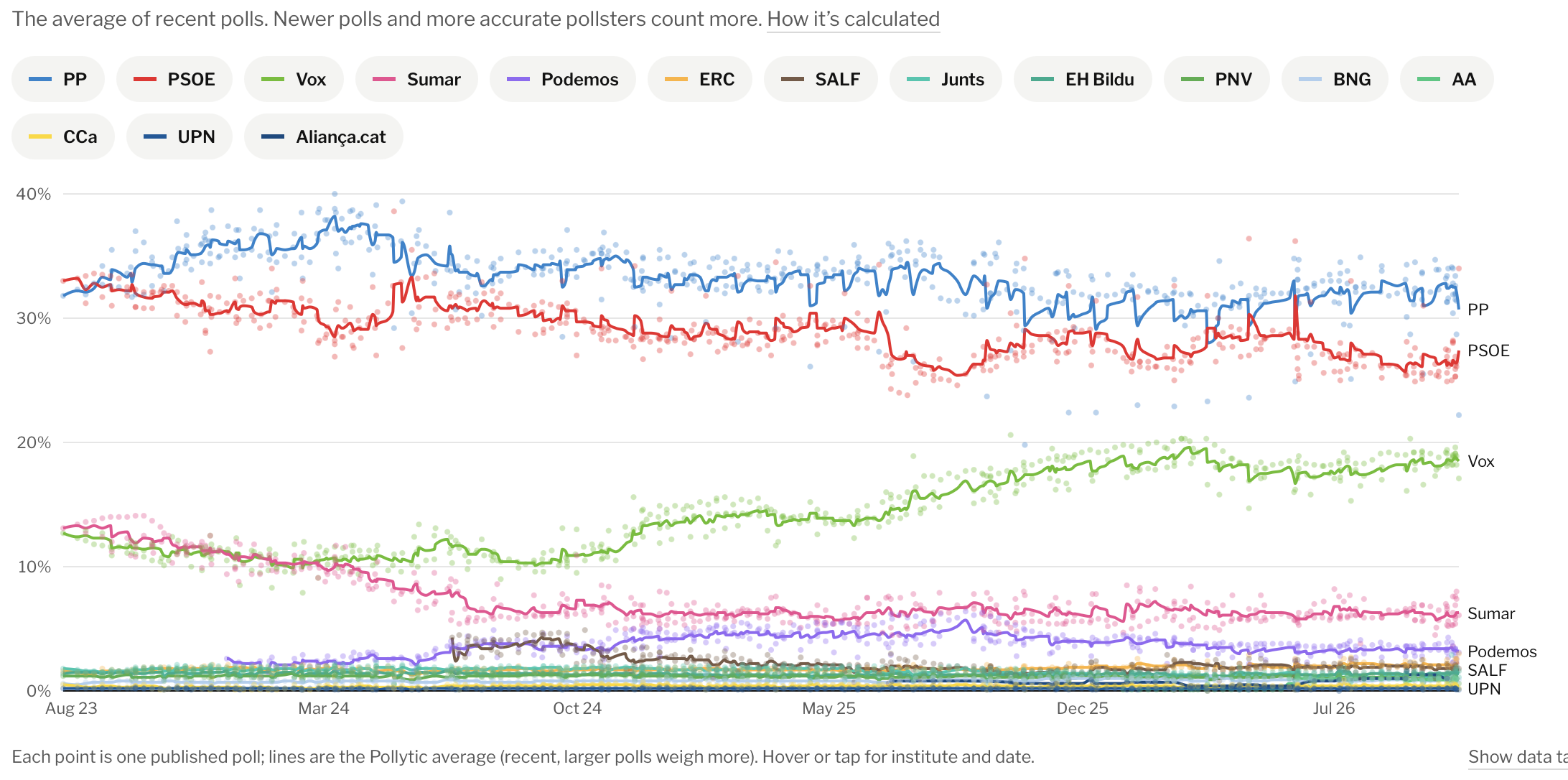
Image: polling results by Pollytic viewed on 18 November 2026 at Pollytic
“Sobre las elecciones y el momento politico” – “On the elections and the political moment”
27 De October 2026; PCE(ML) by J. Romero
Introduction
As we said in the issue just before this, given the storms brewing in Spain, we are re-publishing three articles by the PCE(ML). This is the second of these.
This takes further the analysis of Spain in the post-Franco period, which we saw in the prior article by PCE(ML). But it jumps forward to the current day and assesses a Marxist-Leninist view of the coming elections.
MLRG.online; 18 November, 2026
“Sobre las elecciones y el momento politico” – “On the elections and the political moment”
27 De October 2026; PCE(ML) by J. Romero
“Daniel Cohn-Bendit helps explain the differences between the housing-related mobilizations and other earlier sparks that failed to ignite the bonfire of social revolt. In 1968, as a sociology student at the Sorbonne, he was elevated to the status of a symbol of the student uprising that May. At that time, the major structured currents – which had emerged from “revisionist” betrayal – were beginning to spread; post-Marxism and Eurocommunism were gaining ground across Europe. Amidst this confusion, the French student revolt was hijacked by all manner of opportunists. Seeking to build upon the ashes of the old communist parties – most of which had already abandoned the cause of revolution – they fashioned a movement that was ostensibly radical, yet radical only in its outward forms.
Opportunism sought to channel the political tension expressed in youth revolts toward bourgeois formalism. The goal was not to transcend the capitalist state and construct a new one based on different economic and political foundations; it was no longer about working toward the emancipation of the proletariat using the tools of materialist dialectics, but rather about venting the discontent of a young generation through empty slogans: “forbidden to forbid,” “all power to the imagination,” “let’s be realistic, let’s demand the impossible,” and so on.
We, too, had our own “May 15th” and our own Cohn-Bendits – figures who spoke of addressing problems while sidestepping class objectives, denied the need for mass organization, and shifted initiative to a small circle of “enlightened” petty bourgeois who conducted politics above and apart from the masses themselves.
It did not take long for the vacuity of Cohn-Bendit and his ilk to become apparent: the man—an anarchist at the time – eventually took a different political path and is now an independent commentator, serving as an apostle for Europeanism.
And what of our own Cohn-Bendits? It is best not to look too closely at the biographies of some of them. What is worth remembering is that our own version of “May” helped give birth to a coalition government – a dialectical synthesis of forces that had paved the way for the monarchical regime (steering the struggling populace away from a clean break with Francoism) and those that did the same regarding the “tides” of mobilization against the brutal cuts imposed by M. Rajoy (Explanatory Notes by MLRG.online: Mariano Rajoy Brey Prime Minister of Spain from 2011 to 2018. Leader of the People’s Party) – cuts that had, at the time, placed his government in a precarious position.
Seven years ago, those who – following Franco’s death (November 20, 1975) – had explicitly abandoned any revolutionary path, staking everything on the goal of attaining government power in order to implement their “socialist” policies, finally achieved their objective. They formed a coalition with the very party that, throughout the “transition without a rupture,” had alternated with the PP as a “party of the State” – entrusted with managing the monarchical State. Joining them were figures who had emerged from a populist camp – a movement that sought to stitch together “unmet demands,” following the lead of their post-Marxist mentor, the Argentine Peronist philosopher Laclau. It was a trio that encapsulated a history of betrayals, which ultimately led the Spanish proletariat to defeat.
The epigones of “Carrillismo” joined forces with the party that has always played the role of a “competent manager of the regime” – a party that steered us into NATO, despite having once promised “no, to begin with”; initiated the drive toward economic liberalization by dismantling industry; oversaw the privatization of public enterprises; opened the boundless world of globalization to the Spanish oligarchy (creating the Ibex 35 index); and helped launch the construction and housing boom by, among other things, abolishing the indefinite extension of rental contracts. Meanwhile, those who played at politics – crying out, “Oh Captain, my Captain!” – joined the game, effectively closing the circle of the “politics of the possible.”
Today, however, an unexpected spark has called the harmony of the State into question and exposed the reformist “Left.” The mobilization around the issue of housing has broken eight years of paralysis, putting the reactionary, hardline Right – which had a weak and impotent government cornered – firmly in its place. It has given a voice to the masses, if only temporarily, and disrupted the established course of events.
A movement like the one centered on housing—which calls for organization, defines clear political objectives from the outset (objectives that, while limited, are revolutionary given the current context), and identifies itself in terms of class – bears little resemblance to the chaotic, incoherent mess of 2014. Back then, the only takeaway was that, for its leaders, “ideology didn’t matter a whit” (as Pablo and Manuela put it) and that “it wasn’t about class struggle, but rather ‘those below’ against ‘those above'” – a sentiment that could just as easily have been voiced by any run-of-the-mill Peronist.
The issue, however, is that general elections have been called for November 29th, and the “official” sphere of opinion-makers—the press, talk-show pundits, and establishment intellectuals – has already moved on from social discourse to focus on what is, in a typical bourgeois state, the essential matter: the vote. “Decent” politicians and those who dance to their tune are once again preoccupied with votes, seeking support, making promises, and issuing threats.
The question is whether one should vote, and if so, for whom. Most politically conscious people – those who have taken to the streets and view with sympathy the wave of mobilizations led by young people in struggle – are very clear that, despite the disappointments, confusion, and rage, there is one primary objective: to stop the right wing. Furthermore, they are clear that populist opportunism must be driven out of the political arena.
The sorry spectacle of a submissive Left squabbling among itself to cobble together a “unitary” electoral list is merely the visible tip of the iceberg. Beneath it lies an utter absence of political objectives – a deliberate abandonment of any move toward breaking with the monarchical regime. This is the only policy that unites them, precisely because it reduces them all to the same level. It is this very identity that leads them to hack together their electoral lists: there are no tactical criteria, nor is there any intent to strengthen a radical – let alone revolutionary – position. For them, it is simply about securing a soapbox from which to hold forth on their own anxieties and powerlessness.
They all share the same reformist outlook; the goal is simply to position their leaders, who then serve as focal points for various factions – factions defined by the myriad nuances that have sprouted during the ongoing disintegration of this “Left to the left of the PSOE.”
At first glance, abstention is the only logical course. They do not deserve a single vote. The PSOE – the driving force behind the government – has continued to pursue the “responsible” policies of the old two-party system: pruning the branches to preserve the very regime it has defended from the outset. It must be noted, however, that during the final stages of the slow agony the coalition has endured since its Pyrrhic victory in 2023, Pedro Sánchez and his ministers have taken the initiative. Meanwhile, those who were supposed to serve as their counterpart on the Left have reduced their contribution to constant whining about the obstacles that thwarted their “good faith” efforts within the framework of “social dialogue.”
That said, the qualitative leap that the popular housing movement has brought to mass political participation has yet to coalesce into a sufficiently robust organization – one truly tempered by the realities of struggle. Conscious organization that goes beyond an initial emotional response to an oppressive state of affairs – which can only be built from a class-based position – remains weak; this is because the central objective of the struggle continues to be a break with the monarchical regime, which is the instrument that has, until now, served the financial oligarchy in preventing a genuine democratic rupture.
Ultimately, these elections will take place within a political context defined by an electoral law and a legal and administrative framework tailor-made to protect fascist forces and institutions – designed to ensure the election of those who will not challenge this status quo, and to reinforce a monarchical constitutional “order” that possesses an imposing apparatus to enforce its rule.
We all know that in the upcoming elections, a significant portion of the most politically conscious segments of the masses will choose to abstain. They are fed up with the futile political maneuvering of a coalition government – composed of social-liberals and reformists – which, over the past eight years, has failed to fully honor any of its commitments or to adequately address the pressing problems affecting the working classes.
It is easy to simply go with the flow and call for abstention as a way to bypass the process, or to seek “technical” alternatives – such as casting a blank ballot – that allow one to vote without taking a side. In such a scenario, the logical step would be to organize an active boycott of the elections (in Morocco, our sister party adopted this approach alongside other forces, resulting in a new government that emerged amid an abstention rate of over 60%).
However, in our country today, the popular movement has not yet reached the level of maturity required to pursue this objective with any real chance of success – and, more importantly, doing so would mean abandoning a far more urgent and necessary task: strengthening our organization and giving our struggle a clear goal – a definitive break with the regime. Without this, the struggle risks being reduced to a mere expression of rage, devoid of any political purpose.
Furthermore, we must not forget that the rise of fascism – emboldened and fueled by the government’s own negligence – could lead to the fascists gaining control over the only central state institution they do not yet dominate. This would have dangerous consequences for the development of the revolutionary energy that has already been set in motion.
The conditions for a qualitative leap in the popular struggle are beginning to mature, and we must allow time for the movement to adopt truly revolutionary objectives – the only ones capable of bringing about a radical (root-level) change to the existing order.
Our Secretariat’s statement noted that the conditions are not yet ripe for a final reckoning with a regime that is a direct heir to the Francoist dictatorship – a regime whose institutions still hold the means to impose policies that serve a tiny minority of speculators, bankers, and parasites, at the expense of the working majority.
The core bodies of the bourgeois state’s repressive apparatus – the judiciary, the police, the military, and the political administration – have never been purged. They remain riddled with fascist elements who have co-opted one another, creating a reactionary caste incapable of exercising any sense of proportion or respect for the rights of the majority – a caste prepared to act with the same inhumanity that has always characterized fascists. Unless this scum is cast out and the monarchical regime is dismantled, the path toward strengthening the rights of the working majority will remain blocked.
Given these specific circumstances, what is the stance of Spanish Marxist-Leninists? To promote the slogan: not a single vote for the right.
Yet, beyond this choice – dictated by the current political situation – it is clear that the forces and leaders who have participated in coalition governments do not deserve a single vote from the people. Consequently, any vote they receive is merely a “loaned” vote, intended solely to prevent fascism from immediately seizing control of the government.
The outcome of the upcoming elections on November 29th inspires no enthusiasm among those who have already chosen to speak up – and to empower their fellow comrades in the struggle. Their vote will serve solely to remove an obstacle in the path of a struggle that has, until now, transcended the limits of monarchical democratic “normality” – and which must go even further in its revolutionary resolve.
27 October 2026; PCE(ML) by J. Romero
Re-published MLRG.online 18 November 2026