Spain – After the death of Fascist Franco – from Communist party Spain (ML)
At website PCE(ML)
Introduction
This is the first of three articles that we re-publish, from “Partido Comunista de España (Marxista – Leninista) – PCE (ML)”; “The Communist Party of Spain (Marxist-Leninist)”.
Spain will shortly hold new elections of importance to all working people and communists. The fascists are spoiling for a much heralded victory. Having been Prime Minister three times, the social-democrat Sánchez – despite his skilled demagoguery and survival instinct – is very low in the polls behind pro-fascists.
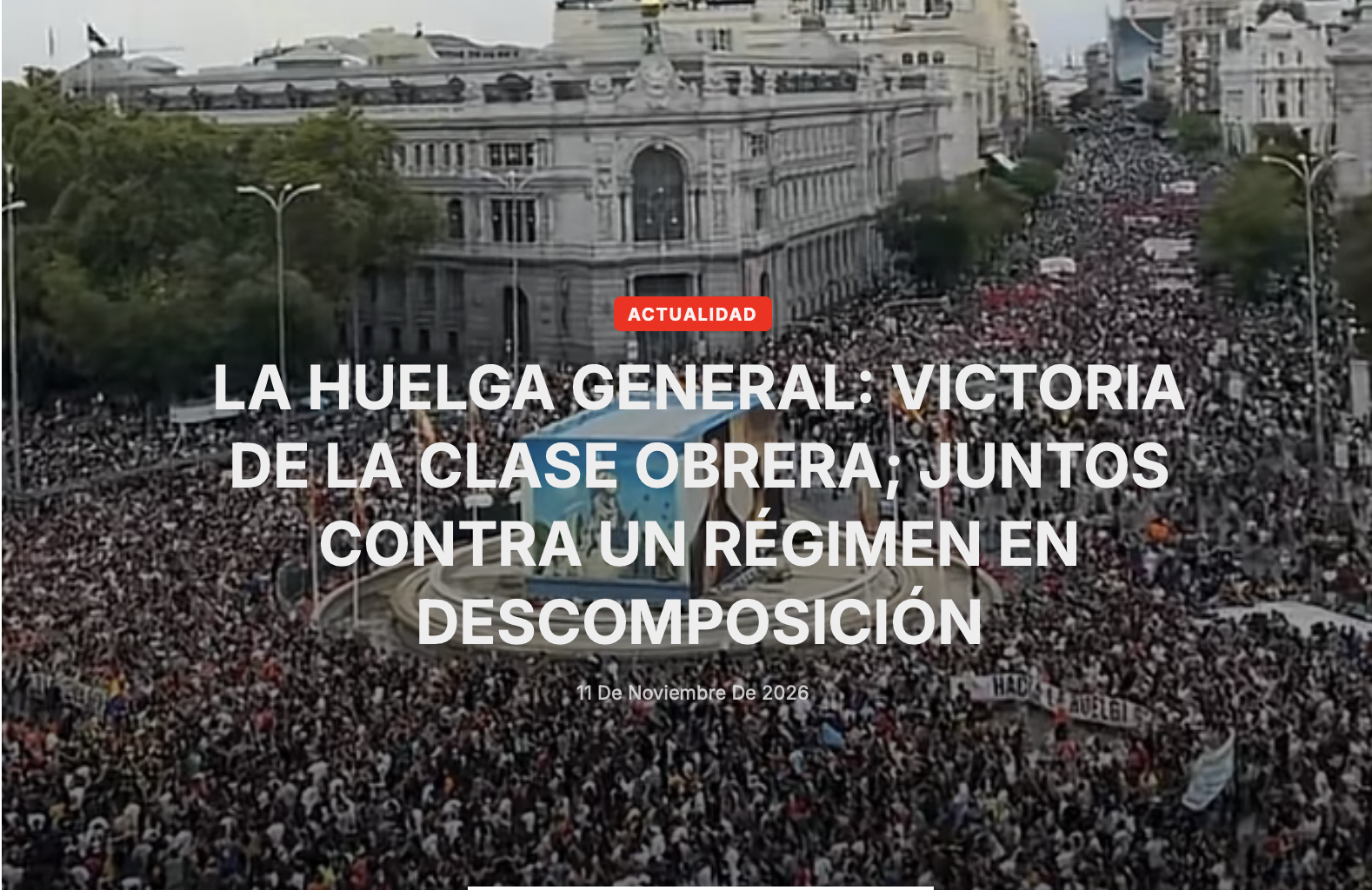
In the last few months we saw massive mobilisations of the young, the homeless, and the working class. Huge numbers responded to the nation wide call for a General Strike on the 11 November, 2026. All of this was at this time, brought to a head following the violent eviction of an 87 year old widow:
“Maricarmen Abascal is 87 years old and for the last 71 years she had lived in the same apartment in Madrid’s central Retiro neighborhood. On Wednesday, September 23, 2026, she was taken out on a stretcher after the police carried out her eviction on their fourth attempt. Hundreds of people were waiting for her outside. For months neighbors, activists and cultural figures had been trying to prevent her from losing a home that has been part of her entire life. Maricarmen spent her first night outside her home at Gregorio Marañón Hospital, where she is being treated for exhaustion, stress and anxiety produced by recent events….
Thousands of people, including numerous youths, protested in Madrid in a spontaneous demonstration that began in front of a controversial luxury penthouse that the Madrid regional government, led by Isabel Díaz Ayuso of the conservative People’s Party (PP), recently purchased for unclear purposes.
The protest attracted 10,000 people, according to the central government, and grew in size throughout the day, forcing the police to cut off General Martínez Campos Street. Dozens of officers with riot gear watched the scene unfold as protesters cried out “Ayuso’s penthouse for Maricarmen!” and “Shame! Shame!”
El Pais September 24, 2026
Maricarmen Abascal died in hospital shortly after, but not before approving the youth revolts described above.
What this issue of MLRG.online contains
This republication of PCE(ML), gives a broad summary of political events in Spain following the death of the fascist dictator General Francisco Franco Bahamonde (1892 – 20 November 1975). This is in part 3 of this issue of MLRG.online.
This outlines the inability and unwillingness of the revisionist Communist Party of Spain (PCE) and the Socialist party (PSOE) – to confront neo-liberalism and its ‘austerity’. This is because these parties had made a pact after the death of Franco – in the words of the PCE(ML) – to place “the main limits to the development of our country since then, which can only be overcome by breaking the pact that the submissive left signed at the time.”
Some readers may be unfamiliar with details of recent Spanish parties and personages. We therefore first offer a simple context to frame this article of the CPE(ML). It takes the form of a two-part ‘prologue‘:
The first is a short timeline of major political events following Franco’s death.
The second gives a very brief description of the major parties in Spain in recent history. It is emphasised that this does not pretend to be complete, nor is it a detailed Marxist analysis of the programmes. Its goal is simply to provide a framework, a starting point allowing the interested reader to follow events up to today.
The material in Part 3; forms the main content in the present publication. It comes from “Unity and Struggle” – Journal of the ICOPML (Unity and Struggle #49 November 2024; pp.98-112). We show extracts from the article by the ICOPML Spanish party member – the PCE(ML) – entitled “On the tasks of the Moment“.
It shows the faltering steps towards a democracy after Franco’s death. Moreover it shows this process unfolding at a time when the “globalisation” of the world market underwent a dramatic boost. The process and its ramifications into Spain are described by the Secretariat of the CPE(ML).
MLRG.online 18 November 2026
- A Time-line compiled and modified, including from Wikipedia
| Date | Event |
|---|---|
| 20 November 1975 | Death of dictator Franco |
| 22 November 1975 | Juan Carlos sworn king, head of state. Arias Navarro remains prime minister |
| January–March 1976 | Democratic protests: 17,455 strikes, 1,672 demonstrations and 283 sit-ins |
| May–June 1976 | Right of Assembly Act allows public demonstrations; Political Associations Act legalises political parties |
| 1 July 1976 | Suárez Prime Minister, announces ‘creation of modern democracy’ |
| 19 July 1976 | Penal Code reformed allowing rights of assembly, association, free speech |
| 30 July 1976 | Amnesty for some political prisoners – excluding “crimes of blood” |
| November 1976 – April 1977 | Political Reform Act passed and ratified by referendum; Labour Relations Act legalises right to strike; Electoral System Act passed; Trade Union Act legalises trade unions; Communist Party and Socialist Party are legalised |
| 14 May 1977 | Don Juan renounces claim to throne |
| 15 June 1977 | First free election held in Spain since 1936; mandates new constitution |
| 21 June 1977 | Spanish Republican government in exile dissolves itself |
| 15 October 1977 | Amnesty Act frees political prisoners, including “crimes of blood”; exiles allowed return to Spain under guaranteed immunity for crimes during the Civil War and Francoist Spain; reestablishment of the Generalitat, the autonomous government of Catalonia |
| 25 October 1977 | Moncloa Pacts – the Agreement on the Program of Sanitation and Reform of the Economy and the Agreement on the Program of Legal and Political Action – economic and political agreements against inflation and unemployment signed by labor unions |
| 6 December 1978 | New constitution ratified by referendum |
| 29 January 1981 | Suárez resigns as prime minister |
| 23 February 1981 | Attempted coup d’état known as 23-F |
| 30 May 1982 | Spain joins NATO |
| 28 October 1982 | Socialist government elected |
- Main Parties of the right
i) The People’s Party (Partido Popular PP)
The People’s Alliance (AP), was founded by Manuel Fraga in 1976 as an alliance of post-Francoist parties. Its successor was the PP which called itself a Christian democratic party, formed in 1989. For much of its parliamentary governmental history, it was led by Mariano Rajoy.
But on 24 May 2018, the National Court found the PP guilty of illegal kickbacks-for-contracts scheme of the Gürtel affair. The court “ruled that the PP helped establish “a genuine and effective system of institutional corruption through the manipulation of central, autonomous and local public procurement” (Wikipedia).
Mariano Rajoy’s government collapsed on 1 June 2018, and Rajoy resigned as PP leader. Pablo Casado became the new leader of the PP, and quickly forged alliances with the far-right Vox party (see below). But Casado was exposed as instigating spying on President of Madrid, Isabel Díaz Ayuso – hence he was forced to resign. Now led by Alberto Núñez Feijóo it won the most votes in the 2023 general election but failed a majority (See PSOE below).
ii) Vox
This party formed in 2013 led by its president Santiago Abascal. It was a split from the People’s Party (PP) which swept up the most rightwing members. Its party platform demands a new Spanish constitution in order to stop regional autonomy and abolish regional parliaments.
It won seats in the April 2019 general election; and then in the November 2019 general election it had 3.6 million votes, gaining 52 seats. It became the third-largest party in the Congress of Deputies. However it faltered in the 2023 Spanish general election losing 19 seats in parliament. It remains the third-largest political party in Spain with roughly 3 million votes.
In October 2020, Vox’s parliamentary group at the Congress of Deputies tabled a motion of no confidence against PSOE Prime Minister Pedro Sánchez. It failed as did a further attempt in March 2023,
Vox has always strongly supported President Donald Trump.
Not only nationally, but it also scored successes in local elections in 2020 and in the Basque Country, Catalonia, and the Community of Madrid. It entered regional governments, often in alliance with the PP. In 2021 the Constitutional Court of Spain has ruled in support of VOX’s attacks on anti-COVID measures.
2. Parties of the social reformists, self-labelled as “of the left”
i) Partido Socialista Obrero Español Spanish Socialist Workers’ Party
The party was formed by Pablo Iglesias Posse in 1879. It has approximately 153,000 members (Wikipedia PSOE). Originally formed as a Marxist party it became rapidly social-democratic.
It is true that the PSOE was a strong opponent of the fascists in the Second Spanish Republic. It was a key part of the coalition government from 1931 to 1933 and 1936 to 1939. But even in the Spanish Civil War it exercised a peculiar demagoguery that descended into frank anti-Marxism.
For example, Francisco Largo Cabellero in the ultra-left wing of the PSOE insisted on rejecting any involvement with the anti-fascist sections of the bourgeoise. This even at the heights of fascist attacks on the Republic (E.H.Carr “The Comintern and the Spanish Civil War”; London 1984; p.2).
However, the majority of its positions took a frankly social-democratic position. After the defeat of the Spanish Civil War to Franco fascism, the PSOE party was banned until 1977 in the transition to democracy. The party remains today an overtly social-democratic party, having restated its position after the death of Franco:
“For the PSOE, socialism is not only synonymous with democracy and freedom; furthermore, the strategy for achieving socialism consists of deepening and expanding democracy. Our path is the democratic road to socialism, based on the will and the struggle of the vast majority.”
“2.2. Deepening and Expanding Democracy”; in El Congreso Extraordinairo Del PSOE; (septiembre de 1979); at wayback machine
Thereafter, the PSOE was elected to government several times: from 1982 to 1996 with Felipe González, 2004 to 2011 with José Luis Rodríguez Zapatero. Since then its leader Pedro Sánchez has been Prime Minister three times since 2018.
Notably, as Leader of the Opposition, Sánchez joined Prime minister Mariano Rajoy of the PP – in opposing the 2017 Catalan independence referendum. These two dismissed the Catalan Government and imposed direct rule on Catalonia in October 2017. However after the Gürtel trial (See above under PP), Rajoy was forced to resign. Rajoy supported Sánchez as his successor. Therefore, since 2018 the PSOE has formed the government under Pedro Sánchez.
The PSOE has strong ties with the largest trade union – the General Union of Workers (UGT). However the failure of the PSOE in government to defend workers became obvious by the 1980s. In response, the UGT called for general strikes against PSOE governments on 14 December 1988, 28 May 1992, 27 January 1994, and 29 September 2010.
The trade unions and other progressives vocally attacked the PSOE for its neo-austerity, pro-capitalist policies. Over the world these are universally the same: deregulation, increasing precarity with temporary work, slashing benefits in unemployment and retirement payments, and privatising state organisations and public services.
While claiming to reinstate left economic policies, Sánchez manifestly failed. Many voters in the PSOE base moved towards Podemos (See below). Sánchez and the PSOE suffered major losses in regional elections in May 2023. But Sánchez called a snap general election, still PSOE still came behind the People’s Party. Yet Sánchez – was appointed by King Felipe VI – to form a coalition government. He allied with Sumar (See below) and was reappointed as Prime Minister on his third term on 17 November 2023.
(ii) Izquierda Unida (IU) – or ‘United Left’
This electoral coalition began in 1986, bringing together 7 parties. But it remains anchored in the revisionist Communist Party of Spain (PCE). The PCE is the only remaining national level party of the IU, which still unites regional parties, as a permanent federation of parties. This is not the place to describe the details of the fall into revisionism of the PCE.
(iii) Podemos – now Unidas Podemos (UP) ‘United We Can’.
Pablo Iglesias Turrión co-founded Podemos, in 2013. The name emulated Tuto Quiroga‘s Bolivian right-wing platform PODEMOS; which combines ‘Power’ (poder) and ‘Democracy’ (democracia). It was renamed in the feminine case – as Unidas Podemos (UP).
On 15 February 2016, Podemos proposed a government formation with PSOE, but Pedro Sánchez, rejected this. Iglesias nonetheless, still eased the path of Sánchez as prime minister. Iglesia has been in high office numerous times in the Government of Spain from 2020 to 2021.
IU joined the Unidas Podemos (UP) coalition forming a parliamentary group in the Congreso de los Diputados between 2016 and 2023.
In the November 2019 Spanish general election, Pedro Sánchez and Iglesias agreed a joint PSOE and Unidas Podemos rule. This ensured Sánchez became prime minister in January 2020.
Igelsias then retired from the national stage to re-enter regional political life. But Vox candidate Rocío Monasterio , supported by President of Madrid Isabel Díaz Ayuso (PP) supported violent attacks on Iglesias. He therefore retired from political life. Numerous scandals around his personal wealth and extravagance surround him.
Podemos performed poorly in the last election, placing fifth with 7.2% of votes. The overall result was a dramatic victory for the PP, supported by Vox.
Since January 2020, IU was part of a national Sànchez coalition government, with one minister. For the 2023 general election, IU took part in the Sumar electoral platform formed by second deputy prime minister and labour minister Yolanda Díaz. It became a political party under the name Movimiento Sumar (English: “Unite Movement”).
3. Extracts from Unity and Struggle Number 49, by the PCE (ML)
Emphases are inserted by MLRG.online.
“… The revisionists in government have never considered, in short, confronting the problems in the economic and political structure that brought about the development of our country.
The point is that the application of any reform program inevitably clashes with an economic and political structure inherited from Francoism and has been consolidated and adapted to changes in the international situation since the beginning of the transition.
The tendencies that the “developmentalism” of late Francoism left as a legacy to the continuing monarchy mark the main limits to the development of our country since then, which can only be overcome by breaking the pact that the submissive left signed at the time.
The beginning of “globalization” in Spain coincided with the transition. After a long period of political instability, in which the Francoist state apparatus was fully committed to imposing the monarchical regime (in the struggle to break with Francoism, more than 100 people were killed by the police or by assassins from fascist gangs, in demonstrations or strikes), once Bourbon “democracy” was established, it was Felipe González’s PSOE that began the path towards the complete “liberalization” of the Spanish economy.
What was becoming a trend during Francoism, was transformed under the monarchy into a consolidated economic structure, characterized by an economy based on services not linked to production, especially tourism, hospitality and construction. Entry into the European Union did the rest, by implementing the CAP (Common Agricultural Policy) and limiting the capacity of intervention of the economic bodies of the State, subjecting major decisions on investment, taxation, public debt, etc. to what was agreed to by the EU. Today, not only the economy of our country, but also work, territorial structure, transport, etc. are determined by this economic policy developed by the different governments of the regime. Another consequence of the economic structure is the depopulation of the interior of Spain, whose population is isolated and completely neglected in essential factors such as health, education, access to culture, etc.
NOVEMBER 2024 | p. 101
This evolution is not a matter of chance: the main demands of the popular movement, which at the time of the death of the assassin Franco was very powerful, organized and experienced in the fight against the dictatorship, were ignored. In the political sphere, these were the break with Francoism, the formation of a Popular and Federal Republic, the purge of the elements involved in the repression and support of the dictatorship, the closure of the Yankee military bases and the withdrawal of their troops, etc.
In the economic, social and labor spheres, they were the reinforcement of the public industrial sector, the creation of a public bank, the protection of employment, the creation of a strong public service, the confiscation of the large estates, the handing over of land to the day laborers and the state promotion of agricultural cooperatives, etc. The renunciation of these demands, the acceptance of a Constitution such as that of 1978, awarded and not the result of a constituent process with popular participation, etc., would not have been possible without the involvement of the leadership of the PCE. The monarchical regime, faithful to its continuist origin, has never questioned the power structure inherited from Franco. The minority that dominated the economy at the dictator’s death continues to do so today. The fundamental institutions of the State are not at the service of the social majority, nor have they been purged of elements of the reactionary caste whose members have continued to co-opt themselves into the organs of the State, to the point of forming a stratum that prevents the development of programs that address the most pressing problems of the population.
The central organs of judicial power, including those charged by the Constitution with its control, respond to the dictates of the political forces that represent the interests of the various sectors of the oligarchy: far from being a guarantee of legality, they have focused on legally justifying political decisions that curtail rights and cut back democratic advances, and on opposing any measure that attacks the interests of the oligarchy. They have not shown any signs of autonomy in relation to the economic power and its political representatives; at the same time, they have carried out an open interference in the other two organs of power, the Government and Parliament, without showing the slightest respect for the principle of separation of powers, so dear to any self-respecting bourgeois democracy.
p. 102 | UNITY & STRUGGLE
The dynasty that occupies the head of State, imposed in its day by Francoism, is the best example of the reactionary and anti-democratic character of the regime. The monarchical Constitution guarantees, in practice, the impunity of the members of the dynasty in relation not only to the acts of their political life, but also to their personal acts. Its first representative, Juan Carlos, continues to live outside the law, legally protected from the innumerable corruption scandals in which he is implicated. His unedifying lifestyle is the subject of jokes by commentators, but the State and its representatives bow their heads before his venal acts. The tenth anniversary of his abdication has been celebrated, but few remember that a decision of such importance was a simple formality that was resolved in just two weeks, just like so many other important decisions.
Now, everyone can see that revisionism is not a revolutionary ideology; that when the revisionist leaders talk about socialism or defending the Republic, they are merely maintaining a formal posture, that their intention has never been to break with the system that they helped to establish against the objectives that energized the clearest and most organized sectors of our class and their own militancy, in the fight against Francoism.
The revisionists claim that we are living in a full democracy, although, they say, there are democratic fringes such as the election of the Head of State; but they oppose going outside the consensual framework of the monarchical Constitution. In reality, the modern history of our country has seen the constant struggle between the people to develop democracy in Spain without obstacles, and reaction to avoid it at all costs; The oligarchy that really controls the State has always demanded acceptance of the status quo and, whenever it has seen its absolute and all-round control of the State threatened, it has used the political and military power in its hands to impose itself.
It is not a question, as the traitor Santiago Carrillo (Note by MLRG.online – Former revisionist leader of the PCE who led the charge into “Eurocommunism”) cynically said, of changing the color of a flag, or of winning a bourgeois republic that maintains the same constitutional restraints that today prevent the social majority from exercising democratic power. It is a question of fundamentally changing the 1978 Constitution, which establishes the limits of a state model and of an institutional and political structure that supports a system dominated by a minority of parasites, big business owners and financiers.
NOVEMBER 2024 | p.103
This is not a democratic formalism; it is about giving the people a voice in determining the form of the State and guaranteeing democracy, the right to self-determination of the historical na-tionalities, the democratic control of institutions, the pending agrarian reform, public control and nationalization of strategic economic sectors, effective control and participation of citizens in the issues that affect them. It is, in short, about applying the program that has always been associated with the struggle for the Republic.
We are rapidly approaching a time when the doubts of the unrepentant reformists will not be of any use, nor will the crazy sectarian and formally radical, but in practice accommodating, activism of the radical opportunists. Unity is urgent, but not just any unity; we need to move firmly towards popular unity around a program with shared political objectives, which goes beyond confronting the crisis that is continuing with the useless weapons of this limited democracy. It is urgent to establish agreements to revive the initiative for the proletariat. Otherwise, it will be the right and fascism that will end up definitively blurring the “misunderstanding” of the continuist [from the Franco period] “democracy.”
Anyone who does not live in their own personal universe, anyone who is not voluntarily detached from political and social reality, knows that the conditions for revolution are not given, that an immense majority of our class is on the sidelines of the political battle, among other reasons, because of the Caesarism [system of absolute power] and arrogance that have characterized the work of opportunists and revisionists.
We are in the democratic-popular stage of the revolution. The task of communists is to work tirelessly to organize the proletariat, taking advantage of all the openings that allow us to reach the masses, to know their problems, which are ours, to explain their causes and propose our program to overcome them, to organize them and learn from them, to take up the forms of struggle that each political moment creates, etc. in order to unite all the efforts of the popular camp to direct them against the common enemy.
Yes, our goal is the socialist revolution, to destroy the bourgeois state in order to build another one on radically different foundations; but at each specific moment, as Lenin advised, we must take into account the specific conditions…
p.104 | UNITY & STRUGGLE
… Little by little, we are seeing a greater participation of young people in social and workers’ mobilizations, a greater interest in learning about and debating political questions; a more active attitude among sectors of young people who want to intervene directly in the political struggle that their class is waging, who refuse to idealize nonsense when the world faces a merciless struggle for the future. Consequently, we also see a greater interest in learning about dialectical materialism, the Leninist ideology that proved in practice the real possibility of putting an end to the capitalist State and building a proletarian State on radically different bases. To join with the practical experience of the youth, to fight the indifference and being implacable in the fight against idealistic degeneration is basic and fundamental for our Party, and it will be more so in the immediate future.
We must start, as we say, from the concrete; We must therefore take into account not only the objective situation of the young people we work with, but also the general environment in which the consciousness of the youth is being formed and its concrete expression in the sphere in which each comrade acts. Our youth comrades logically manage their own codes of relations, those of their generation, which are influenced by that; but, on the other hand, these objective limitations of which we speak: scattering, tendency to individualism, even to self-isolation, are not determining and immutable conditions for political work with the young sectors, nor can we consider ourselves immune to them: the subjective state of the struggle affects us all…”
p. 108 | UNITY & STRUGGLE
“… In the report to our 9th Congress we said: “Faced with reformists and doctrinaires, our task is to create spaces of socialization that help to reconstruct the political and social fight, to try to put the contradiction between capital and labor at the center of the political chessboard, and not to waste our forces on projects that would lead us to maintain an erratic and incoherent policy in practice, to blur our objectives and disorient us.”
We are not the driving force of the revolution, nor do we pretend to be. Our role is different: to lead the struggles that are going to take place in order to orient them in a revolutionary direction; and, for this, we must be the first in combat, to give and share responsibilities, to encourage people to take them up and to trust the people who are fighting alongside us. Today we are not in a revolutionary situation and it is precisely at these times when the determining factor is knowing how to protect our organization and help strengthen the organization of the masses; because the very dynamics of imperialist politics will be what activates the political and social conflict sooner rather than later….”
p. 110 | UNITY & STRUGGLE
“… Sixty years have passed since the formation of the PCE (m-l); sixty years of struggle in defense of Marxism-Leninism. In this long history, our Party has waged an implacable battle against revisionism.
Today, the opportunist currents have revealed their ideological nakedness, their practical emptiness. Today, the opportunist currents have revealed the ultimate goal of their activity: to detach the proletariat from the revolution; today, our Party is more necessary than ever. Imperialism is preparing for war and is trying to put an end to all the advances that the proletariat has achieved in struggle. The communists all over the world are fighting alongside us; with them we have committed ourselves to conquer a future without classes, without exploiters or exploited….”
p. 110 | UNITY & STRUGGLe
Secretariat of the Central Committee of the PCE (m-l)
September 2024
Republished 18 November 2026