The Rise of the Alternative for Deutschland (AfD) in Saxon-Anhalt Elections 2026
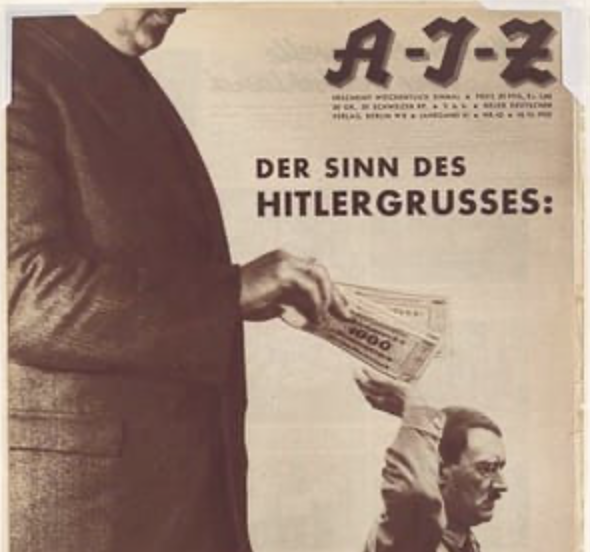
The image is from an earlier German fascism – made by John Heartfield (1932) The sense of the image is that the business and finance sectors financed Adolf Hitler. Today, the “Alternative for Deutschland (Germany)” in Germany – has its roots in the same ruling social class. Image from here
The Rise of the Alternative for Deutschland (AfD) in Saxon-Anhalt Elections 2026
Introduction
The recent election in Saxon-Anhalt Germany, marks a major turning point. For the first time in post-war Germany, an openly fascist party is near enough in an election to take over a state government. Of course this is the “Alternative for Deutschland” AfD. It is in the view of the ‘Financial Times’ columnist Gideon Rachman:
“truly an event of global significance. The AfD’s Saxony branch has been classified as rightwing extremist by Germany’s domestic intelligence services. Some in the party flirt with Nazi imagery and slogans.”
“A German election result heard around the world”; Financial Times; 7 September 2026.
It is true that the AfD has not won an absolute majority, meaning it cannot rule without a coalition. But it needs only 3 turncoats from one of the other parties to achieve this. It is likely that Sara Wagenknecht’s Bundnis Sara Wagenknecht (BSW); or the ruling Christian Democratic Union (CDU) coalition members, will provide that. The BSW previously has said that they would do so if needed, and the Conservative Christian Democratic Union formed the early membership of the AfD – and has been flirting with the AfD for some time.
That is if the AfD winning candidate chooses to seek those members to switch parties. He – Ulrich Siegmund – has said previously he would not. But he is currently under pressure from the party leaders in Berlin to do exactly that.
While no doubt the AfD is openly fascist and anti-immigration – it does not appear this was the deciding issue for voters. According to one exit poll (cited by the correspondent of ‘Conter’ – a Socialist organisation in Scotland based in Edinburgh and Glasgow) – in a podcast, participants who had voted for the AfD said the motivating factor for them was as follows:
Immigration 9%
Economy 15%
Peace in Europe 17%
Social Security 25%
Hear at minute 4’37 seconds at: Conter podcast here
It seems that social security and economic issues took precedence. The main culprits for the rise of the AfD to this position are those who colluded in ruling parties with this agenda. Namely social democrats of the SPD and Die Linke, who refused to take a principled position against the on-going cuts in social services and prospects of pension cuts. The ongoing mass job cuts at the motor car factories – most recently at Volkeswagen – add to the extraordinary uncertainty and economic insecurity of the working class.
We noted previously (MLRG.online “The “Metamorphoses’ of Would be CDU Chancellor Friederich Merz and the 2025 German Federal Elections”; 6 February 2025) that the ruling Federal Chancellor Merz’s Coalition (led by the CDU) was effectively building bridges with the AfD – breaking any so-called “firewall” (‘Brandmauer’) against the fascists:
“But in particular, in the Eastern parts of Germany the principle became eroded. Especially after Thomas Kemmerich was elected Minister President of Thuringia with both AfD and CDU support in 2020. In fact Merz explicitly exempted local district council cooperation with the AfD..”
MLRG.online 6 February 2025
One other on-going factor behind the rise of the AfD, is the wish of the Putinite Russian state to undermine the Merz Government – or indeed almost any German government. As Gideon Rachman comments:
“Vladimir Putin’s circle had been eagerly anticipating an AfD breakthrough in the Saxony-Anhalt elections. Last month, Kirill Dmitriev, a key Russian intermediary with the Trump administration, posted excitedly on X: “Germany Awakens on September sixth”. Both the language and the date of that post seemed significant. “Germany Awake” was a Nazi slogan. Dmitriev’s post appeared on August 23 — the anniversary of the signing of the 1939 Molotov-Ribbentrop Pact between Nazi Germany and the Soviet Union.”
“A German election result heard around the world”; Financial Times; 7 September 2026.
“Russia has concrete reasons to support the AfD. The party is campaigning to end German aid to Ukraine, restore economic ties with Russia and an increase in Russian-language teaching in German schools.”
“A German election result heard around the world”; Financial Times; 7 September 2026.
The recent allegations of Russian attacks on German soil, such as the unexploded bombs at Leipzig airport, have raised tensions further. Without any evidence that is made public, the Merz Government has made clear it intends to rachet up pressures on Russia. Such fear-mongering will raise general war tensions in Europe even further. We intend to write more fully about these separately in the near future.
The vote results are stark as seen below, which also shows the per cent changes since the first column for each part (2021) and current results.
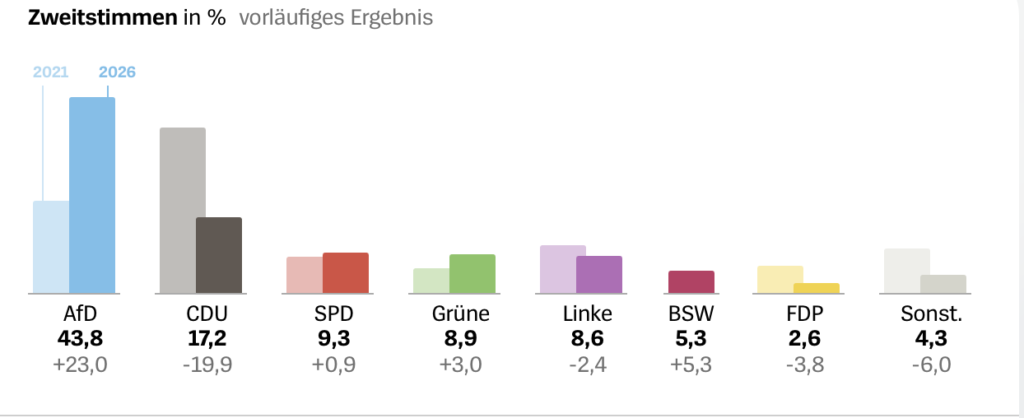
Der Speigel; ‘Second Votes preliminary results’; in “Landtagswahl Sachsen-Anhalt”; September 7 2026; at here
(A short update as of 8 September 1100 am EST:
The architecture of German politics has now shifted. As Merz admitted on Monday 7 September and reported on 8 September in the Financial Times:
“Asked on Monday why the CDU was losing support, Merz said he had no clear explanation.
“I just see that the two major people’s parties that we once had are in serious danger,” he said. “This has been true for the SPD for a long time, but it also applies to us”…
Pressed repeatedly over his personal responsibility for the Saxony-Anhalt defeat, Merz acknowledged that he had “been an issue in the campaign.”
Anne-Sylvaine Chassany; “Merz’s CDU in crisis after far-right victory in Saxony-Anhalt”; Financial Times; 8 September, 2026.
There appear to be at least three possible ways forward for the CDU, according to the same report in the Financial Times:
One to switch Chancellor – and the name currently being touted by “CDU insiders” is Hendrik Wüst, the premier of North Rhine-Westphalia, Germany’s most populous state;
Another is to “end the coalition and govern as a minority administration with the current Bundestag, freeing the CDU from having to dilute its policies to secure SPD backing” – in other words, to then feel freer about slashing social expenditure and coming even closer to the AfD policies;
and the third is “for Merz’s CDU to muddle through, pressing ahead with unpopular welfare reforms alongside its junior coalition partner, the SPD, whose poll ratings are also languishing”. FT Ibid September 8, 2026.
There is a fourth in our view. That is to find ways of further enabling an open partnership with the AfD. The recent forced resignation of Jens Spahn, formerly “the head of the CDU/CSU parliamentary group in the Bundestag” – over the issue of surrogate mothering and fees paid for that ’service’ – comes to mind. (See MSN Euronews 18th July 2026). Spahn had been long working behind the scenes to embarrass the SPD, and conciliating the AfD. ] End of 8 September update.
We believe the following article is of interest to Marxist-Leninists.
It was written before the results were known, by “Arbeit Zukunft”. We give a machine translation of this below. It shows the provenance of the AfD as a capitalist party.
MLRG.online 7 September 2026.
From Arbeit Zukunft.de September 6, 2026
Whose party?
As expected, discussions surrounding the AfD are heating up in the run-up to the upcoming state and local elections in eastern Germany.
Ulrich Siegmund‘s victory in Saxony-Anhalt seems inevitable, and reflexively, bourgeois-liberal forces are reigniting the AfD ban proceedings and the debates surrounding a resilient democracy. At the same time, Campact (A grouping calling for ‘strategic voting’ – See https://www.campact.de/strategisch-waehlen/sachsen-anhalt-2026/ – editor) is launching an election campaign for the SPD and the Greens, aiming to prevent an AfD-only government by securing their entry into the state parliament. There is a consensus: the AfD’s success must be halted somehow. But to find the right tactics in the fight against the AfD, one must first understand exactly who we are dealing with.
“Emerging from the West German elite”
In an interview, former CDU Minister-President of Saxony-Anhalt Haseloff raises an important point. Even though Haseloff wants to emphasize that the AfD is not a purely East German phenomenon, he uses the term “elite” appropriately. Contrary to the reputation the AfD has cultivated over the years as an anti-establishment party, it is a party of the ruling class and emerged from within its ranks. For example, in 2012, the group “Electoral Alternative 2013” was formed, criticizing the CDU’s course under Merkel in the context of the so-called migration crisis. This group comprised right-wing authors, professors, businesspeople, and members of the FDP and CDU. Of the 58 initial signatories, almost all from West Germany, 28 were university professors with various advisory and supervisory roles in different companies. Among them were members of the advisory board of the Mont Pelerin Society, which gave rise to neoliberalism and to this day maintains an important global network of anti-worker think tanks.
From this group, the AfD would soon emerge, with key figures such as Bernd Lucke, Alexander Gauland, Beatrix von Storch, and Hans-Olaf Henkel. Henkel had previously served as president of the Federation of German Industries (BDI) and on the supervisory boards of corporations like Bayer, Continental, and Daimler Aerospace. Lobbying organizations such as the Hayek Society and the Initiative for a New Social Market Economy (INSM) were also among the important networks involved in building the party. The INSM lobbying organization was founded by the employers’ association Gesamtmetall and continues to be financed by various employers’ associations to mobilize support through new PR campaigns against minimum wages, wealth taxes, and workers’ rights.
Particularly in connection with the “euro bailout” of the early 2010s, Lucke’s circle represented the segment of German capital that primarily produced for the German market and did not, like export-oriented monopoly capital, profit from the eurozone and the exploitation of other European countries. For example, in 2014 Lucke was invited to give a lecture on his vision for the euro at the employers’ association “Die Familienunternehmer” (The Family Businesses). Over the years, the AfD has increasingly developed into a party that has intensified its nationalist and neoliberal course.
Who benefits from the AfD?
Even though co-chairman Chrupalla describes his party as “the only proud workers’ party” and the AfD does indeed achieve the highest poll numbers among the working masses, a study by the Institute for Research on Right-Wing Extremism once again provides evidence of the party’s anti-worker stance:
“The AfD stands for economic and social policies that would do its own voters more economic harm than good.”
This means the AfD consistently pursues policies for the elite from which it itself emerged. In its tax policy, for example, it wants to lower income tax and opposes inheritance or income taxes, while maintaining value-added tax. Only the wealthy would benefit from this tax policy, and the resulting shortfall in tax revenue would lead to further social cuts. At the same time, the AfD proposes shortening the duration of unemployment benefits and introducing a mandatory work requirement after just six months of unemployment. The German Institute for Economic Research (DIW) calculated that the AfD’s economic policies would result in the wealthiest 10% of the population in Germany earning €86 billion more in profit annually, while the state would lose €116 billion in tax revenue each year. The DIW also predicts that in Saxony-Anhalt, where the AfD enjoys its highest polling numbers nationwide, the annual income of workers would decrease by €1,600 per year.
Even though the AfD can compete with the FDP in its tax breaks for companies, voices from various supervisory boards and employers’ associations repeatedly denounce the AfD as the greatest threat to democracy. A striking feature of this is that the core of the criticism, as voiced by Mercedes CEO Ola Källenius or the president of the Confederation of German Employers’ Associations (BDA), focuses on the fact that the loss of skilled workers from abroad or the European sales market would harm the economy. Thus, it’s not about the party’s misanthropic ideology, but rather the need for cheap labor from abroad and the profits of the export-oriented sectors of German capital.
Even though the CDU remains the preferred party of most German corporations, the AfD has adapted its platform on key issues such as migration and the EU to the needs of German capital and its monopolies, and will publish a new party platform in 2027 that will further pander to these monopolies. The truth is, therefore, that the firewall against the business sector is constantly being challenged. Most recently, former Siemens CEO Joe Kaeser of the CDU called for a break with coalition partner SPD, which would require AfD-CDU cooperation to secure a parliamentary majority. Given the growing inter-imperialist contradictions and the accompanying challenge of uniting the working masses behind the interests of German capital through nationalism and societal division, the AfD is increasingly likely to become a target for capital.
All together against the AfD?
Of course, one cannot remain indifferent to the question of which party governs. Any government in which the AfD is part of the coalition will mean even broader attacks on democratic rights, trade unions, education, and healthcare. At the same time, it must not be forgotten from whose womb and under what conditions the AfD was able to grow. If, currently, under the clamor of German capital for military preparedness and profit maximization, all parties are pulling together to massively increase armaments, attack the retirement age, or drastically cut social spending, then one must ask:
How does the current government’s policy differ from the AfD’s platform?
Here, too, the national “we” is invoked at every opportunity, and the lie of prosperity for all through a “strong German economy” is spread – it should be noted that DAX-listed companies made record profits in the first quarter of 2026 and yet still cut 31,000 jobs. When the Left Party (Die Linke) in Saxony-Anhalt considers cooperating with the CDU to prevent the AfD from participating in government, when Campact sees campaigning for the SPD and the Greens as the solution, a false “us” versus “them” is being created.
Are we dependent on the CDU, which is only slightly less racist? Is the SPD, which is currently trying to undermine the eight-hour workday, our salvation?
On the contrary: they are the arsonists from whose ashes the AfD was able to rise, and they themselves are part of the elite for whom they make policy. The enormous potential that the anti-fascist movement in Germany is capable of mobilizing will be able to put the first obstacles in the way of the AfD and the rightward shift, once it breaks free from the constraints of the other bourgeois parties. Only when we understand how to link the anti-fascist struggle with the struggle for better working and living conditions, for more democratic rights, and against war will the true camps in which “us” and “them” find themselves be revealed.”
From Arbeit Zukunft
As re-published in MLRG.online; 7 September 2026