USA Midterms – strategies to “fix a win”
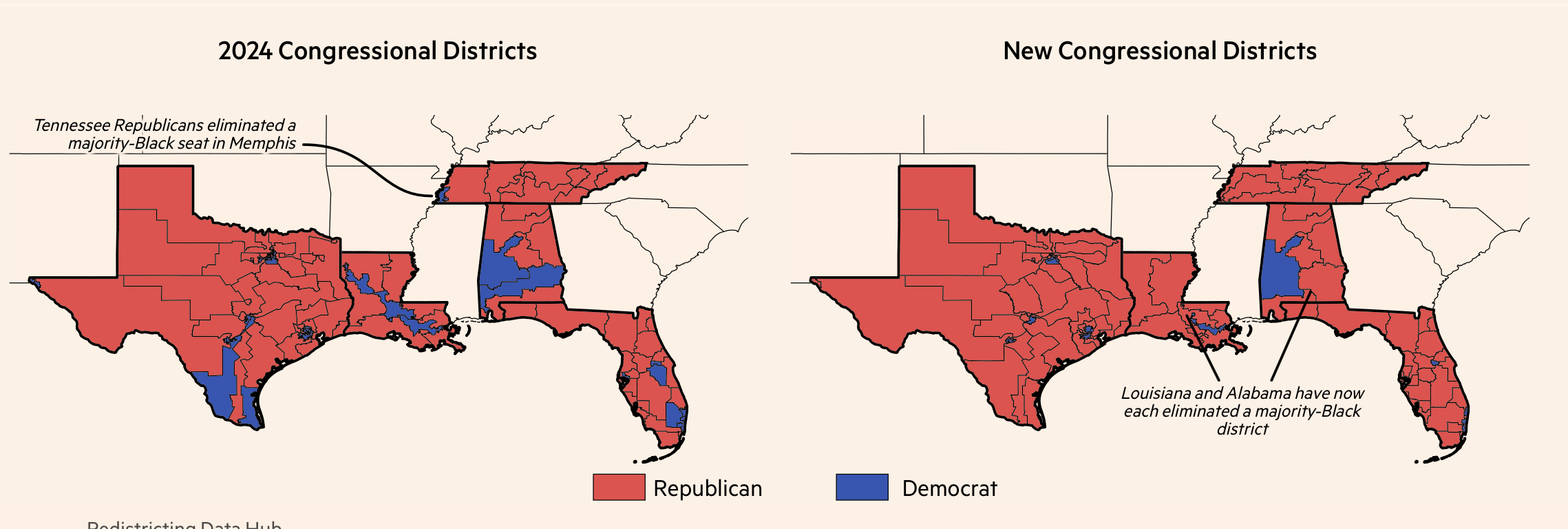
Image: From Kaye Wiggins; “How the Supreme Court greenlit America’s gerrymandering battle”: Financial Times, October 2 2026; behind paywall here. Caption in article reads “Republicans could gain a dozen congressional seats from mid-cycle redistricting in southern states Congressional district lines in five southern states which have updated their maps, shaded based on 2024 election results”. Note: Data source for map is freely available from original source at Redistricting Data Hub here
Introduction
We have repeatedly written about the dangers of the Trump Presidency for workers of the USA. We have also written often about the crisis of the USA state with its current ruling class. This has we have said, leads it to adopt more and more neo-fascist types of rule. The mid-term elections are coming up on November 3, 2026. Trump’s popularity has sunk. He appears unconcerned, and indeed ‘detached’ from any reality. Meanwhile, his government – assisted by the Supreme Court – is placing more and more restrictions of a truly ‘free vote’. Moreover, statements from Trump’s close allies indicate willingness to deploy ICE agents at the polls. We review this data, and other means of restricting a free vote. We end by reminding of the provocation of the so-called “Reichstag Fire” that led to the imposition of fascism in the Germany of 1933.
MLRG.online, 3 October, 2026
A brief synopsis of the USA governmental system
Outside of the USA, some may only have a vague understanding of the governmental system. It has two chambers – thus it is “bicameral“. The two chambers are the House of Representatives and the Senate. Under Article One of the Constitution of the United States, they jointly are responsible to pass or defeating all legislation – or “bills” submitted them by their members.
Of these two chambers, the House is the “lower” chamber and the Senate is the “upper” chamber:
“…the House of Representatives is the lower house, with the United States Senate being the upper house….”
Wikipedia accessed on 2 October 2026
Members of the House serve a fixed term of two years, with each seat up for election before the start of the next Congress. Members of the Senate consist of two senators per state, who serve six-year terms, making 100 members in total for 50 states.
This year the composition of the House carries some potential threat to Trump, of which the latter is acutely aware:
“If Democrats take control of the House, they will decide whether Trump can pass legislation through Congress. They would also almost certainly launch investigations into the president and top members of his cabinet. Members of the House serve two-year terms, so the entire 435-member lower chamber of Congress is up for re-election this November. ”
Lauren Fedor, James Politi, Ian Hodgson; et al; “US midterm elections 2026: The FT’s guide “; Financial Times at August 4, 2026
If any bills are passed by the House, they then go to be approved by the Senate. If they pass there, they go to the President to sign. The Senate in addition has other duties also including:
“… exclusive power to confirm U.S. presidential appointments, to approve or reject treaties, and to convict or exonerate impeachment cases brought by the House. …
the approval of treaties, the confirmation of Cabinet secretaries, federal judges (including justices of the Supreme Court), flag officers, regulatory officials, ambassadors, other federal executive officials, and federal uniformed officers. If no candidate receives a majority of electors for vice president, the duty falls to the Senate to elect one of the top two recipients of electors to that office. The Senate conducts trials of officials who have been impeached by the House.”
Wikipedia USA Senate, accessed 2 October, 2026
The situation currently in the USA coming mid-term elections of November 3, 2026
If this was to be a “fair fight” – a truly fair election – it seems likely that the Democratic party would obtain control of the House of Representatives and the Senate. Why do we say this? The overwhelming majority of polls suggest this to be the case. It is true that among the Republican identifying electorate only, he remains overall popular on all issues except on the issue of prices and inflation (See below):
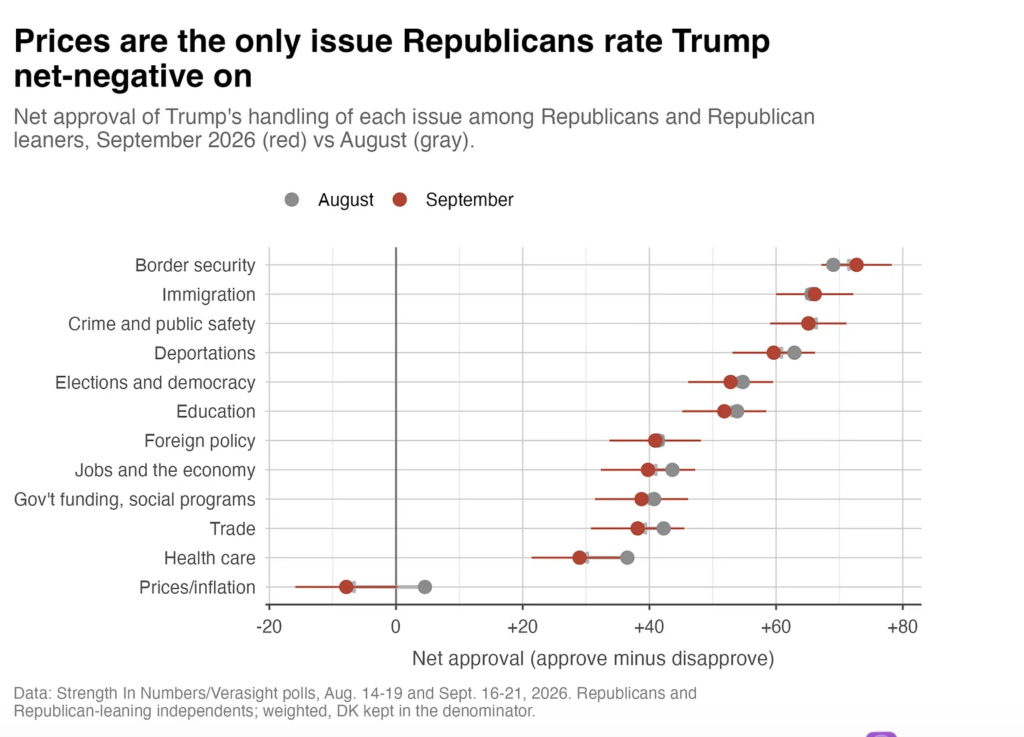 G.Elliot Morris, pollster; “Amid rising diesel prices, Republicans turn against Trump for first time on handling inflation”; Strength In Numbers 2 October 2026
However, overall, Trump has become dramatically unpopular for a number of reasons. These include:
– the erosion of the Obama health care provisions;
– inflation and the impacts on working-class standards;
– the high and rising price of oil fuel;
– the overt hounding of visible immigrants, both legal and possibly ‘illegal ‘, has divided the population but is fiercely resisted by many Americans;
– the now ‘never-ending’ war in Iran;
– and the evident corruption of the Trumpites; and of course a growing and visible inequity
Projected outcomes assuming a fair election was to be held
What then would be the prospects for the electoral rebuke of the Trump forces and the Republican government – if unlikely though it is – a “free vote” was to take place?
Firstly, as regards the Senate – or the “Upper House”? What are the signs?
“Months ago, the Republicans’ majority in the upper chamber looked impregnable. … Now Democrats appear in a commanding position to take not just the US House but potentially even the Senate too…
Democrats face an uphill battle to take back control of the Senate, where 35 seats of the 100-member legislature are up for grabs.
Just 12 of these are rated as competitive by the Cook Political Report, a non-partisan newsletter that analyses US election campaigns. The rest are in safely “red” Republican states or “blue” Democratic states and are unlikely to change hands…. Democrats need a net gain of four seats if they are to retake the upper chamber…”
Lauren Fedor, James Politi, Ian Hodgson; et al; “US midterm elections 2026: The FT’s guide “; Financial Times at August 4, 2026
When these considerations are weighed into formal projections – a graphic below shows the growing gap between Democratic chances (growing) and Republican chances (shrinking) of controlling the Senate
(y-axis shows percent chance of Senate control estimated between January 2025 to October 2026):
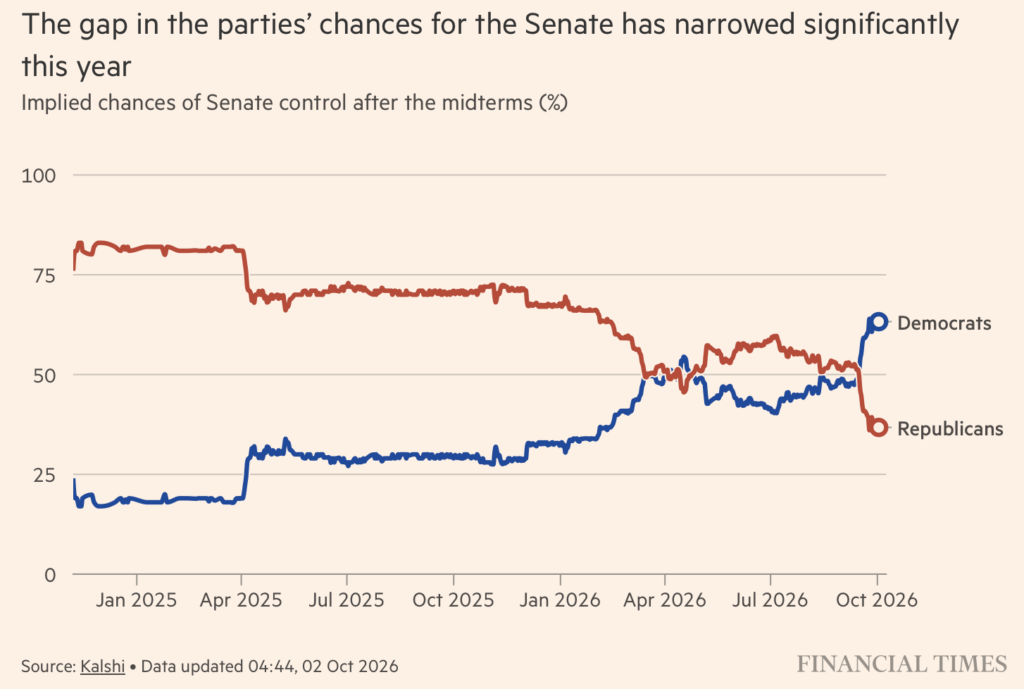 Lauren Fedor, James Politi, Ian Hodgson; et al; “US midterm elections 2026: The FT’s guide “; Financial Times at August 4, 2026
Similarly, as regards the House of Representatives or the Lower House, again there seem to be opportunities for the Democratic Party overall. But the situation here is affected by gerrymandering (on which we discuss more as below):
“If Democrats take control of the House, they will decide whether Trump can pass legislation through Congress. They would also almost certainly launch investigations into the president and top members of his cabinet.
Members of the House serve two-year terms, so the entire 435-member lower chamber of Congress is up for re-election this November. The vast majority of the races are uncompetitive — partly due to decades of gerrymandering…
Although this redistricting has historically taken place after the census once every 10 years, Republican-controlled state legislatures recently redrew election maps in southern states such as Texas. Democrats responded with their own gerrymandered map in California. …
The process has left only about 20 races that could decide the contest.”
Lauren Fedor, James Politi, Ian Hodgson; et al; “US midterm elections 2026: The FT’s guide “; Financial Times at August 4, 2026
Nevertheless, projections on the House still look good for the Democratic Party, as shown below in the blue solid line versus the Republican red solid line (the y-axis shows predicted percentage of the vote; the shading around the solid lines are confidence limits):
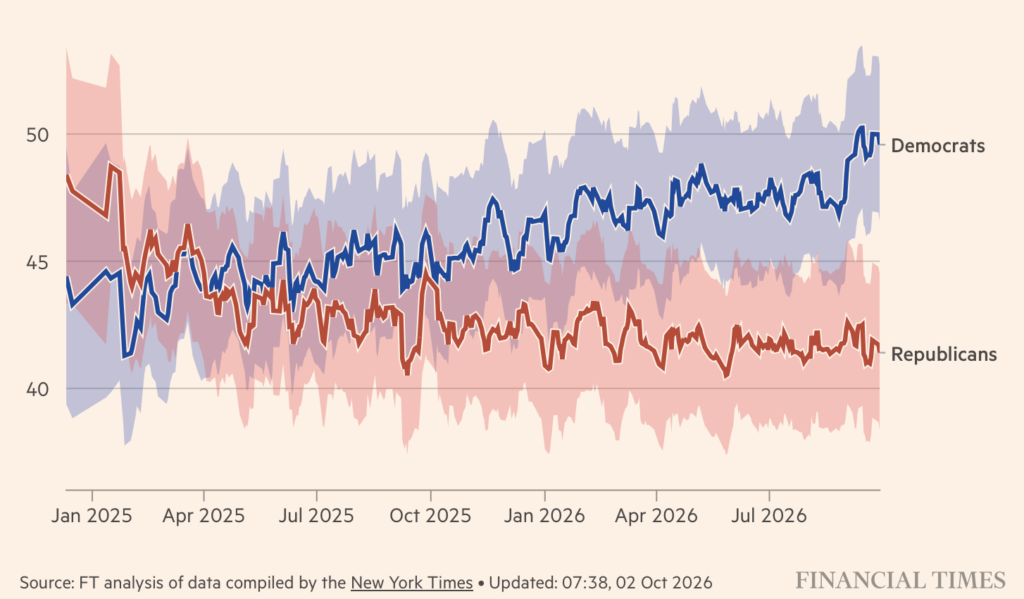 Lauren Fedor, James Politi, Ian Hodgson; et al; “US midterm elections 2026: The FT’s guide “; Financial Times at August 4, 2026
But – (and a big but) – it is not even now a fair fight – and it will not be on election day – a fair fight
The stark reality is that is not going to be a “fair fight”.
The Trump Republicans will do all they can to avoid having to resort to open violence, a direct steal at the polls. As we will see, they have no moral objection to this last resort, even if a violent last resort is needed. But other methods will be used first.
What are the more usual and conventional thoughts about the barriers to any electoral rebuke to Trump?
There are at least three predominant ones: cash, gerrymandering, and prevention of mail ballots. If all else is clearly failing, only then will the already voiced threats of overt violence become a reality. That these threats are uttered even now is ‘fair warning’. Nonetheless, let us examine the three barriers short of violence.
i) Cash
The amount of freely flowing, “on hand” cash is staggering. Even the Democratic Party finances are extraordinary. But even this is overwhelmed by the monies that are openly declared – for the Republican and MAGA Incorporation. Below is the known money – up to August 4 – flowing into each of the 3 relevant organisations, denoated by the x-axis in millions of US Dollars.
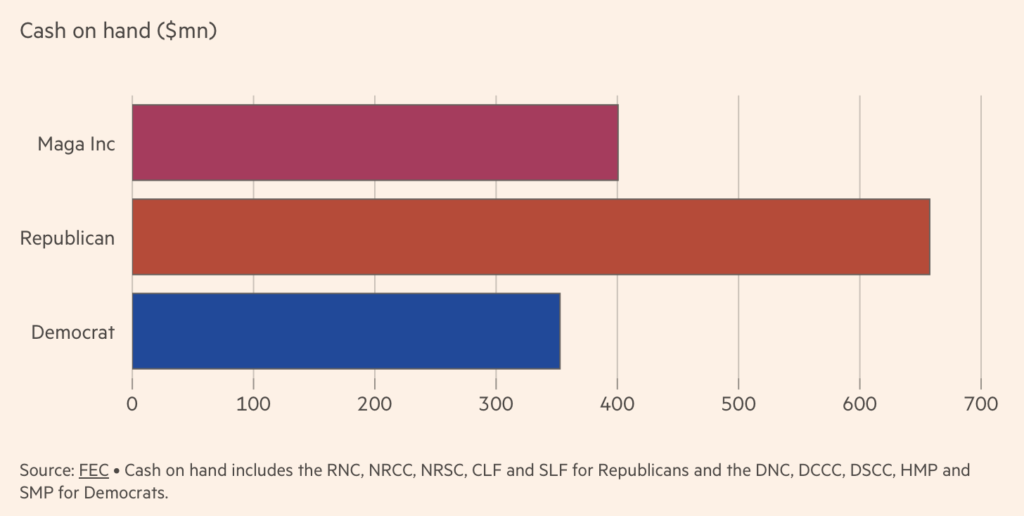 Lauren Fedor, James Politi, Ian Hodgson; et al; “US midterm elections 2026: The FT’s guide “; Financial Times at August 4, 2026
Moreover, the monies into Republican coffers appears otherwise to have increased since then with huge spending on ads:
“Republicans have outstripped Democrats’ ad spending, flooding the airwaves to defend their grip on Congress as Donald Trump’s declining popularity threatens to inflict deep losses on his party in the midterm elections.
Republican political committees have reserved roughly $1bn in advertising spots between September 1 and election day in early November, compared with about $730mn for Democrats, according to an FT analysis of AdImpact data.”
Ian Hodgson, James Politi and Alex Rogers; ” Republicans spend big to counter Donald Trump’s sinking popularity”; Financial Times 24 September 2026
2) Gerrymandering
This is the term for the redrawing of the electoral map for vote advantages to a particular party. As Wikipedia puts it – it is:
“The political manipulation of electoral district boundaries to advantage a party, group, or socioeconomic class within the constituency.
The manipulation may involve “cracking” (diluting the voting power of the opposing party’s supporters across many districts) or “packing” (concentrating the opposing party’s voting power in one district to reduce their voting power in other districts)…
Gerrymandering is a portmanteau (or “blend” – ed) of a salamander and Elbridge Gerry, Vice President of the United States … who, as governor of Massachusetts in 1812, signed a bill that created a partisanly-drawn district in the Boston area… similar to the shape of a salamander.”
Wikipedia accessed 2 October, 2026
This is very relevant today as the Supreme Court of the USA (SCOTUS) has struck down electoral reforms across the country. In particular, this has by design, enabled racist redrawing of electoral maps in the South, as in Louisiana. The map above in the title shows this in fact. Such re-drawing of the electoral maps, happened despite the 1965 “Voting Rights Act” – which took account of census-recorded demographic changes:
“Louisiana was a bastion of the slaveholding economy before the Civil War and Black people still make up 32 per cent of the state’s population. It had two majority-Black districts to represent them, out of the state’s total of six. Now it has just one… The boundary change came after a landmark April Supreme Court decision, Louisiana vs Callais, that ruled the 2024 districting) was an “unconstitutional racial gerrymander”…
The ruling gutted the 1965 Voting Rights Act, a central achievement of the civil rights era, which prohibited racial discrimination in voting. Supporters said the US constitution did not allow states to sort voters by race.
Electoral boundaries were traditionally redrawn every 10 years based on the census, but recently Republican- and Democratic-controlled states across the US have been remaking their electoral maps with increasing frequency in a tit-for-tat race to derive maximum partisan advantage. This year the process has been accelerated by President Donald Trump.
Republicans have been the main beneficiaries of the changes and are projected to net about four seats, according to the Cook Political Report.”
Guy Chazan; “Black voters rally against new electoral maps in the US South”: Financial Times 2 October 2026
Our own extremely low opinion of the SCOTUS is also to be found at – SCOTUS 2025: “Dickensian Ass” or just tied to Trump Executive Orders? May 29th, 2025;
3) Preventing mail in ballots, and intimidating fair counts at the post-office
A concerted attempt is already being made to prevent mail-in ballots. Such mail-in ballots have traditionally favoured Democratic voters.
The Trump administration’s push to use the Post Office as a block was left extremely late. Whether by design or ineptitude, it makes for added confusion and technical problems. This almost certainly will cause an unfair removal of ballots that fail to match arbitrary minor criteria.
So much so that the Federal judiciary ruled the Post Office to be stopped from implementing the changes. However – our good old Supreme Court (SCOTUS) – over-ruled the Federal Judge. But this is complicated by over-lapping edicts. As the Washington Post had it on September 14:
“Whether any of the Postal Service’s changes will take effect is unsettled. Trump signed an
executive order telling the Postal Service in March to review ballot envelopes and limit who could receive mail ballots. A federal judge blocked the order in June, but last month the Supreme Court cleared the way for it to temporarily go into effect when it found states had sued prematurely. After the Postal Service formally announced its new rules, the judge – hearing the challenge again – blocked those plans. The administration is now again asking the Supreme Court to give it the green light, and a decision is expected soon.”
Patrick Marley and Laura Meckler; “The new threat election officials fear: Trump’s federal government”; The Washington Post; September 13, 2026
But the saga continues as Jane Wise describes in World Socialist Web Site (WSWS) on September 30. The Post Office interference is only one issue, and SCOTUS has also intervened on a so-called “SAVE- citizenship verification” scheme:
“But the drive to place federal police and security agencies inside the election process continues. The White House earlier declined to categorically rule out ICE agents near polling locations, although DHS later said it was not planning immigration operations targeting polling sites…
The Supreme Court on September 25 also stayed a lower-court ruling that had blocked the administration’s expanded SAVE citizenship-verification database, allowing the system to remain in operation while the litigation continues.”
Jane Wise; “Nearly 1,000 private armed guards deployed in USPS plants, as Trump
continues offensive against mail-in balloting”; WSWS 30 September 2026
Systematic Alien Verification for Entitlements (SAVE) – is a pernicious means of enabling Trump to block voting rights. This was an old database created in 1986, and used for governments to “search an individual’s immigration status to determine their eligibility for certain federal programmes.” It was radically expanded by Trump 18 months ago and now includes Social Security information and more. The potential for blocking legitimate voters led to a legal challenge from the ‘League of Women Voters’ and the Electronic Privacy Information Center. The SCOTUS intervened to set aside the lower court ruling:
“The US Supreme Court will allow the Trump administration to deploy a federal immigration database for voter verification ahead of the congressional midterm elections in November.
The top US court on Friday lifted a federal judge’s ruling blocking the Department of Homeland Security from using a centralised national citizenship data system to check voter rolls, despite the court’s liberal justices dissenting.
The majority wrote that “the Federal Government has an obligation to respond to requests from state and local election officials seeking to verify the citizenship of voters”.
“The order below prevents the Federal Government from using the program it believes is best suited to the task,” the justices said.
The decision is a boon for President Donald Trump’s efforts to overhaul election rules ahead of the November vote and follows significant pushback from lower courts.”
Ella Lee; “US midterm elections 2026 – US Supreme Court lets Trump deploy voter database ahead of midterms”‘ Financial Times September 25, 2026
The sorry saga of the technicalities and challenges of verifying a mail-in ballot, at the Post Office was detailed in the Washington Post:
“Inside the U.S. Postal Service this summer, software engineers and policymakers scrambled to build something new: a verification system that, according to an anonymous whistleblower, could hold up an untold number of ballots.
By late August, members of the team realized the rushed schedule would leave them just four days to test the full system. When a member raised concerns about the technology’s quality and the lack of testing, a senior Postal Service official gave little guidance other than saying, “We cannot fail.” The official said everything must work perfectly and there was no other choice, according to the whistleblower disclosure that a federal official submitted to Congress two weeks
ago. As the deadline approached, multiple officials used profanity to describe the plan as a disaster, calling it a “s— show,” according to the disclosure. The Postal Service was scheduled to launchthe technology on Sept. 1, but so far it hasn’t been made available.
Under the Postal Service plans, election officials would upload lists of voters through an online portal. They would then submit their mail ballots to the post office, sometimes in batches of thousands at a time. If postal clerks found any mismatches — including for voters who moved or got married and changed their names — they would reject the entire batch, according to the whistleblower.
The Postal Service moved fast, but it did not compromise its work, Postmaster General David Steiner said in a statement. “We stand behind both the rigor of our process and the resulting system,” he said….
White House spokesperson Lauren Bis said Trump will keep fighting in court for what she called “common-sense measures to protect the security of mail-in ballots and ensure only Americans vote in American elections.”
Time is running out. Local officials in North Carolina and Wisconsin started mailing ballots to voters early this month under existing policies. Other jurisdictions are set to do the same soon.
“It’s the potential for complete chaos,” said Gerry Cohen, a Democrat on the Board of Elections for Wake County, North Carolina.
A recent incident in Leon County, Florida, brought a preview of the confusion Trump’s last-minute rules could bring. The county elections supervisor submitted his ballot envelope to the Postal Service in case the new rules go into effect — only to have the Postal Service reject it because the
return address was 0.014 inches too close to another line of text.
The Postal Service later relented and accepted the envelope, but Mark Earley, Leon’s elections supervisor said Friday that the incident was a taste of the nationwide “chaos and confusion” possible if the rules go into effect.”
Patrick Marley and Laura Meckler; “The new threat election officials fear: Trump’s federal government”; The Washington Post; September 13, 2026
Worryingly, armed private guards are to be thrown into the mix also… “to provide security“:
“nearly 1,000 armed private security guards are being deployed into United States Postal Service facilities in the final weeks before the November 3 midterm elections. Frank Albergo, president of the Postal Police Officers Association, told Raw Story that the union had been notified of about 39,000
work hours per week for 972 full-time armed guards across 54 USPS facilities, including 18 that
previously did not have them….
Brian Benson, a Postal Inspection Service spokesman in Denver, was unusually blunt. The guards, he said, are deployed “to provide security and act as a deterrent to criminals or employees who may wish to compromise the mailstream.”
Jane Wise; “Nearly 1,000 private armed guards deployed in USPS plants, as Trump
continues offensive against mail-in balloting”; WSWS 30 September 2026
Some rank-and-file trade union memberships have emerged to fight this:
“In its September 13 statement, “Postal Workers: Refuse to withhold ballots! Defend mail-in voting and the post office!” the USPS Workers Rank- and-File Committee called on postal workers to make clear in advance that they would not participate in any attempt to interfere with the delivery of ballots.”
Jane Wise; “Nearly 1,000 private armed guards deployed in USPS plants, as Trump
continues offensive against mail-in balloting”; WSWS 30 September 2026
But this is a minority representation of the post office workers whose main unions – as far as we know – have not made moves against the Trump mail offensive.
Finally, if all that fails for the “democratic” Republicans, then there is an overt threat of violence that has been made by leading Trumpites. Here for instance is the FBI Director – Kash Patel‘s response:
“Meanwhile, FBI Director Kash Patel has refused to rule out FBI agents being present at polling places on Election Day.”
Jane Wise; “Nearly 1,000 private armed guards deployed in USPS plants, as Trump
continues offensive against mail-in balloting”; WSWS 30 September 2026
The story is not over… Even worse, voter intimidation is being threatened.
4) Legitimate worries of overt violence at the polls
In 2022, court rulings had largely stopped armed people intimidating potential voters:
“The activists (men and women – ed) staking out the ballot drop boxes in suburban Phoenix wore body armor and face coverings. With guns at their sides, they recorded residents as they deposited their votes during the last midterm elections.
Voting-rights groups sued, and a federal judge put a stop to them, ruling they had to stay at least
250 feet away while armed to ensure voters were not intimidated.
Four years later … Pima County Attorney Laura Conover is treating the 2022 incident as a lesson on the importance of moving quickly this fall if anyone — including Immigration and Customs Enforcement (ICE) agents — tries to interfere with the election’s administration…”
Patrick Marley and Laura Meckler; “The new threat election officials fear: Trump’s federal government”; The Washington Post; September 13, 2026
Correspondingly, new Republican manoeuvres are openly being discussed this year. The government is directly planning to get involved – despite any court rulings:
“This year, Conover and other officials across the nation are preparing for the possibility that the most serious risks may come from President Donald Trump, his agencies and allies — including many now in power at the federal, state and local levels. Election officials are contemplating ideas that once sounded outlandish, such as troops seizing voting machines, the president dictating last-minute election rules or rogue officials blocking the certification of results.
For the last year and a half, Trump and his administration have disparaged long-standing voting practices, dismantled federal agencies that protect elections, impounded ballots from past elections, amplified conspiracy theories, threatened to prosecute election officials, tried to limit mail ballots and pushed to require proof of citizenship to register to vote.
Their efforts have touched on nearly every stage of voting and could affect control of Congress, as ”
Patrick Marley and Laura Meckler; “The new threat election officials fear: Trump’s federal government”; The Washington Post; September 13, 2026
Trump has already publicly announced the possibility of taking “emergency” “powers” if needed:
“Since Trump returned to office last year, his backers — including (Stephen K) Bannon and a lawyer close to Trump — have pressed the president to declare a national emergency that they say would unlock powers for him to rewrite election rules.
The idea resurfaced last month, when Trump appeared on a Real America’s Voice program hosted by Wayne Allyn Root. With election legislation stalled in the Senate, Root pressed Trump to declare an emergency that he said would allow him to limit mail ballots and require people to prove their citizenship to register to vote.
“Let me just say that stranger things have happened, okay?” Trump responded. “I’ll leave it at that.”Patrick Marley and Laura Meckler; “The new threat election officials fear: Trump’s federal government”; The Washington Post; September 13, 2026
Of course the ICE agency is an ideal force for Trump to deploy, and his minions come right out and say that. Here for instance are Stephen Bannon, and three Republican candidates for state governorship:
“Last month, former Trump adviser Stephen K. Bannon told the audience of his popular MAGA podcast that the president should send an “up-armored ICE presence at these polling booths.”
Critics might call that intimidation, Bannon said, and they would be right. “It’s an intimidation if you’re a foreigner,” he said. “It should be intimidating.”
In Maine, the Republican nominee for governor also said he’d ask the administration to send ICE agents to the polls. Georgia’s Republican gubernatorial nominee spoke favorably of using National Guard troops. The GOP candidate for governor in Michigan said he’s talked to the head of the FBI about agents having a presence in the state ahead of Election Day. All three states are key in determining which party will control Congress and, after 2028, the presidency.
Federal law makes it a felony to station troops or armed agents where an election is being held.
But the statute carves out an exception for repelling enemies of the United States, and Trump’s critics worry he could invoke that provision by arguing without evidence that noncitizens could try to vote.
Even a brief appearance by troops at the polls — and the inevitable online clips of them there — could dissuade voters from casting ballots, election officials and experts worry.
The Justice Department said it will beef up its plans to send election monitors to polls this fall. A top department official has said she would deploy as many as 1,000 of them, but hasn’t said where they will go.”
Patrick Marley and Laura Meckler; “The new threat election officials fear: Trump’s federal government”; The Washington Post; September 13, 2026
The left in general has actively discussed all these above scenarios. However, no unified response has been given, and as far as we can tell – nothing very widespread in terms of resistance on these aspects. We note the Democratic Party initiative on the “New Battlefield Project” (see “conclusions”). However, if this is run by the Democratic Party, then we are right to voice some reservations about its efficacy.
5. What Casus Belli – or Pretexts – can be found? Shades of the 1933 Reichstag Fire
Furthermore, what has not yet been adequately considered – is a possible “Reichstag Fire” event.
This was the infamous arson that was deliberately set by the Nazis in Germany on the eve of parliamentary elections. It came at a doubtful time for the National Socialist Party of Hitler. As the historian Alan Merson put it:
“… it looked increasingly doubtful whether the National Socialist Party would obtain a simple majority on its own or even with its Nationalist allies… It was at that point, on the evening of 27 February, that the whole situation was changed by the Reichstag Fire: The first of those sensational acts of stage violence… The Fire was a highly imaginative act of provocation which was used ot whip up a wave of panic and of anti-Communist hysteria…”
Alan Merson; “Communist Resistance in Nazi Germany”; London 1985; p.31
W.B.Bland takes up the story:
“On 27 February 1933 – a few days before elections were due – a fire severely damaged the building of the German Parliament in Berlin – the Reichstag:
“Smoke and flames were seen from the windows of the Reichstag, in the heart of Berlin … at about 9.15 p.m. The fire brigade was there by 9.25. The main hall was already a roaring cauldron…
A Dutch half-wit named Marinus Van der Lubbe was arrested when police found him in the burning ruins”.
(John Gunther: ‘Inside Europe’; London; 1936; p. 58, 59).
“The Reichstag building was set on fire in 20 places”.
(‘Keesing’s Contemporary Archives;’, Volume 1; p. 690).
Adolf Hitler, Hermann Goering and Joseph Goebbels were quick to arrive at the scene and attributed the fire to ‘arson by Communists’…
At once,
” orders were issued for the arrest of all Communist members of the Reichstag. The entire Socialist press throughout Prussia was immediately suppressed”.
(‘New York Times’, 17 September 1933, Section 9; p. 3).
On the day following the fire, 28 February 1933, Hitler exploited the situation by prevailing upon the aged President Hindenburg:
“to sign a decree ‘For the Protection of the People and the State’ suspending seven sections of the constitution which guaranteed individual and personal liberties.”
(William L.Shirer: ‘The Rise & Fall of the Third Reich’; London; 1971; p.243).
As ‘Times’ correspondent Douglas Reed wrote:
“When Germany awoke, a man’s home was no longer his castle. He could be seized by private individuals, could claim no protection from the police, could be indefinitely detained without preferment of charges; his property could be seized, his verbal and written communications overheard and perused, and his newspapers might no longer freely express their opinions”.
(Douglas Reed: ‘The Burning of the Reichstag’; London; 1934; p. 20).
and by election day, 5 March 1933,
“practically all of the leaders of the Communist Party, including … Ernst Thaelmann, the Party’s chief in Germany, were under arrest, either in prison or concentration camps)”.
(‘New York Times’, 17 September 1933, Section 9; p. 3).
….The International Committee for Aid to Victims of Nazi Fascists, headed by Albert Einstein, organised an international commission of jurists to investigate the Reichstag Fire. It met in London under the chairmanship of Dennis Pritt. Its report, published before the Reichstag Fire Trial began, concluded:
“That Van der Lubbe was not a member of the Communist Party.
That no connection whatever could be traced between the Communist Party and the burning of the Reichstag…”
(‘Keesing’s Contemporary Archives’, Volume 1; p. 956).
Indeed, the Commission concluded that the real arsonists were most likely to have been the leaders of the Nazi Party, who wished to find a pretext for the repression of rival parties – in particular the Communist Party. It found:
“… That the examination of all the possible means of ingress and egress to or from the Reichstag made it highly probable that the incendiaries made use of the subterranean passage leading from the Reichstag to the house of the President of the Reichstag (Goering – Ed.).
That the happening of such a fire at the period in question was of great advantage to the National Socialist Party…. for those reasons and others, grave grounds existed for suspecting that the Reichstag was set on fire by, or on behalf of, leading personalities of the National Socialist Party”.
(‘Keesing’s Contemporary Archives’, Volume 1; p. 956).
The Commission’s findings were abundantly confirmed in 1946 at the Nuremberg Tribunal. Hans Gisevius, an official in the Prussian Ministry of the Interior at the time, gave evidence:
“Hitler in a general way had expressed a wish for a large-scale propaganda campaign. Goebbels undertook to prepare the necessary proposals and it was Goebbels who first thought of setting the Reichstag on fire. Goebbels discussed this with the leader of the Berlin SA Brigade, Karl Ernst, and he suggested in detail how it should be done.
A certain chemical . . . was chosen. After spraying, it ignites after a certain time — hours of minutes. In order to get inside the Reichstag, one had to go through the corridor leading from the palace of the Reichstag President (Goering — Ed.) to the Reichstag itself. Ten reliable SA men were provided, and then Goering was informed of all details of the plan”.
(‘Trial of the Major War Criminals before the International Tribunal’, Volume 12; Nuremberg; 1947; p. 252).”
From W.B.Bland; “Georgi Dimitrov: Tool of Imperialism”;Compass 1994; at Alliance ML; Mar. 1994 No. 112;
Citing the Reichstag Fire will be taken as alarmist by some. However, to dismiss this history and such concerns would be foolish for Marxists. ( See “Of Men and Boogeymen: DeSantis, Trump, and the New Anti-Communist Movement”; MLRG.online April 30, 2025
Conclusions
Of course, in matters such as this, there are so many imponderables that nothing can be clearly 100% accurately predicted. We cannot be precise about what is coming; no one outside of Trump’s inner circle knows for sure. But perhaps we can be reasonably sure of the following:
(1) The next few weeks will see increasing attempts at provocations.
Just how extreme the various forms of potential provocation will become is quite uncertain.
As we write, we are aware of a renewed major troop and naval presence off the shores of Iran (see MLRG.online 5-6 October 2026). It is not impossible that such a heightened “crisis” will be today’s “Reichstag“. Moreover, pressure is being placed on Russia by new NATO provocations (see MLRG.online at 5 October 2026). This may also be used as a pretext. Obviously, many other unforeseen possibilities may unfold.
(2) There is a relative lack of preparedness in the class
In essence, if the worst were to happen – the USA working class is pretty unprepared in our estimation. It is true that the Democratic Party itself has started some moves:
“Democratic state parties announced Monday that they are launching an operation for the midterm elections they’re calling the “New Battlefield Project,” intended to recruit 10,000 volunteers to guard polling places in case armed federal officers show up.
Activists are planning mass protests if the Trump administration tries to interfere with voting or ballot counting. And legal scholars are distributing white papers advising judges what they should do if the government tries to seize ballots.”
Nicholas Riccardi & Matt Brown; “Democrats and activist groups plan to push back if Trump tries to interfere in midterm elections”; Associated Press; September 14
We also have had some other indications of the class moving to defend itself – for example the ‘No Kings Movement” (See “The Shaping up of the Anti-Trump, Anti-Fascist Front in the USA – The People of the USA are on the move” MLRG.online at 15 June, 2025 ).
But the “No Kings” movement is probably quite unprepared for the scale of ferocity that is possible. The spontaneous movements that arose on the streets of Minnesota against ICE – were more determined (See “Minnesota strides forward against ICE”; MLRG.online January 26, 2026). As we said there:
“The working class is in a war. The Minnesota Strike was the first indication of how to organise – it goes beyond the “No Kings” demonstrations of the very recent past of June 2025.”
Nonetheless, that was limited in scope, being restricted to one geographical area. Moreover, at that time there was the benefit of a relatively unrestrained press and media coverage. There are no guarantees of that situation holding.
3) There is no single center as a united party should be
Without an influential Marxist-Leninist party, the required tasks are even more difficult to manage.
Currently – Working class advocates in all USA localities and in all places of work, and places of study – must raise the alarm. They must inform their neighbours, co-workers, co-students – that preparations are needed. We are confident that despite the lack of a central organisation, the class will certainly resist any infringements that may arise. New channels of communication must be established in the brief interval we have before the mid-terms.
MLRG.online 3 October, 2026