Chile – Red Front Movement 1973 republication: “Chile: The ‘Peaceful’ Road to Counter-Revolution”
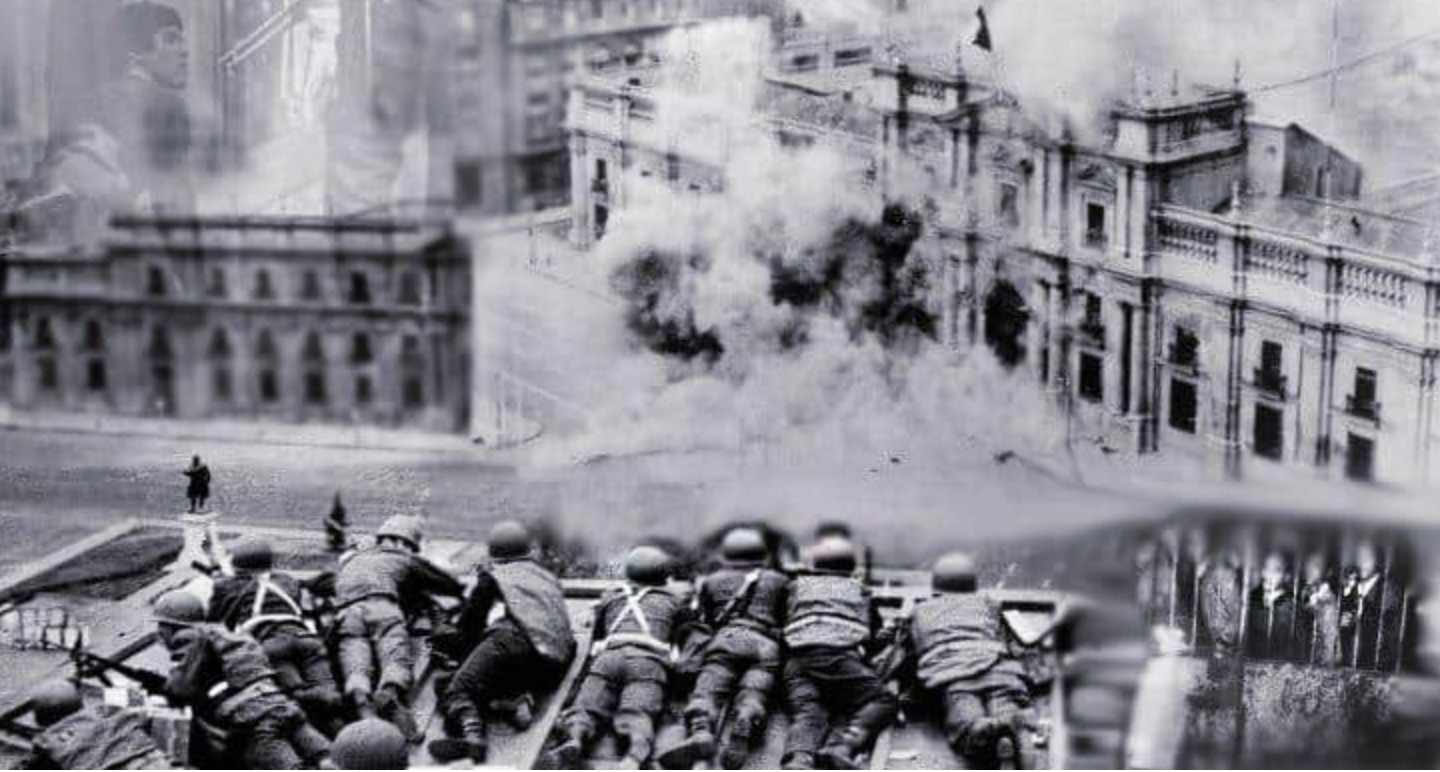
Frontspiece image; The Presidential Palace of Allende under bombardment and assault.
From https://trueactivist.com/wp-content/uploads/2016/09/golpechile.jpg
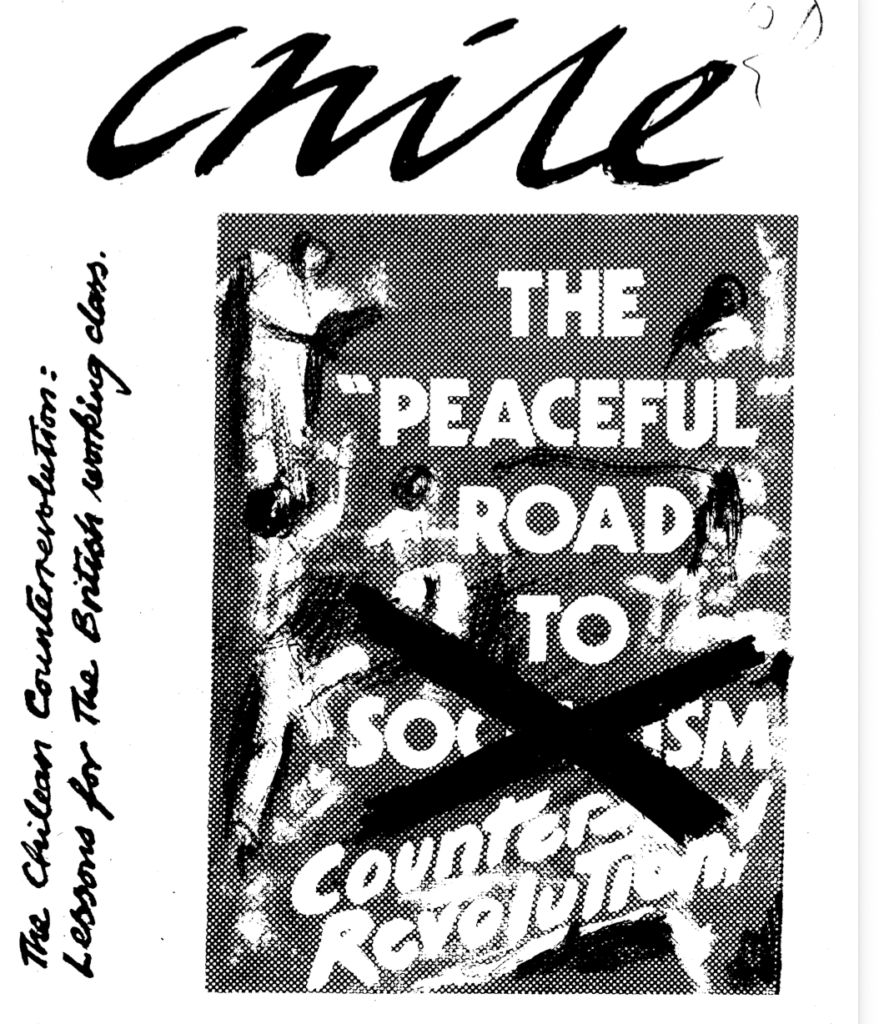
Below is the original cover of Red Front pamphlet on the Chilean Coup
2026 12 September Introduction by MLRG.online in re-publication
Key words:
Parliamentary road to socialism; Salvador Allende; Chile; military coup
Republication by MLRG.online Preface
On September 11th of 1973, 11 September 1973, military officers led by General Augusto Pinochet launched a coup, killing the elected President Salvador Allende and put Chile completely into the hands of foreign capital – overwhelmingly that of the USA. It is appropriate, therefore this 11 September to remember the lessons of the Chilean coup.
In essence, these lessons revolve around the futility of trusting the “peaceful parliamentary road” to socialism. As we face fascism in several countries, these lessons are pivotal even today. We will bring the situation in Chile up to date from the days of Pinochet at a later juncture. But the hold of USA imperialism on the South American continent remains predominant.
Even as it is today threatened by Chinese penetration – the USA uses the Monroe Doctrine – now the Donald Trump Doctrine – with viciousness. We saw its most refined and targeted brutal enactment in Venezuela recently. (See “The Capture of Nicolaus Maduro and the current strategy of USA imperialism” January 4, 2026).
In an updated article regarding Maduro’s capture, on January 26th, 2026 – we noted the USA has always been adept in finding its stooges. In Venezuela, it was Delcey Rodríguez – who most recently has enabled the takeover for USA ends of oil reserves. As we said:
“Venezuela was the first most blatant expression of the newly brushed-off “Monroe Doctrine”. But instead of a USA marine landing of forces in the country, a sophisticated snatch operation was launched. The capture by USA forces of Maduro and his wife was assisted by high officials in ex-President Maduro’s own cabinet…
This inner cabinet betrayal of their co-capitalist Maduro, was led by – Delcey Rodriguez . As we have now become aware, this “accommodation: with the USA was in long negotiation since August 2025 – as reported by the “Miami Herald”:
“A group of senior Venezuelan government officials, led by Vice President Delcy Rodríguez and her brother Jorge, who is president of the National Assembly, have quietly promoted a series of initiatives in recent months aimed at presenting themselves to Washington as a “more acceptable” alternative to Nicolás Maduro’s regime, …
to persuade sectors of the U.S. government that a “Madurismo without Maduro” could enable a peaceful transition in Venezuela—preserving political stability without dismantling the ruling apparatus…”
Miami Herald; October 16, 2025″ at: MLRG.online 26 January 2026
The story of struggle against the USA and Chinese imperialist exploitations of South America continues. We return in this article to the USA sponsorship of Pinochet’s coup against Allende.
Note on the publication history of this article
First published by the Red Front of the Marxist-Leninist Organisation of Britain in 1973. Unsigned, however, it bears the marks of W.B.Bland’s writing. Quoted by Alliance ML, and Marxist-Leninist Currents, it was republished in full first at EROL approximately 10 years ago (at EROL). We have chosen to republish it because of the anniversary of the coup in Chile, which established a corporate state in an open fascism.
MLRG.online 12 September, 2026
Original Introduction by ‘Red Front’
This pamphlet represents a departure from the previous practice of “RED FRONT” in as much as, in the past, the journal, in keeping with the aims of the “Red Front Movement,” has been concerned with the progress of the class struggle in Britain rather than in distant lands such as Chile.
We have taken the step of publishing this pamphlet on the development of the tragic counter-revolution in Chile, however, precisely because the lessons of the Chilean events are of the very greatest significance for the British working class movement.
Although a semi-colonial country within the sphere of influence of US imperialism, Chile has had a history of “parliamentary democracy” not greatly dissimilar from that of ‘Britain”. In particular, the theory of “peaceful parliamentary transition to socialism” put forward by the revisionist Chilean Communist Party was basically the same as that put forward by the Communist Party of Great Britain since 1951.
True, the Chilean Communist Party had greater influence among the workers of Chile than does the CPGB among the workers of Britain, and it was a partner in the Allende coalition government. But it must be borne in mind that the rise of national liberation movements in the colonial periphery of the imperialist world and the steadily rising tempo of contradictions between the rival imperialist powers is in the process of transferring to the industrially developed heartlands of imperialism violent class contradictions similar in intensity, though different in form, to those experienced in Chile.
Should the political situation in Britain make it desirable – the ruling class of monopoly capitalists may well deem it expedient to accord to the Communist Party a similar role in the parliamentary facade that conceals the state apparatus of force to that which has been occupied for so many years by the increasingly discredited Labour Party
If the streets of London and Manchester are not to run, like those of Santiago and Valparaiso with the blood of the workers, if the British workers are to take the only road that leads to socialism – the road of preparing for socialism, the revolution under the leadership of a steeled and disciplined General Staff – then the dangerous illusion of “peaceful, parliamentary transition to socialism, which leaves the workers disarmed before the unrestrained violence of the ruling class, must be thoroughly exposed.
Until the working class in Britain, as elsewhere, has built up its General Staff in the shape of a Marxist-Leninist Party equipped with a correct scientific programme of revolutionary advance, no significant social progress can be made. The “peaceful, parliamentary road to socialism” is inevitably, as it was in Chile, the road to counter-revolutionary white terror.
Those are the principal lessons which all politically conscious workers must draw from the tragic events in Chile.
It is the aim of this pamphlet, which is based on a recent discussion meeting held under the auspices of the “Red Front Movement” , to press these lessons home.
CHILE: THE “PEACEFUL” ROAD TO COUNTER-REVOLUTION
When the Popular Unity Front government headed by Salvador Allende took office in Chile in 1970, with the participation of the Chilean Communist Party, this South American country became for the revisionist leaders of the communist Parties “the great experiment“, which would demonstrate the practicability of the programme of “peaceful, parliamentary transition to socialism”.
Marxist-Leninists use the term “revisionist” to describe a politician who, while continuing to claim his loyalty to Marxism-Leninism, has repudiated the scientific Marxist-Leninist analysis of the state as essentially the machinery of force of the ruling class to present its parliamentary facade as a genuinely democratic machine which the working people can make use of in order to transform the existing society constitutionally into a socialist society.
The revisionist theory of “peaceful, parliamentary transition to socialism” is not merely an illusion; it is a dangerous illusion since it has the effect of disarming the working class and leaving it helpless before the violence, constitutional or unconstitutional, of the ruling class.
Soon after the Allende government came to office, the organ of the Marxist-Leninist Organisation of Britain published an analysis of the situation in Chile under the title of this pamphlet. It read in part:
“Although presented by the revisionist Communist Parties throughout the world as a shining example of ‘the peaceful road to socialism’, the Allende government
is in no way a socialist government of the working class: it represents the interests of the Chilean national bourgeoisie – which seeks to throw off the dominant influence of U.S, imperialism in order that it may itself exploit the working people of that country.
Even from a constitutional point of view, the Chilean Popular Unity Front government is in a precarious position; it holds only a minority of seats in the Chamber of Deputies…
But the impossibility of it attempting to take ‘the road to socialism’ even, if it wished to, is demonstrated by the fact that the armed forces remain in the control of the most reactionary, pro-imperialist section of’ the ruling class and have the power to stage a military coup to destroy the whole parliamentary system.
Of course, this last factor does not make it impossible for the Chilean working people to establish socialism. But they can do so only by creating their own revolutionary armed force to disrupt and destroy the apparatus of coercion which faces them. :
But to urge this course would involve repudiation of ‘the peaceful road to socialism preached by international revisionism. As Luis Carvolan, General Secretary of the Chilean Communist Party puts it:
“To hold that armed confrontation is inevitable implies the immediate formation of an armed people’s militia. In the present situation that would be equivalent to a mark of defiance to the army (‘Morning Star’, December 29h, 1970′, p. 4)
One can but agree with Corvolan, however, when he says
‘What has happened in Chile is not irreversible.” (ibid.; p. 4)
In fact, the ‘peaceful road to socialism’ in Chile, as elsewhere, is simply the road to counter-revolution!”
(RED FRONT, July/August, 1971; p.19).
That events in Chile should have followed the course foreseen by Marxist-Leninists more than two years ago is due to no mystical second sight, but to elementary Marxist-Leninist analysis. Given the existing state structure in Chile and the domination of the working class by the pernicious ideology of “peaceful, constitutional advance”, this course of events was bound to proceed to its bloody climax with all the inevitability of a Greek tragedy.
Semi-Colonial Chile
The state of Chile lies along the south-west coast of South America, with an area three times the
size of Britain. Colonised from the 16th Century on from Spain, the majority of its 9 million people are of mixed Spanish and Amerindian descent.
Chile is predominantly a country of primary production – of agricultural and pastoral farming and forestry. Following the discovery of great mineral wealth at the beginning of the 20th. century, however, Chile is today a principal mining country of South America; it is among the world’s largest producers of copper and nitrates, and also has rich deposits of coal, iron and oil. Until two years ago, the mining industry was predominantly owned by United States capital, and in 1970 US investment in Chile stood at some $700 million.
Industrial production is mostly small-scale, concerned with the production of food and clothing for local consumption.
The country’s economy is thus distorted along colonial-type lines – based on primary production from agriculture, forestry, and mining for export, with industrial production held back.
Although Chile obtained its nominal “independence” in 1818, it was for many years before 1970 in fact a semi-colony of United States imperialism, ruled by a class alliance of landlords and comprador bourgeoisie dependent upon the US imperialists.
In 1925 a new constitution was adopted along the lines of that of the United States, based on separation of powers, a two-house Congress consisting of a Chamber of Deputies and an upper Senate, and a Presidential form of government. Within this democratic facade, the ruling class sought to develop a two-party system of the kind which served the ruling classes
in the United States and Britain, based on the openly right-wing and pro-imperialist National Party and the Christian Democratic Party, standing officially for
“moderate social reform”.
In September 1964, the candidate of the Christian Democratic Party, Eduardo Frei, was elected President for a six-year term.
The 1970 Election
During Frei’s presidency, the movement for genuine national independence rose to new heights. In the absence of a Marxist-Leninist party of the working class standing f0r the organisation or armed national liberation struggle under the leadership of the working class, the leadership of this movement could only be taken by the national bourgeoisie – by that section of the Chilean capitalist class the economic development of which was being held back by the country’s
dependence upon imperialism.
By 1969 this movement had taken organisational shape by the formation of the Popular Unity Front (a coalition of parties headed by the revisionist Communist Party and the “left” social-democratic Socialist Party, both standing formally for “peaceful, parliamentary transition to socialism”.
The new coalition adopted a programme designed to serve the interests of the national bourgeoisie, the principal points of which were the nationalisation of the banks and of large foreign-owned companies.
The leaders of the Christian Democratic Party sought to arrest the swing of working-class and petty bourgeois support towards the new coalition by donning a left man: it adopted a demagogic election programme calling also for “nationalisation of the banks and of large foreign-owned companies!
The Presidential election took place on September 4th, 1970, the electorate had a choice of three
candidates:
Jorge Alessandri, standing as an “independent” with the support of the National Party;
Redomina Tomic, representing the Christian Democratic Party under the slogan of “the Christian Left”; and
Salvador Allende, leader of the Socialist Party, representing the Popular Unity Front.
Progressive electors who had rejected the openly right-wing pro-imperialist candidate – thus had to judge which of the second two candidates was most likely to put the same (at least on paper) programme into effect, on the basis of their experience of six years
of Christian Democratic government. The greater number inclined to the candidate of the Popular Unity Front.
The result of the Presidential election was as follows:
Allende: 1.1 million votes (36.3%)
Alessandri: 1.0 million votes (34.9%)
Tomic: 0.7 million votes (27.8%).
Since no candidate had received an absolute majority of votes, the constitution required that the election of the President be carried out by Congress, elected the previous year. Here the Popular Unity Front held only 70 seats against 130 held by its political opponents.
The election of Allende was by no means assured, despite the fact that he had obtained the highest number of votes on September 4th.
I.T.T. Steps In
The United States imperialists had no doubts that the Popular Unity Front, while it carried no danger of socialism; was quite genuine in its election pledges, to bring about the nationalisation of foreign-owned- which in Chile means mainly US-owned companies.
Already (as became known later on as a result of the intra-imperialist struggles in the United States manifested in “Watergate”), Harold Geneen, President of the huge US “multinational” monopoly International Telephone and Telegraph Corporation (ITT), had in July, before the election, offered to William Broe, head of the Latin American division of the Central Intelligence Agency, “a substantial sum” if the CIA would intervene to bring about the election of Alessandri).
After the election, a further series of high-level meetings on Chile took place involving Geneen, John McCone (former director of the CIA, now a director of ITT but retaining the post of “consultant” to the CIA), Richard Helms (the current director of the CIA), and Henry Kissinger (Special Advisor on Foreign Affairs t0 President Nixon). At these meetings, Geneen offered the CIA a million dollars if it would undertake a programme of bribery, economic disruption, and other actions leading up to a military coup that would either prevent Allende’s installation as President of Chile or remove him afterwards. Nixon himself sent a confidential memorandum to the US Ambassador in Santiago, Edward Knorry, instructing him to use “whatever means lie in your power” to assist such an operation.
The ITT’s lobbying –for the moment – failed. The majority of the US imperialists, and of their dependent ruling class in Chile itself, felt that it would be tactically preferable to alienate a significant number of its supporters from a Popular Unity Front government in office before taking steps to remove him – either constitutionally by impeachment if that proved practicable, or unconstitutionally by a military coup if it did not.
On October 24th, 1970, therefore, the Chilean Congress elected Salvador Allende as President of Chile.
The deputies and senators of the Christian Democratic Party, retaining for the moment their “left” mask, voted for him. Allende then proceeded to form a government drawn from the various parties making up the Popular Unity Front.
Progressive Measures
The government began immediately to put into effect its programme of bringing the key resources of the country under the control of the national bourgeoisie. Among the more important enterprises nationalised, between December 1970 and September 1971 were the banks – both Chilean and foreign-owned, the iron ore mines (owned by the US-Bethlehem Steel Corporation), and the copper mines (owned by the US Anaconda Company and the US Kennecott Corporation). In April 1971, state control was established over foreign exchange
transactions.
The government also accelerated the activities of the “Land Reform Corporation – set up by the previous administration but barely active. The corporation was instructed to take over 227 large estates totalling more than 1 million hectares for resale to peasants.
Confrontation with the USA
The Allende government came into open confrontation with the US imperialists not (at least publicly) over the right of a government to nationalise a US-owned enterprise, which the US government was prepared, if grudgingly, to concede, but over the question of compensation for such nationalisation.
Until the nationalisation of the copper mines in July 1971, the government had paid full compensation to the former owners. But in the case of the US copper companies, Allende declared that with an investment of $80 million they had reaped profits of $1,566 million, so that in calculating compensation, allowances should be made for “excessive profits.”
In August 1971, US State Department spokesman, Robert Mcloskey, said that no further US loans would be made to Chile until “satisfactory assurances” had been given on compensation.
In October 1971, Chilean Controller-General Hector Humores announced that the excessive profits made by the US copper companies had been calculated at $378 million, so that no compensation would be paid to the former owners. Two days later, US Secretary of State William Rogers said that this action “could jeopardise the flow of private funds and erode the base of support for assistance” not only in relation to Chile but also in relation to “other developing countries”. On October 22nd. Rogers told a meeting of executives of companies
affected by Chilean nationalisation measures that the US government intended to invoke the Hickonloopor Amendment to cut off all US “aid” to Chile unless the decision not to pay compensation to the copper companies was revoked.
The Alienation of the Poor Peasantry
Despite the acceleration of the activities of the Land Reform Corporation already mentioned, the process of “redistribution” of land to the peasants was held up by the hostility of the courts, while finance companies were unwilling to lend the purchase price to the peasants most in need of land. The result was that the land reform provided benefit only to the richer peasants, and the poor peasants began to take over some of the large estates for themselves. By January 1971 they
had taken over nearly 300 estates as “squatters”.
Such “squatting” was in conflict with the concepts of the revisionist Communists and the social-democrats concerning legal and “constitutional” advance. And when the fulminations of the Communist and Socialist Ministers about “illegal acts” and the need to maintain “law and order’ were ignored, in September 1971 the government ordered police and troops to evict the squatters and arrest their leaders.
The Allende government had succeeded in following “the constitutional road” at the cost of alienating an essential base of its support, the poor peasantry.
The Alienation of the Urban Petty Bourgeoisie
One of the main social problems in Chile, under the Allende government was that of inflation. This was caused primarily by the government increasing the money supply in order to meet its “legal obligations” in respect of the $500 million a year needed to meet charges on the enormous foreign debt inherited from previous administrations and the huge sums agreed as
compensation for nationalisation.
A further problem was a catastrophic fall in agricultural production, mainly as a result of economic sabotage by landlords and rich peasants. Wheat production, for example, fell from 1.4 million tons in 1971 to 0.7 million tons in 1972, so that more than half the country’s wheat had to be imported. The cost of food imports rose from $180 million in 1970 to $4oo million in 1971. This not only aggravated the government’s foreign exchange problems, but led to food shortages and black-marketeering.
The position of the working class in this situation was at first assisted to some extent by wage-
scales which were linked to the official cost-of-living index. But for the urban petty bourgeoisie the situation became increasingly difficult and alienated from the government many among this class who had previously given it their support.
The alienation of the petty bourgeoisie from the government was assisted by the activities of some organisations presenting themselves as to the “left” of the Popular Unity Front, notably the Movement of Revolutionary Left (MIR),‘ and the Organised Vanguard of the People (VOP), which split from the MIR in 1969. Under anarchist leadership, the main activities of those organisations lay in the fields of individual terrorism. They were, for example, responsible for the assassination in October 1970 of General René Schneider, Commander-in-Chief of the army, and for the
assassination in June 1971 of right-wing Christian Democratic Party leader, Edmundo Perez.
The right-wing opponents of the government, of course, presented those acts of terrorism as induced by the “left-wing” atmosphere engendered by the government.
The Opening of the Right-Wing Offensive
By July 1971 the leaders of the Christian Democratic Party decided that the alienation of the urban and rural petty bourgeoisie from the government had proceeded far enough for it to be opportune for them to throw off their “left” mask. At a by-election in this month the party threw its weight against the PUF and in support of the candidate of the National Party. A minority section of the Christian Democratic Party broke away in protest at this action to form the Christian Left Movement (including 7 of the 53 CDP deputies), which maintained support for the government.
In January 1972 two further by-elections were held, and the Popular Unity Front candidates were defeated in both.
The right-wing now felt itself in a strong enough position to open an offensive against the government. In February 1972 the combined opposition in Congress passed a Bill through a joint session of Congress amending the Constitution, retrospectively to October 197,1, to provide that no enterprise could be partially or wholly nationalised without a specific Act passed by both Houses of Congress.
On April 6th. President Allende vetoed the constitutional amendment. This led to the resignation of two Ministers who were members of a · small party within the government coalition, the Party of the Radical Left (PIR).
In May, the Presidential veto was over-ruled by Congress.
The ITT Revelations.
In March 1972 the position of the Allende government was strengthened somewhat by the publication in the United States of the leaked confidential papers relating to the ITT-CIA conspiracy of 1970, already referred to. These revelations aroused such strong public indignation in Chile that in the atmosphere which followed, President Allende secured the passage
through Congress in May of a Bill nationalising the Chilean Telephone Company (in which ITT held a 70% interest).
The 1972 “Employers Strike”
In October 1972 the right-wing offensive took a new form in a nation-wide lock-out by the Lorry Owners’ Federation, euphemistically referred to in the right-wing press as a “strike”. This paralysed the transport of goods, and greatly aggravated the already serious food shortage.
By mid-October the Lorry Owners’ Federation lock-out was extended by short “strikes” of petty
bourgeois professionals, shopkeepers, peasants, etc.
The lorry owners demanded as the main condition for ending their lock-out the bringing into the government of representatives of the armed forces. On October 31st. the government surrendered and resigned. Allende then appointed a new cabinet in which the leaders of the three armed services were given Ministerial portfolios:
General Carlos Prats, Commander- in-Chief of the army, as Minister of the Interior;
Rear-Admiral Ismael Huerta as Minister of Public Works and Transport; and:
Air Force General Claudio Sepúlveda as Minister of Mines.
On November 6th. the lorry owner ended their lock-out after negotiations with General Prats had
conceded 90% of their demands.
The Foreign Policy of the Allende Government
Faced with the prospect of the ending of the “aid” from the United States on which previous administrations had depended and with the huge demands of foreign exchange by its acceptance of foreign debt charges and the need for increased food imports, the Allende government
sought from the outset to relieve the situation by fostering trade with and obtaining “aid” from countries in which their fellow revisionists held office.
The government thus established diplomatic relations with Cuba, the Democratic People’s Republic of Korea and the Democratic Republic of Vietnam, as well as with socialist Albania and other countries.
It signed trade agreements with the Soviet Union, China, Cuba and many of the countries of Eastern Europe, as well as with the DPRK and the DRV.
In May/Juno 1971 Foreign Minister Medina Almeyda made a tour of Eastern European capitals and returned with credits totalling $100 million. But the principal sources of “aid'” were China ($181 million between January and June 1972) and the Soviet Union ($675 million between January and December 1972).
In January 1973 President Allende returned from a tour in which he visited Cuba, Peru, Mexico, Algeria, and the Soviet Union, and addressed the General Assembly of the United Nations in New York.
The 1973 Congressional Election
Despite the events of 1972, despite the alienation from the government of the urban and rural petty bourgeoisie, the Allende government retained the support of most of the Chilean workers. Further, the Commander-in-Chief of the army, General Prats – holding the post second in importance to that of President Allende, that of Minister of the Interior – made it clear that so long as he was in command of the army, it would take no part in any unconstitutional action.
It was in this situation that on March 4th, 1973, elections were held for all 150 seats in the
Chamber of Deputies and for half the 50 seats in the Senate.
The right-wing opposition parties with which the Christian Democratic Party was now solidly aligned formed themselves into the Federation of Democratic Parties, hoping that they would now win the two-thirds majority in the new Congress required under the Constitution to impeach President Allende.
In fact, the association of the Christian Democratic Party (CDP) with the openly right-wing, pro-imperialist National Party caused many former supporters of the CDP among the working class to transfer their support to the Popular Unity Front. The latter increased its share of the poll from 36.3% of the Presidential election 1n 1970 to 43.4%.
However, the Federation of Democratic Parties received 54.7% of the poll, and the seats in the
Congress were distributed after the election as follows:
Seats Chamber of Deputies
1969 1973
Popular Unity Front: 54 63
Federation of
Democratic Parties: 93 87
Other parties 3 –
Seats for the Senate
1969 1973
Popular Unity Front: 16 19
Federation of
Democratic Parties: 32 30
Other parties: 2 –
Thus, despite the reduction in its share of the poll, and in the number of its members in both Houses of Congress, the combined opposition retained its majority in both Houses but failed to obtain the two-thirds majority it had hoped for.
The possibility of removing President Allende constitutionally was postponed for several years.
The Alienation of the Working Class
Fortified by the increased vote received by the Popular Unity Front in the congressional elections, when a new government was formed on March 27th. it was a purely civilian government.
Meanwhile, inflation was proceeding at an accelerated rate – according to official figures, prices rose by 85.6% in the first six months of 1973 compared with 27.5% in the first six months of 1972. The sliding wage rates now no longer kept pace with the rapidly rising cost of living. Workers were becoming worse off under the “socialist” government than they had been under the former Christian Democratic government.
In November 1971, the “revolutionary” Prime Minister of Cuba, Fidel Castro, on an official visit to Chile, had told Chilean workers of the need for “restraint” in wage claims. Now the workers could afford “restraint” no longer. They put in wage claims which exceeded the government’s “anti-inflationary” levels, and when these claims were rejected, they went on strike. And in many
cases those strikes took the now traditional – but “unconstitutional – form of sit-in strikes.
On March 31st., 1973, the now Minister of the Interior, Gerardo Espinoza, warned workers that the government would in future “strictly apply the law in regard to the maintenance of “order” against those who “illegally occupied” property.
But the strike movement grew, with the biggest strike at the El Teniente copper mine lasting from April to July. Since this was now state-owned, Communist and Socialist Ministers began to denounce the strikers as “seditious elements.” When President Allende met a delegation of striking copper miners, a joint statement of the Central Committees of the Communist and Socialist Parties condemned his action and called for “a firm attitude towards those who practice sedition”.
The Allende government had now alienated not only the petty bourgeoisie, but even the militant workers.
The New Right-Wing Offensive
In May, 1973, the fascist organisation “Fatherland and Freedom” issued a call for ”direct action” to overthrow the government. The administration then banned meetings and demonstrations of the organisation, which went underground and began to engage in terrorism.
In June both Houses of Congress voted unanimously (government deputies and senators having walked out of’ the Chamber) to suspend Sergio Bitar (Minister of Mines), Luis Figueros (Minister of Labour) and Orlando Milius (Minister of’ Economic Affairs), thus constitutionally depriving them of office. In the same month, the Supreme Court decided to prosecute Anibal Palma (Secretary- General to the government) for having “unconstitutionally” issued a temporary closure notice on a radio station which had broadcast the fascist call for “direct action”.
On June 24th, President Allende warned against characterising the armed forces as “reactionary-contending that they were “a dynamic factor in Chile’s development”. Five days later, on June 29th, members of a tank regiment led by Colonel Roberto Souper and his cousin Carlos Enrique (a leading member of the fascist organisation Fatherland and Freedom)
surrounded and shelled the Presidential palace, but were dispersed after a three-hour battle by army units under the orders of Commander- in-Chief General Carlos Prats.
On June 30th. President Allende asked Congress to grant him emergency powers to deal with the
threat of counter-revolution. The Chamber of Deputies rejected his request by 81 votes to 52, the Senate by 23 votes to 11.
On July 3rd. the Intervención General (a body functioning as a constitutional court on the legality
of government decisions) ruled that a simple majority in Congress was sufficient to veto any Presidential decree.
On July 17th. the Lorry Owners’ Federation renewed its lock-out, taking 75% of Chile’s lorries off the road and all but paralysing the transport of goods. This soon caused even graver food shortages and seriously disrupted production. When the government attempted to requisition lorries for essential services, the owners immobilised them by removing essential parts and demanded the dismissal of the Special Commissioner appointed by the government to direct the requisitioning. His resignation was announced on August 15th.
Meanwhile, on July 25th. President Allende appealed to the leaders of the Christian Democratic Party, to hold a “dialogue” with the government in accordance with their Presidential Programme, as the “last chance to avoid civil war”. After a few days of talks, the Christian Democrats demanded that representatives of the armed forces should be brought back into the government.
On July 27th Captain Aturo Araya, aide-de-camp to President Allende, was shot dead by terrorists in his home.
On August 8th, President Allende bowed to the demands of the leaders of the Christian Democratic Party. A “Government of National Security” was formed, including:
Admiral Raul Montero as Minister of Finance;
General Carlos Prats as Minister of Defence;
General Jose Maria as Minister of Lands and Settlement; and
Air Force General Cesar Ruiz as Minister of Transport and Public Works.
The Chamber of Deputies then adopted a resolution condemning the government for “systematic violation of the constitution”, thus providing the pretext for the army to overthrow the government in the name of “defending the constitution”.
The Military Coup
On August 23rd., 1973 the General Staff’ of the Army resolved that General Carlos Prats should resign as Minister of Defence – and also as Commander-in-Chief of the army – on the grounds that the ”honour of the army had been compromised by his participation in a government which was acting in violation of the Constitution”. He was replaced as C-in-C by General Augusto Pinochet.
On September 9th, two days before the military coup, Nathaniel Davis, the US Ambassador to Chile, flew back to Santiago after a hurried visit to Washington.
On September 10th, the Pentagon sent a signal to the US warships lying off Chile’s main port of Valparaiso, telling them to expect a military coup within 24 hours.
On September 11th, the army, on the orders of the new Commander-in-Chief, General Augusto Pinochet, seized power in a military coup, and Allende was murdered in the burned-out shell of his Presidential Palace.
On September 13th. the us State Department admitted that the US administration had known of the impending coup 48 hours before it took place, but had given no warning to the Chilean government.
On September 14th. General Augusto Pinochet, commander-in-chief of the army, was proclaimed “President” of Chile.
Meanwhile, the new military dictatorship had banned all political parties which had supported the Allende government; together with the trade unions; had dissolved Congress; had arrested thousands of active supporters of the former government who had not been butchered out of hand; had begun the burning of “Marxist books”; and had announced the preparation
of a new Constitution based on fascist corporations.
“The Great Experiment”
The “Great Experiment” in Chile has ended, as it was bound to end in white terror imposed virtually without resistance from the working people as a result of their ideological and organisational disarmament by the theory of “peaceful, parliamentary transition to socialism”.
On April 19th, 1972, President Allende told a mass rally of workers in Santiago:
“In this country there will be no civil war… The discipline of the armed forces and respect for the Constitution will crush any attempt at sedition”.
This statement, which expresses the core of the criminal deception of the Chilean workers by their revisionist and social-democratic leaders, is the epitaph of the Allende government.
That the revisionist leaders of the Communist Parties put forward the absurd theory of “peaceful transition to socialism – not as an accidental mistake, but as a conscious policy of betrayal of the working class is shown by their refusal to draw the elementary conclusions from the catastrophic failure of “the great experiment” in Chile.
But honest, politically conscious workers must draw those conclusions: that socialism can be achieved only when the working class in each country has organised itself into a revolutionary army under the leadership of a disciplined Marxist-Leninist General Staff which will smash the state apparatus of force of the ruling class in a socialist revolution.
Republication MLRG.online 12 September, 2026
Other relevant articles on South America published more recently:
October 2021; on Peru and Death of Chairman Gonzalo
April 2023; On Pablo Neruda