Dmitry Shostakovich and Politics of Music 1917-1945: Part Two
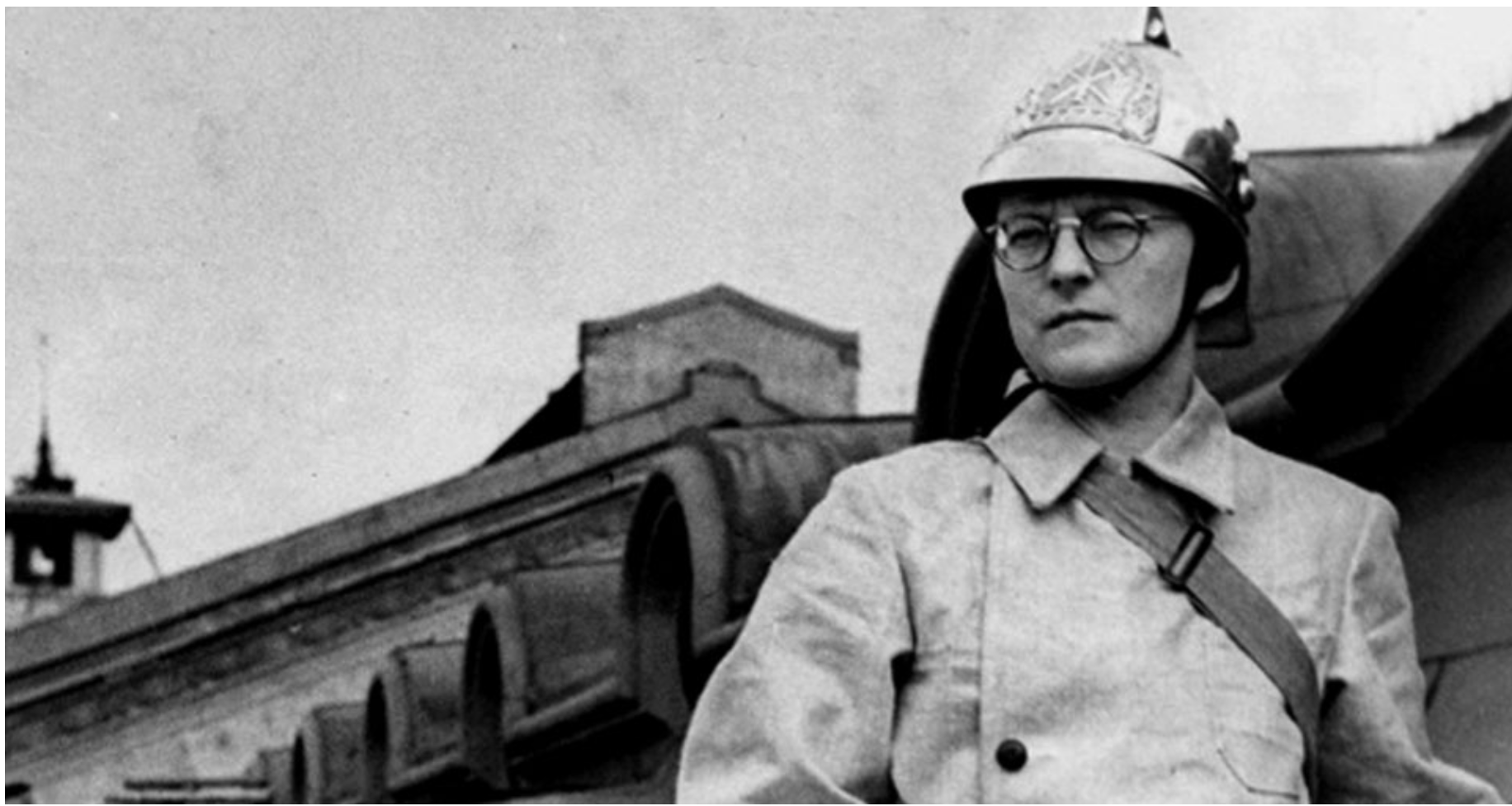
Image showing Dmitry Shostakovich as a fireman during the Siege of Leningrad during World War 2; from “Peoples’ World”; Jenny Farrell; “The Siege of Leningrad: Shostakovich and the airbrushing of history “ June 26, 2019
PART TWO: ” Blaring Trumpets, Banging Drums: Dmitry Shostakovich and Politics of Music 1917-1945″
8 October2026;
Table of Contents
General Introduction
Overview of the three parts of “Blaring Trumpets, Banging Drums: Shostakovich”
Introduction to Part Two
Beethoven’s creation of new musical forms
Shostakovich’s early career
Lenin and partiinost
What were the main contradictions in the standard history of the Soviet composers and the Zhdanovischina ?
9. Music of Shostakovich leading up to the 1934 opera “Lady Macbeth of Mtsensk”
Early Family Life
Early successes, Symphony number 1
The Second (“October”) and Third Symphony
Film music and the Song of the ‘Counterplan’
Musical Influences on Shostakovich
Clashes with RAPM
Shostakovich’s first opera “The Nose”
- ‘The Lady Macbeth of Mtensk’ Opera of 1936 – the first major public controversy over Shostakovich’s music
The Premier and the first two years following
The Pravda response to Shostakovich’s opera
Who wrote and coordinated the Pravda attacks?
More on the Pravda critique
Following the Pravda article
What we know directly of the reactions of Stalin and Maxsim Gorky
The musical charges in the Pravda article – “Formalism, dissonance, epigonism, crude naturalism”
i) the charge of formalism
(ii) The charge of epigonism
(iii) The charge of dissonance
(iv) Pessimism and optimism in music
(v) The charge of coarse naturalism
(vi) The charge of borrowing from jazz – and ‘low art’
(vii) The charge of ignoring folk song
What might explain Stalin’s dislike of the opera?
- The 5th Symphony as Shostakovich’s Response to the Pravda articles
Withdrawal of Shostakovich’s 4th Symphony
The State and the artist’s response
Initial Soviet and Western Audiences’ reactions to the 5th Symphony
How did the 5th get the sub-title ‘a Soviet artist’s creative response to just criticism’ ?
- Wartime ShostakovichConclusion to Part Two
Editorial Notes:
All references for websites consulted were accurate between April to 19 August 2026.
-Dates (Year of birth -Year of death) are provided for most of the main players, if available in public.
_______________________________________________________________________
PART TWO:
Blaring Trumpets, Banging Drums: Dmitry Shostakovich and Politics of Music 1917-1945″
Part One of this work published from September 24, 2025, at MLRG.online
“Tradition is not the worship of ashes. It is the preservation of fire.”
Gustav Mahler (1860-1911).
Presumed to be from either Thomas More (1478-1535); or perhaps derived from Jean Jaurès (1859-1914):
“c’est nous qui sommes les vrais héritiers du foyer des aïeux; nous en avons pris la flamme, vous n’en avez gardé que la cendre.”
Jean Jaurès ; cited at https://classicalmusicguide.com/viewtopic.php?t=38761
“Every composer, even the greatest, proceeds from something existing, from one or several related things. Some of the innovators achieve such forms as hardly contain traces of the origin.
Others, the great synthesizers, develop all previously existing things into a whole never before conceived.”
Béla Bartók ((1881-1945) ) Inaugural lecture at the Hungarian Academy of Sciences,
“Liszt-problëmk “(“Liszt-Problems”): From Bartok’s “Der Einfluss der Volksmusik auf die heutige Kunstmusik, Melos, Berlin 1920; Cited by F. Bónis; “Quotations in Bartók’s Music. A Contribution to Bartók’s Psychology of Composition”; Studia Musicologica Academiae Scientiarum Hungaricae, 1963, T. 5; Report of the Second International Musicological Conference, Budapest, 1961 (1963), pp. 355-382
Overview of the three parts of this work
Dmitry Shostakovich and his works are an important lens through which to examine several areas less studied by Marxist-Leninists. These areas are: the relation of the arts to society; the relation of the working class and its party to the arts; and the hidden struggle against this creation of socialism. They explain some of the major fault lines of the USSR from 1917-1953.
Part One of this work discussed sources on Dmitry Shostakovich. It noted the domination of the alleged “Testimony” published by Solomon Volkov (1944- ). Volkov claimed it consisted of novel material including probing interviews with Shostakovich. Many respected musicologists and scholars noted several fabrications in this work, including Laurel Fay and Elizabeth Wilson. It is now widely accepted that alleged statements of Shostakovich were fabricated. In his musical interpretations, Volkov simply “hears” anti-Soviet tropes in each bar of Shostakovich.
We also reviewed some principles of aesthetics fundamental to socialist artists, and some revisionist deviations. This ranged over the history of USSR art movements and ultra-left revisionisms. A key attack on ultra-left distortions was launched by V.I.Lenin. Anatoly Lunarcharsky (1875–1933) had supported ultra-leftism in the arts including Proletkult and (Russian Association of Proletarian Writers RAPP). The equivalent in music was Russian Association of Proletarian Musicians (RAPM).
Part One ended at the dismantling of RAPM and the creation of the All Russian Union of Soviet Composers in 1932. This was precipitated by the dangerous splitting tendencies of RAPM. One historian of Russian music, Richard Tarushkin (1945- 2022) commented:
“The reining-in of the proletarian cultural organisations became necessary in order to regain the good will of an alienated intelligentsia… Sergei Prokofiev (1891-1953)… had been frightened off by the RAPM, which all but wrecked his second tour in 1929.”
Richard Taruskin; “Public lies and unspeakable truth interpreting Shostakovich’s Fifth Symphony”; in Fanning D Ed; “Shostakovich Studies”; Cambridge; 1995; p.20
Replacing RAPM the Party created “The Union of Soviet Composers”:
“The Union of Soviet Composers … encompassed the entire country…The Union of Soviet Composers… was established by a decree of the Central Committee of the Soviet Communist Party, promulgated on 23 April 1932, entitled ‘On the Restructuring [perestroyka] of Literary and Artistic Organisations.”
Richard Taruskin; “Public lies and unspeakable..”; Ibid; p.18
The Ultra-leftists of the RAPM leaders were therefore dis-enfranchised in 1932:
“The Union not only funded the various composers, but it introduced a form of “peer-review” – with a ‘Bolshevik self-criticism’ or internal ‘pokaz’t’. Shostakovich was a member of this Union… The Moscow Union was Chaired by an appointee of the CPSU(B) who initially was the editor of Sovetskaya Muzika – Nikolai Ivanovich Chelyapov… ”
Tarushkin ibid; cited Part One
As we argued in Part One, the ex-leaders of RAPM found their way back into positions of influence and power. This was to be shown in both 1936 and 1948.
Part Two
This current piece, focuses more directly on Shostakovich and his music. It moves from early struggles to the Second World War. It also traverses the first major controversy in 1936 over his opera “Lady Macbeth of Mtsensk”.
Part Three covers the post-war period up to Stalin’s death. Therefore also the major debate over the arts in the “Zdhanovischina”, as led by as A.A.Zhdanov (1896-1948). During World War 2, the Soviets led the Allied military victory of the anti-fascist war. By 1945 the USSR had huge losses in population and was economically devastated. The former Allies reneged on prior commitments for a peaceful coexistence as Winston Churchill (1874-1965) announced in his Fulton speech. So began the Marshall Plan and the associated “Cold War”.
In response a major re-evaluation took place of political, cultural and scientific directions in the USSR. This was the Zhdanovschina. In the musical world the term refers to Zhdanov’s speech on the Union of Composers in 1948.
Convention views the Zhadanovischina as a narrow-minded and doctrinaire assault on science, the arts and music. Supposedly this was dictated by Stalin aimed at a brutal obliteration of independent thought. In this view the USSR state dictated to artists and scientists what they should do.
I will argue many of the events of the Zhdanovschina and the ‘music war’ were part of the Politburo battles against Stalin. In this ultra-left views emerged which distorted the Leninist views on the Arts.
Standard histories now show that older standard ‘simplistic’ views are incorrect. The musicologist Patrick Zuk (1968- ) disputes the assertions of older authors like Boris Schwartz (1906- 1983) of a simple black and white narrative. That narrative was one of “coercion, capitulation, and artistic compromise” in the music of the period:
“The careers and creative achievements of most Soviet composers – including major figures, such as Nikolai Myaskovsky (1881-1950), Aram Khachaturian (1903-1978), and Vissarion Shebalin (1902-1963),… (in) Laurel Fay’s biography of Shostakovich and Simon Morrison’s work on Sergei Prokofiev have acted as valuable correctives in demonstrating that the life and work of these composers defy analysis in terms of simplistic schemata of coercion, capitulation, and artistic compromise.”
Patrick Zuk; “Nikolay Myaskovsky and the ‘‘Regimentation’’ of Soviet Composition: A Reassessment”; The Journal of Musicology, Vol. 31, Issue 3, pp. 354–393.
Zuk notes a complexity that cannot be reduced to the simplicity favoured by most current accounts.
Obviously my view on the work and political development of Shostakovich, differs from current standard Marxist or Marxist-Leninist views of the aesthetics debates of both 1936 and 1948.
I saw the opera “Lady Macbeth” staged in the 2025 Leipzig Shostakovich Festival directed by Anders Niilson (1978-). The famous Pravda title – “Muddle Instead of Music” expresses the common Marxist-Leninist view.
I do not agree with this label, nor do I accept that “Lady Macbeth” is a decadent opera. However I also disagree with the standard bourgeois view that the state has “no right” to set the tone on socialist aesthetics. I argue that to explain the events around Shostakovich’ music, we should account for a battle between Marxist-Leninists and revisionists within the USSR.
Introduction to Part Two
Some Marxists castigate the views on art of V.I.Lenin (1870–1924), Josef Stalin ( 1924-1953) and Andrei Aleksandrovich Zhdanov (1896-1948). Often they try to distinguish Lenin from the others.
These Marxists overlook that Karl Radek (1885-1939) and Nikolai Bukharin (1888-1938) participated in the 1934 Writers Congress meeting. This meeting set some standards for Socialist Realism. The speeches by Radek and Bukharin were quite consistent with those of Zhdanov and Maksim Gorky (1868-1936) in August 1934. (Gorky, Radek, Bukharin, Zhdanov and others “Soviet Writers’ Congress 1934” at Marxist Internet Archive 1934). For example, Radek:
“The task confronting proletarian literature is to reflect the protest of the masses, their aspiration to struggle, and to show them that way out from war which the Soviet proletariat found when it overthrew the power of the bourgeoisie and established a proletarian republic.”
Karl Radek; “Contemporary World Literature and the Tasks of Proletarian Art“; in Soviet Writers Congress 1934’ ; p.63-4; In ‘The Debate on Socialist Realism and Modernism in the Soviet Union”; London 1977; from H. G. Scott, in English: ed., Problems of Soviet Literature: Reports and Speeches at the First Soviet Writers’ Congress (Moscow: Co-operative Publishing Society, 1935) is at Internet Archive p. 85
Or Bukharin:
“It is interesting to trace the evolution of formalism in art as the evolution of decadence in bourgeois art… Formalism in literary theory, as we have seen, is closely linked up with formalism in art itself. Its most glaring error is that it attempts, on principle, to tear art from its vital social context. It creates the illusion, or the fiction, of an entirely independent “series” of phenomena in art…
Demyan Bedny is a genuine proletarian poet… one can speak here of a “union of the working class with the peasantry under the hegemony of the proletariat.” This is the intellectual axis, the dominant key, the regulating principle or “social meaning” of his poetry. But his wide influence among the masses is the result of the whole diverse complexity of component elements in his work. He takes as his material the “latest news.” The forms he employs are those suited to the level of the millions…
In comparison with so-called literary language, it is, if you wish, primitive…
we must make one critical remark, which, in its turn, will probably call forth a critical remark from my friend, Demyan Bedny. It seems to us that the poet is not now taking into account all the tremendous changes, the incredible growth of culture, its growing complexity, its richer content, the heightened tone, the changed dimensions of all our social life. He takes new subjects, but everything else remains almost as of old. For this reason he is becoming out-of-date..”
N.I. Bukharin: Poetry, Poetics and the Problems of Poetry in the U.S.S.R.; 3. The Turning Point; in Soviet Writers Congress 1934’’; Ibid; Marxist Internet Archive
Shostakovich was a shooting star in early Soviet music. He graduated from the Petrograd (formerly St.Petersburg) Conservatory and immediately began to display his skills in various musical experiments. At its most professional his early works dazzled international musicians, for example in his First Symphony.
Most biographies of Shostakovich, whether socialist or anti-socialist, acknowledge that he held progressive and Bolshevik views – at least early in his career. To express these he wished to develop a fitting, new musical form. So he experimented as in his early years he had to simply learn how to mould a new content and form. The young Shostakovich, infusing socialist content into a classical form required a series of musical experiments. Unsurprisingly his new musical forms were not immediately understood.
While Shostakovich’s life and works were unique, many other artists in other times have faced similar struggles in expressing new musical thoughts. One apt example is Ludwig van Beethoven (1770-1827). Beethoven was as anxious as Shostakovich to place in music a sense of social justice. Yet Beethoven’s audience did not understand new forms. We know he complained to visitors in 1822 of a lack of recognition for his music:
“Beethoven had become critical of the Viennese reception of his works. He told the visiting Johann Friedrich Rochlitz in 1822:
“You will hear nothing of me here… Fidelio? They cannot give it, nor do they want to listen to it. The symphonies? They have no time for them. My concertos? Everyone grinds out only the stuff he himself has made. The solo pieces? They went out of fashion long ago, and here fashion is everything. At the most, Schuppanzigh occasionally digs up a quartet.”
Thayer, Alexander Wheelock; “Thayer’s Life of Beethoven. Vol. 2. Princeton: Princeton University Press; p.801; cited at Wheelock A
For Beethoven, music was no decorative side-dish to accompany life – it was a vital force:
“For most of his life Beethoven sought to encapsulate in music his faith in humanity as a transcendent value and his belief that good will ultimately triumph over evil. More than anything else he wrote, ‘Fidelio”… ”
Matthew Boyden, “Opera – The Rough Guide”; London 1997; p.111
‘Fidelio’ is a story of an unjustly imprisoned man (Florestan) condemned to be executed, and imprisoned with other victimised opponents of a tyranny. He is saved by his brave wife (Leonore). Beethoven took 10 years to re-write Fidelio, before it was finally accepted into performance. Beethoven’s first version of it in 1804 was ‘Leonore’, which was very poorly received:
“Beethoven’s unconventional music was not well received – one member of the audience summarized the opera as a “miserable mixture of low manner and romantic situations”. Shocked by the hostility, Beethoven completely revised the score, cutting one of the acts and replacing the overture; but the new version was only slightly less unpopular. Eight years later, Beethoven returned to his opera and after another extensive revision he produced a final two act Fidelio. Performed in the Kärntner Theatre in Vienna, this Fiedelio was a success, perhaps because in the words of Joseph August Röckel (who sang Florestan) it was played to a “select audience”.
Boyden, “Opera…” Ibid 1997; pp.113.
This success finally came to an opera with a clear narrative line, celebrating struggle against tyranny. But its history obviously did not bode well for Beethoven’s ‘experimental’ works. For example, audiences did not understand his Grosse Fuge final of the B-flat quartet string quartet (Here the Danish String Quartet at Beethoven Quartet).
After the premier of the string quartet in 1826, this exchange took place:
“After performing the premiere, Karl Holz, who was also the composer’s secretary and confidant, told Beethoven about the encores for the second and fourth movements. Beethoven growled, “And why didn’t they encore the Fugue? That alone should have been repeated! Cattle! Asses!”
Solomon, Maynard “Beethoven”; 1980 Granada; p.447; cited at: Wikipedia Grosse Fuge
Beethoven’s Grosse Fuge was an explicit homage to J.S.Bach (1685-1750), but it took an unusual form:
“The subject also bears a striking resemblance to Johann Sebastian Bach’s musical spelling of his surname. The four notes of the Bach motif are spelled in reverse by the final pitches of Beethoven’s subject: B-C-A-B♭. As Beethoven was in the thick of composing the string quartet and wrestling with its finale, Friedrich Kuhlau visited him on 2 September. Kuhlau jotted the Bach motif in Beethoven’s conversation book. In reply, Beethoven drunkenly scribbled out a canon using the motif. He sent Kuhlau a finished three-part canon on the motif with some lyrics that punned on the Danish composer’s name. Bach’s cryptogram appears in several Beethoven works from this period, including sketches for an overture based on the motif.”
cited at: Wikipedia Grosse Fuge
Today the Fugue is considered by some as visionary:
“Enough time has passed that we can say now, with certainty, that the aesthetic ideals and impulses behind the Grosse Fuge were almost precisely a century ahead of their time. We live in an age that has learned to value the quartets of Bela Bartok (1881-1945), Arnold Schoenberg (1874-1951), and Elliott Carter (1908-2012) and that accepts the creations of far lesser composers. It is absurd to claim today that the Grosse Fuge does not belong as the finale of Beethoven’s B-flat quartet…”
Kahn, Robert S.. Beethoven and the Grosse Fuge : Music, Meaning, and Beethoven’s Most Difficult Work, Bloomsbury Publishing USA, 2010; p. 6
As Beethoven himself told his “trouser button-ed” Gerhard von Breuning, a young man he trusted, “It will please them some day”:
“Gerhard… (was) the son of Beethoven’s childhood friend Stephan van Breuning, who attended the composer so faithfully at the end of his life that Beethoven called the 13-year-old boy his “trouser button.” Breuning wrote that he visited Beethoven on his deathbed, found him sleeping, and so sat down and browsed through the latest conversation book, “to see who had been there in the meantime and what they had talked about.” One thing I found there was: “The quartet of yours that Schuppanzigh played yesterday didn’t go over very well.” When he woke up a little later, I held that bit up in front of him, asking what he had to say about that. “It will please them some day” was the laconic answer he gave me; and to that he added fully and firmly aware that he wrote as he thought fit, and was not led astray by the judgments of his contemporaries: “I know; I am an artist.”
Kahn, Robert S.. Beethoven and the Grosse Fuge…” , Ibid 2010; p. 8
Several elements in Beethoven’s story were to reappear in the case of Shostakovich.
Shostakovich’s early career
From early on Shostakovich achieved considerable critical success, as in for example his Symphony No.1. This was his graduation piece. Both Western conductors and perceptive artists inside the USSR appreciated his work. That included the Russian cellist Msitslav Rostropovich (1927-2007)
”The First Symphony is a brilliant call to freedom and the future… At that time he wrote it, he was full of hope… there was (also) the more general hope… inspired by the revolution… “
Mstislav Rostropovich; cited by Simon Behrman; “Shostakovich. Socialism, Stalin and Symphonies”; London 2010; p. 43;
In the new Soviet era, new musical forms were needed. But transcending old forms to fit a new socialist content, was not easy and could only be realised in experiments. But these were not immediately tolerated. Shostakovich’s first serious such attempts yielded Symphony No. 2 and 3. They were not completely convincing, falling at times into mechanical propaganda. This led to his became increasingly attacked by ultra-leftists of the RAPM.
The famous 1936 controversy revealed very sharply divided views – extreme praise to extreme denunciation. A damning critique of his work appeared in “Pravda”. It was often alleged that Stalin wrote it. – but musicologists now hold that the article was not written by Stalin, but by David Zaslavsky (1880-1965). It is probable that the article was commissioned by the ex-RAPM leader Platon Kerzhentsev (1881-1940), who we met in Part One. It led directly to Shostakovich’s own “self-criticism” in the celebrated 5th Symphony.
I believe the opera “Lady Macbeth of Mtensk” is a strong indictment of women’s suffering from patriarchs and oppression under Tsarism. It mocks the bourgeois hypocrisy of family relations as much as it skewers the corrupt Tsarist police. For me musically it supports those themes. The attack on the opera was consistent with the long term hatred for Shostakovich held by the ex-RAPM members. It is true that Stalin was not a friend of the opera in question. But he did not want Shostakovich to be suppressed.
Shostakovich met incomprehension by adapting his musical approach. By the end of the Second World War, Shostakovich had largely emerged intact from the critiques. In the process his musical skills had heightened. His musicianship was now such that he could more reliably touch the people while avoiding simplistic propaganda.
He then achieved some of the highest art in the pinnacles of socialist music. That is in the 7th symphony. While the 7th achieved critical success, the 8th puzzled many – and the 9th led to even more puzzlement. Once again detractors from the old RAPM attacked him. Many ex-RAPM leadership were now embedded in strong positions.
Obviously Shostakovich’s career raises the question of the relationship of the state to the arts. For Marxists the opinions of Lenin (1870–1924) remain fundamental, what were they? Lenin mainly uses the term “literature” mainly regarding the party press, but he also references broader literature.
He espoused “partiinost” positions in the Arts – a word he coined to mean “party spirit”. Lenin was prompted to this word, by the failed 1905 revolution. Lenin argued it was time to break the habit of using an “Aesopian” language in the Party Literature that had developed under Tsarist autocracy:
“The new conditions for Social-Democratic work in Russia which have arisen since the October revolution have brought the question of party literature to the fore. The distinction between the illegal and the legal press, that melancholy heritage of the epoch of feudal, autocratic Russia, is beginning to disappear. It is not yet dead, by a long way…
An accursed period of Aesopian language, literary bondage, slavish speech, and ideological serfdom!…
the half-way revolution compels all of us to set to work at once organising the whole thing on new lines. Today literature, even that published “legally”, can be nine-tenths party literature. It must become party literature in contradistinction to bourgeois customs, to the profit-making, commercialised bourgeois press, to bourgeois literary careerism and individualism, “aristocratic anarchism” and drive for profit, the socialist proletariat must put forward the principle of party literature, must develop this principle and put it into practice as fully and completely as possible.”
“What is this principle of party literature? It is not simply that, for the socialist proletariat, literature cannot be a means of enriching individuals or groups: it cannot, in fact, be an individual undertaking, independent of the common cause of the proletariat. Down with non-partisan writers! Down with literary supermen! Literature must become part of the common cause of the proletariat, “a cog and a screw” of one single great Social-Democratic mechanism set in motion by the entire politically-conscious vanguard of the entire working class. Literature must become a component of organised, planned and integrated Social-Democratic Party work.”
Vladimir Ilyich Lenin; “Party Organisation and Party Literature 1905”: . ‘Works” Moscow 1965, Volume 10, p.44-49.
However less often noted, Lenin’s language and intent, was immediately tempered within the very same article itself. For he goes on to praise literary” personal initiative, individual inclination, thought and fantasy, form and content”. Lenin then states that “literature is least of all subject to·mechanical adjustment or levelling, to the rule of the majority over the minority”:
“All comparisons are lame,” says a German proverb. So is my comparison of literature with a cog, of a living movement with a mechanism. And I daresay there will ever be hysterical intellectuals to raise a howl about such a comparison, which degrades, deadens, “bureaucratises” the free battle of ideas, freedom of criticism, freedom of literary creation, etc., etc. Such outcries, in point of fact, would be nothing more than an expression of bourgeois-intellectual individualism. There is no question that literature is least of all subject to· mechanical adjustment or levelling, to the rule of the majority over the minority. There is no question, either, that in this field greater scope must undoubtedly be allowed for personal initiative, individual inclination, thought and fantasy,, form and content. All this is undeniable; but all this simply shows that the literary side of the proletarian party cause cannot be mechanically identified with its other sides. This, however, does not in the least refute the proposition, alien and strange to the bourgeoisie and bourgeois democracy, that literature must by all means and necessarily become an element of Social-Democratic Party work.”
Vladimir Ilyich Lenin; “Party Organisation and Party Literature 1905”: . ‘Works” Moscow 1965, Volume 10, p.44-49.
Actually Maksim Gorky expressed much the same sentiment in his 1934 speech extolling the formation of the ‘Writers Union”:
“The Writers’ Union is not being created merely for the purpose of bodily uniting all artists of the pen, but so that professional unification may enable them to comprehend their corporate strength, to define with all possible clarity their varied tendencies, creative activity, guiding principles, and harmoniously to merge all aims in that unity which is guiding all the creative working energies of the country.
The idea, of course, is not to restrict individual creation, but to furnish it with the widest means of continued powerful development.”
Gorky M; “Soviet Literature”; in “Soviet Writers Congress 1934’ ; p.63-4; In ‘The Debate on Socialist Realism and Modernism in the Soviet Union”; London 1977; from H. G. Scott, in English: ed., Problems of Soviet Literature: Reports and Speeches at the First Soviet Writers’ Congress (Moscow: Co-operative Publishing Society, 1935) is at Internet Archive
That same 1934 Congress where Socialist Realism was introduced, added to partiinost two other notions to distinguish this new art form. Namely ‘narodnost’ and ‘indeynost’:
“the literal definition of socialist realism when it was formally announced at the 1934 Writers’ Congress. Both here and in later key writings, socialist realism was described as a literary method with three underpinning criteria: narodnost’ (having the quality of being ‘‘for or of the People’’), ideynost’ (possessing ideological content), and partiinost’ (possessing party-mindedness).”
Pauline Fairclough; ”Was Soviet Music Middlebrow? Shostakovich’s Fifth Symphony, Socialist Realism, and the Mass Listener in the 1930s“; The Journal of Musicology, Vol. 35, Issue 3, pp. 336–367; citing “Soviet Writers Congress 1934’ – ‘The Debate on Socialist Realism and Modernism in the Soviet Union”; London 1977; from H. G. Scott, in English: ed., Problems of Soviet Literature: Reports and Speeches at the First Soviet Writers’ Congress (Moscow: Co-operative Publishing Society, 1935) is at Internet Archive
I argue that at times the approach taken to the arts in the USSR, even after the 1930 dissolution of the ultra-left RAPM went beyond what either Lenin or Gorky argued for. Ultra-leftist applications did indeed “stop personal initiative, individual inclination, thought and fantasy, form and content.” The approach – at times – descended into a “mechanical adjustment”.
I also argue that the concept of state guidance in the arts was correct, but it was also especially prone to a particular form of ultra-left revisionist distortion. In 1936, Stalin appeared to have recognised this, and there is some evidence that this was corrected:
“‘Well, we’ll put this case aside. Don’t let’s trouble the musicians”. With these words to the Leningrad composer Yurii Shaporin (1887–1966), uttered in 1935, Stalin dismissed the case of the operetta composer Nikolai Strel’nikov (1888–1939), who had recently been arrested.”
Caroline Brooke; Soviet Musicians and the Great Terror; Europe-Asia Studies,
Vol. 54, No. 3, 2002, 397–413; citing M. Rutman, ‘Melodiya dlya dvoikh’, Sankt-Peterburgski e Vedomosti, 7 November 1998, p. 10.
Only such an understanding of ultra-left deviations in arts and music policies can resolve several apparent contradictions in the music history. Part Two examines contradictions in regards to interpetations of Shostakovich’s life over the “Lady Macbeth” episode, namely:
(1) Following attacks on Shostakovich by the more narrowly “partiinost” representatives, why did Shostakovich continue to obtain support from important proponents of partiinost?
For example, when the attack on Lady Macbeth started, no less than Maxim Gorky defended Shostakovich as we pointed out previously. However this episode is discussed more fully below.
Part Three will address two further contradictions:
(2) Why were the 1948 attacks on “formalism” in music, and charges against Shostakovich, Sergei Sergeyevich Prokofiev (1891–1953) and Aram Khatachurian (1903–1978) not sustained?
Even in the controversial meeting “Conference of Musicians at the CC of the All-Union Communist Party” in Moscow January 1948, several composers and music critics spoke sharply to disagree with the charges against Shostakovich.
Moreover despite Shostakovich’s music being banned after the meeting – Stalin ‘un-banned’ Shostakovich’s music following a telephone conversation between him and Shostakovich.
(3) What did Stalin mean when he started a linguistics debate to halt ‘dictatorships in science’ ? This was a struggle in several fields – not just in linguistics (Bland W.B. “Struggle Against Revisionism in the Field of Linguistics”: London 1997; at MIA; and Kumar H; “Lysenko, Views of Nature and society – reductionist biology as a Khruschevite revisionist Weapon”; Alliance ML; Toronto 1993).
The “halt to dictatorships in science” is relevant also in biology (Hari Kumar; “Engels, Reductionism and Epigenetics – The Lysenko Debate;” Marxism and Sciences” 2022 Vol 1(1); 157–191. Finally academic scholars such as Ethan Pollock (“Stalin and the Soviet Science Wars Pollock, Princeton USA; 2006) show some of that history in other fields including physics and philosophy.
If these contradictions are all put together and resolved, a far more nuanced picture than is usual emerges.
This nuance seems difficult for many Marxist-Leninists trapped in a reductionism. They believe that to reject Trotskyism means to accept all that happened during Stalin’s lifetime as correct. This leads to historical simplification. Equally Trotsky followers cannot resolve these contradictions satisfactorily.
This affects the views of the ’Socialist Workers Party of the UK, expressed by Simon Behrman (“Shostakovich, Socialism, Stalin and Symphonies”; London nd; ISBN 9781905192663). A talk given by Peter Kwasiborski also falls into simplifications and factual errors to render propaganda (of “The Communist”; for the Revolutionary Communist Party (RCP) UK; at RCP 6 January 2026 entitled : “Shostakovich: The musical voice of the Russian Revolution.)
This article focuses far more on the politics than technical musical aspects. More guidance about technical aspects in Shostakovich’s music can be found in Christopher Norris; “Shostakovich – The Man and his Music”:London 1982. This contains many unique insights, including progressive composers such as Alan Bush (1900-1995).
I only discuss some of Shostakovich’s compositions. In particular little attention is given to the voluminous chamber music including Shostakovich’s works for piano, cello, and the Pushkin Romances.
The first appearance of new names is underlined accompanied if possible with birth and death dates. While reasonably consistent about transliteration, some cited authors use alternative versions of names.
Let us now enter the direct world of Shostakovich and his works.
9. Music of Shostakovich leading up to the 1934 opera “Lady Macbeth of Mtsensk”
Early Family Life
Dmitry’s father, Dmitrya was an amateur singer; his mother Sonya was a pianist graduate of the St.Petersburg Conservatory. She started teaching “Mitya” when he was eight in 1915. While this is relatively old for a prodigy, she was startled:
“his mother sat her eight-year-old son down at the piano for his first lesson. Within minutes, she recognized that she was dealing with a youngster of precocious musical ability, possessing perfect pitch and a phenomenal memory. He demanded from the outset to be given a piece to play, so his mother placed the piano arrangement of an andante from a Haydn symphony in front of him. After asking her to explain the meaning of the various accidentals, he proceeded to play the andante slowly, but with perfect accuracy.”
Laura Fay, “Shostakovich: A Life“; Oxford 2000;.p. 9
By 1918 he was giving school concerts of Beethoven’s Sonata No. 5 (C Minor). At the time revolutionary Petrograd was in a revolutionary ferment in 1905-1917. Obviously this affected his family life. But already his parents were well known as progressives who welcomed Bolshevism:
“The young Shostakovich’s grasp of the import, and his conscious embrace, of the revolutionary milestones of 1917 were almost certainly exaggerated both by his Soviet biographers and, when expedient, by himself…” But:
“His paternal grandfather had been a political exile… in 1907 one of his maternal aunts had married a member of the Social Revolutionary Party in prison as he awaited trial for the murder of a policeman during a police raid… Another aunt joined the Social-Democratic (Bolshevik) Party in the wake of the bloody events of 1905 and for a time duplicated illicit literature while living on the Shostakovich premises… Dmitriy and Sofya Shostakovich welcomed guests with a broad spectrum of beliefs – political, religious. . . (the family took part in) the solemn funeral procession (in) Petrograd, on 23 March (5 April) 1917, to lay 184 victims of the February Revolution to rest in a common grave… among the nearly 1 million mourners… singing the revolutionary funeral march, “You Fell a Victim.” When they returned home that evening, young Mitya played “You Fell a Victim” on the piano…
The story that he went to meet Vladimir Ilyich Lenin’s train when it arrived at the Finland Station on 3/16 April 1917… is almost certainly one of the apocryphal episodes. . ”
Laura Fay, “Shostakovich: A Life“; p.11-12
I do not believe that Shostakovich was ever a full Bolshevik. However I believe he was a progressive and and he genuinely hoped for socialism in the early years of the USSR. I do not think this sentiment ever left him, although he became extremely cynical about the prospects after the 1930s.
Early successes, Symphony number 1
Shostakovich was admitted to the Leningrad Conservatory as a prodigy at the age of 13 in 1919. It was intended he should study piano alone. But Alexander Glazunov (1865-1936), the famous composer and Director of the Conservatory – heard him play his Opus 2 piano pieces. Glazunov quickly insisted that Shostakovich should also study composition.
He quickly excelled and became recognised as talented. Even after he was seriously ill with TB, he graduated in piano, with the highest marks. Glazunov called him “already an accomplished musician”. As there was hunger in the city, and he was ill. Glazunov asked the Minister of the Arts Anatole Lunarchsky (1875–1933) to help support Shostakovich’s heating and feeding needs:
“Glazunov sent another urgent appeal for help to the People’s Commissariat of Enlightenment (Narkompros), warning that the “death of such a person would be an irreparable loss for the world of art.”
Laura Fay, “Shostakovich: A Life“; p.21
His First Symphony completed Shostakovich’s graduation in composition. It impressed the well-known conductor Bruno Walter (1876-1962) then still based in Berlin. Laura Fay, cites the conductor Nikolai Malko (1883-1961) of the Leningrad Philharmonic Orchestra. He called the Symphony Number 1 “one of the most sympathetic and energetic propagandists of new music in Russia” (Fay Ibid p. 30). Malko was “duly impressed” by Symphony No. 1 and took it up.
But Shostakovich himself was not quite sure about it and described as “gloomy”. It was a time of personal crises; his father had recently died, and a close friend (the poet Vladimir Kurchavov (1900-1925) ) was dying. Moreover his own TB took a sharp and serious turn:
“His First Symphony was designed to shock – he called it in a letter “Symphony-Grotesque” – because it was “gloomy”. Shostakovich explained that a close friend was dying and his family was – like much of Leningrad – very hungry…”
Elizabeth Wilson Ibid p. 47-48; 51
Constructing a symphony in the classical method is a difficult enough technical exercise. But even more difficult is to simultaneously innovate as well. Within the USSR, criticism was not lacking
“N. N. Strelnikov pointed to the fresh ideas, their versatile development, and the genuine talent permeating every measure as the unquestionable strengths of the work. But he was disappointed by the composer’s inclination to substitute technique and external effect for any probing of emotional depth or psychological insight. In singling out, in particular, the failure of the slow movement to fulfil its expressive mission, Strelnikov was not alone… the critic M.M. Sokolsky… concluded that “lyricism is not yet Shostakovich’s domain.”
Fay “Shostakovich: A Life Ibid p. 32
However, Shostakovich was not aiming for lyricism. Unsurprisingly then, not everyone understood Shostakovich’s First Symphony. Though Alexander Glazunov was one of his teachers, his sister – Zoya Dmitryevyna Shostakovich (1908-1990) quotes him as mystified:
“Glazunov sat and listened to it; he left the hall saying, “I don’t understand it.” Glazunov was a man of the old regime, and he drank an awful lot.“
Zoya Shostakovich; cited in Wilson E; “Shostakovich A Life remembered; Ibid p. 9
However, the 1st Symphony was a robust piece, and it proved popular with eminent conductors both in the USSR and abroad. Mstislav Rostropovich detected a hope buried in the gloom of the symphony, the same gloom identified by Shostakovich. Some socialists such as Behrman see a quality of being able to:
“communicate effectively with a mass audience without becoming banal or populist”;
Behrman S; “ Shostakovich – Socialism, Stalin and Symphonies”; Ibid p. 42.
Shostakovich at this stage expressed an overall support of the Bolsheviks:
“as a youth, Shostakovich was not especially active politically, although he followed current events and was innately patriotic and civic-spirited. In letters to Tanya Glivenko, he revealed a supportive stance toward communism, as well as a disdain not uncommon among the intelligentsia for the fruits of the New Economic Policy (NEP). He greeted the news of Lenin’s death in January 1924 with grief – according to his sister Mariya… To his musical correspondents, however, he rarely mentioned politics at all; the possibility cannot be ruled out that his comments to Tanya were responsive to her own interests and convictions.”
Fay “Shostakovich: A Life”; Ibid p. 36.
He composed several other works at this early stage. Alongside composing, he was honing his own already powerful piano skills. Already for several years he had played piano to accompany silent cinemas, a main source of income for his family after the death of his father. Such experiences informed his accomplished later film composition skills.
He went on to become an internationally known pianist with works by Frederick Chopin (1810-1849). Famously and likely both unfairly and to his own chagrin, he did not win any prize at an international competition in Warsaw. Yet it was acknowledged that he was a superb pianist, and he gave many concerts across the USSR.
The Second Symphony (“October”) and Third Symphony
Shostakovich had now made a splash nationally and internationally. He was commissioned by Lev Shulgin (1890-1968) of the State Music Publishing House (Muzsektor) in 1927 for honouring the 10th anniversary of 1917. This became known as Symphony No.2 “October” and included a set poem by Alexander Bezïmensky (1898-1973). Shostakovich struggled because he found the libretto too overtly propagandist, he was:
“mortified by the poor quality of Bezïmensky’s verses… Shostakovich found the verses “repulsive” and was not optimistic about his ability to redeem them musically.”
Fay, Laurel E. (2000). Shostakovich: A Life. New York; p. 40
“In ‘To October” Shostakovich set verses by the poet Bezymensky which he heartily disliked, calling them “quite disgusting”:
Wilson E; “A Life Remembered”; p.61
“The choral section gave the composer particular trouble. Shostakovich told Yavorsky confidentially, “I’m composing the chorus with great difficulty. The words!!!”
Bobykina, I. (1993); ‘Letters to a Friend]; Moscow, 1993; cited at Symphony Number 2 Shostakovich at Wikipedia)
From the full verses (Appendix One) Shostakovich’s verdict can be disputed. The lyrics praise the revolution, and perhaps seem mundane. But the sentiments are very far from ‘disgusting’ in my view. Maybe Shostakovich was reacting to the artistic struggle. For as he was to write to the conductor of the Moscow premiere:
“In “To October” I tried to convey the pathos of struggle and victory,” and… he classified the manner in which the predominantly polyphonic composition unfolds as “dialectically linear.” Shostakovich was proud of the technical prowess he was able to display, manifest most imposingly at the climax of the instrumental portion of the score with the superimposition of thirteen independent instrumental cadenzas climaxing in overlapping waves of chromatic scales and twenty-two-voice “ultra-polyphony.”
Fay Ibid; p. 43-44
Leaving the words aside, what does Symphony No.2 sound like? The piece consists of only one movement divided into three distinct passages. It is short – lasting only 17’ 39 seconds. It can be heard as played by the Orchestra and Choir of the Marinsky led by conductor Valery Gergiev (1953- ) at: Youtube Symphony No 2 Gergiev. It seems more convincing to me in the short excerpts by the Boston Symphony Orchestra and the Tanglewood Festival Chorus under Andris Nillson (1978- ) (at Tanglewood Niilson)
My own description follows, using time-markings from Gergiev’s rendition with the Marinksy on ‘YouTube’ Symphony No 2 Gergiev.
At first there is an almost inaudible soft turmoil, which becomes an initial chaos. Slowly, by around 3 minutes, this settles into a theme. This takes on an urgent call at around 4’30”. The ensuing waves of alternating quiet and then a repeated urgency – herald a coming break of some sorts. That comes in by 5’ 50” with a solo violin inaugurating a Largo. It makes a single call which is then joined by various winds and a trumpet sounds a new theme around 8’30”. Various accelerations speed up the motion towards 11 minutes and at 11.30 an orchestral chord ends in an unmistakable siren, or a factory whistle.
That introduces a Choir. This now enters and sings the following words of the poem:
“We marched,
we asked for work and bread.
Our hearts were gripped in a vice of anguish.
Factory chimneys towered up towards the sky Like hands,
powerless to clench a fist.
Terrible were the names of our shackles:
Silence, suffering, oppression. . .
We knew, Lenin,
that our fate Bears a name: Struggle.
Struggle! You led us to the final battle. etc“
The Score says here: The factory whistle repeats.”
The reaction to the Second Symphony ranged across all extremes. The Second Symphony was, said one of his teachers Maximillien Steinberg (1883-1946), An:
“Utter emancipation from vertical line… Can this really be “New Art”? Or is it only the daring of a naughty boy?”
Wilson Ibid; p. 62
Another teacher at the Conservatory – Nikolai Myaskovsky (1881-1950) – was more favourably inclined, even though he made clear he disliked Shostakovich personally:
“You know I don’t like his [Shostakovich’s] music. But he touches a raw nerve… his music simply and spontaneously thrills you. I spat at the rehearsals of “To October” – it was just as disgusting as rehearsals of Stravinsky – but in concert the piece simply stunned me; everything was so forceful, everything in the right place, so concise and yet so interestingly and consummately laid out. He’s a disagreeable boy, but a really major talent.”
Fay Ibid; p.44
Inevitably it was attacked by RAPM. A leading member of RAPM – Zhitomirsky in a later interview said:
“His 2nd Symphony (‘October’ from 1927) was not only hardly comprehensible to me, but I actively disliked it. What was this?… Our ideal was music, that while completely professional and serious would be accessible to the People. The musical language of Shostakovich’s Second Symphony seemed to be artificially complex, and the composer made no concession to the tastes and the habits of the proletarian listener… Now I dislike it for other reasons… It was a child of our illusions of the 1920s.”
Daniel Zhitomirsky; in interview with Elizabeth Wilson, in Ibid; pp.71-72
Despite the latter views, the piece won a prize in the Leningrad Philharmonic contest.
Whether in response or not, Shostakovich’s Third Symphony (In E flat Op.20 1929; ‘May Day’ – was more accessible to general audiences. This set a poem as well, but was this time as chosen by Shostakovich.The words of the Futurist poet named Semyon Kirsanov ((1906–1972) are below. Tt was played by the conductor Alexander Gauk (1893-1963) in January 1930 in Leningrad – to only “cautious enthusiasm” (Robert Dearling, “The First 12 symphonies:portrait of the artist as citizen-composer” in: Shostakovich the Man and his Music”; Ed Christopher Noriss London 1982; p.54).
However, others later praised it including the composer and music critic Boris Asafyev (1884-1949). He called it “the birth of the symphony out of the dynamism of revolutionary oratory” (cited in Schwarz, Boris, “Music and Musical Life in Soviet Russia 1917-1970”, p. 80). It is now played infrequently. However the critic Howard Posner introduces the programme for the LA Philharmonic, puts it:
“Kirsanov’s poem uses the annual May Day parade as a metaphor for the march of socialism and justice, and Shostakovich took the idea one step further by composing the musical equivalent of a parade, in which themes and sections pass by and are gone, without the repetition and development that are generally considered the essence of symphonic form. While working on the Symphony, he told another composer “it would be interesting to write a symphony in which no theme is ever repeated.” Listeners so inclined can hear marches, and perhaps crowds singing in unison, or even an oration, particularly in the extended passage for unison trombones.”
At LA Philharmonic, Posner
In a version again by Valery Gergiev and the Marinskii (at youtube).
After the various marches preceding, the following can be suddenly heard at 25’ 30 – Trombones and trumpets announce a “change”. But this is quite drawn out.
Until finally around 26’ 42 a cymbal clash brings a crescendo which ends in the joyous entry of the chorus:
“On the very first May Day (“the first first of May”, in Russian)
a torch was thrown into the past,
a spark, growing into a fire,
and a flame enveloped the forest.
With the drooping fir trees’ ears
the forest listened
to the voices and noises
of the new May Day parade.
Our May Day.
In the whistling of grief’s bullets
grasping bayonet and gun,
the tsar’s palace was taken.
The fallen tsar’s palace:
this was the dawn of May,
marching ahead,
in the light of grief’s banners.
Our May Day:
in the future there will be sails,
unfurled over the sea of corn,
and the resounding steps of the corps.
New corps, the new ranks of May
their eyes like fires looking to the future.
factories and workers
march in the May Day parade.
We will reap the land,
our time has come.
Listen, workers, to the voice of our factories:
in burning down the old, you must kindle a new reality.
Banners rising like the sun,
march, let your steps resound.
Every May Day
is a step towards Socialism.
May Day is the march
of armed miners.
Into the squares, revolution,
march with a million feet!”
One later observer felt that the Symphony was still in a period from before he really found his voice:
“The Symphony can be seen as Shostakovich’s continuing attempt to find a new path:
“If a new order had replaced the old, new musical sounds should replace traditional sounds… provided… it… did not approach too closely either the conservatism of the past or the hateful atonalism of the then current Viennese school.”
Robert Dearling, “The First 12 symphonies: portrait of the artist as citizen-composer” in: Shostakovich the Man and his Music”; Ed Christopher Noriss London 1982; p.52
Film music and the Song of the ‘Counterplan’
Playing piano accompaniments for the silent cinema was an important income for Shostakovich. That background helped him to now write for that medium. Early on Shostakovich wrote various film scores, ballets and lighter fare.
Stalin’s view of Shostakovich’s famous “Song of the Counterplan“ are known, as conversations exis. These are with Boris Zakharovich Shumiatsky (1886-1938), who was in charge of the major Soviet film agencies. The “Counterplan” was very popular:
“the first real blockbuster Soviet sound film, “Counterplan“, directed by Fridrikh Ermler (1898-1967) and Sergei Iutkevich (1904–1985) and made for the fifteenth anniversary of the October Revolution in 1932, contained a hit song written by Shostakovich, “Song of the Counterplan” (“The morning greets us with a chill”). Stalin became fascinated with the song…
On 31 May 1934, while watching a newsreel about the May Day parade in Leningrad, Stalin “praised in particular the melodic and rhythmic nature of the music and the quality of the sound, in contrast with a number of our films where the sound is a source of cacophony and ‘unintelligible’ music.” …
The film “Counter-Plan” (1932) brought Shostakovich enormous popular success. The film describes the spontaneous creation of a workers’ plan’ (or ‘counterplan’ to boost production and increase their factory’s norm. The ‘Song of the Counterplan” became Shostakovich’s greatest hit, and was sung all over the country. . .
Stalin: “The morning greets us”… All the songs from this movie are good, simple, melodic.”
See Stalin conversation with Voroshilov and Shumiatsky in Leonid Maximenkov “Stalin and Shostakovich: Letters to a “Friend”; in Laurel Fay Ed; “Shostakovich and His World“; Princeton 2004; p.45)
Here are two clips from the original film – first with only the tune (at The Counter-Plan). The words with translation are here (at The Counter-Plan Plus words). Certainly the song itself was an ‘ear-worm’.
Stalin appreciated other Shostakovich film scores:
“A month later, Stalin watched a documentary about the epic passage of the icebreaker Cheliuskin through Arctic ice. Shumiatsky records: “First the documentary was shown without the music accompaniment, but when the piano came in, Iosif Vissarionovich said:
‘The cinema really does presuppose music and this latter aids the viewing a great deal.'”
On 30 October, upon returning from a long vacation in the resort of Sochi on the Black Sea coast (where he also watched movies), Stalin praised—and not for the first time—the first Soviet musical comedy, “Merry Fellows” (1934; directed by Grigorii Aleksandrov (1903-1983), music by Isaak Dunaevsky (1900-1955), because it was “technically and musically well done,” notwithstanding the talk that some writers had criticized it sharply for its “hooligan traits.”
Stalin conversation with Voroshilov and Shumiatsky in Leonid Maximenkov “Stalin and Shostakovich: Letters to a “Friend”; in Laurel Fay Ed; “Shostakovich and His World“; Princeton 2004; p. 45)
On 15 December 1934, two weeks after the murder of Sergei Kirov, Stalin watched the film “Maxim’s Youth” shortly after Kirov’s death:
“Maxim’s Youth”, directed by Grigorii Kozintsev (1905-1973) and Leonid Trauberg (1902–1990) with a score by Shostakovich. This was the first sound film to exemplify the biography of a Bolshevik leader who was simple, not university educated, not an emigre… the soundtrack was a true revelation. It provided a bright, optimistic, and prophetic dimension in the somber days after Kirov’s funeral…
On 18 December, with Politburo members and candidate (i.e., non-voting) members Anastas Mikoian, Lazar Kaganovich, Andrei Andreev, Andrei Zhdanov, and their families, Stalin watched Maxim’s Youth again. During the scene where prisoners sing the revolutionary song “Varshavianka,” a song that Shostakovich would later quote in other works, including his Eleventh Symphony, Stalin’s audience started singing along. Art turned into reality. Stalin told Zhdanov, “It’s very strong. That will touch the masses of spectators.” Stalin praised the work of the cameraman and Shostakovich’s music as “good, cultured.” He singled out in particular Shostakovich’s prologue, and the “strong numbers played on accordion.” Not long after, Shostakovich was brought to the attention of the Politburo to be considered for an honorary title – Merited Activist of the Arts of the Russian Federation – for his service in the cause of building the Soviet cinema industry, the only composer nominated in a long list…”
(Stalin conversation with Voroshilov and Shumiatsky in Leonid Maximenkov “Stalin and Shostakovich: Letters to a “Friend”; in Laurel Fay Ed; “Shostakovich and His World“; Princeton 2004; p. 45-46)
Shostakovich wrote such music and songs with relative ease. But he had a broader vista and ambition.
Musical Influences on Shostakovich
Undoubtedly Shostakovich both listened to and was influenced by several contemporary Western composers. In the USSR , Alban Berg (1885–1935) was popular as he wrote about the decadence and hopelessness of the West. Berg attended the USSR premiere of his own opera “Wozzeck” in Leningrad:
“Alban Berg – who attended the Leningrad première of Wozzeck in 1927—was impressed by the “excellent” musical preparation, the belcanto singing, the modernistic stage sets – “it was a theatrically strong performance”, he concluded, and the success was “stormy””.
Boris Schwarz; “Music and Musical Life in Soviet Russia: Enlarged Edition, 1917-1981”; Indian Ibid; p. 32
It seems that Shostakovich attended this performance.
While Berg was frowned on in the USSR, this particular opera was based on the novel “Woyzeck” by Georg Büchner (1813–1837) written in 1836. Büchner was a member of “Young Germany” and a revolutionary mentioned by Frederick Engels (Frederick Engels; “On The History of the Communist League”; at Engels Communist League at Marxist Internet Archive).
As summarised by a Soviet critic, the play depicts:
“… A real nervous breakdown, carrying with it madness in the bud… It suppresses the soul of the hero, Woyzeck, a wretched downtrodden pauper who becomes – and cannot help but become – a victim of wealth, power and nature. He kills his girlfriend and the play is meant to show that he had no choice but to kill her given the circumstances in which he lives… a lovely girl who is forced to become a prostitute, and a very good and intelligent boy who is turned into a murderer by circumstances.”
Georg Büchner by A. K. Dzhivelegov 1935; at Dzhivelegov at MIA
Shostakovich was still searching for his broader musical path integrated with a socialist outlook. His content remained often ‘self-consciously’ socialist. But he had not yet been able to integrate it into his own distinctive musical style successfully.
He had already decided to compose his first opera. He decided upon “The Nose”, a short story by the satirist Nikolai Gogol (1809-1852).
Clashes with RAPM
Even as a student h Shostakovich had already come under attack by RAPM. The Conservatoire had undergone a “purge of ‘unwelcome elements” under RAPM direction. Shostakovich was dismissed from holding any teaching position after his graduation in 1929.
Shostakovich had already developed a standard response to criticism. If necessary, it seemed as if he would sign anything or say anything. Simply to enable him to do what he thought of as being his own work. Today his positions at times leaves him open to the charge of opportunism.
In response to RAPM criticism, he joined an RAPM campaign to stifle ‘light music’. It was on the face of it, hypocritical, as he had himself just written such music. His composition “Tahiti Trot”, became extremely popular in the USSR. However he joined a battle against “light music”:
“In response to a March 1930 survey by the RAPM journal Proletarskiy muztkant (Proletarian Musician) in the campaign to stifle the publication and performance of “light music”… (Shostakovich’s) reply (was to)… enthusiastically support the battle against the “light genre” in music, especially gypsy music (exemplifying the degenerate legacy from the bourgeois past) and the foxtrot (subsuming jazz and decadent influences from the West)… he advocated censorship, expulsion of offenders from composers’ societies, and active propaganda through the Party and other social organizations:
“Only together with all of Soviet society, leading widespread educational work on the class essence of the light genre, will we succeed in liquidating it.”…
Knowing he had been guilty of the very outrages he was decrying, Shostakovich … acknowledged his own political mistake in … “Tahiti Trot”, claiming that it was intended as a number from his ballet “The Golden Age”…”
Fay, Laurel E. Shostakovich: a Life”; New York: Oxford University Press, 2000, p.60
Characteristically it is not always possible to say what Shostakovich really believed. However at minimum, Shostakovich bowed to the RAPM pressures, trying to avoid them:
“In April 1929… Shostakovich lamented the incredible polarity of opinions to be found in the contemporary press… these… reflected, as the composer well knew, the increasingly militant hegemony of a narrowly defined “proletarian” cultural agenda.”
Fay, Laurel E. Fay, Laurel E. “Shostakovich: a Life”; 2000, p.56-57;
He sought to preempt criticism, to insulate himself . To do that he linked with the “Theater of Working-Class Youth” (TRAM). At the same time, he affiliated to the Leningrad arm of the Association of Contemporary Music (ASM). He then joined the ‘Circle for New Music’.
It is quite possible that he was genuinely interested in all of these varied musical forms and was simply soaking up many inspirations. But the cynical view is that he was shielding himself against criticism by working with working-class youth:
“From the time of its founding, early in 1926, Shostakovich had been a member of the Leningrad Association of Contemporary Music (LASM)…
(he) switched his support to the Circle for New Music because that was where he felt the high-quality musicians had congregated… He was not dependent for his livelihood on a single institution; he had negotiated contracts to provide music to order with a broad range of theaters (both musical and dramatic), film projects, and other organizations. His concert appearances also brought in income…
Even while dismissing “The Nose”, proletarian critics were able to praise Shostakovich’s contribution in other areas, most particularly his work with the Theater of Working-Class Youth (TRAM).”
Fay, Laurel E. “Shostakovich: a Life”; 2000, p.57;
Shostakovich wrote for at least two TRAM productions. Despite his tensions with RAPM, he believed in a proletarian content, and I think likely, he was still enthused with the Bolsheviks:
“Shostakovich… wrote music for two more TRAM productions over the next year and a
half: “Virgin Soil“, op. 25, on a theme of collectivization (premiered 9 May 1930), and “Rule, Britannia!”, op. 28, on the class war abroad (premiered 9 May 1931). For Shostakovich, collaboration with TRAM undoubtedly represented something more positive than simply a (self- ed) defense…
He took active part in TRAM’s debates, outspokenly defending the criterion of quality for the future development of proletarian musical culture. On the question of ideology in music, he defined it not as the subject matter of a work but the expression of the composer’s attitude toward the subject.”
Fay, Laurel E. “a Life”; Ibid 2000, p.58;
Shostakovich’s difference with the RAPM was not apparently about whether to have content that reflected the revolution’s needs. Rather, it was on such issues such as ‘complexity’, ‘quality’, ‘technicality’ in music.
RAPM had already criticised his Second Symphony. But his first opera provided a clearer attack on Shostakovich.
Shostakovich’s first opera “The Nose”
Throughout his life, Shostakovich was attracted to jokes, humour and a biting irony and satire. It is not surprising that he was drawn to the writer Nikolai Gogol (1809–1852).
“The Nose” was a satire with a plot of a General whose nose takes on a separate life from himself and runs away. Even Shostakovich’s friends thought this strained. But he pressed on, saying it was a good satire on past life and bureaucracy. There is justification in his perspective:
“In Nose,” wrote Shostakovich in 1928:
“Gogol, while making use of the strange incident regarding the loss by collegiate assessor Kovalev of his nose, creates a remarkable satire on the era of Nicholas I (1796-1855). He portrays the weak and vulgar Kovalev… a dullard clerk from a newspaper office, a non-commissioned patrolman – kvartal’nyi, who is obsessed with administrative enthusiasm, a bribe-taking drunken barber Ivan Iakovlevich and his shrewish wife Praskovia Osipovna, and many other characters, typical in their pettiness, who are seen against the overall back-ground of a bureaucratic, police era.”
Shostakovich Cited in Alexander N. Tumanov; “Correspondence of Literary Text and Musical Phraseology in Shostakovich’s Opera the Nose and Gogol’s Fantastic Tale”; The Russian Review, Vol. 52, No. 3 (Jul., 1993), pp. 397-414.
Citing Gogol was not of itself a problem. After all Gogol was invoked by Stalin in 1936. In a speech Stalin cites Gogol’s Pelageya as an example of a woman who offers to show the way, but is herself clearly confused about direction. (“On the Draft Constitution of the U.S.S.R; Report Delivered at the Extraordinary Eighth Congress of Soviets of the U.S.S.R. 25 November 1936; Stalin 1936 at MIA
It was on the grounds of both the form of the opera and content that the “Nose” was attacked by the RAPM:
“… the opera was immediately subjected to ruthless criticism that focused… on the opera’s serious ideological flaws, esoteric style, and rejection of classical operatic values… “The Nose” was branded “the infantile sickness of leftism.”
Fay, Laurel E. “Shostakovich: a Life”; Ibid; 2000, p.55
Daniel Zhitomirksy (1906-1992) close to RAPM, regarded “the Nose” as not merely experimental but ‘formalist’ and ‘decadent’. In 1929 Zhitomirsky wrote a polemic condemning “the Nose” noting that Shostakovich ‘had strayed from the main road of Soviet art.” (Elizabeth Wilson ibid; p. 71).
After open criticism was heaped on him, Shostakovich became defensive:
“the pretensions of “The Nose” as an opera accessible to, suitable for, and worthy of the masses were repudiated unequivocally by the proletarian critics. Shostakovich was upset by the published criticism: “The articles are doing their work and those who read them won’t go to see The Nose.”
Fay, Laurel E. Shostakovich: a Life”; Ibid, 2000, p.55
But the criticism appeared to have been heard. Around this time, Shostakovich himself recognised the shortcomings of his succeeding ballet music for “The Golden Age”:
“In a letter… Shostakovich… confessed that in his own eyes it was a humiliating failure: “In any musical spectacle, music plays the primary and not a servile role, and if this is not taken into account in the production of the spectacle, then the spectacle will not succeed.”…
Shostakovich’s negative appraisal of “The Golden Age” was seconded by the savage reviews of proletarian critics, who judged it much more harshly than did its audiences.
The ballet ran for ten performances in 1930 and eight in 1931.”
Fay, Laurel E. Shostakovich: a Life”; Ibid, 2000, p.61
In responseShostakovich claimed that his own style was already becoming simplified. Shostakovich attributed this turn as influenced by Maxsim Gorky (1868-1936). Yet at the same time he distinguished ‘simplicity’ from ‘epigonism’, which meant a reiteration of old forms:
“… In mid-August 1934 in Moscow Shostakovich began the composition of the Sonata for Cello and Piano in D Minor, op. 40… Viktor Kubatsky… former principal cellist at the Bolshoy Theater and organizer of the Stradivarius Quartet… gave the premiere of the new sonata in Leningrad on 25 December 1934 accompanied by the composer…
Shostakovich related the simplification of style in the cello sonata, which he regarded as a step forward, to the influence of Maxim Gorky’s articles on the “purity of language… in music. But he drew a sharp distinction between simplicity and oversimplification:
“Sometimes the struggle for a simple language is understood somewhat superficially. Often ‘simplicity’ turns into epigonism. But to speak simply doesn’t mean one should speak as they spoke fifty to a hundred years ago. This is a trap many composers fall into, afraid of accusations of formalism. Both formalism and epigonism are the worst enemies of Soviet musical culture.”
Fay, Laurel E. “Shostakovich: a Life”; Ibid; p.80-81
At the same time, Shostakovich also deprecated the “vulgarity” of the jazz fad:
“I am not against jazz as such. But I am against those ugly forms in which the universal, almost mindless enthusiasm for the genre has manifested itself” … “here and there vulgarity (poshlost’) and philistinism are rearing their heads.”
Fay, Laurel E. “Shostakovich: a Life”; Ibid; p.79
Again, this latter remark sounds quite hypocritical.
10. ‘The Lady Macbeth of Mtensk’ Opera of 1936 – the first public major controversy over Shostakovich’s music
While Shostakovich had been critiqued harshly, it was mainly within musical circles. The USSR public and citizens were not really aware of any of this. This was to change dramatically.
The Premiere and the first two years following
The opera premiered in 1934:
“On 22 January a new opera by Shostakovich, Lady Macbeth of Mtsensk, had a triumphant première in Leningrad; it was hailed as a great achievement of Soviet culture.”
Boris Schwarz; “Music and Musical Life in Soviet Russia: Enlarged Edition, 1917-1981”: ibid p. 73
The British Marxist-Leninist, W.B.Bland (1916-2001) evaluated the opera controversy writing:
“The libretto was based on a short story by Nikolay Leskov (1831–1895) entitled ‘Lady Macbeth of the Mtsensk District’. It paints a horrible picture of the main character:
It tells the story of Katerina Ismailova, the wife of a provincial merchant, who has an affair with a clerk in her husband’s office, poisons her father-in-law, then joins her lover in strangling her husband and, finally, murders her little nephew. For Leskov – Katerina was a depraved criminal, but Shostakovich presented the story as a tribute to women’s liberation.“
Bland W.B.; “The Case of Dmitry Shostakovich (1936)“; in “Stalin and the Arts – On Marxist-Leninist Aesthetics”; From Speech to Stalin Society London 1993; printed in “Alliance 53 August 2004: at Alliance ML
But the libretto of Shostakovich wrote together with Alexander Preys (1905-1942), was significantly changed. Katerina was no murderer of a nephew, and she is made more understandable. Moreover, her father-in-law is shown to be a tyrannical capitalist, and patriarch. One who harboured desires to rape Katerina. The lover she takes is a rural worker. Bland says Shostakovich’s intent was to “minimise Katerina’s guilt”:
“… for Leskov, Katerina was a squalid, selfish criminal – deserving of the condemnation which she encountered. Shostakovich, as he later said, intended his music to minimise her own guilt. ‘The musical language of the whole opera is intended to exonerate Katerina, he declared”.
Norman Kay: ‘Shostakovich’; London; 1971; p. 26
Shostakovich’s words also describe an attempt to display “the nightmarish conditions of pre-revolutionary Russia“:
“As early as 1932, he explained in the cultural periodical Sovetskoe iskusstvo that the subject of Lady Macbeth [is] … the truthful and tragic depiction of the fate of a talented, intelligent and outstanding woman perishing in the nightmarish conditions of pre-revolutionary Russia… Apart from the fact that Ekaterina Lvovna murders her husband and father-in-law, she is nevertheless a sympathetic figure. I tried to cast her whole environment in a negative, satirical light. I do not recognise the word “satirical” as “funny” or “mocking.” On the contrary, in Lady Macbeth I tried to create a kind of satire that exposes, tearing off masks and creating hatred for the terrible abuses of merchant life.”
Fairclough, Pauline, “Shostakovich’s Lady Macbeth of the Mtsensk District”; Chapter 1; Oxford 2025; p. 8-9
For the Moscow and Leningrad premieres Shostakovich wrote that:
“My role, as a Soviet composer, was to approach the story critically, and to adopt a Soviet perspective while keeping the strengths of Leskov’s tale. Therefore, I made some changes…
I tried to make Ekaterina Lvovna a positive character with whom the audience would sympathise. To achieve this sympathy was far from easy: Ekaterina Lvovna carries out several deeds that are incompatible with ethical and moral values…
I prefer to explain the events in this way: Ekaterina Lvovna is an intelligent, talented and interesting woman; because of the stifling and nightmarish conditions of her life, surrounded by
the cruel and greedy merchant milieu, her life has become sad, dull and bitter.“
Fairclough; “Shostakovich’s Lady Macbeth… ”; Chapter 1; Ibid; p.10
Bland correctly wrote that “the opera caused a sensation in the United States”:
“A Western critic coined the word ‘pornophony’ to describe … the bedroom scene”.
Boris Schwarz: op. cit.; p. 371;
And the ‘New York Sun’ agreed:
“Shostakovich is without doubt the foremost composer of pornographic music in the history of the opera”.
Boris Schwarz: ibid.; p. 120;
However, Bland did not acknowledge that in fact the opera had also received considerable acclaim inside the USSR. Moreover, while Bland is correct that it “caused a sensation in the USA”, this was often one of outrage in the West. For example, the Western press stated:
“Some of the capitalist critics were outraged at the lurid happenings on the stage and in the pit. William Henderson wrote in The New York Sun, “Shostakovich is without doubt the foremost composer of pornographic music in the history of the opera.” He called Lady Macbeth a “bed-chamber opera” and said that “passages which in their faithful portrayal of what is going on become obscene. If this is musical art, then it is time for sackcloth and ashes”. Henderson must have been thinking of the suggestive trombone slides that accompanied the seduction scene – an effect described by an American journal as “pornophony”. It shocked and delighted the New York audience, though it was dropped in Leningrad, and Olin Downes of The New York Times wrote, “Its cheapest and most obvious features… won the most frenzied applause . . .” Downes accuses Shostakovich of “effrontery and lack of self-criticism.”
Boris Schwarz; “Music and Musical Life in Soviet Russia: Enlarged Edition, 1917-1981”: Ibid p. 73-74
In contrast, the initial response in the USSR from Soviet critics was far more positive than that in the West:
“The musical press praised it to the skies, calling it “the best Soviet work, the chef-d’oeuvre of Soviet creativity.’ (N. Cheliapov, “Marksistsko-leninskoe muzykovedenie na novuiu stupen’,” Sovetskaia muzyka, 1933 no. 4). It was anticipated that this would become the first truly Soviet work in the national and international repertoires. A poem published in one of the daily newspapers noted that the combined age of three brilliant young opera composers – Shostakovich, Ivan Dzerzhinskii (1909-1978) (The Quiet Don, after Mikhail Sholokhov’s novel), and Valerii Zhelobinskii (1913–1946) (Komarinskii muzhik) – was a mere eighty years, and concluded complacently that “There is no other country with such a flowering of talents.”
Sheila Fitzpatrick; “The Lady Macbeth Affair: Shostakovich and the Soviet Puritans”;in “The Cultural Front: Power and Culture in Revolutionary Russia”; Cornell NY; 1992; p.185-186
“Soviet critics, while deploring some of the more lurid aspects of the opera, considered it nevertheless “the result of the general success of Socialist construction, of the correct policy of the Party” as stated in the “historic decree” of 23 April 1932. Such an opera “could have been written only by a Soviet composer brought up in the best traditions of Soviet culture”. Shostakovich was credited with having “torn off the masks and exposed the false and lying methods of the composers of bourgeois society…” The conductor of the première, Samuil Samosud, (1884-1964) summarized the general feeling in these words, “I declare Lady Macbeth a work of genius, and I am convinced that posterity will confirm this estimate. One cannot help feeling proud that, in a Soviet musical theatre, an opera has been created that overshadows all that can possibly be accomplished in the operatic art of the capitalist world. Here, too, our culture has indeed not only overtaken, but surpassed, the most advanced capitalist countries.”
Boris Schwartz; Ibid; p. 73
Yet other Soviet critics had objections, largely around the lack of any positive human figure other than Katherina. For example, the musicologist Alexander Ostretsov. Before the Pravda article Ostretsov voiced concerns, as Fairclough outlines:
“in a long analytical piece for Sovetskaia muzyka in 1933… he focused his objections:
“Shostakovich interprets the criminal world of bandits, murderers, thieves, arsonists and horse thieves in terms of a kind of epic House of the Dead, accepting punishment for their crimes, as though hard labor was an inevitable evil in life…
We are far from blaming Shostakovich and Preis for not depicting criminals as carriers of ideas of the revolutionary underground and for not turning them into political exiles, conscious fighters
against tsarism…
But this in no way justifies an undifferentiated approach to hard labor and convicts, summarizing all hard labor in the image of a resigned convict, clanking their shackles and slavishly accepting a beating from their tormentors. We cannot agree with such an interpretation of penal servitude …
[for] not finding colors for anger, unquenchable resistance and the fight against the age-old oppression of the bloody regime and the social order that gave rise to it. Such interpretation dis-
torts historical reality… [I] t facilitates passivity and belief in… the iron logic of the historical process.”
Fairclough P; “Lady Macbeth… “; Ibid p. 13-14
We must agree with Fairclough’s own assessment that:
“Ostretsov ’s… objection is rooted in a very specific kind of Soviet worldview: one that is more profoundly weighted toward Marxist-Leninist philosophy than Shostakovich’s. It gets
to the very nub of what was not in fact especially “Soviet” about this opera, despite Shostakovich consciously striving to rework his nineteenth-century source in true Meyerholdian style.”
Fairclough P; “Lady Macbeth… “; Ibid p. 14
Nonetheless it was a popular success in the USSR. It is quite curious that the opera played to packed houses in the USSR for about 2 years before it was discredited:
“In the two-plus years of the opera’s run, the Maliy Opera Theater tallied eighty-three performances of Lady Macbeth; for the forty-nine performances through the end of 1934 the average attendance was calculated at an impressive 92.8 percent of capacity, and the show reaped an enormous profit.”’
Within five months of its premiere, the opera had already been broadcast on the radio five times from the Nemirovich-Danchenko Theater and once from the Maliy… the Moscow production and attentive to its continued welfare. This production ran for ninety-four performances through the winter of 1936; in the summer of 1934 it scored a hit on tour in provincial Voronezh. Word about the sensational new Soviet opera quickly spread abroad. Within two years of its unveiling, staged or concert versions of Lady Macbeth had been performed in the United States, Argentina, Czechoslovakia, Sweden, Switzerland, and England.”
Fay, Laurel E. “Shostakovich: a Life”; Ibid; p.77
“By the end of 1935 the opera had already chalked up ninety-four performances at the Nemirovich-Danchenko Theater and more than eighty by the Malyi Opera in Leningrad.’ On 26 December 1935 the Bolshoi Theater’s Second Company in Moscow launched a new production of the opera under the baton of Melik-Pashaev. A few weeks later, Leningrad’s Malyi Opera took its own Lady Macbeth production on tour to Moscow, giving the first Moscow performance on 8 January 1936.”
Sheila Fitzpatrick Ibid p. 185
Whatever criticism was felt by the ex-RAPM figures it was outweighed by public enthusiasm:
“once Lady Macbeth opened in Leningrad and Moscow, its sheer popularity overwhelmed these
old grudges and there was little space left for those who wished to carp.”
Fairclough P; “Lady Macbeth…” Ibid; p.23
Such in fact – was the favourable response of the USSR public that Shostakovich was already planning to write a “Soviet Ring of the Nibelungs”:
“His plan for a trilogy of operas expanded to a tetralogy: “I want to write a Soviet Ring of the Nibelungs. It will be an operatic tetralogy about women, in which Lady Macbeth will take the place of The Rhinegold. The driving image of the next opera will be a heroine of the People’s Will movement. Next, a woman of our century. And, finally, I will portray our Soviet heroine, embracing collected features of women from the present and the future, from Larisa Reysner to Zhenya Romanko, the best female concrete worker on the Dneprostroy Dam project. This theme is the leitmotiv of my daily reflections and of my life for the next ten years.”
Fay, Laurel E. “Shostakovich: a Life”; Ibid; p.78
This regrettably was not to happen and he never completed another opera. I believe that his subsequent operas would have indeed contrasted the Tsarist-era Katerina’s descent into a self-absorbed sexuality with a Soviet-era Katerina’s building of socialism. But that experiment was never to be performed or written.
What happened to discredit the first opera and Shostakovich?
The Pravda response to Shostakovich’s opera
As Bland describes:
“In January 1936, however,
” … when Stalin finally saw ‘Lady Macbeth… he did not like it, … he walked out before it was over”.
Victor I. Serov: ‘Dmitry Shostakovich: The Life and Background of a Soviet Composer’; New York; 1943; p. 220
“For Stalin the opera was a painful experience”.
Robert Stradling: ‘Shostakovich and the Soviet System’, in: Christopher Norris (Ed.): ‘Shostakovich: The Man and his Music’; London; 1982; p. 197
Most sources agree that Stalin walked out on the concert on the 26th January 1936. It is also certainly clear that Stalin did not like the opera. Bland continues that a few days later:
“’Pravda’ carried a leading article entitled ‘Chaos instead of Music’ which, as its title indicates, was strongly critical of the opera.”
Bland Ibid.
Another title for the article is “Muddle Instead of Music: On the Opera Lady Macbeth of the Mtsensk District”, which appeared on 28 January 1936. As Bland noted, claims were made by Solomon Volkov (1944- ) that the Pravda article was written by Stalin:
“Volkov wrote as follows:
“Shostakovich himself insisted that the article
“… actually expressed the opinion of Stalin”…
Solomon Volkov (Ed.): ‘Testimony: The Memoirs of Dmitry Shostakovich1; London; 1981; p. 113
Volkov claimed it was
“… dictated, in fact, by Stalin.”
Solomon Volkov: Introduction to: ‘Testimony: The Memoirs of Dmitry Shostakovich’; op. cit.; p. xxix
However, in Part One, we saw that to rely exclusively on Volkov’s “Testimony” is unwise. But if Stalin did not write the article, who did?
Who wrote and coordinated the Pravda attacks?
There have been multiple opinions on who the author was. One scholar, Andrew Wachtel (1959- ) reviewed the varying claims made by several different authors :
“The unsigned editorial appeared in Pravda on January 28th 1936; two days after Stalin attended a performance of D. D. Shostakovich’s opera Lady Macbeth of Mtsensk District…
“Maksimenkov persuasively attributes the article to P. M. Kerzhentsev, while Ian Macdonald points to Stalin, Solomon Volkov to Stalin and David Zaslavskii, Elizabeth Wilson exclusively to Zaslavskii, Sheila Fitzpatrick to A. A. Zhdanov, and Frans Lemaire to Kerzhentsev and V. Gorodinskii.”
Andrew B.Wachtel; Citing L. Maksimenkov, Sumbur vmesto muzyki: Stalinskaia kul’turnaia revoliutsiia 1936-1938” (Moscow: Iuridischeskaia kniga 1997); in “Epic Revisionism: Russian History and Literature As Stalinist Propaganda, edited by Kevin M. F. Platt, and David Brandenberger, Madison, Wisconsin, 2006; p. 135;
Authorities today are still divided, however the ‘confession’ of David Zavlasky has convinced most that he was the author. Pauline Fairclough’s summary follows:
“In a letter to Mattias Grinberg written in July 1953, Zaslavsky admits that he wrote the first of two articles about Shostakovich on instructions from above: “I would never have dared to write such an article. And all of a sudden, out of the blue, I got an assignment from top management. There were only two exact instructions: the title of the article ‘Muddle instead of music’ and the idea: music of this kind can lead to Meyerholdism…. I wrote the article right away, in one sitting, off the top of my head.”
The text was apparently only lightly edited: “there were almost no editorial changes, only some minor stylistic ones.” What is more, Zaslavsky claims that he intended the article to appear under his own name, not as a proxy for Stalin’s own views: “I wrote that Shostakovich was a composer of outstanding talent and that he could correct his mistakes. The editor deleted this phrase. I don’t know whether it was on his own initiative or on instructions from above. I objected strongly to this deletion and withdrew my signature. So the article turned out to be an editorial and had a significance far in excess of what it would have had otherwise.”
Pauline Fairclough “Lady Macbeth…”; Ibid; p. 30
I believe it is reasonable to believe that an instigator was Platon M. Kerzhentsev (1881-1940). This is consistent with his prior ultra-leftist approach, as a leading member of Proletkult. (See Part One). By 1936 he had found a berth in the “All-Union Committee for the Arts”:
“At the beginning of 1936, just before the Lady Macbeth affair, a new All-Union Committee for the Arts was established under the leadership of an Old Bolshevik, Platon Kerzhentsev, who had a long association with the militant proletarian approach to culture)…”
Sheila Fitzpatrick; “The Cultural Front: Power and Culture in Revolutionary Russia”; Cornell NY; 1992; p. 198.
It is not accidental that during this period not only was Shostakovich attacked, but so were several former members of RAPM – accused of insufficient changes to their policies:
“Former members of the Russian Association of Proletarian Musicians, leading figures in the Composers’ Unions, professors from Moscow Conservatoire and members of the regional
and republican arts administrations all came under fire at this time – as, once again,
did Dmitrii Shostakovich.”
Caroline Brooke; Soviet Musicians and the Great Terror; Europe-Asia Studies,
Vol. 54, No. 3, 2002, 397–413;
On 17 January 1936 Kerzhentsev was put into a lead position in the All-Union Committee for Artistic Affairs:
“On 17 January 1936… the establishment was announced of an All-Union Committee for Artistic Affairs (subsequently transformed into the USSR Ministry of Culture) to oversee all artistic organizations, including theaters and educational institutions.”
Fay, Laurel E. Shostakovich: a Life; p.88
This enabled Kerzhentsev to launch a counter-offensive. He had already been very vocal against Shostakovich over the TRAM productions . He now seized the opportunity to re-attack Shostakovich following Stalin’s walk-out.
Within eleven days of his appointment, Kerzhentsev had organised the attack. Recall that Stalin’s unhappy experience at the Opera was on the 26th January. The Pravda article appeared on January 28th, 1936.
More on the Pravda critique
Bland cited the words of the Pravda article itself, which declared:
“From the first moment, the listener is knocked over the head by an incoherent chaotic stream of sounds. The fragments of melody, the germs of musical phrases, are drowned in a sea of bangs, rasping noises and squeals. It is difficult to follow such ‘music’; it is impossible to remember it… And so it goes on, almost right through the opera. Screams take the place of singing. If, once in a while, the composer finds his way on to a clear melodic path, he immediately dashes aside into the jungle of chaos, which sometimes becomes pure cacophony… Expressiveness… is replaced by a crazy rhythm. Musical noise is supposed to express passion.
All this is not because the composer lacks talent, or because he is incapable of expressing ‘strong and simple emotions’ in musical terms. This music is just deliberately written ‘inside-out”, so that nothing should remind the listener of classical opera… and simple, easily accessible musical speech… The danger of this ‘Leftism’ in music comes from the same source as all ‘Leftist’ ugliness in painting, poetry, education and science. Petit-bourgeois ‘innovation’ produces divorce from real art, from real literature… Shostakovich, in reality, produces nothing but the crudest naturalism… It is crude, primitive and vulgar”.
Cited by Bland; Leading Article, in: ‘Pravda’, 28 January 1936, in: Alexander Werth; ‘Musical Uproar in Moscow’; London; 1949 (hereafter listed as ‘Alexander Werth (1949)’; p. 48-49
The Pravda piece also charges that there were no redeeming features seen in the opera – not even a proper tune – only “dissonance”; “formalist clowning” and “nervous, convulsive, spasmodic borrowing from jazz”:
“From the first minute, the listener is shocked by deliberate dissonance, by a confused stream of sound. Snatches of melody, the beginnings of a musical phrase, are drowned, emerge again, and disappear in a grinding and squealing roar. To follow this “music” is most difficult; to remember it, impossible…
The singing on the stage is replaced by shrieks. If the composer chances to come upon the path of a clear and simple melody, he throws himself back into a wilderness of musical chaos – in places becoming cacophony. The expression which the listener expects is supplanted by wild rhythm. Passion is here supposed to be expressed by noise…
This music is built on the basis of rejecting opera – the same basis on which “Leftist” Art rejects in the theatre simplicity, realism, clarity of image, and the unaffected spoken word – which carries into the theatre and into music the most negative features of “Meyerholdism” infinitely multiplied. Here we have “leftist” confusion instead of natural human music. The power of good music to infect the masses has been sacrificed to a petty-bourgeois, “formalist” attempt to create originality through cheap clowning…
borrow from jazz its nervous, convulsive, and spasmodic music…
coarsest kind of naturalism…
The music quacks, grunts, and growls, and suffocates itself in order to express the love scenes as naturalistically as possible. And “love” is smeared all over the opera in the most vulgar manner. The merchant’s double bed occupies the central position on the stage. On this bed all “problems” are solved. In the same coarse, naturalistic style is shown the death from poisoning and the flogging – both practically on stage.“
Pravda 28 January 1936; as cited here at a web archive
We will deal below with the definitions of some of these key terms in music. However, to this listener, what was then considered strange and new, may not be so dissonant today. I think the opera unfolds as a condemnation of the patriarchal attitude towards women in the Tsarist regime, and a lamentation for women whose aspirations only lay in fickle and shallow men. While the music registers “a bewilderingly eclectic range of styles”; it also tries to achieve a voice for Katernia. As the music scholar Richard Tarushkin says:
“the composer makes sure that one character and one character only, is perceived by his audience as a human being. From the very first page of the score, Katernina’s music is rhapsodic, soaring, and (most telling) endowed with the lyric intonations of Russian folk song. As the curtain rises to reveal Katerina alone, lamenting her fate, the clarinet plays a sentimental phrase that had been characterized as “the soul of Russian music” by Glinka (1804-1857), the first great Russian composer, a century earlier. Katernina’s is the only music in the opera with emotional “life” as it was traditionally portrayed.”… Every other member of the cast is portrayed as sub-human… the police, the priest, the “seedy lout. . their music reeking of the music-hall, of military bands, and circus parades.”
Richard Taruskin; “The Opera and the Dictator. The peculiar martyrdom of Dmitry Shostakovich”; The New Republic March 20, 1988; p. 34-40.
Undoubtedly the music was graphic and depicted the sexual act. A conversation between Alexander Werth (1901-1969) and Tikkon Khrennikov (1913-2007) ( later chief of the Composers’ Union) throws a light on the then current views:
“At a Molotov reception… Khrennikov started talking about.. Lady Macbeth… He was positively grundyish. “Ugh… why he gives you there a musical rendering of – Ugh! – the the Sexual Act!!” I remarked that after all (Richard) Wagner (1813-1883) had done much the same in Tristan and the Walkure “Ugh yes, horrible” said Khrennikov, “but Shostakovich is even more naturalistic, even more horrible.”
Werth; ‘Musical Uproar’ Ibid p. 90-91
Following the Pravda article
A few days later, in February, ‘Pravda’ published another leading article, this time strongly critical of Shostakovich’s ballet ‘The Limpid Stream“;
“The music is without character; it jingles; it means nothing”.
Leading Article, ‘Pravda, 6 February 1936, in: Victor I. Serov: op. cit.; p. 208
Shostakovich asked to meet Kerzhentsev:
“At his request… he was received by Kerzhentsev in Moscow. Shostakovich indicated to him his acceptance of the Party’s guidance, albeit somewhat conditionally, and his desire to prove it in his creative work. He was anxious to know whether he needed to write some sort of letter. The chief of the Committee for Artistic Affairs outlined to him the steps that would be required for his rehabilitation, including rejection of his formalist mistakes and the influence of critics like Sollertinsky, the production of music accessible to the masses, and, in future, the submission of any proposed opera or ballet project to advance screening by the Committee for Artistic Affairs. At the end of the audience, Shostakovich asked Kerzhentsev to convey to Comrades Stalin and Molotov the earnest desire of Soviet composers to be granted a meeting with Stalin.”
Fay, “A Life”; Ibid; 2000; p.90
But the meeting made no difference.
“On 10 February… Platon Kerzhentsev made it explicit that the larger reach of the Pravda editorials extended well beyond Shostakovich and the field of music to all spheres of the arts. To the beleaguered composer, whose fundamental stature as a composer he did not question, Kerzhentsev, a veteran Bolshevik cultural official, offered the following public advice:
“If up to this point Shostakovich composed in privacy… then now his work should proceed first and foremost from our country’s abundant repertory of folk song. It would not be a bad idea for Shostakovich to take a page from the book of Rimsky-Korsakov (1844-1908). Contact with the abundance of the folk musical heritage had a beneficial effect on his whole work. Only Shostakovich should not restrict himself to the songs of the Russian people as Rimsky-Korsakov did but should travel around the whole Soviet Union and become acquainted with the rich mine of musical folklore of the peoples of the Soviet Union.”
Fay, Laurel E. Shostakovich: a Life; p.88
There is little doubt that Stalin’s views were definitely negative about the opera.
But it also seems quite consistent with later history that he did not wish to suppress Shostakovich. Although Kerzhentsev was so inclined. The next steps came in March when Kerzhentsev held a meeting on 14 March of leading cultural figures:
“Kerzhentsev (head of the new Committee on the Arts) made clear at a meeting of leading cultural figures, specially summoned to consider the implications of the Pravda editorial, on 14 March. The articles on Shostakovich, he emphasized, “apply to all fields of art without exception.” In practical terms, the message was that meetings should be held in each field to determine how – and above all to whom – the new policy should be applied. The assumption was that formalists in all artistic fields should be named, criticized, and made to change their ways.
The general policy directive to be extracted from the Pravda editorial was against “formalism” (Western-influenced modernism) and “naturalism” (vulgarity, pornography, tastelessness) in art. The term ‘“Meyerholdism” (meierkhol’dovshchina) was sometimes used to express this particular combination; and indeed Vsevolod Meyerhold (1874–1940), the famous theater director who had close professional and personal relations with the much younger Shostakovich, was in some respects probably the hidden target in the Lady Macbeth affair.”
Sheila Fitzpatrick Ibid p. 199-200
Kerzhentsev had to contend with those like Maxsim Gorky who sprang to Shostakovich’s defence. Gorky vented anger at “hacks” and “talentless people“ who had seized on Shostakovich.
Kerzhentsev was one of those ‘hacks’:
“The Pravda article hit him just like a brick on the head, the chap is utterly crushed… “Muddle,” but why? What does this so-called “muddle” consist of? Critics should give a technical assessment of Shostakovich’s music. But what the Pravda article did was to authorize hundreds of talentless people, hacks of all kinds, to persecute Shostakovich. And that is what they are doing… You can’t call Pravda’s attitude to him “solicitous,” and he is deserving precisely of a solicitous attitude as the most talented of all contemporary Soviet musicians!”
Laurel E Fay; “Shostakovich: a Life”; New York; 2000; Chapter 6; p.91; citing M. Gorkyy, “Dva pis’ma Stalinu,” Literaturnaya gazeta (10 March 1993): 6.
The reservoir of jealousy and personal bitterness against Shostakovich became evident at the meetings held by Kerzhentsev. The hostility was however attenuated by the Composers Union chief, one Nikolai Cheliapov (1889-1934). Rival composers like Tikhon Khrennikov (1913-2007) and Vano Muradelli (1908-1970) were especially resentful of Shostakovich’s prestige:
“The Moscow discussions also disclosed considerable envy and resentment of the praise heaped on Shostakovich over the past few years. The whole younger generation felt obliged to become “little Shostakoviches,” one composer complained.” A student at the Moscow Conservatory – probably the young Vano Muradeli who was to find himself at the center of a similar row twelve years later – said that those who disliked modernism had been intimidated by Shostakovich’s great prestige and afraid to criticize it. Tikhon Khrennikov (future head of the Composers’ Union) and other speakers in the Moscow discussions were particularly bitter about earlier comments that Shostakovich was virtually the sole exception to the general “provincialism” of Soviet music, the only home-grown composer whose work had won real acceptance in the West.” The accusation of provincialism was particularly resented in Moscow because it was associated with Leningrad’s claim to cultural superiority and greater sophistication.”
Yet despite these partial signs of positive response to Pravda’s signal and the absence of any outright defense of Shostakovich in the Moscow discussions, the Moscow composers’ and critics’ reaction was still relatively lukewarm. The head of the Composers’ Union, Nikolai Cheliapov, sounded no more than dutiful in his criticism of Shostakovich.” Formalist music critics in Moscow who might have been expected to engage in public self-criticism failed to do so.” Several major figures on the Moscow musical scene either failed to show up at the meetings or failed to speak.”
Sheila Fitzpatrick Ibid p. 203-4
To some extent then, the ex-RAPM leadership, including Kerzhentsev had not succeeded as well as they would have liked. Moreover, they were to face a counter-attack soon.
The counter-attack on former RAPM figures
Most accounts of ‘Lady Macbeth’ ignore the specific timing in which the attack occurred. In especial, the renewed assault on ex-RAPM leaders is not usually taken acocunt of. However, the attack on ’Shostakovich was followed by a renewed assault on the top ex-leaders of RAPM and Russian Association of Proletarian Writers (RAPP) – Lev Ledinsky (1904–92) and Leopold Averbakh (1903-1937) respectively:
“The plenum of the Central Committee of the Communist Party held in February–March 1937 witnessed calls by Stalin and Molotov for workers to exercise vigilance in looking out for signs that enemies might be at work, as well as an exhortation from Zhdanov for greater criticism and ‘democracy’ in local-level organisations. This call had repercussions in the musical world, and conferences were convened in order to discuss the shortcomings of a number of institutions.
The arrest of the literary critic and former leader of the Russian Association of Proletarian Writers (RAPP), Leopold Averbakh (1903-1937), in April 1937, coincided with the fifth anniversary of the Central Committee Resolution of 23 April 1932 which had ordered the abolition of the ‘proletarian’ arts organisations such as RAPP and its musical counterpart, RAPM.
His arrest sparked off a debate on the whole subject of the proletarian artistic organisations, together with near-universal condemnation of their former leaders. An editorial in Sovetskaya muzyka in May 1937 drew attention to the need to maintain the struggle against the ‘remnants’ of RAPM, while taking care to distinguish between those former activists who had reoriented their work and
recognised their previous errors, and those – like the former leader of RAPM, Lev Lebedinsky (1904-1992), who, it was claimed, had failed to do so and were allegedly acting as agents of the Trotskyist Averbakhovshchina in music.”
Caroline Brooke; Soviet Musicians and the Great Terror; Europe-Asia Studies, Vol. 54, No. 3, 2002, 397–413.
It is difficult not to see the attack on Shostakovich as anything other than as a part of a renewed but disguised battle between ultra-leftists of RAPM and their opponents. For:
“Almost simultaneously with the attack on Shostakovich in Pravda, the composer
Vissarion Shebalin (1902–63) had published an article in Sovetskoe iskusstvo in which
he argued that the Moscow Union was failing its members…
A plenum of the Moscow Union held in April 1936 accepted that the Union had ‘lost its role as a leading ideological centre’ in the musical world, and acknowledged the need for serious restructuring…
Platon Kerzhentsev, the head of the All-Union Arts Committee (under Sovnarkom), denounced organisational weaknesses within the union…
Kerzhentsev, in his summing up of the December 1936 meeting, described the Moscow Union
as ‘inert’ and in serious need of reform, and the participants at the April meeting laid a hefty share of the blame for the unsatisfactory work of the Moscow Union at the door of its chairman, Nikolai Chelyapov (1889-1937).”
Caroline Brooke; Soviet Musicians and the Great Terror; Europe-Asia Studies, Vol. 54, No. 3, 2002, 397–413
While Chelyapov was blamed for the state of affairs, Kerzhentsev did not point out that it was former RAPM leaders that had been perpetuating factionalism and promoting their own. This was termed a ‘Rapmovshchina.’ That was however pointed out by the rank and file, who wrote in Izvestiya:
“The scapegoating of Chelyapov was taken a step further in June 1937, when an article appeared in Izvestiya giving an account of the meeting which had taken place in the Moscow Union the previous month at which the former RAPM leadership had been ‘unmasked’ as having promoted factionalism within the union. This article laid a ‘huge share of the blame’ for the disintegration in union affairs on Chelyapov…Deprived of adequate leadership, the article went on, the union had come to be dominated by former RAPM leaders, who had instituted a regime of favouritism, promoting works by and offering support to their friends and supporters, while denying such assistance to other members.”
Caroline Brooke; Ibid.
Even by October 1937, several (anonymous) composers wrote a letter to Molotov alleging that Chelyapov had continued to ensure a hidden RAPM leadership by appointing his ally:
“October 1937, an anonymous letter was sent to Molotov by a group of composers expanding on the points made in the Izvestiya article. It pointed out that ‘around four months have passed’ since the article appeared, ‘but no radical changes have taken place in music institutions’ On the subject of the alleged Rapmovshchina, the authors wrote that
“the discussion about RAPM was conducted [in May] UNDER THE LEADERSHIP OF THE
ENEMY CHELYAPOV, who adroitly helped the RAPMovtsy… evade full exposure and
destruction, using his post as chairman of the Composers’ Union … After the article in
Izvestiya, Chelyapov rejected all of the accusations made … at a special session of the
Presidium of the Composers’ Union … however, he decided to remove himself, insistently
recommending as his successor N. CHEMBERDZHI . (capitals in original).”
Caroline Brooke; Ibid.
Kerzhentsev certainly won his main round against Shostakovich. But the hidden battle between RAPM and its opponents continued to play out. In the process, Kerzhentsev lost his job:
“Kerzhentsev, and with him Shatilov, fell from grace in early 1938. Kerzhentsev’s replacement, Aleksey Nazarov, did not keep his job for long, and it seems from the archival record that this can only have been a good thing for musicians. In 1938 he called a meeting at the Moscow Philharmonia very like the one chaired by Kerzhentsev in 1936, where complaints and requests could be aired. But when the conductor Aleksandr Gauk (1893-1963) called for a wider range of Western classics in the repertoire, so that Soviet composers might learn choral technique from Mozart, Beethoven and Handel, Nazarov pompously responded:
‘Classical programmes were useful fifty or sixty years ago. They have no Soviet content. When they [Soviet audiences] listen to such a programme they think – have we or have we not had Soviet power for the past twenty years? . . . If the people go to a concert, they want to hear sounds that
chime with their own feelings. They seek, but do not find, those echoes in worn out classical things.’ Nazarov was replaced by his own deputy, Mikhail Khrapchenko (1904- 1986)…”
Fairclough Classics For the Masses “; ibid; p. 156; ref #33 See Simo Mikkonen, Music and Power, 363.
Shostakovich was right in the middle of this battle. Both because of his success, and likely also because Stalin did not enjoy his opera – he became the focus of the RAPM inspired attack.
Do we know what Stalin’s own reaction was to Shostakovich overall?
What we know directly of the reactions of Stalin
Regardless of who wrote the Pravda articles, Stalin certainly discussed it on 29 January 1936, in a conversation between Soviet leaders. Stalin used similar language as in the Pravda article, for example “The orchestra cracks, squeals, something screeches, something whistles, something jingles”.
Again was in a conversation recorded by Shumiatsky, Stalin makes some praise but also criticism. It is worth giving a lengthy quotation about:
“Voroshilov (addressing Shumiatsky): And what do you think about how the issue of Shostakovich’s music was raised in Pravda?;
Shumiatsky: It was raised correctly. I have been fighting for clear, life-affirming, i.e.,
realistic music for a number of years. I have even written about this more than once in the past, … On the other hand, I have been arguing vehemently with composers about that character of music that is based on folklore, on the sources of folk music and the best classical music.
Stalin: Yes, I remember the article in Pravda. It set the course correctly…
Molotov: What did it do for music in the cinema?
Shumiatsky: It produced a couple of quite good symphonic and vocal melodies, for example Golden Mountains [Shostakovich], The Tempest [Shcherbachev], Aerograd [Kabalevsky], Merry Fellows, and a number of interesting – or rather – the best Soviet mass songs: “The morning greets us with a chill” [i.e., “Song of the Counterplan”], the “March from Merry Fellows,” “Kakhovka” [Dunaevsky], and others…
Stalin: : “The morning greets us” is from “Merry Fellows”. All the songs from this movie are good, simple, melodic.”
Voroshilov: No… “The morning greets us” is, in fact, from Counterplan. You mean its music is by Shostakovich?
Shumiatsky: Yes, that is his song. Personally, I think that like the majority of composers, Shostakovich can write good, realistic music, but on the condition that he is directed.
Stalin: That’s the crux. They aren’t being directed. And thus people are throwing themselves into thickets of all kinds of eccentricities. And they are even praised for this, praised to excess. But now when an explanation has been given in Pravda, all our composers should start creating music that is transparent and understandable, and not rebuses and riddles in which the meaning of the work dies. On top of this, it is necessary for people to use melodies skillfully. In some movies, for example, you are brought to deafness. The orchestra cracks, squeals, something screeches, something whistles, something jingles, hindering you from following the visual images. Why does leftism thrive so in music? There is one answer: no one is paying attention, no one places on composers and conductors the demands for a clear mass art. The Arts Committee should take the Pravda article as a program for musical art. If it doesn’t, it will do badly. In this respect, the example of cinema should also be taken into account.
Voroshilov: Shumiatsky is right. Not all of the composers are leftists. There’s Knipper, Dunaevsky. Shumiatsky: Kabalevsky and others. Of course, there are individuals among them with eccentricities. Not many inveterates. If they are taken in hand firmly, the deviations, the cacophony can be averted.”
Leonid Maximenkov; “Stalin and Shostakovich: Letters to a friend”; in Fay; Ibid; p.47-48;
Again – it seems clear that what Stalin had in his mind was not a ‘suppression’. It was of a ‘direction’. This is also evident from the number of honours that Shostakovich was to receive in the years from 1940 onwards.
We previously remarked that there was a lobby on behalf of Shostakovich, including Maxsim Gorky. While Gorky called for a “technical assessment” of the music – rather than simple abuse, the technical clarifications did not follow. As one of Shostakovich’s biographers also makes clear:
“Even now, the immensity of Shostakovich’s talent and creative potential was not cast in doubt, and pleas were issued not to turn him into a “living corpse.”
Fay, Laurel E; “Shostakovich: a Life”; Oxford University Press, 2000, p.90
Indeed, one Shostakovich scholar – Richard Tarushkin – argues that the attack on the composer was “pre-ordained” to fail because of the support behind him. Tarushkin goes further to even argue all the controversy was an elaborate charade:
“I want to examine Shostakovich’s Fifth Symphony, notoriously designated ‘a Soviet artist’s creative response to just criticism’ and first performed in Leningrad on 21 November 1937, at the very height of the Yezhovshchina (named after Nikolai Ivanovich Yezhov (1895-1940) Commissar of Internal Affairs from 1936 to 1938)… Its tumultuous, ecstatic reception has become a legend. It led to the composer’s rehabilitation – or would have, were it not that his forgiveness was surely just as foreordained as his fall.
Thanks to the system of pokazi (peer reviews) and the need for securing performance clearance from the Committee on Artistic Affairs, Shostakovich’s work was known on high before its public unveiling. Its status as apology and as promise of a personal perestroyka was a conferred status, bestowed from above as if to show that the same power that condemned and repressed could also restore and reward.”
Richard Taruskin; “Public lies and unspeakable truth interpreting Shostakovich’s Fifth Symphony”; in Fanning D Ed; “Shostakovich Studies”; Cambridge Ibid; p.24-25
Stalin seems to have recognised Shostakovich’s talent but required “direction”, not suppression.
The musical charges in the Pravda article of Formalism, dissonance, epigonism, crude naturalism, nervous borrowing from jazz
So far in the article, we have not examined the specific musical accusations and potential definitions. Amongst the most important charges made in the Pravda article (and Stalin’s recorded conversation) were that Shostakovich’s music was “formalist“, “dissonant” and showed “epigonism“. The other main musical criticisms in Pravda were, the music was “loud” or “noisy”; “borrowed from jazz its nervous, convulsive, and spasmodic music“; and showed “coarse naturalism“ and “vulgarity”.
i) the charge of formalism
In February 1935 Shostakovich had already been charged with formalism. At that stage he had dismissed it. Shostakovich described formalism as synonymous with “not using words”. Since he had used the words of poems in his Symphonies 2 and 3, presumably he meant the charge did not apply to him. At this time also he gave a defence of both Alban Berg (1885–1935), and Kurt Weill (1900-1950):
“at a conference on Soviet symphonic composition in February 1935, when Shostakovich had remarked on the thorny issue of “content” in music: “There was a time when this was all greatly simplified. If you set verses, it would seem, there’s your content; if you don’t – there’s your formalism.” In the same forum he had gone on to urge more thorough study of Western music: “In order to study such leading masters as Alban Berg, Kurt Weill and others, the Union of Soviet Composers ought to organize a seminar. We need to become more deeply, seriously acquainted with the musical culture of the West, for there is much of instructive interest there.”
Fay, Laurel E; “Shostakovich: a Life”; p.88
Pauline Fairclough summarises formalism as “difficulty“:
“formalism” – shorthand for using language considered to be too difficult for the mass listener, with the implied accusation of undue Western influence…”
Fairclough; “Lady Macbeth”; Oxford Ibid; p. 22
Shortly after the Pravda attacks on “Lady Macbeth” and “Limpid Stream“, in April Pravda republished Maksim Gorky’s article on “Formalism”. This article explicitly discussed formalism in relation to literature and not music. But an extrapolation to music was obviously intended by the editors of Pravda. To avoid “formalism” meant to stress simplicity and reduce “unnecessary ornamentation and elaboration”:
“… in April when Pravda published for the first time Maxim Gorky’s article “On Formalism”, written the previous year. Gorky argued that “formalism as a ‘manner,’ as a ‘literary technique,’ most often serves to cover up emptiness or poverty of the soul.” As anyone can see by comparing such formalists as Marcel Proust and James Joyce with Shakespeare, Pushkin, and Tolstoy, straightforward realism and simplicity are best, and “unnecessary ornamentation and elaboration” only diminishes the impact of a work. Healthy people have a “biological need” for harmonious forms; they “love melodically organized sounds and bright colors”; they want art to make their life happier and more beautiful, not complex and depressing.”
Sheila Fitzpatrick Ibid; p. 199.
But forms in music, just as in all other arts and in nature and society, evolve over time. I think it is reasonable to suggest that “difficulty” in music may grow over historical time. In music, changes often reflect the need for new content. This was the empirical experience of Ludwig van Beethoven :
“When Ludwig van Beethoven began to compose, he was content to use the classical sonata form he inherited from Wolfgang A. Mozart (1756-1791) and Joseph Haydn (1732–1809), But at a certain stage in the maturing of the bourgeois reflective content and the progressive effective content of his music, he became aware that the complexity, power and objective realism of his sound-world was suffering through the attempt to pour new wine into old bottles. He therefore found it necessary to create a new symphonic form, that of the choral symphony, in which the scope, emotional impact and intelligibility of this content was greatly enhanced in complexity and degree of integration, partly through the inclusion of the choral poem, partly through the much greater fluidity and expressive flexibility of the thematic structure and the melodic line itself…
In the relation between content and form, it is, therefore, content which plays the primary role, while form arises out of and serves content as its vehicle of expression. It is the function of technique to serve content and form equally.”
W.B.Bland and Maureen Scott; Communist League; London 1972; “Theses on Art”;
Simply re-treading old forms under socialism is not always the best, or at least it is not the only option. All composers in moving ahead, at some point reference their predecessors. Pyotr Ilyich Tchaikovsky (1840-1893) who was held up as a model for composers over this period had been heavily influenced by Western composers of the “Romantic” era including Franz Lizst (1811-1886). Interestingly audiences in St.Petersburg 1893 received his Symphony number 6 (The Pathétique) with “mixed reaction”. (Britiannica “Pyotr Ilyich Tchaikovsky”).
(ii) The charge of epigonism
The view was common against epigonism – ” orblind imitation” was not be used in music needed but the best of “classical” inspiration was necessary. This fine balance was made explicit in 1948:
“Zhdanov: What do you musicians mean by that term?
Shaporin: Epigonism is the worst form of traditionalism. Tradition means the development of your predecessors’ ideas.
Zhdanov: I should like to get this straight. Who is branded an epigone? Is it those who learn from the classics?
A Voice: Blind imitation!”
Conference of Musicians at the Central Committee of the All-Union Communist Party: Moscow January 1948. Ibid; in Werth “Musical Uproar in Moscow”; London 1949; p. 50
But Shostakovich had himself been intent on finding new forms for the new society. But then he was accused of just an “imitation” of Western composers.
(iii) The charge of dissonance – and what is consonance, harmony and chords?
Pravda seemed to identify the charge of “dissonance” as equivalent to “loud sounds”. Shostakovich used that at times. Stalin’s dislike of the loudness in the opera may be explicable in terms of the staging:
“Another unfortunate detail, which may have particularly affected the performance on January 26 that Stalin attended, was that the box he habitually sat in – overhanging the right-hand side of the stage, not the old Tsar’s box facing the stage – was positioned right over what was likely to have been (given traditions of opera pit layout) the brass section and the onstage brass band…
The effect must have been deafening. As Atovmian recalled, Shostakovich – who had watched the reactions in Stalin’s box throughout from his box on the opposite side – was extremely distressed by the sonic assault on Stalin and his entourage, afterward asking his friend:
“Tell me, why was it necessary to increase the sonority of the “banda” so excessively? Those sitting in the government box must have been deafened by such a sonorous brass section. I feel in my heart that this year, like all leap years, will bring me another misfortune.”
Fairclough P; “Lady Macbeth…”: Ibid p.28
However musicians generally view dissonance as the opposite of “consonance”. Together they both form “harmony”. One other term will arise, which is a “chord”. That consists of more than one note played at the same time. The American composer Aaron Copeland (1900-1990), wrote a book for lay audiences on “What to listen for in music” in which he describes these terms.
Copeland was at one stage a communist sympathiser and composer (Taylor Dorrell; “How Communist farmers in Minnesota helped radicalize composer Aaron Copeland”; May 6, 2025; ; and Emilie Schulze; “Copland and Communism: Mystery and Mayhem“; Musical Offerings 2022 ; Volume 13, Number 1 23 ).
According to Copeland, harmony was a relatively new invention in musical history. He dates harmony from about the 9th century AD, and it appears to have been a later refinement than rhythm or melody. He explains that harmony allowed potential for dissonance. Dissonance arises when chords are played closely in sequence or time, but are at very different ends of the scales of notes. But what is considered as ‘harmonious’ has changed considerably since harmony first began in the 9th Century.
Until the “Middle Ages” (for Copeland around the 9th Century AD) any two notes together formed “harmony”. Then in the Renaissance, three notes sounded together became understood as harmony. As we move down the centuries, there has been a movement to using “chord progression”. This means a number of harmonies:
“with a specific destination or purpose, such as reinforcing the tonic or modulation to a new pitch center. Chord progressions are common in Western music”.
Wikipedia “chord” at Wikipedia
For simplicity, we will stay with this sense of “harmony to a specific destination or purpose”. Copeland describes some of these variations in harmony over history, becoming more complex over time:
“The birth of harmony is generally placed in the 9th century because it is first mentioned in treatises of that period…
(and) The sounding together of separate tones produces chords. Harmony… Is the study of those chords and their relationships; very slowly .. (we can) assimilate chords of greater complexity and modulations to farther off keys. Almost every epoch has its harmonic pioneers: Claudio Monteverdi (1567-1643) and Carlo Gesualdo da Venosa (1566 -1613) in the 17th century introduced chords of greater complexity and modulations that shocked their contemporaries in much the same way that Modeste Moussorgsky (1839-1881) and Richard Wagner (1813-1883) shocked theirs.”
Aaron Copeland; “What to Listen for in Music”; New York originally 1939; 2009 edition; p.53;
Thereafter consonance and dissonance continued to evolve. Copeland describes a later 20th-century development with Claude Debussy (1862–1918), who he calls the “most instinctive musician… who dared to make his ear the sole judge of what was good harmonically”.
Copeland calls “chords“ a matter of “the period” of history:
“To say that a consonance is a pleasant making sound, and a dissonance unpleasant, is … too simple. For a chord is more or less dissonant to you according to the period in which you live, according to your listening experience, and according to whether the chord is played fortissimo in the brass instruments or caressed pianissimo in the strings. So that a dissonance is only relative – relative to you, your epoch, and the place that it holds in the piece as a whole.”
Copeland Ibid; p. 63.
The substantive point is that dissonance and consonance in music have not been historically static. The application to Shostakovich of the term “dissonant’” makes little sense. A related point is that the sense of what is “harmonious” is related to what is considered “beautiful“.
But beauty is a dialectical interaction with an audience member:
“Beauty is that combination of qualities in a work of art, which affects the fundamental psychological and personality attributes of a consumer in a positive manner. A work of art, which so affects those attributes, is beautiful to that particular consumer- whilst one which fails to so affect them is either not beautiful to him – i.e. is one to which his psychology and personality are either not able to respond or else-which he finds consciously ugly.
The same work of art may affect the psyche of one consumer in a positive way and the psyche of another consumer in a negative way – that is, it may be beautiful to one consumer and ugly to another. The beauty (or non-beauty, or ugliness) of a work of art is not, therefore, an objective attribute of a work of art; it is a subjective attribute which has meaning only in relation to a particular consumer, or to a particular category of consumers.
Aesthetics is sometimes defined as “the critical appreciation of beauty”. Scientific socialists reject this definition, since the beauty of a work of art is subjective, relative to a particular consumer or to a particular category of consumers, while the aesthetic quality of a work of art is, as has been said, objective, inherent in the work of art itself.”
Scott and Bland; for Communist League; “Theses on Art” Ibid; at Theses on Art
Moreover beauty also varies by historical age. Again it is a subjective and not an objective phenomenon. There are “generally accepted canons of beauty are those which best serve the interests of that society at that period “. But if so, they can change and can be modified over time:
“Whether a particular work of art is beautiful (or non-beautiful, or ugly) to a particular consumer depends, therefore, on more than mere sensory perception; it depends on the dialectical interaction and ultimate synthesis in one affective moment of response of all three of the above fundamental psychological attributes of personality:
sensory perception, intellectual judgment and emotional responsiveness.
This response is, in turn, dependent upon a complex of psychological characteristics built up during the consumer’s life experience, which may be called the consumer’s canons of beauty. The closer the content and form of a work of art correspond to the consumer’s canons of beauty, the more beautiful it is to him. As the consumer’s life experience continues, as the external world and his relations with it change, so do his canons of beauty change and develop in and through the psychological processes described above.
Within a particular society at a particular time, there are generally accepted canons of beauty just as there are generally accepted canons of morality, and these are socially determined. These generally accepted canons of beauty are those which best serve the interests of that society at that period – in the case of a class-divided society, those which best serve the interests of the ruling class at that period. As society changes, or as the interests of the ruling class within a particular society change, so do the generally accepted canons of beauty change.”
Scott and Bland; for Communist League; “Theses on Art” Ibid; at Theses on Art
The sense of beauty is changeable over time is the essence. If that is so, it can be moulded. Both Shostakovich and his detractors were trying to achieve the same thing, but the RAPM left-overs wanted a static sense of ‘harmony’ and ‘beauty’.
(iv) Pessimism and optimism in music – on Major and Minor scale in music
In the USSR an emphasis was placed on the criterion of optimism for the future in Soviet art and music. This is in fact not so far from a sentiment that was expressed by Aristotle (384-322 BCE):
“Besides, when men hear imitations, even apart from the rhythms and tunes themselves, their feelings move in sympathy. Since then music is a pleasure, and excellence consists in rejoicing and loving and hating rightly, there is clearly nothing which we are so much concerned to acquire and to cultivate as the power of forming right judgments, and of taking delight in good dispositions and noble actions…
Aristotle is clear in conceding that even purely instrumental music can arouse distinct emotions, due to both its melodic and rhythmic elements.”
Matteo Ravasio citing Aristotle in “History of Western Philosophy of Music: Antiquity to 1800”; 2021 at Stanford Dictionary of Philosophy”.
Having established that music may influence humans into “forming right judgments”, Aristotle, in essence, states that humans are strongly influenced by musical form and content. This is the same contention as that of the principles that are in general those of Socialist Art. The latter stressed that art should express a hope for the future – not pessimism. There are technical elements we should bring in at this point.
A brief digression on what are Major and Minor keys is warranted.
“Scales’” is a term meaning a series of notes played in sequence. These are placed into Major and Minor “keys”. The Key is a run of notes in a measure called an octave, and the distancing between each note dictates what is called the Major and Minor keys:
“A scale is a sequence of notes in ascending or descending order, defined by a specific pattern of whole steps and half steps. The pattern determines the character – change one interval, and the emotional quality shifts. Both major and natural minor scales contain seven notes before repeating…..
Major and minor scales are the bedrock of Western harmony. Every chord progression, melody, and modulation traces back to these scale types and their variants.”
at ‘Music Genius’
How are the scales constructed and how do they differ between Major and Minor keys?
“The hallmark that distinguishes major keys from minor is whether the third scale degree is major or minor. Major and minor keys are based on the corresponding scales, and the tonic triad of those keys consists of the corresponding chords; however, a major key can encompass minor chords based on other roots, and vice versa.
As musicologist Roger Kamien explains, “the crucial difference is that in the minor scale there is only a half step between the ‘2nd and 3rd note’ and between the ‘5th and 6th note’ – as compared to the major scales where the difference between ‘3rd and 4th note’ and between ‘7th and 8th note’ is [a half step].” This alteration… “greatly changes” the mood of the music, and “music based on minor scales tends to” be considered to “sound serious or melancholic,’ at least to contemporary Western ears.”
Wikipedia at Major and Minor Scales
Many music authorities state that the keys express different moods. As does Emma Blair – a piano teacher who is active on the net:
“Major usually sounds happy or fun, while minor often sounds sad or serious. Chords from major keys typically have a dominant, complete sound to them, while chords from minor keys often sound more dissonant and interesting.”
Emma Blair at ‘The difference between major and minor keys”
This difference between the keys and corresponding moods, was invoked at times against Shostakovich.
Shostakovich was definitely aware of this, and was a master of playing the emotions of the listener. He at times intertwined ‘tragedy’ with ‘optimism’. In fact, a Western observer has noted that the use of minor keys was surprisingly common in Soviet music:
“It is noteworthy that Katyusha, Meadowland and numerous other Soviet songs are set in a minor key, often preferred by Russian composers for their larger works as well. Music in minor keys is commonly supposed to produce a debilitating rather than invigorating effect on the singers and the listeners. On the military record of the Red Army, this notion will have to be revised, for fully three-quarters of the songs included in the Krasnoarmeiskil Pesennik (Red Army Song Book), published in Moscow in 1942, are in minor keys”.
Nicolas Slonimsky, “Soviet Music and Musicians”; The Slavonic and East European Review, December, 1944, Vol. 22, No. 61; at p.16 of pp. 1-18
The use then of minor keys was certainly not restricted to Shostakovich in the USSR. Yet he was criticised for the emotion of pessimism.
(v) The charge of “coarse naturalism”
The essence of realism is not a photographic depiction, nor is a realist form necessarily rigid. Exaggeration is an accepted form of realist expression – so long as it is making a socially valid point:
“Realism, the true reflection of reality in a work of art, does not mean mere photographic representation.
Scientific Socialists understand that, beneath the surface of something which appears static, the forces of change and development are at work, so that the thing itself is changing and developing, even though we cannot see this process on the surface.
True realism, therefore, penetrates beneath the surface of things to reveal the process of their change. Only scientific Socialism, the world outlook known as dialectical materialism, provides the key to penetrating beneath the surface of things; only a Socialist artist who has made Marxism-Leninism, dialectical materialism, his world outlook, can, therefore, be a complete realist in the form of his art…
Realism differs also from naturalism in that it permits deviation from naturalistic representation where this assists in the fuller expression of the aspect of reality concerned. In satire, in the cartoon, features are exaggerated not to falsify reality, but to heighten it.
If an artist paints the grass in a meadow red merely as a ‘gimmick’, this falsifies reality. But if he paints the grass in the exercise yard of the Attica State Prison red, to symbolise the massacre which took place there in 1971, this may well serve to heighten the realism of the painting.”
Scott and Bland; for Communist League; “Theses on Art” Ibid; at Theses on Art
If this is true – then the exaggeration of sounds – such as brass band instruments suggesting coitus – is understandable as more than a simple “coarse naturalism”. If the exaggeration is performed to make an artistic point in relation to content, it can serve a useful artistic role.
This is how I understand the portrayal of sex in “Lady Macbeth”.
Gorky does not insist only on ‘socialist realism’. He points out that even ‘critical realism’ (ie not socialist realism) can be useful to “throw light on the survivals of the past”:
“Without in any way denying the broad, immense work of critical realism, and while highly appreciating its formal achievements in the art of word painting, we should understand that this realism is necessary to us only for throwing light on the survivals of the past, for fighting them, and extirpating them.”
Maxim Gorky; Speech “Soviet Literature “ August 1934; in “Gorky, Radek, Bukharin, Zhdanov “Soviet Writers’ Congress 1934,” page 64, London 1935; at: Writers Congress 1934
I believe that this is what Shostakovich was doing in the opera. He was highlighting the past oppressions of patriarchy.
(vi) The charge of borrowing from jazz – and ‘low art’
Shostakovich’s famous “Tahiti Trot“ was defintely a “jazzy” theme. Despite Shostakovich’s expressions of dislike of jazz when it was in a “ugly, vulgar form“, likely this was only to deflect the attacks of the RAPM. Undoubtedly he was attracted to the elements of jazz. He composed Jazz Suite No.1 in 1934 (Hear Ricardo Chailly (1953- ) and the Royal Concertgebouw Amsterdam at Jazz Suite No.1.).
Then, in 1938, he wrote another “Jazz Suite” for the “Newly formed” State Jazz Orchestra:
“The Suite for Jazz Orchestra No. 2… written in 1938 for the newly founded State Jazz Orchestra of Victor Knushevitsky, and was premiered on 28 November 1938 in Moscow (Moscow Radio) by the State Jazz Orchestra.”
Wikipedia; Jazz Suite no.2 at Wikipedia Jazz Suite 2
It is interesting then that according to the New York Times, Stalin auditioned the band for initial approval:
“By 1938, Stalin himself auditioned the State Jazz Orchestra, touching off similar state-sponsored ensembles across the Soviet Union.”
Serge Schmemann; “Soviet Jazz has survived Politics.“ New York Times; March 25, 1984
But the appeal of jazz was early on combatted by the ultra-leftists of RAPM. Yet despite attacks on it, a lot of jazz music was played in the Soviet Union:
“Perhaps the most surprising aspect of the decade after the Lady Macbeth affair was the popularity of jazz and variety music. Despite Pravda’s distaste for the “nervy, convulsive, epileptic music [copied] from jazz” in Shostakovich’s opera, jazz flourished in this period as never before or since. The leading jazzmen were not only immensely popular and visible, they were also immensely well paid by the state. The only real restriction in this field was that the jazz was home-grown: after the Great Purges, foreign jazz groups did not tour.”
Sheila Fitzpatrick Ibid p. 209
Jazz was both popular and widespread in Soviet Russia, which intensely upset the RAPM. They hated any “lowbrow” music:
“The Soviet Union had its own highly popular jazz entertainers in the 1930s, of whom the best-known were Aleksandr Tsfasman (1906—1971) and Leonid Utesov (1895–1982). Their songs were widely known and sung (Shostakovich collaborated with Utesov on his 1931 music-hall spectacle “Declared Dead” [Uslovno ubitı¨y]). Light music of all kinds was so popular, in fact, that from the late 1920s to 1932, the militant proletarian faction in Soviet musical life tried to close off every avenue of what it saw as, though did not call, ‘‘lowbrow’’ musical entertainment.”
Pauline Fairclough; ”Was Soviet Music Middlebrow? Shostakovich’s Fifth Symphony, Socialist Realism, and the Mass Listener in the 1930s“; Journal of Musicology, Vol. 35, Issue 3, pp. 336–367
But jazz, whether played by foreign groups or by Russian groups, was hardly inherently reactionary. The origins of jazz by African Americans were closely related to slavery in the Americas:
“jazz, musical form, often improvisational, developed by African Americans and influenced by both European harmonic structure and African rhythms. It was developed partially from ragtime and blues and is often characterized by syncopated rhythms, polyphonic ensemble playing, varying degrees of improvisation, often deliberate deviations of pitch, and the use of original timbres. Jazz has been called America’s greatest art form…”
Gunther Schulle Jazz Music; Britannica Editors; accessed May 26, 2026 at Encyclopaedia Britannica
One home of jazz was New Orleans, which served as a veritable melting pot of musical blends:
“New Orleans was home to Congo Square, a space where slaves would gather and play music. That tradition started a bit before 1820, and it brought together people from a wide array of countries, each introducing a bit of their nation’s unique sound to the mix.
Over time, the blending of African music and Caribbean music was joined by marching band instruments. Marching bands were highly prevalent during the Civil War. They introduced many people to various brass instruments, and the united sound eventually formed the genre known as ragtime. The influence of New Orleans music, with its rich cultural exchange and ethnic diversity, played a crucial role in the development of jazz.
Spiritual music was also popular during the era and made its way into what ultimately became the jazz sound. After the Civil War, formerly enslaved people from throughout the American south brought blues to Louisiana. In time, all of these sounds melded together, leading to the genre that became jazz. New Orleans brass bands also significantly shaped early jazz with their lasting impact and contributions from horn players.
Ultimately, exactly when the genre known as jazz began is a bit debated. Most feel it started in the late 1800s or early 1900s. However, it ultimately rose to fame in the 1920s.”
Origins of Jazz at Jazz Observer
Jazz was thus developed by blacks facing racism in the USA:
“the United States housed a black subculture, constituting at that time about ten percent of the American people, which had proven extremely difficult to assimilate into the mainstream. These people had developed for their own use a musical system that had proven attractive to white Americans…”
Collier, James Lincoln. Jazz : The American Theme Song, Oxford University Press, 1993; p.4-5.
“It was widely agreed that the music had come out of the black subculture. Gilbert Seldes, who popularized the term “the lively arts,” wrote in 1924 that jazz came from “genuine folk music of the Negro slave”; in 1925 Virgil Thomson said flatly that “Africa has made profound alterations in our European inheritance”; Olin Downes, in his oft-quoted review of the Paul Whiteman Aeolian Hall concert, said that jazz had “Negro” origins.”
Collier, James Lincoln. Jazz: The American Theme Song, Oxford University Press, 1993; p.18
It was a “participatory” music in its origin – for the people:
“This sense that music was a communal effort continued to be part of the black tradition in America well into the present century, and is probably still true today. Blacks did not sit quietly in a circle around a singer or small band, listening. Music instead was participatory, as in the ring shout of the black church, the dances that went on in Congo Square until well into the second half of the nineteenth century, in the work song, in the custom of the “second line” in the New Orleans
Collier, James Lincoln. Jazz : The American Theme Song, Oxford University Press, 1993;’ p.29
“Participatory music of this kind cannot be largely improvised. It must conform to known patterns and practices. In the work song, for example, the song leader— who was often exempted from work— had a certain freedom to vary his line, but the workers who constituted the ensemble had to sing more-or-less-preset melodies in their responses. 9 The same was true of the church ring shouts, where the music was well-known spirituals, with standard words and melodies. There was always some room for variation, as there was in West African tribal music. Members of the congregation or labor gang could sing a parallel line, usually an octave or a fifth away from the main melody; they could sing occasional notes at some distance from the melody; and they could add melisma in the spirit of the moment if they wished.
Collier, James Lincoln. Jazz : The American Theme Song, Oxford University Press, 1993; p.29
It is ironic that this type of folk-music of the black former slaves and then workers and share-croppers of America was disparaged by some socialists.
Finally, as seen the question of jazz brings up the issue of so-called ‘high’ versus ‘low art’. Certainly Shostakovich used the distinction:
“Shostakovich himself used the term ‘‘high art’’ in his 1931 article for the paper ‘Rabochiy i teatr’ – ‘‘Declaration of a Composer’s Duties,’’ in which he dismissed the value of all his incidental and film scores written over the last few years. He selected only two of his works (his opera The Nose and his Third Symphony) as deserving ‘‘a place in the development of Soviet music’’ and laying full claim to being ‘‘high art’’ (vı¨sokoye iskusst-vo). By extension, therefore, the music he was dismissing was not ‘‘high art’’ at all, but a less satisfactory or compromised art – perhaps not ‘‘low,’’ exactly, but not ‘‘high’’ either.”
Pauline Fairclough; ”Was Soviet Music Middlebrow? Shostakovich’s Fifth Symphony, Socialist Realism, and the Mass Listener in the 1930s“; The Journal of Musicology, Vol. 35, Issue 3, pp. 336–367
The charge of borrowing from jazz, is shallow.
(vii) The charge of ignoring folk song
Folk song is one source of music, and it often ramifies into many other forms including classical music. How is to be defined?
“Traditionally, a piece of folk music should have some or all of these characteristics:
-It’s transmitted (passed from one user to the next) orally, rather than via a written score
-The original composer is often unknown – instead the tune and/or words spread organically
-The music is played on traditional instruments
-It may have themes of cultural or national identity
-It’s often functional, meaning that it is associated with other activities – for example, a particular song may be sung at harvest time
-It has tended, historically, to be rural in origin
-It was often, traditionally, more participatory than presentational. A group of people would take part in singing and playing a folk song together, rather than sitting to watch a performer.”
“What is folk music?” September 27, 2022 “Classical Music BBC’; at BBC Folk Music
This applies to the way in which the term ‘folk music’ was mostly used in the USSR. It was a common original basis for Russian composers such as Rimsky-Korsakov (1844-1908) and Pyotr Ilyich Tchaikovsky.
But music – like any other aspect of life – cannot be and is not – static. Why should folk music be the only source? This is a statement without any justification, and I believe it makes no sense. It was, however, consistent with what had been argued by the proponents of RAPM for a long time.
What might explain Stalin’s dislike of the opera?
Bland had argued that Marxist-Leninist criticism of a socialist state is fully justified. We agree that active fostering of progressive art in a socialist state is the only correct policy for Marxist-Leninists. However, I do not believe that “Lady Macbeth of Mtensk” is or was anti-socialist.
My view is that the opera “Lady Macbeth of Mtensk” is a strong indictment of women’s suffering from patriarchs and police enforced oppression under the Tsarist regime. It mocks the bourgeois hypocrisy of family relations, and skewers the corrupt Tsarist police. Although I think that Stalin did not write the editorials, the Editorials certainly reflected his own distaste for the opera. Fairclough has an astute summary of the affair:
“We can only speculate on what might have been: Stalin would certainly have been deafened by the powerful brass, but it seems unlikely that he would have enjoyed Lady Macbeth even if he and Shostakovich had exchanged boxes. In all probability, it was simply not the kind of music that he liked, and Katerina was probably not the kind of heroine he liked either. Yet it is also probable that Stalin was less personally invested in Shostakovich’s fall from grace than might be assumed. Lady Macbeth was, from this fateful evening, caught in a snare that was undoubtedly approved by Stalin, but which was executed and controlled by cultural officials eager for advancement, sustained by jealous or fearful musical colleagues and which, ultimately, claimed Meyerhold himself as its greatest prize: his theater was closed in 1938, the director was arrested in the summer of 1939 and shot in prison in 1940.”
Fairclough P; “Lady Macbeth…”: Ibid p. 29
Why did Stalin dislike “Lady Macbeth” so much – and despite having liked Shostakovich’s film scores so much? I believe there are three main explanations.
Firstly, it is known that Stalin had fairly conventional musical taste and he much preferred folk music. There is no shame in that. But personal taste should not be the decider of what state policy on music should be.
Most writing on Socialist Art focuses on literature. Here, says Gorky, ‘individual creativity’ was to be “furnished with the widest means of continued powerful development”:
“The Writers Union is not being created merely for the purpose of bodily uniting all artists of the pen, but so that professional unification may enable them to comprehend their corporate strength, to define with all possible clarity their varied tendencies, creative activity, guiding principles, and harmoniously to merge all aims in that unity which is guiding all the creative working energies of the country. The idea, of course, is not to restrict individual creation, but to furnish it with the widest means of continued powerful development.”
Maxim Gorky; Speech “Soviet Literature “ August 1934; in “Gorky, Radek, Bukharin, Zhdanov “Soviet Writers’ Congress 1934,” page 25-69, London 1935; at: Writers Conference 1934 Marxist Internet Archive.
Secondly, it is likely that thee was a prudishness on the part of Stalin. The ease of depiction of sexual relations in the opera probably offended Stalin. If so, this was a view that was personal to Stalin. It can be questioned as to whether this was necessarily the “right” political view to hew to. At least that is my view. Marx had said:
“Nothing human is alien to me.”
“Your Maxim? Nihil humani a me alienum puto”; in
“Karl Marx’s “Confession”,1865; in Karl Marx, Friedrich Engels, CW, London 1987; Vol. 42, 567; and at MIA:
This certainly applies to sexual relations. It seems unlikely that we will ever know any final ‘truth’ about Stalin’s views of sexual morality.
Whatever the truth about his own prudery, Stalin was certainly aware of ramifications extending to support of the new initiatives in family law in the USSR. These affected the climate towards depictions of sexuality. This brings up the following.
Thirdly, the opera arrived on stage at a turning point in the USSR state’s attitudes to family structure. A whole series of intense discussions about morality, divorce, and family structure had occurred for some years. These came to fruition in the 1936 revised family laws. There had been a shift of the Bolsheviks view of the moral pendulum in the USSR between the years 1917-1936.
After the 1917 revolution, some Bolsheviks developed a vision of a freedom from “family oppressions” for the USSR. Some Marxist-Leninists, including Lenin, warned against dissolution of stable family links. However, the entrapment of women by the old Tsarist legal code moved Bolshevik women to demand changes. This included a much freer path to divorce.
As a result, a “Code on Marriage, the Family and Guardianship” was ratified by the Central Executive Committee of the Soviet (VTsIK) in October 1918:
“The new code swept away centuries of patriarchal and ecclesiastical power and established a new doctrine based on individual rights and gender equity”.
Wendy Z. Goldman; “Women the State and Revolution: Soviet Family Policy and Social LIfe 1917-1936”; Cambridge UK, 1993; p.49.
This Code:
“… constituted nothing less than the most progressive family legislation the world had ever seen. It abolished the inferior legal status of women and created equality under the law…. The Code established divorce at the request of either spouse: no grounds were necessary. And it extended the same guarantees of alimony to both men and women”.
Wendy Z. Goldman Ibid; p.51.
Of course this was a complete reversal of the rigid iron binding of marriage. It was soon found to be untenable in the early USSR conditions.
Some men abused the new freedoms of easy divorce, and took serial wives. By 1927 20% of men and 17% of women getting married had been previously divorced. A sociologist called the situation “sexual anarchy” (Wendy Z. Goldman Ibid; p.297-8).
Worse, men often then reneged on alimony rights to their ex-wife. Moreover, as women entered rightly into the workforce, their ability to fully care for children became more difficult. The family was breaking up, but USSR society was a long way from the establishment of communism, and an adequate social care structure for children.
One problem was already present in the aftermath of Tsarism and the First World War of “homeless waifs” (besprizornost’ ). But it grew enormously. While the state tried to accommodate them into orphanages, these were inadequately resourced. Of course the Civil War was raging. By 1921-1922 6,603 children’s homes held 540,000 children. With a lack of food during the war, many died (Goldman W.Z. Ibid; p.68) . Many of these children turned to crime, and by 1920 Felixs Dzerzhinsky (1877-1926) (head of the Cheka) was alarmed (Goldman W.Z., Ibid p. 66). The scale of the problem was enormous:
“In 1927 there were approximately 190,000 children in state institutions, and between 95,000 and 125,000 on the streets. Orphans from poor or landless peasant families, batrak children who worked as herders in the summer, children of large, impoverished families and of single mothers, neglected children, runaways from the children’s homes, could all be found on the streets. The Fifth All-Russian Congress of the Department of People’s Education (ONO) noted that the current sources of homelessness and juvenile crime were no longer famine and hunger, but “the breakup of the old life and the continuing absence of any stable form of new life… The emphasis on prevention revealed a heightened awareness of the ties between besprizornost’ and family disintegration, as well as a stronger commitment to preserving the family Unit…”
Wendy Goldman;Ibid; p.296-297; 306
There was a drift back to the need to shore up the family:
“The campaign against male irresponsibility culminated several months later in an explosion of profamily propaganda surrounding a draft of a new law. It was designed to increase the penalties for nonpayment of alimony, make divorce more difficult, prohibit abortion, and expand the number of childcare facilities. Published on the front page of Pravda on May 26 and widely distributed in pamphlet form, the new legislation promised to “struggle with a frivolous attitude toward the family and family responsibility.”
Wendy Goldman;Ibid; p.332
Consequently, by 1936 a new law was put into effect:
“The campaign against male irresponsibility culminated several months later in an explosion of profamily propaganda surrounding a draft of a new law. It was designed to increase the penalties for nonpayment of alimony, make divorce more difficult, prohibit abortion, and expand the number of childcare facilities. Published on the front page of Pravda on May 26 and widely distributed in pamphlet form, the new legislation promised to “struggle with a frivolous attitude toward the family and family responsibility.”
Wendy Z. Goldman Ibid; p.331.
It was in this climate that the very open portrayal of sexual passions depicted in Lady Macbeth was being viewed.
Finally, obviously Stalin was not infallible. MLRG.online has previously stated that:
“We do not believe that any positions of any of the great leaders are automatically valid for all time, and for all societies. All humans are products of their time and history – even the great leaders of the proletarian movement. It is certain that the prevalent societal pressures influenced the thinking of Marx, Engels, Lenin, and Stalin – and Bebel for that matter. That includes their thinking upon sexuality – to at least an extent.”
MLRG.online ““Nothing Human Is Alien To Me” – Theses on Gender and Sexuality “; citing Thesis #9; at MLRG.online Gender and Sexuality February 14 2024.
Shostakovich’s own recantation and revision of his work
Shostakovich himself realised that his own first version of “Lady Macbeth” could be improved.
“Katerina Izmailova was Shostakovich’s own revision, made of his own free will in the … post-Stalin era.. with … his close friend Isaak Glikman, who revised the libretto at the composer’s request. Although Katerina Izmailova is regularly assumed to be a “sanitized” version that we can honorably ignore today, in fact… it remained Shostakovich’s preferred version. He refused to authorize revivals of Lady Macbeth once his revision was available for hire internationally, and his letters to Glikman show a clear desire to remove the most vulgar language… The biggest change was the wholesale excision of the Act One sex scene between Katerina and the worker Sergei. Shostakovich removed over one hundred bars of the opera’s most powerful music, either pasting replacement pages over them so firmly that his original score could no longer be accessed or crossing out the music with thick red pencil…
Glikman asserted that Shostakovich, far from being “forced” to clean up parts of the libretto, did so of his own free will: “The truth is that when the opera was originally performed . . . the inappropriate reaction of some members of the audience to the rumbustious, vulgar and iconoclastic remarks made by Sergey and some of the other characters upset Shostakovich.”
Pauline Fairclough “Lady Macbeth… “; Chapter 2; Ibid; p. 37-38; 43
The effects on Shostakovich of the 1936 attack
Isaak Glikman (1911-2003) – his close musical friend and later his secretary, related some of the personal effects upon Shostakovich. Glikman writes of Shostakovich’s strength of feeling of music and determination to continue to compose:
“The opera Lady Macbeth of Mtsensk brought Shostakovich fantastic and incomparable fame which has no analogy in living memory. Its productions both in the Soviet Union and abroad generated immense praise and delight. And when the triumph reached its apogee, all of a sudden the catastrophic article Muddle Instead of Music’, published in Pravda in late January 1936, struck Shostakovich down from those dizzy heights whither he had been borne on the crest of the opera’s
success….It was during this very period of time that Dmitry Dmitriyevich once day announced to me: ‘Even if they chop my hands off, I will still continue to compose music – albeit I have to hold the pen in my teeth.’
This was said in a calm, business-like fashion with no sense of drama or affectation”.
Issak Glikman “Letters to a Friend”; cited by Elizabeth Wilson “Shostakovich: A Life remembered”: Ibid; p. 110-111;
In May 1936, Otto Klemperer (1885–1973) the famous conductor, came to Moscow to conduct the Leningrad Philharmonic playing Beethoven. But he wanted to see the score of the 4th Symphony and persuade Shostakovich to allow him to conduct it in the West. (Cited from Glikman by Wilson Ibid p.116). The symphony was then under rehearsal by the Leningrad Philharmonic. But the director of the Philharmonic (I.M.Renzin) and the secretary of the Composers Union (V.E. Iochelson) summoned Shostakovich and heavily persuaded him into withdrawing the work. It was only premiered in 1961, although a two-piano version was published in Moscow in 1946. However, Klemperer had arrived at a difficult time for Shostakovich personally, and for the USSR.
For it was during this time that Sergei Kirov was assassinated in 1936 (See Bland W.B. “MLRB: Report no.13 “The Kirov Murder”; London circa 2000; at Marxist Internet Archive Bland pages at Kirov). An intensification of the Yezhovschina began under Nikolai Yezhov (1895-1940). The sweeping trials included that of Bukharin and Isaac Babel (1894–1940):
“In early March 1938, the highly publicized “wrecking” trial of Nikolai Bukharin and a score of other prominent figures began. Later that month a counterrevolutionary writers’ organization was exposed in Leningrad, implicating a number of prominent writers. In May 1938, Osip Mandelstam was arrested (he was sentenced to five years at hard labor and perished in a transit camp in late December). In May 1939, they came for Isaac Babel (he was shot in January 1940).”
Fay Laurel E. Fay; “Shostakovich: a life”; Ibid p. 114.
Several of Shostakovich’s circle were arrested, and some disappeared. Including his brother-in-law the physicist Vsevolod Frederiks, his mother-in-law, the astronomer Sofiya Varzar (a friend), his uncle, Boris Kornilov who had written the tex of the ‘Song of the Counterplan”, Adrian Piotrovsky (who had written “Rule Britannia” and the words of “The Limpid Stream”; his friend and collaborator the theatre director Vsevolod Meyerhold were arrested in the summer of 1939. (Wilson Ibid p. 121). Shostakovich defended these, as for example in his response to Meyerhold:
“After prolonged attacks in the press, on 8 January 1938 Meyerhold’s theater in Moscow was finally shut down by order of Kerzhentsev… Meyerhold was summarily tried on 1 February 1940 and shot a day later. Shostakovich only learned the full truth about Meyerhold’s fate in 1955, when he took a strong
stand supporting the director’s rehabilitation at a time when his own situation was none too secure.”
Fay Laurel E. Fay; “Shostakovich: a life”; Ibid p. 114-115.
Undoubtedly many of these were likely miscarriages of justice. They left their mark on Shostakovich.
But as we will see from 1940, Shostakovich was seeing a public acclamation. How did he obtain this release from the RAPM attacks and from the ‘Pravda’ article opprobrium?
We resume Shostakovich’s musical life-story with the role of his 5th Symphony. Meanwhile the 4th Symphony was to be quietly overlooked for years.
11. The 5th Symphony as Shostakovich’s Response to the Pravda articles
The Withdrawal of Shostakovich’s 4th Symphony
As Bland says, Shostakovich did not respond publicly to the Pravda critiques:
“Shostakovich… suffered in silence”.
Stanley Sadie (Ed.): ‘New Grove Dictionary of Music and Musicians’, Volume 17; London; 1980; p. 265
But says Bland, Shostakovich took note of the criticism:
“In December 1936 he withdrew his 4th Symphony… saying that he was dissatisfied with the finale”.
James Devlin; ‘Shostakovich’; Sevenoaks; 1983; p. 9
On the 4th Symphony, which Shostakovich withdrew from any public hearing, Tarushkin explains that it was “anything but classical”, and likely this would have provoked further criticism:
“And while the unconventionally structured, maximalistic Fourth had been grandiose (as the composer later put it) to the point of mania, it was anything but ‘classical’ – which is exactly why it could not be performed in the aftermath of his denunciation. For it was precisely at this point, the very apex of political pressure, that Soviet composers were first directed to emulate ‘russkaya klassika’ as a timeless model, signifying a return to healthy, ‘normal’ musical values after the excesses of early Soviet modernism.”
Richard Taruskin; “Public lies and unspeakable truth interpreting Shostakovich’s Fifth Symphony”; in Fanning D Ed; “Shostakovich Studies”; Cambridge Ibid; p.26-27
The Fifth Symphony, written under some speed, was more “conventional,” leading to an “orgy of public praise”… with the implication of “the composer’s obedient submission to discipline”:
“With its ample yet conventional four-movement form, even down to an improbable minuet (as many have characterised the scherzo), its unextravagant yet sonorous scoring and its notable harmonic restraint, the Fifth Symphony amounted to a paradigm of Stalinist neoclassicism, testifying, so far as the powers were concerned, to the composer’s obedient submission to discipline. It was time to reward him.
The immediate reward was an orgy of public praise (later there would be Stalin prizes and titles and honorary posts). It went on for months, to the point where Isaak Dunayevsky (1900-1955), the songwriter who was then president of the Leningrad Composers’ Union, tried to put on the brakes. On 29 January 1938, the day of the Moscow premiere, he circulated a memorandum comparing the Fifth’s reception to a stock speculation, a ballyhoo, even a psychosis that threatened to lead Soviet music into a climate of ‘creative laissez-faire… Typical of the composer’s official welcome back into the fold (and typical as well of the tone of grovelling civic panegyric that inevitably accompanied Soviet public rhetoric) was a pronouncement by the composers Anatoliy Alexandrov (1888-1982) and Vasiliy Nechayev (1895-1956): ‘A work of such philosophical depth and emotional force’, they wrote, ‘could only be created here in the USSR.”
Richard Taruskin; “Public lies and unspeakable truth…” Ibid; p.26-27
Shostakovich had emphasised that Soviet music could contain tragedy, a view which was against RAPM tenets. But Shostakovich had also argued that to make a Soviet tragedy required an additional component. Namely, “Soviet tragedy must be suffused with a positive idea.” In the case of the 5th says Taruskin:
“A special effort was made to dissociate the symphony’s ‘tense and tragic moments‘ from any hint of ‘pessimism‘… Shostakovich: “I think that Soviet tragedy, as a genre, has every right to exist; but its content must be suffused with a positive idea, comparable, for example, to the life-affirming ardour of Shakespeare’s tragedies. In the literature of music we are likewise familiar with many inspired pages in which [for example] the severe images of suffering in Verdi’s or Mozart’s Requiems manage to arouse not weakness or despair in the human spirit but courage and the will to fight.”
Richard Taruskin; “Public lies and unspeakable truth..” Ibid; p. 33
Some like the pianist and conductor Vladimir Ashkenazi (1937- ) have argued that the 5th expressed this sense of the tragic.
“… Question: You have already recorded the Fourth and Fifth Symphonies. Do you see a big break between the Fourth and Fifth Symphonies? Is there a signal in the Fourth as to how Shostakovich may have developed in different circumstances?
“Answer (Very thoughtful) Difficult to say. I think there is a distinct border, a watershed, between the Fourth and Fifth. My guess is that… there was a spectacularly talented young composer in the Fourth Symphony. And I think in the Fifth Symphony there is already a man who has suffered a lot, who developed a way of expressing himself. In the Fourth it is not yet self-expression. It’s just the reaction of a very interested individual to the world around him. Then, … he was vilified by Stalin for the opera Lady Macbeth and, while rehearsing the Fourth Symphony in Leningrad, decided to scrap it.
I think he suffered very much. He must have felt he was a very talented man. He already had success and a certain recognition. He wasn’t an idiot – he knew it was unfair to make him a public culprit, and there was a lot of suffering in his soul and mind. You can hear it in the Fifth Symphony. Here is an individual who is suffering from the injustice of the world. It’s not just a reaction to the world that is happening around him. It’s already an inner problem which became one of his hallmarks.
But what is interesting to me is that it doesn’t sound like self-pity, which you can find in Chekhov and Mahler, for example. I don’t find self-pity in Shostakovich. Although it is his torture, it becomes sublimated, totally transcended. It becomes the tragedy of an individual, not of Shostakovich but of an individual, a victim of the Soviet system. You can feel it in the Fifth to some degree already. You certainly feel it in the Sixth, in the first movement, and in the Eighth, Ninth, and Tenth, and in the Violin Concerto. Along with his grotesque satire and disdain for the trivia around him, this is the strongest point of his greatest output. It is the tragedy and the darkness of the life of an individual within totalitarian oppression.”
“Shostakovich And The Soviet State – Vladimir Ashkenazy talks about the composer”; (Here).
In his final sentence, Ashkenazi notes that in Shostakovich, the “strongest point of his greatest output” – is the tragedy and the darkness of the life of an individual.
This certainly rings true.
The State and the artist’s response to Symphony No.5
As Bland writes, the bourgeois criticism of what happened to Shostakovich after “Lady Macbeth”, revolves around an insistence that there be no state involvement in art at all. In contrast Bland argues that such direction given to Shostakovich was a justified step in the socialist state of the USSR:
“In fact, criticism of a work of art by the Marxist-Leninist Party of a socialist state is not criticism by ‘politicians’, but represents the collective opinion of the most advanced cultural leaders of the country – (citing:)
“Whereas Western criticism represents the subjective opinion of an individual critic, Soviet criticism is a collective opinion expressed in the words of an individual critic”.
Boris Schwarz: op. cit.; p. 320
Bland points out that the 5th Symphony has a major place in the classical music canon. This, says Bland, is evidence that the state discussion of 1936 did not harm culture in the USSR:
“Most Western musicologists agree with Peter Heyworth (1921-1991), who holds that the Marxist-Leninist criticism of Shostakovich and other composers:
“… did immense damage to the cultural life of the Soviet Union”.
Peter Heyworth: ‘Shostakovich without Ideology’, in: Gervase Hughes S Herbert Van Thai (Eds.): ‘The Music Lover’s Companion’; London; 1971; p. 201
Perhaps understandably, Shostakovich sought out a state-based ‘approval’ for the 5th Symphony. He wrote that he hoped listeners would hear “in my music a turn towards greater clarity and simplicity“:
“Shostakovich was quick to seek (or to be granted) its protection. In an article that appeared over the composer’s name in a Moscow newspaper shortly before the first performance in the capital – its headline, ‘My creative response’, became the symphony’s informal subtitle – we read:
“Very true were the words of Alexey Tolstoy (1883-1945), ‘that the theme of my symphony is the formation of a personality. At the centre of the work’s conception I envisioned just that: a man in all his suffering… The symphony’s finale resolves the tense and tragic moments of the preceding movements in a joyous, optimistic fashion.”
That man, the symphony’s hero, is explicitly identified with the composer and his recent past:
‘If I have really succeeded in embodying in musical images all that I have thought and felt since the critical articles in Pravda, if the demanding listener will detect in my music a turn towards greater clarity and simplicity, I will be satisfied.‘”
Richard Taruskin; “Public lies and unspeakable truth..” Ibid; p. 33
But this does not mean that Shostakovich decried or disavowed his earlier work, in especial “Lady Macbeth”. He wrote to the Georgian composer Andria Melitonis dze Balanchivadze (1906-1992):
“One must have the courage not only to kill one’s work, but to defend them. As it would be futile and impossible to do the latter, I am taking no steps in this direction. In any case, I am doing much hard thinking about all that has happened. Honesty is what is important. Will I have enough in store to last for long I wonder> But if you ever learn that I have ‘dissociated’ myself from “lady Macbeth”, you will know that done so 100%. I doubt this will happen soon, however. I am a ponderous thinker and am very honest in all that concerns composition”.
Cited from letters of Balanchivadze; in Wilson E; Ibid; p. 113
As always a frequent question with Shostakovich for all commentators of any political stripe, is “How seriously can we take his words?”
I think it is certain that Shostakovich was not a Marxist-Leninist. But he was a progressive who sincerely wanted to provide music of value to a socialist state. As a historian of Soviet music and Shostakovich. Pauline Fairclough suggests:
“a composer of Shostakovich’s stature sincerely wished for this music-loving constituency to enjoy his music, and that he crafted a style that was both congenial to him and intended to be widely enjoyed and understood by his compatriots.”
Pauline Fairclough; ”Was Soviet Music Middlebrow? Shostakovich’s Fifth Symphony, Socialist Realism, and the Mass Listener in the 1930s“; The Journal of Musicology, Vol. 35, Issue 3, pp. 336–367
But was Shostakovich also at times an opportunist in his words? I think the answer has to be yes.
Initial Soviet and Western Audiences’ reactions to the 5th Symphony
A rare event came at one of the Leningrad performances. Glikman reported the audience was in tears in the Largo of the third movement (Wilson Ibid; p.128). At another, the final notes were immediately followed by a group of “Party Activists for Culture, Science and Arts” who mounted the podium to propose a greetings telegram to Shostakovich (Wilson Ibid p.129). Thus as far as the Soviet audience was concerned – the premiere was received with much praise:
“At the Leningrad premiere, its slow movement was reported to have brought the audience to tears, and at the same concert, the finale – with its famous, protracted D-major apotheosis – won the composer such a passionate reception that Shostakovich’s friends feared the riotous show of support might rebound on the vulnerable composer.”
Pauline Fairclough; ”Was Soviet Music Middlebrow?…; Ibid; J. of Musicology, Vol. 35, Issue 3, pp. 336–367
But this approach cuts no ice with some – who look down on popular reaction. Audience reaction is – according to the pianist and conductor Vladimir Ashkenazy (1937- ) – a very poor guide. In an interview Ashkenazy attributed popular positive reactions to the 5th Symphony to the fact that it is “easier”. It is true, however, that he then grudgingly accepts that “nothing wrong with an accessible piece like the Fifth Symphony being popular“; and moreover that the 5th “has substance”:
“Question: Even in the West, the Fifth is his most popular symphony. Do you feel this popularity is justified?
Well, it’s accessible enough, very clear, very tonal. You don’t need to make a great effort listening to it, or studying it. This contributes to many pieces being very popular, not just Shostakovich! Other pieces are more complex. You need a greater effort, but you get greater rewards too. That’s human nature. What’s easier to listen to very often becomes more popular, and this is very unfair to many pieces. But there is nothing wrong with an accessible piece like the Fifth Symphony being popular. It has substance at the same time.
“Shostakovich And The Soviet State – Vladimir Ashkenazy talks about the composer”; at here
Yet Ashkenazy is totally dismissive of any putative role of Soviet criticism in fashioning the 5th:
“Question: Does it contribute to the widely accepted greatness of the Fifth Symphony that, through it, he found not only a means of self-expression but was forced to express things which were internal?
The Soviet authorities, you mean? In my humble opinion, I think they hailed the Fifth Symphony only because of the D major at the end.”
“Shostakovich And The Soviet State – Vladimir Ashkenazy talks about the composer”; at here
What does it mean to “end on a D Major” as Ashkenazi states? We discussed the evocations of mood using the Major key for optimism etc; or the Minor key for pessimism. Perhaps justly Ashkenazy can be accused of being one-sided here. However, actually this following comment by Shostakovich himself, which comes close to Ashkenazy’s statement:
“The conductor Boris Khaikin (1904-1978) recalled a conversation with the composer in late 1937:
Shostakovich told me: “I have finished the Fifth Symphony in the major and fortissimo… It would be interesting to know what would have been said if I finished it pianissimo and in the minor?” .. (I understood)… when I heard the Fourth Symphony which does finish in the minor and pianissimo.”
Cited by E.Wilson; Ibid; p.127
In any case, openly anti-Soviet artists and critics at the time of its premiere agree with Ashkenazy in the denigration of the 5th. Thus, for instance, Igor Stravinsky (1882-1971) and Nicholas Nabokov (1899-1977):
“If the symphony secured that rehabilitation, in the darkest years of Stalin’s Terror, then surely it belongs in the category of conformist art, safely socialist realist, definitely Soviet in style and spirit, and therefore a work that audiences outside the Soviet Union would be right to approach with extreme caution. In 1939, that is precisely how some very influential figures, most notably Igor Stravinsky (1882-1971) and Nicolas Nabokov (1903-1978), heard the symphony. Stravinsky famously lampooned it as the ‘‘symphony of socialism,’’ while Nabokov deemed it ‘‘banal’’ and ‘‘trite.”
Fairclough, Pauline; Ibid.
In contrast, the musicologist Pauline Fairclough pushes back. She rightly points out the stark contrast between audience positive responses and often critical views of experts. She identifies Volkov’s pivotal role in setting modern understandings of Shostakovich as a victimized, tortured soul. She goes on to legitimately ask whether the arguments stemming from Volkov, Stravinsky etc. make any historical sense at all? :
“Volkov wrote: ‘‘It’s as though someone were beating you with a stick, saying ‘your business is rejoicing, your business is rejoicing’ and you rise up, shakily and go on your way, muttering ‘our business is rejoicing, our business is rejoicing.’ What kind of apotheosis is that? You have to be a complete oaf not to hear that.’’
Unsurprisingly, this way of hearing the ending has become the norm: pre-concert talks, program notes, and other popular accounts of the work frequently quote Volkov or reference his interpretation. Yet this reading defies historical logic. We cannot credibly assert that socialist realism was required from Soviet composers during this period, declare or imply that this socialist realist music is in some way substandard or compromised, and then laud the most successful symphonic work of the entire Stalin era (with Shostakovich’s Seventh Symphony the only competition). If only a ‘‘complete oaf’” could miss the alleged dissidence of the finale’s coda, then the symphony’s success in its own time makes no sense. The Volkov reading places a fig leaf over the naked logical flaw, claiming that the work’s success was due to Shostakovich’s cleverness in pleasing both ‘‘the authorities’’ and his more astute listeners. In some way, the reading goes, it could be both socialist realist and anti-socialist realist, pro-Soviet and anti-Soviet, conformist and non-conformist, and even dissident.”
Fairclough Ibid
Bland notes that “this new symphony, written in the light of the Marxist-Leninist criticism, proved to be his finest work to date”. He then quotes a number of mixed reviews from music critics, including from Volkov…:
“The Fifth … to this day remains Shostakovich’s most admired work.”
(Solomon Volkov: op. cit.; p. xxxi).
“Its first movement is Shostakovich at his best . . . and shows a new maturity; this maturity reaches its greatest depth and power in the third movement, the now famous Largo. The entire symphony seems, indeed, to satisfy the demand of the Soviet people that their new music should be ‘powerful and intelligible’. . . . Dmitry’s triumph could be compared only with the comeback of an idol of the prize-ring”.
(Victor I. Serov: op. cit.; p. 231-32).
“The 5th Symphony was received with unanimous praise and the critics rushed to acclaim it”.
(James Devlin: op. cit.; p. 10).
“Shostakovich’s 5th Symphony takes its place amongst the most profound and significant works of world symphonic music. At the same time, all its ethical and aesthetic elements, as well as the underlying idea and its embodiment in music, belong to Soviet art”.
(David Rabinovich: ‘Dmitry Shostakovich”; London; 1959; p. 50).
“It (the 5th Symphony — Ed.) proved to be Shostakovich’s first fully mature work. Naturally enough, the Party’s cultural officials were jubilant. Had not their criticism been admitted by its object as deserved? Better still, had it not yielded fruit in the shape of the finest score that Shostakovich had yet written?”.
(Peter Heyworth: op. cit.; p. 202).
As a result, says Bland, even a hostile Peter Heyworth feels compelled to point out:
“If Shostakovich’s weaknesses as a composer are to be attributed to the stultifying dogmas enforced by Zhdanov, why is his Symphony No. 12, written in the full flood of Khrushchev’s thaw, by far his worst”.
(Peter Heyworth: op cit.; p. 199).
This extreme variation of opinion extends to today.
But even those praising his work of the 5th Symphony struggle to place it into the narrative of the “soul tortured by Stalin and socialism”. For example -According to the late, fiercely anti-Marxist-Leninist conductor of the San Francisco Symphony Michael Tilson Thomas (1944-2026) – Shostakovich constructed the 3rd movement as a “prayer for people that died” as a memorial for the victims of the purges, says Alexander Barentschik, the concert master for the San Francisco Symphony” (See at minute ca. 31’ 35 sec onwards – at Tilson Thomas)
Indeed, says Tilson Thomas, it was written as a “memorial for Stalin’s victims”, and that it was written such that “the audience would recognize references to the liturgy from the Orthodox church.” (See at 32 minutes Tilson Thomas).
What can one say?
The same problem arises as always with such retrospective viewing – there is potential for a biased interpretation. There is absolutely no evidence for any of Tilson’s ‘expert’ musings. Startlingly, even the film itself points out that Shostakovich had composed the 5th Symphony, before the large 1937 purges, and that the Symphony premiered in 1937 (minute 43 45 s at Tilson Thomas)…
Clearly this is only a minor problem for Tilson Thomas’s interpretation of the piece… It ends, says Tilson Thomas – with a “dense and slow march” in the 4th movement, where “audiences would have recognized” the scene from “Boris Godunov where the crowd is forced to praise the Tsar.” (46 m 57 sec at Tilson Thomas).
How did the 5th get the sub-title ‘a Soviet artist’s creative response to just criticism’ ?
It is commonly understood that it was Shostakovich who adopted the title given above but Taruskin calls this a ‘notorious designation’. Taruskin points out how the 5th allowed the expression of satisfaction in the bureaucracy that the ‘process’ had worked:
“Shostakovich’s rehabilitation became an opportunity for fulsome official self-congratulation. ‘One feels that Shostakovich has been through and thought through a great deal’, wrote Mikhail Mikhailovich Gromov (1899 -1995), the polar aviator and Hero of the Soviet Union, who in a fashion so typical of the day was serving as all-purpose Party mouthpiece:
‘He has grown as an artist. His growth, one cannot doubt, was abetted by stern, just criticism.’ ‘Shostakovich is a great, truly Soviet artist’, wrote the very partiyriiy (partiinost – Ed) critic Georgiy Khubov (1902-1981) on behalf of the Union in its official organ. He was at pains to note that Shostakovich’s perestroyka (i.e. re-structuring – Ed)went beyond mere style to the profoundest levels of consciousness. The theme of ongoing personal perestroyka beginning precisely with the Fifth Symphony, was sounded again a year later by Yuliy Kremlyov (1908-1971), writing in the official organ about Shostakovich’s (first) string quartet.“
Richard Taruskin; “Public lies and unspeakable truth…” Ibid; p.24-25
Bland points out that although this inscription did not originate with the composer,
“… Shostakovich . . . accepted it”.
(Stanley Sadie (Ed.): op. cit., Volume 17; p. 265).
Tarushkin in his concluding remark, labels the 5th as his “first really heroic symphonic work”:
“Except for his withdrawn Fourth Symphony, Shostakovich’s Fifth was his first really heroic symphonic work…”
Richard Taruskin; “Public lies and unspeakable truth..” Ibid; p.26-27
Shostakovich’s Sixth Symphony
Spring was on Shostakovich’s mind apparently now, after his relief following the success of the Fifth. He wrote his First String Quartet at this time, which was well received in 1938:
“Don’t expect to find special depth in this, my first quartet opus. In mood it is joyful, merry, lyrical. I would call it ‘spring-like.’” (Years later Shostakovich would expand on the conceptual “program”of his First Quartet: “I tried to convey in it images of childhood, somewhat naive, bright, springlike moods.”)…
Audiences and critics required no excuse for the composer’s “lyrical intermezzo.” They were uniformly charmed by the unexpectedly fresh, childlike simplicity of the unpretentious work on its premiere in Leningrad on 10 October 1938 by the Glazunov Quartet. On 16 November, Shostakovich attended the Moscow premiere23of hisFirst Quartet played by the Beethoven Quartet.”
Laurel Fay; Ibid p. 112
Shostakovich in some hope, said that the Sixth Symphony would also be ’spring like”. But this was not so perceived:
“The musical character of the Sixth Symphony will differ from the mood and emotional tone of the Fifth Symphony, in which moments of tragedy and tension were characteristic. In my latest symphony, music of a contemplative and lyrical order predominates.I wanted to convey in it the moods of spring, joy, youth.”As he was putting the finishing touches on the symphony in October 1939, Shostakovich reiterated its intended moods of “spring, joy, youth, lyricism.”
Laurel Fay; “Shostakovich A life”; Ibid; p. 115
The reception to the Sixth was much more muted:
“Nonetheless, critical reception of the Sixth Symphony on the whole was decidedly less enthusiastic.” However, this was to be quite different with his next composition however, his first Piano Quintet. After Kerzhentsev was toppled from power in early 1938, Mikhail Khrapchenko (took) over as president of the Committee from 1939, and more importantly, the pace of the purges at last beginning to ease, the situation within the Composers’ Union stabilized… ”
Fairclough Classics For the Masses “; ibid; p. 156; See Mikkonen, Music and Power, 363.
Hereafter, Shostakovich was fairly untroubled by serious criticism until the 1948 episodes.
Shostakovich receives honours from 1940 onwards
One major contradiction of the usual narrative (i.e. Shostakovich as the repetitive target of Stalinist oppression) lies in the repeated honours that Shostakovich won. Even during the most intense times of any criticism levelled at his music. It makes it difficult to accept that he was, as standard accounts allege, so severely victimised. At least this was true up to the year 1947.
For example, the honours he received in the period from 1940 included his “first Soviet decoration honoring his services to film “. After this first award, “awards, titles, and prizes came on a regular basis“. And he was also elected to official local and national government posts:
“In 1940, Shostakovich was nominated for the Order of Lenin, the highest Soviet order, once again for his film music, specifically the “Maxim trilogy” – “Maxim’s Youth”, and its successors, “Maxim’s Return” (1936-37) and “The Vyborg District” (1938) – as well as “The Great Citizen” (directed by Fridrikh Ermler; first series, 1937; second series, 1938-39). In May 1940, the thirty-three-year-old composer was awarded instead the second most prestigious order, the Red Banner of Labor. In other words, Shostakovich’s first Soviet decoration honored his services to film. From that point on, awards, titles, and prizes came on a regular basis. Without striving for nomenklatura status and honors, Shostakovich managed to acquire them with enviable regularity. At the age of twenty-seven, for instance, he was appointed to a committee on gramophone recordings of the Central Committee’s Politburo. As a civil servant, Shostakovich began his service at the local level, when he was elected to the Leningrad city council in 1934, at the age of twenty-eight. In 1947, he was elected a deputy to the Supreme Soviet of the Russian Soviet Federated Socialist Republic (RSFSR), representing Leningrad’s Dzerzhinsky district, a post to which he was continually reelected until his election to the Supreme Soviet of the USSR in 1962, at first representing Leningrad, and from 1966 representing Gorky (now Nizhnii Novgorod).”
Leonid Maximenkov; in Fay Ibid; p. 48
Some of this prestige that he achieved after the war, was surely achieved with the successes of his war-time compositions, to which I turn to now. This now brings the Stalin Prizes into view as well.
12. Wartime Shostakovich – The War Symphonies (7th, 8th, 9th) and other works
By 1945 at the end of World War 2, Shostakovich had attained a major position in Soviet arts. This is shown in the history of the Stalin Prize. Shostakovich got five – In order:
1941 – for Piano Quintet;
1942 – for Symphony No. 7;
1946 – for Piano Trio No. 2;
1950 – for Song of the Forests and the score for the film The Fall of Berlin;
1952 – for Ten Poems on Texts by Revolutionary Poets.
This section discusses some of those pieces up to 1945, including his three wartime symphonies and some of his chamber music. It was a chamber work that won Shostakovich’s first Stalin prize.
The Stalin Prize
In June 1925, the Lenin Prize was inaugurated after the death of Lenin. The prize was 100,000 roubles. Up to 1934, thirty-two scientists were awarded the prize. But in 1936, the ultra-leftist Communist Academy, was dissolved and made into the Academy of Sciences. (We dealt with the ultra-left aspects of the Communist Academy previously in Part One of this work at Shostakovich Part One).
It took until 1929 before a similar prize was established, which was announced on the same day as Stalin’s 60th birthday. Marina Frolov-Walker notes that it would have been easy to miss the announcement.
“On the same day that Pravda was filled with articles marking Stalin’s sixtieth birthday… a new state prize for excellence in the arts and sciences was to be established. The day was 21 December 1939, and over the following months, the picture gradually came into focus: there were to be ten prizes made available in the arts, four of them reserved for literary works, to the value of 100,000 roubles each. Only works that had been presented to the public for the first time in 1940 were eligible for nomination… on 16 March 1941 the country was informed of the first ‘Stalin Prize laureates’, as they were officially called, through a lengthy list of their names and achievements that covered the first two pages of Pravda . Notably, the first category on the front page was ‘Music’, and the first artist depicted in the row of portraits on page one was none other than Dmitry Shostakovich.”
Frolova-Walker, Marina. Stalin’s Music Prize : Soviet Culture and Politics, Yale University Press, 2016; p. 1-2
How had the Stalin Prize originated? While she claims skeptical that the following anecdote she retells is true, Marina Frolov-Walker offers no alternative:
“There is a colourful story that offers a possible answer, and it is worth retelling even if we must exercise some scepticism. It runs as follows: at one point in 1939, Stalin discovered that a metal safe in his office contained piles of banknotes and, on enquiring, he was told that these were his royalties on his published works, translated and printed around the world. He then wanted to know whether other Politburo members were also receiving such royalties, angered by the thought that they might be profiteering from their Party work. He immediately convoked an extraordinary meeting of the Politburo, which led to the decision that royalties from Party publications abroad should be used to fund prizes for the highest achievements in science and technology, as well as literature and the other arts. One Politburo member piously suggested that the prize could bear Stalin’s name and the awards held on his birthday. And so it is possible that Stalin Prizes were indeed Stalin’s prizes, funded at least in part from his own earnings.”
Frolova-Walker, Marina. Stalin’s Music Prize : Soviet Culture and Politics, Yale University Press, 2016; p.11
Frolov-Walker in her notes refers the story as being related by the Marxist-Leninist, Alexander Poskrebyshev (1891-1965):
“This story passed through several pairs of hands. Alexander Poskrebyshev, Stalin’s chief secretary, allegedly told it to Lev Kandinov, a writer who was an aide to the Tajik prime minister, when they met at a VIP retreat near Moscow in 1965. Three decades later, Kandinov, who had ended up in New Jersey, passed it on to the journalist Raisa Silver, who published it in an émigré newspaper. The story lacks corroboration from any other source; even so, it is unlikely that any evidence to the contrary will emerge.”
Raisa Silver, ‘Istorii novogodney nochi’, Russkiy bazar (1998), no. 1/351, http://russian-bazaar.com/en/content/1998.htm (accessed 28 March 2013). Reprinted in V. F. Svin’yin and K. A. Oseyev (eds), Stalinskiye premii: dve storonï odnoy medali. Sbornik dokumentov i khudozhestvenno– publitsisticheskikh materialov (Novosibirsk: Svin’yin i sïnov’ya, 2007), 57– 60.”
Reference note #2 Chapter 1; at p. 347 of Frolova-Walker, Marina. Stalin’s Music Prize…” Ibid 2016.
Contrary to general opinion, this historian of the Stalin Prize makes it clear that the awards were not the exclusive prerogative of Stalin alone:
“Stalin’s whims had a direct effect in only a handful of cases, while the hundreds of other music prizes were the result of collective decisions.
Frolova-Walker, Marina. Stalin’s Music Prize…” Ibid 2016; p.9
Even the first selection committee consisted of 40 leaders of the arts and sciences (Frolow-Walker Ibid p.17). The process became quite “labyrinthine”, with several steps after the initial meeting of the Komitet po Stalinskim premiyam (the Stalin Prize Committee – KSP). Later this involved Zhdanov closely:
“KSP → Ministries → Agitprop → Politburo Commission → Politburo → Stalin…
During these years, Zhdanov became central to the prize system, presiding over the ministerial and Agitprop stages, so that both bodies had to send their lists to him, and he would collate and revise… (As Dmitry Shepilov recalled – Ed)… “Before sending Agitprop’s corrections [to Stalin] every single proposal was discussed and assessed at Zhdanov’s…”
Frolova-Walker, Marina; Ibid p. 19, 22-23
But Stalin was certainly appraised of necessary details, and provided input:
“Dmitry Shepilov (1905-1995) claimed that Stalin came to the Politburo meetings better prepared than anyone else. A voracious reader with a daily average of 300 pages, 52 he kept a pile of books and thick journals on the left side of his desk which even literati found intimidating: he could easily put them to shame. Konstantin Simonov (1915-1979), believed that if Stalin did not manage to read every nominated work, then from his contributions to the meetings, he had at least read all that were likely to raise a debate. According to Shepilov, it was in the field of literature that Stalin made his most dramatic interventions, pulling surprises out of his sleeve:
Stalin: Here is a novella that was published in Zvezda at the end of last year (he mentioned the author and title). I think this is a fine novella. Why hasn’t it been nominated for a prize? (Everyone is silent.) Have you read it?
Me [Shepilov]: No, I haven’t.
Stalin: I understand. You don’t have the time. You’re busy. Well, I’ve read it. Anyone else? (Everyone is silent.) Well, I’ve read it. I think we can give it a second-class prize.”
Frolova-Walker, Marina. Stalin’s Music Prize..” Ibid; p. 26
Of course, at 100,000 roubles per award – the size of the monetary value of the Prize was startlingly high:
“Compared to the salaries of ordinary workers, this was an astonishing sum of money. Manual workers were paid, on average, 300 roubles a month, so for them, the value of a single prize would not be far short of their own lifetime earnings. Higher up the social scale, heads of university departments commanded 1,500 roubles a month, so even for them such a prize would also be an extraordinary windfall…
The money awarded was only part of the value of the prize. Collateral benefits included huge print runs, productions nationwide, performances and, importantly, spin-offs…”
Frolova-Walker, Marina. Stalin’s Music Prize…” Ibid 2016;p.12-13
Given the prestige and rewards, and Stalin’s involvement although at a distance, Shostakovich’s successes contradict most accounts. He was not an outright persecuted composer, or a passive victim.
The first Stalin Prize that Shostakovich won was for his first Piano Quintet.
The Piano Quintet and Shostakovich’s first Stalin Prize
This piece was in part inspired by Shostakovich’s friendship with the members of the Beethoven Quartet, with whom he wanted to play. It won the Stalin Prize and confirmed Shostakovich’s skills. After the muted reception to this 6th Symphony:
“Shostakovich’s next work would have the happiest fate of all: it won him a medal, a large sum of money, enormous prestige and the means of concertizing with his new friends, the Beethoven Quartet. Composed in the summer of 1940, the Piano Quintet picked up on what was already a strong vein of classicism in Shostakovich’s music and developed it to a high level of mastery.”
Fairclough, Pauline. Dmitry Shostakovich, London 2019. p. 70
The Quintet quickly became popular:
“the Piano Quintet in G Minor, op. 57, elicited uniformly enthusiastic responses from listeners and critics alike. They immediately recognized it to be a splendid continuation of classical tradition (with polyphonic mastery worthy of Bach in the fugue), a work of beguiling clarity, melodic charm, and vitality, indelibly suffused with the imprint of Shostakovich’s individuality. Begun during the summer of 1940… the Piano Quintet received its premiere in Moscow on 23 November in a performance by the Beethoven Quartet with the composer at the piano, during another showcase festival of Soviet music…”
Pauline Fairclough, “Dmitry Shostakovich”; London 2019; p.115
It was nominated for a Stalin Prize by the Leningrad Union of Composers. Once more RAPMers denounced Shostakovich in articles. Moisey Grinberg, an old RAPM die-hard, immediately denounced it in a letter to Stalin (See “Classics for the Masses: Shaping Soviet Musical Identity under Lenin and Stalin Pauline Fairclough; Chapter 4”). Grinberg wrote about “a Bachian scheme” containing “abstract quests“:
“An atmosphere of unhealthy sensation has been created around the Piano Quintet by D. Shostakovich. Yet in its essence this is a composition of profoundly Western orientation…
The editors of Pravda made a mistake by publishing an article … in which the quintet is touted as “unquestionably the best composition of 1940,” and Shostakovich as a neoclassic who has contributed “practical clarity to our debates about the mastery of classical experience.” The first movement of the quintet, it is true, is constructed in a classical, Bachian scheme. But how much there is in this quintet of stilted, singular new sounds resulting from abstract formal quests. And how little there is of genuine beauty and strength, emanating from an awareness of genuine life, from the realization in music of great human feelings.… This is music that does not connect with the life of the people.”
Grinberg likened the “atmosphere of unhealthy sensation” surrounding Shostakovich’s new quintet to the veneration of Lady Macbeth in the days preceding the appearance of Pravda’s “Muddle Instead of Music.”
Fay Ibid p. 117
Yet a previous critique of Shostakovich included that he had ignored and did not learn from the past masters. In his Quintet, as even Grinberg conceded, Shostakovich incorporated structures from and was inspired by J.S.Bach (1685- 1750). There remains considerable disbelief even now, about the success of this piece in some circles with Stalin. As Tatiana I. Naumenko says:
“To this day, some researchers tend to see something mysterious in the awarding of the prize to the Quintet. For example, Volkov asks the question:
“What had attracted Stalin in the Quintet? Its political and ‘civic’ value must have seemed like zero to him then. Could he have been charmed by its neo-Bachian restraint, spiritual profundity, and impeccable craftsmanship?”
Indeed, such questions would have been entirely legitimate if the decisions about the award had been made personally by Stalin. However, the transcripts reveal a much more complex picture. The members of the Stalin Prize Committee, including Khrapchenko himself, were by no means silent extras. During the discussions, disputes and disagreements often arose. The names of some of the “committee members” (among them Khrapchenko appears more often than others) are still mentioned with resentment for not supporting and defending. Of course, the lists of laureates were agreed upon with Stalin; indeed, there were also quite a few cases of categorical interference on his part. However, it also happened that he did not even get acquainted with the proposed work…”
Tatiana I. Naumenko; “Shostakovich and Khrapchenko: On the Problem of “The Artist and Power”: Contemporary Musicology 2025/9(3); p.12-60; at Cont Musicology
Naumenko shows Stalin’s involvement in the discussions over the Quintet. These were pointed, but fair and favoured Shostakovich. The Stalin Prize Committee did not function by ‘diktat’ of Stalin:
“During the discussion in the Kremlin, Stalin questioned the “public resonance” of the work, while Khrapchenko defended this “resonance.” His (i.e. Khrapchenko’s) diary entry for March 19, 1941 describes the episode as follows:
Stalin asks: Who has heard Shostakovich’s Quintet?
Khrapchenko pointed at Poskrebyshev.
Poskrebyshev then stated that he had heard it and liked it. The music is simple
and clear.
Stalin: Where was the Quintet performed?
Khrapchenko: It was performed in the Tchaikovsky Hall and in the Conservatory.
Stalin: It was probably performed for a small group?
Khrapchenko: No, there were about one and a half thousand people there.
In addition, the Quintet was broadcast on the radio. (Stalin became noticeably irritated.)
Stalin: Do the broad masses know it?
Without waiting for an answer, Stalin began to find fault with the wording: How is it written here: “completed [fem.acc.] in 1940” or “completed [masc.acc.] in 1940”? What is important is not to say this, but whether this work is being shown and since when. It needs to be redone. (Silence). Why should we work for you? (After some time, I formulated it. I read out…)
After a pause, Stalin asked the question again: Has the musical score of this work been published?
Khrapchenko: The score was published in a relatively small print run. There is no need for a large print run. This is a quintet, we don’t have many quintets.”
Tatiana I. Naumenko; “Shostakovich and Khrapchenko: On the Problem of “The Artist and Power”:
Contemporary Musicology 2025/9(3); p.12-60; at Cont Musicology
“Shostakovich with members of the Beethoven State Quartet. Russian National Museum of Music. M. I. Glinka State Central Museum of Musical Culture KP-6389/19. N-8897”; from Tatiana I. Naumenko; “Shostakovich and Khrapchenko: On the Problem of “The Artist and Power”: Contemporary Musicology 2025/9(3); p.12-60; at Cont Musicology
As Pauline Fairclough summarises, after winning the Stalin Prize, Shostakovich had become an “establishment composer”:
“… in March 1941 Shostakovich won a First Class Stalin Prize for the Quintet, worth 100, 000 roubles. A professor at the Conservatoire, a Deputy of Leningrad’s City Council, a Stalin Prize winner and a father of two – Shostakovich was now every inch the establishment composer.
Fairclough, Pauline. Dmitry Shostakovich, London 2019; p. 73
The Leningrad Symphony Number 7
In my view, the Seventh Symphony marks one of the highlights of his socialist art. He stayed in the city of Leningrad throughout the long siege. This is not the place to give a full history of the start of the Second World War on 22 June 1941 and its progress in the USSR. However it is pertinent that the siege of the city of Leningrad was an extraordinary demonstration of the resistance of the USSR people to invading German fascism:
“Hitler’s troops advanced with alarming speed towards Leningrad, whose capture and destruction was a key Nazi war objective. Already partially encircled by later that summer, Leningrad was cut off from all evacuation and supply routes by September 1941 and was thus placed under siege conditions. By the time the blockade was lifted in January 1944 more than a million Leningrad citizens had starved to death. Although Shostakovich had probably already begun mentally planning the Seventh Symphony before the invasion (or announcing its premiere in May would have seemed extraordinarily overconfident), he began written drafts only from July.
Fairclough, Pauline. Dmitry Shostakovich, London 2019; p.73
Shostakovich wrote most of it relatively quickly, and was aware that his opening for the piece might be ridiculed:
“By August he played the first movement to Glikman, commenting that the invasion theme itself – an innocent little piccolo tune that is at first ridiculous, but becomes ultimately terrifying – would probably spark unflattering comparisons with Ravel’s Bolero. ‘Well, let them,’ Shostakovich allegedly concluded. ‘That’s how I hear war.’
Fairclough, Pauline. Dmitry Shostakovich, London 2019; p.73
Later Bela Bartok (1881-1945) was indeed to take the invasion march as bait, as discussed below. However, the work became, in the musical historian Kiril Tomoff’s words:
“The single most significant musical work produced during the war was Shostakovich’s Seventh Symphony. Though he may have been thinking about the musical ideas that would fill the symphony before the war, Shostakovich began writing furiously in the early days after the Nazi attack. He completed most of the symphony during the early months of the war, before he was evacuated from Leningrad. Dedicated to the city of Leningrad, it quickly became a powerful symbol of the heroic defiance of the Soviet population in the face of the Nazi invasion. Copies of the score were flown by military plane out of the Soviet Union so that the piece could be performed in Great Britain and the United States, performances which popularized the symphony the world over and symbolized the common struggle of the Allies. At home, the Seventh was premiered in Kuibyshev, where Shostakovich had completed it in evacuation, and then performed in Moscow and throughout the evacuated rear. In one of the most momentous performances in music history, a makeshift orchestra was pieced together for a defiant performance in blockaded Leningrad itself. These performances and the radio broadcasts of them had tremendous symbolic meaning that provoked such a powerful response that descriptions are rarely missing from any memoir of the war years. By the end of the war, the piece was entrenched in the Soviet cultural canon as a “chronicle” of the suffering of the Soviet population during the war.”
Tomoff, Kiril; “Creative Union: The Professional Organization of Soviet Composers, 1939-1953”; Cornell Ithaca; 2018; p. 86;
Today there is some criticism of the work, but it should be said that the more predominant view is positive:
“Leningrad Symphony No. 7 in C Major, Op. 60, symphony by Dmitry Shostakovich, known as “Leningrad.” The work premiered informally on March 5, 1942, at Kuybyshev (now Samara), a provincial city alongside the Volga, where the composer and many of his colleagues were seeking refuge from World War II. Five months later, it would be given in the city whose name it bore under highly dramatic circumstances; the work would come to stand for Russian courage in the face of crisis and still is imagined to represent survival against difficult odds.
Few important compositions have ever been performed under quite so trying circumstances as Dmitri Shostakovich’s Symphony No. 7. It was August 9, 1942. Not only was Europe at war, but the German army stood at the gates of Leningrad. So long had the city been under siege that several orchestra members had succumbed to famine during the rehearsal period, and the ensemble, finding itself short of players, put out a call for help. The Russian military officer in command of defense forces released any soldier who could play an orchestral instrument reasonably well long enough for the performance, which was transmitted by loudspeakers around the perimeter of the city, both to hearten the Russian people and to make the point to the Germans that surrender was not at hand. During the concert, empty chairs were placed in the orchestra to represent musicians who had perished before the performance could be given. The Germans initiated an attack just as the concert was beginning, but Soviet commanders ordered their artillery to refrain from firing until the symphony had been played.”
Betsy Schwarm; “Dmitri Shostakovich Leningrad Symphony No. 7 in C Major, Op. 60
by Shostakovich”; Britannica
In Leningrad, Shostakovich volunteered for active duty, but the army kept him out of dangerous actions. He was however, allowed to serve on the fire duty team. While most of the Leningrad Philharmonic was flown out, Shostakovich refused to leave in September. Like Anna Akmatova (1889–1966), he broadcast to the city on the radio that he was staying and composing in the city. Finally Shostakovich was ordered to fly out in October. Then he had a creative block in finishing the 7th, until he heard that the fascists had been evicted from the outskirts of Moscow:
“The artist Nikolay Sokolov, who socialized with the composer in Kuibyshev, reported that Shostakovich told him he had been unable to write the finale of the Seventh while the news from Leningrad and the front was so bleak. But then the tide turned: ‘as soon as the news came through that the Fascists had been smashed outside Moscow, he sat down to compose in a burst of energy and excitement. He finished the Symphony in something less than two weeks.’
Fairclough, Pauline. Dmitry Shostakovich, 2019; Ibid; p. 74
The association with the city of Leningrad and its heroic people remains indelible:
“Though the prestigious Philharmonia had been evacuated, the Radio Orchestra and its conductor, Karl Eliasberg, remained in the blockaded city. The orchestra itself had long since been disbanded, and very many of its players had been called up or had already perished from starvation. Calls went out for musicians to perform the ‘Leningrad Symphony’, with the promise of extra rations to help them regain the strength to play. Those who could be summoned from the front were brought back, and all those who could still play, however feebly, were set to rehearsal. Blockade survivors in the orchestra recalled that the weakened musicians never had the strength to play through the symphony in its entirety before the concert took place, and several of the players actually died after being recalled to perform. Yet on 9 August, Eliasberg and his Radio Orchestra performed the ‘Leningrad’ to an audience who could scarcely believe that, in the midst of so much suffering, they could really be sitting in the Great Hall of the Philharmonia on Nevsky Prospect listening to a symphony that had been dedicated to them. Eliasberg’s performance was relayed to loudspeakers positioned facing the Nazi encirclement positions and we know that the soldiers, as intended, found it both disconcerting and demoralizing. The conductor Semën Bïchkov reported that after the war, East German tourists who were returning to Leningrad after having been soldiers in Hitler’s army sought out Eliasberg and told him that they had listened to the symphony as they… they understood the city of Leningrad would never be defeated. One former soldier actually told him that they wept as the music played.”
Fairclough, Pauline. Dmitry Shostakovich, 2019; Ibid p.75-76
Inevitably, it was brought forward for the Stalin Prize. Its review by the USSR Stalin Prize Committee was proposed even before the premiere:
“In February 1942, even before the premiere of the Symphony, a preliminary meeting of the Committee for Stalin Prizes in Literature and Art took place in Kuibyshev, at which Shostakovich played the Seventh Symphony on the piano. Present were Alexey N. Tolstoy, Renhold M. Glier, Boris E. Khaikin and Mikhail B. Khrapchenko. And just two weeks later, on 19 February 1942, in Tbilisi, … the Seventh Symphony was nominated for a first-degree prize, also before its first performance.”
Tatiana I. Naumenko; “Shostakovich and Khrapchenko: On the Problem of “The Artist and Power”: Contemporary Musicology 2025/9(3); p.12-60; at Cont Musicology
Some on the Committee (it is unclear who it was in Naumenko’s article) apparently recalled – in a negative manner – that Shostakovich had already been before the committee:
“The Seventh Symphony was discussed… in the Kremlin that took place on 10 April 1942. In addition to Stalin himself, G. M. Malenkov, A. A. Andreyev, V. M. Molotov, A. S. Shcherbakov, Voznesensky, Poskrebyshev, Saburov, Tevosyan took part in the discussion. Shcherbakov reported.
Shostakovich’s Seventh Symphony evoked the remark:
“Is this the very work to which we were forced to award a prize last year?” [5, p. 377].
This turn of phrase is typical: “they forced him to award a prize”: this is probably how Khrapchenko’s persistent position in relation to the Piano Quintet was remembered. It is also characteristic that those present at the Kremlin meeting were rather cool in their response to the enthusiastic reaction that the Symphony, which had already been performed in Kuibyshev, played on the radio and noted in the central press as a major social and musical event, had evoked. When asked about last year’s work, Shcherbakov replied that it was a new work, adding: “It was overpraised, but it is a major work” [5, p. 377].”
Tatiana I. Naumenko; Ibid.
The claim is sometimes voiced that the Symphony was a veiled attack on Stalin. Apart from a wishful – but fanciful – hearing of Stalin’s footsteps, this claim rests on the following as cited in an article about the 7th on-line:
“Flora Yasinovskaya, a neighbor of the Shostakoviches in Kuybyshev, in which Shostakovich is said to have spoken the following words (the Soviet music theorist Lev Mazel (1907- 2000) later made the notes public, and Taruskin quotes them):
“Fascism is not simply Nazism. This is music about terror, slavery, spiritual exhaustion. The Seventh (and the Fifth) are not just about fascism, but about our system, and about all tyranny and totalitarianism in general.”
Author not named; “Shostakovich Symphony No. 7 “Leningrad” — Satire, Heroic Hymn, or Something Else”, via Mazel via Yasinovskaya’s unpublished notes (via Taruskin 1997); cited at Shostakovich 7th Symphony Classical Guide
Yet the author of that same piece quoted above, immediately states this rests on “one of the principal bases of Volkov’s Testimony”. Moreover, that while it is a “central piece of evidence for the post-Volkov reading of the symphony as “anti-Stalinist mimicry,” but … the source itself carries an internal contradiction.“:
“That said, we should keep in mind that one of the principal bases for this Stalin-critique reading is the testimony in Volkov’s Testimony (1979), the credibility of which has been questioned from the moment of its publication. For example, in Volkov’s book we find the statement “I wrote my Seventh Symphony, the ‘Leningrad,’ very quickly. … From the first days of the war I sat down at the piano and started work” (a passage Fay identifies as a verbatim copy of a 1939 article by Shostakovich), followed within a page by the contradictory statement “The Seventh Symphony had been planned before the war and consequently it simply cannot be seen as a reaction to Hitler’s attack. The ‘invasion theme’ has nothing to do with the attack. I was thinking of other enemies of humanity when I composed the theme” (later equated by Volkov with Stalin and his henchmen) – …
The two passages stand side by side within the same chapter, plainly contradicting one another (Fay 1980). The latter statement has become one of the central pieces of evidence for the post-Volkov reading of the symphony as “anti-Stalinist mimicry,” but it is worth bearing in mind that the source itself carries an internal contradiction.”
“Shostakovich Symphony No. 7 “Leningrad” — Satire, Heroic Hymn, or Something Else”, via Mazel via Yasinovskaya’s unpublished notes (via Taruskin 1997); cited at Shostakovich 7th Symphony Classical Guide
We saw Shostakovich’s anticipated criticism of his opening march. Indeed, almost as if he had heard Shostakovich’s defiance defending a ‘Ravel-esque’ Bolerian phrase, the Hungarian exiled anti-fascist composer Bela Bartok parodied the march of the fascists. He told his story to Antal Dorati (1906-1988):
” the Concerto for Orchestra, … was commissioned by Serge Koussevitsky (1874–1951) for the Boston Symphony Orchestra… Bartok asked me: ‘Do you know what the interruption in the “intermezzo interrotto” is?’
‘Of course I do, Professor’.
‘Well?’
‘It is a quote from The Merry Widow’.
‘And who is that?’
Momentarily nonplussed, … evidently, it was not a quote from there. What was it, then? … he confided that he was caricaturing a tune from Shostakovich’s Seventh Symphony, the Leningrad, which was then enjoying great popularity in America, and, in Bartok’s view, more than it merited.
‘So I gave vent to my anger‘, he said. His verbal description of that Interrupted Intermezzo is very touching and should be remembered:
“The melody goes on its own quiet way when it’s suddenly interrupted by a brutal band-music, which is derided, ridiculed by the orchestra. After the band has gone away, the melody resumes its waltz – only a little bit more sadly than before”.
Antál Doráti; “Bartókiana (Some Recollections)”; Tempo, Mar., 1981, New Series, No. 136 (Mar., 1981), pp. 6-13
Bartok was by then dying of leukaemia in New York. While a great collector and user of Hungarian folk-music, he was not immune from jealousy and petty-mindedness.
It needs to be acknowledged that Shostakovich did say that the work – the 7th and also the 5th – were directed at more than just the German fascists:
“in the Seventh there is real hope. Yet though the positive ending captured the spirit of optimism that was so desperately needed during the war, Shostakovich confided in those close to him that the official reading of the Seventh Symphony had its limitations. To Flora Litvinova, their young neighbour in Kuibyshev, Shostakovich cautioned: ‘music, real music, can never be literally tied to a theme. National Socialism is not the only form of Fascism; this music is about all forms of terror, slavery, the bondage of the spirit.’ Litvinova told Elizabeth Wilson that later, when Shostakovich trusted her more, he informed her directly that the Seventh Symphony, and the Fifth as well, were ‘about our system, or any form of totalitarian regime’.
Fairclough, Pauline. Dmitry Shostakovich, 2019; Ibid; p. 75
By this time, Shostakovich had been deeply scarred by the miscarriages of justice under Yezhov’s control of the secret services. It would not be surprising if he held this against the USSR government. Nevertheless, the 7th Symphony remains a popular work, and most who hear it now have no difficulty in hearing German fascist boots. Most have no trouble hearing the workers and people of Leningrad resisting the fascist invaders.
The 8th Symphony and the Trio
While the 7th Symphony was largely applauded in the USSR, Shostakovich’s next Symphony was not an exultant cry of victory. Although the Soviet army was now on the offensive and Stalingrad had been a turning point. A victorious musical cry did not come from Shostakovich. Instead, a muted and almost sorrowful ending disappointed many.
I think Shostakovich was lamenting the dead of the war and the totality of suffering, although he denied that. But his closest friend Ivan Ivanovich Sollertinsky (1902-1944) knew better:
“That summer (of 1943) Shostakovich completed his Eighth Symphony, finishing it in September. Sollertinsky wrote … ‘It is far more difficult and acerbic than the Seventh or Fifth Symphonies, and therefore it is unlikely to become popular.’ …
At the time Shostakovich composed the Eighth Symphony, the war had taken a decisive turn in the Allies’ favour: Soviet forces had defeated Hitler’s armies at the Battle of Stalingrad by January 1943 … Officially, the rhetoric of war had shifted from solidarity in the face of shared suffering to assurance of victory. But Stalingrad had cost close to half a million Soviet lives; the city itself was utterly destroyed and fighting still continued. Though Shostakovich sought to protect his new work with anodyne statements, describing it as expressing his creative mood ‘influenced by the joyful news connected with the victories of the Red Army’, colleagues were not so easily put off. …
Sollertinsky reported that the symphony immediately accrued a group of powerful enemies and in fact, after a hostile discussion about the work in the Composers’ Union in March 1944 , it was effectively barred from further performance. Despite Shostakovich’s claim to have written an ‘optimistic’ symphony, that was simply not what many listeners heard. Yet the Eighth does end in a gentle C major that could conceivably match the composer’s description of its overall message: ‘Everything that is dark and gloomy will rot away, and the beautiful will triumph.’
Fairclough, Pauline. Dmitry Shostakovich, 2019; Ibid; p.82
In private Shostakovich remained evidently sarcastic about the USSR government:
“Writing to Glikman on New Year’s Eve, 1943 , Shostakovich observed caustically, “1944 is around the corner. A year of happiness, joy and victory . . . The freedom-loving Peoples will at long last throw off the yoke of Hitlerism, and peace will reign throughout the world under the sunny rays of Stalin’s Constitution.”
Fairclough, Pauline. Dmitry Shostakovich, 2019; Ibid; p.83-4
In 1944 his very close friend Sollertinsky died. Shostakovich dedicated a new piano trio to him (Number 2 in E Minor; Op67. It not only has an openly “sombre leave-taking”. But it also began a deep interest in Jewish folk music and intonation. No doubt this was in part sparked by news of the Nazi death camps and the Jewish murders:
“of tributes, the slow movement is a sombre leave-taking, expressing in music what even Shostakovich’s own words could barely articulate: ‘We shall not see him again. I have no words with which to express the pain that racks my entire being. May his memorial be our abiding love for him . . . Ivan Ivanovich is no more. It is very hard to bear.’ 22 However, the Trio’s finale seems to be about something quite different, and marks the start of a new element in Shostakovich’s voice. Its dance-like character is unmistakeably Jewish in flavour, and not only that: its two main themes oscillate between a ghostly dance and a shrill, agonized response that eventually becomes the movement’s furious climax. Though Shostakovich never explained the meaning behind it, the Soviet press was for a time filled with reports of Nazi atrocities in the death camps, including Vasily Grossman’s report from Treblinka that guards had forced Jewish prisoners to dig their own graves and dance upon them. From this point on Jewish musical intonations would become an increasingly entrenched part of Shostakovich’s musical personality, and in at least two subsequent works he would explore the theme of Jewish persecution explicitly.
Fairclough, Pauline. Dmitry Shostakovich, 2019; Ibid; p.85
“The E Minor Piano Trio by Dmitri Shostakovich … In February 1944, the composer’s very close friend Ivan Sollertinsky died suddenly of a heart attack. Within days, Shostakovich began composing the Piano Trio No. 2, dedicating it to the memory of Sollertinsky. Between that time and early August, when he completed the second movement, Russian troops had liberated Nazi death camps at Treblinka, Belzec, Sobibor, and Majdanek. The shattering reality of the Holocaust began to be revealed with that news, and Shostakovich, who had been extremely sympathetic toward Soviet Jews since at least the late 1930s, was deeply grieved.
Thus, the tragic significance of the piano trio took a turn at the midpoint, becoming an elegy for the murdered Jews of the Holocaust. Shostakovich consciously emulated Jewish style music in the trio, especially the final movement. When the work was premiered in November 1944 (with the composer at the piano), the audience was profoundly moved. One listener reported, “The music left a devastating impression. People cried openly. By audience demand, the last ‘Jewish’ part of the Trio had to be repeated.”
at: Camerarta
“About Jewish music, Shostakovich said:
I think, if we speak of musical impressions, that Jewish folk music has made a most powerful impression on me. I never tire of delighting in it; it is multifaceted; it can appear to be happy while it is tragic. It is almost always laughter through tears.
Dmitry Shostakovich; cited at: Camerarta
Inevitably, both the Trio and the 8th Symphony were discussed at the Stalin Prize Committee. The 8th was quickly rejected, even by Krapchenko. It was the writer Alexander Fadeyev (1901-1956) whose views that the Trio was “captivating” that won out in discussions on the trio:
“This decided the fate of the Trio against the backdrop of the rejected Eighth Symphony. It should be emphasised that it was Khrapchenko, who had rejected the 8th Symphony a year earlier, who most persistently recommended the Trio for the award of the Stalin Prize of the first degree. Elena Dvoskina, the publisher of the 1945 transcript fragment, believes that the best argument was the touching speech of Alexander Fadeyev Indeed, the speech of the head of the Writers’ Union played the necessary role.
At that time, the words found by Fadeyev turned out to be the most convincing:
“I am a person with a complete lack of musical education, but this work impressed me extremely, and I remained under its impression for a long time. Of everything we heard at the Committee, the strongest impression I had was from this Trio”. The word “impressed,” repeated three times throughout a short statement, and repeated by a professional writer who knows the immutable laws of literature well, largely decided the outcome of the matter.
… at the beginning of Fadeyev’s speech… he said:
“On the issue of Shostakovich, I support the point of view of Mikhail Borisovich that he should be awarded for the Trio and given first prize. I do not agree with Mordvinov that the Trio can be called a formalistic piece. It impresses a person who is very inexperienced in specific matters of music. This work simply captivates a person with a living soul. This is an outstanding work.”
Tatiana I. Naumenko; Ibid.
Stalin was quietly but persistently prepared to listen to the group consensus over the Prize for the trio. The dialogue quoted by Naumenko is extremely interesting:
“In the end, the Trio received the award, but this time, too, the Kremlin meeting was not without controversy. Recording some significant moments of the discussion in his diary, Khrapchenko refers to the special opinion of Beria, who proposed
removing the issue from discussion altogether, since “the material was not sent out, and no one had time to prepare.”
Next, Khrapchenko reproduces verbatim the dialogue between Stalin and Beria.
Stalin asked whether it was true that the question had not been prepared?
Beria insisted that the material must first be studied. His next line shows that it was not about the Trio at all. “Some comrades receive bonuses year after year. Here in art — every year Shostakovich, Khachaturian — Khachaturian, Shostakovich.”
Stalin asked Khrapchenko how many times the prize had been awarded to Shostakovich.
Khrapchenko replied that he had received it twice and was now presenting himself for the third time.
Stalin, addressing Beria: Well then, what do you want? Postpone?
Beria confirmed.
Stalin: If we simply take your statement into consideration, I hope that will satisfy you?
Beria objected.
Stalin: So, you are trying to postpone the discussion. And you categorically insist on your proposal. You are a desperate person.
Stalin addressed everyone: Well, how is it?
All supported the proposal to postpone.
Thus, the decision to award the Trio in the Kremlin was made only at a repeat meeting…”
Tatiana I. Naumenko; Ibid.
9th Symphony
The last of the War Symphonies was the 9th. There had been great anticipation for this, as perhaps a mark of the war, and an expectation of an echo of Beethoven’s 9th Symphony. It received popular attention and praise:
“Though the finished Ninth was far from a throwaway work, its first movement is perky rather than grandiose, and the all-important finale begins with a grotesquely humorous bassoon solo, giving the distinct impression of a fixed grin rather than genuine high spirits. As with the Sixth Symphony, popular reception was extremely positive, and the last three (out of five) movements were encored by audience demand at the premiere. Yet – … Shostakovich’s colleagues were less enthused. A general sense of disappointment at his failure to provide the expected Soviet ‘Ode to Joy’ pervaded Composers’ Union discussions… memorably the critic Izrael Nestiev (1911-1993) who accused him of letting down the Soviet people with the ‘cynical, pernicious grotesquerie’ of his Ninth Symphony.”
Fairclough, Pauline. Dmitry Shostakovich; Ibid 2019. p. 86-7; 89
It was discussed with “consternation” at the Prize Committee:
“The Ninth Symphony also caused consternation at the Stalin Prize Committee. Its discussion took place in the spring of 1946. Only Shaporin (1887-1966) spoke in favour of the Symphony, characterising it as an entertaining grotesque symphony: “It was done with the brilliance and wit inherent to Shostakovich. Sounds good.” However, only Isaak Dunaevsky (1900-1955) supported him:
The positive and enormous significance of the 9th Symphony is that Shostakovich, as a legislator of symphonic “fashions,” in this case poses a very important and necessary problem of a light genre symphony — extremely necessary, because if the master opens the way to a wonderful world, this riot of sounds, this extraordinary light and mischief, which make this work optimistic, deserves all attention. I am not a fan of Shostakovich’s sound concept, but the piece makes a sunny impression.
Khrapchenko objected:
Symphony No. 9, in my opinion, is not one of Shostakovich’s best works. It’s masterfully written, but I don’t feel it has much sparkle or depth. It seems to me that this work is rather of an intermediate nature. This is a work that the composer carried out during a break between major works, and there are no serious grounds for putting it forward.”
As a result, the Ninth Symphony did not receive any prize. ”
Tatiana I. Naumenko; Ibid.
To even a casual listener, the satire is obvious and unexpected for a work on the victories after the war. And yet – he was still being “showered” with prizes and praise – hardly a mark of disfavour:
“Shostakovich was showered with honours and awards in 1946 . 27 He was elected Chairman of the Leningrad branch of the Composers’ Union (Vladimir Iokhelson’s old job), given his third Stalin Prize (for the Piano Trio), awarded the Order of Lenin in December 1946 and, in October 1947 , as part of the thirtieth anniversary celebrations, Shostakovich and his fellow composers Prokofiev, Khachaturian, Shebalin and Yury Shaporin were named People’s Artists of the rsfsr (Federation of Soviet Republics). In time for the revolutionary celebrations, Shostakovich dashed off an enjoyable medley of popular tunes, his cantata Poem of the Motherland – again falling well short of anything that could be described as ‘majestic’.”
Fairclough, Pauline. Dmitry Shostakovich; Ibid 2019; 89
This is all the more difficult to reconcile, since at the same time Shostakovich was under surveillance at a time. Recently the murder of Solomon Mihhoels had taken place – and Shostakovich had shown compassion to the bereaved family:
“Veniamin Basner revealed to Elizabeth Wilson that Shostakovich had been called for interrogation in 1937 . It also takes account of Shostakovich’s growing public sympathy with Jews, something that had become extremely dangerous in the viciously anti-Semitic years of late Stalinism. Zak quotes Muradeli as having told him, I know personally that he [Shostakovich] was under surveillance by the nkvd , as if he were a spy . . . When in January of ’ 48 they killed Mikhoels, Shostakovich immediately came to his family, expressed his condolences, and spent a long time in this apartment. This was immediately ‘noted’, and reported where appropriate…
his friend, the composer Moisey (Mieczysław) Weinberg, (1919–1996) was married to Mikhoels’s daughter Natalia. Natalia told Elizabeth Wilson that Shostakovich came round to their apartment on the day of his murder and had said to her and Weinberg, quietly, so that no one else in the room could hear, ‘I envy him’ – neither he nor Mikhoels’s family then understood that his death had not been an accident.”
Fairclough, Pauline. Dmitry Shostakovich; Ibid 2019; 91-92
In 1948, he also finished his First Violin Concerto especially for the virtuoso David Oistrakh (1908-1974 ) who premiered it. However his period of quiet was about to come to an end.
Conclusion by the end of the war :
By the end of the war Shostakovich’s position in Soviet music was un-paralleled. As was the state of musicians overall in the Soviet Union, which was very good. As the Russian-American critic Nicolas Slonimsky, (1894-1995) put it, their situation was “higher than that… in any other country”:
“The social status of Soviet musicians is higher than ever in the history of Russia, or in any other country for that matter. Soviet composers are assured economic security and given every facility to enable them to write music without thought of the daily cares. Morally too, Soviet composers are given every encouragement through a unique system of government prizes, ranging from 10,000 to 100,000 rubles, awarded for symphonic and other work. Thus Shostakovich received the “Stalin prize” of 100,000 rubles for his piano quintet (certainly the greatest sum of money ever paid a piece of chamber music), and a like prize for his Seventh Symphony. Myaskovski received a Stalin prize for his Twenty-First Symphony. Khachaturian was awarded the same prize for his ballet “Gayanane” but gallantly returned the money to Stalin with a request to use it for building a tank for the Red Army. The Committee of Fine Arts of the Council of the USSR is in charge of commissions to write symphonies, operas and chamber music. The Committee pays a definite fee for the composition of each work, 10,000 rubles for a symphony and lesser amounts for smaller works. In addition, the composer receives a lump sum from the State Music Publishing House for publishing rights and royalties. The question of publication is naturally free from commercial considerations, and so we find that all of Myakovsky’s twenty-four symphonies have been published or scheduled for publication in the near future…Soviet composers are given, whenever possible, housing facilities to enable them to go on with their work. This continued even in war conditions”
Nicolas Slonimsky, “Soviet Music and Musicians”; The Slavonic and East European Review, December, 1944, Vol. 22, No. 61; at p.15 of pp. 1-18
We have noted some of the main contradictions in Shostakovich’s career up till 1945. Two strands have been weaving throughout both Part One and Part Two. To name them, these are firstly, the battle between ultra-leftists in the arts and music and an attempt to resist this. Secondly the evident dislike of Stalin for the opera “Lady Macbeth of Mtensk District”, but his evident refusal to attack Shostakovich.
But even more turbulent times were still to come. We will explore these and the Zhadnovschina in Part Three. This brings in the third strand that we will weave into the already complicated story. Namely, the ultra-leftist positions in the various specific fields of ideology. We anticipate this will be published in 2027.
January to August 2026; minor proofing to 8 October, 2026.
Link to Part One of this work: “Blaring Trumpets, Banging Drums: Dmitry Shostakovich and Politics of Music 1917-1953 in the USSR” at MLRG.online September 26, 2025