Racism, Antisemitism, and the NHS. What does the Mann Report really mean?
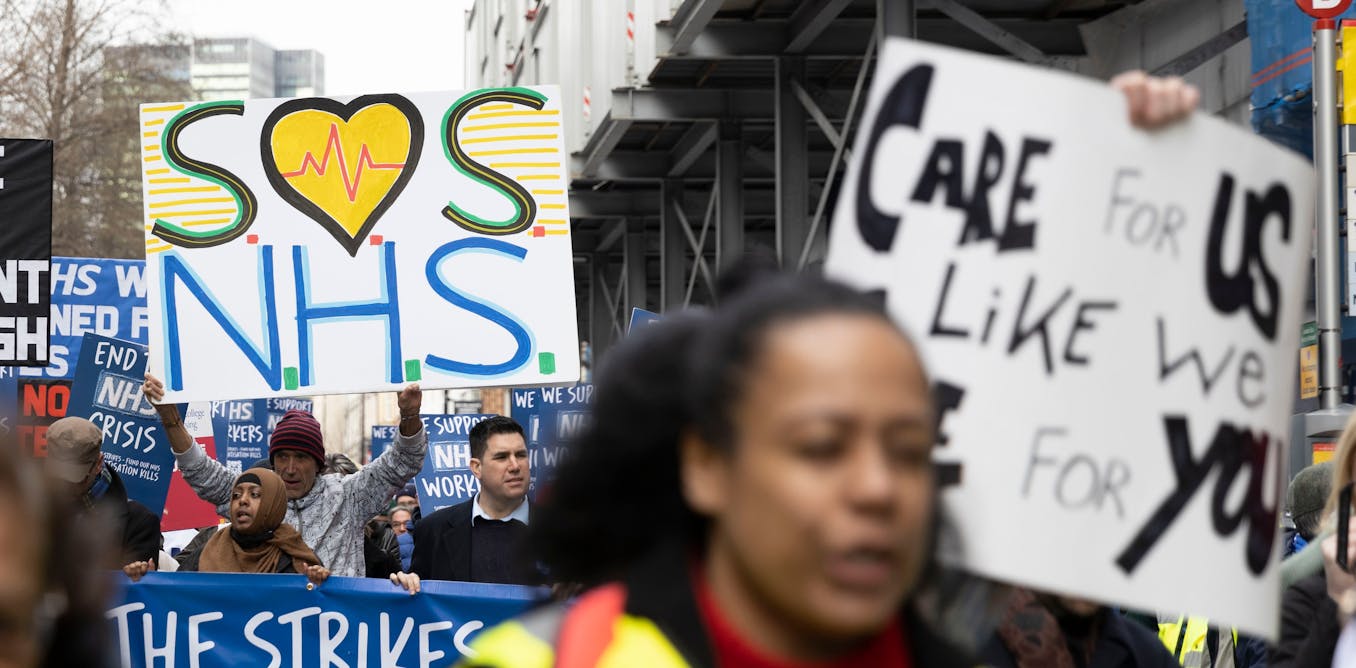
Image from “The Conversation”
The Mann report– unbalanced and should be put on hold
By a Medical Consultant in the NHS 16 June 2026
Introduction by MLRG.online 16 June 2026
The British working class continues being assaulted by the Labour Government’s unrelenting pressure on living standards. Meanwhile, it faces the ravages of racism. This is fed by misleading reports in the news enabling amplification by the neo-fascists – led by Nigel Farage. Coupled with this is a concerted and clever campaign to confuse the meaning of anti-racism, and confuse it with support of pro-Israeli forces. Anti-Zionism is thereby being mislabelled as anti-Semitism. A major force in this has been Lord Mann, who now extends his reach into the NHS directly.
Lord Mann’s past involved being a spearhead against Jeremy Corbyn to purge the Labour Party of any impetus towards a socialist path. His report on racism in the NHS will not bring anything good. An activist in the NHS in this article, analyses Lord Mann and his past and his report. It shows up Mann’s fostering of confusion between anti-Zionism and anti-Semitism.
Editors MLRG.online, 16 June 2026
What is the purpose of Lord Mann’s report?
Lord Mann’s report on ‘antisemitism and other forms of racism in the NHS and healthcare regulatory system’ was recently published. When announcing Lord Mann’s review, one of the headlines in the government press release was: “Steps taken to end scourge of antisemitism in the health service.”
A representative from the Board of Deputies of British Jews was then quoted as saying: “For much of the last 2 years, Jewish staff and patients have felt let down by the NHS while antisemitism has been allowed to flourish and thrive with hospitals, medical schools and other health spaces becoming unwelcoming for Jews.”
The press release also quoted a number of other representatives of Jewish organisations. The CEO of the Jewish Leadership Council said: “Antisemitism in the NHS has been out of control. We have seen doctors describe hospitals as cesspits of ‘Jewish supremacy’ and praise Hamas as ‘legends’, with the regulators and tribunals not taking substantive action. It is vital that Jewish patients are able to trust that their healthcare providers will treat them without prejudice. This continued lack of action has severely undermined trust.”
The Jewish Medical Association (JMA) was also quoted: “For the past 2 years JMA has become increasingly concerned about blatant expressions of antisemitism – simply anti-Jewish racism – that have become widely tolerated across healthcare. British Jewish healthcare students, professionals and patients find this profoundly distressing and intimidating.”
In addition, the CEO of Jewish Care remarked (albeit with more balance): “Jewish Care welcomes the government’s commitment to tackling antisemitism and racism across the NHS and wider society. These measures send a powerful message that hatred and discrimination have no place in healthcare or anywhere else.” In all, the press release contained 24 references to antisemitism, 9 to racism and 1 to islamophobia; no Muslim, Arab, Black or Palestinian organisations were quoted in the press release.
The report itself states that it addressed two principal questions:
1. How do we make sure in the NHS in England that perpetrators of antisemitism and other forms of racism are held to account with effective action taken to tackle their behaviour?
2. How do we make sure that patients and staff are protected from racism within the NHS in England and across the UK health and care professional regulation system?
Racism in the NHS
There should be no argument that racism is an issue within the NHS (as in all sections of society). Directed against staff, it is now making life unbearable for some and leading to a troubling fall in applicants from overseas wanting to come and work in the service. Prof Nicola Ranger, general secretary of the Royal College of Nursing recently observed that: “A sustained campaign of anti-migrant rhetoric is fuelling a growing cesspool of racism, including against international and ethnic minority nursing staff, without whom our health and care system would simply cease to function.” According to Jeanette Dixon, chair of the Academy of Medical Royal Colleges, the NHS is being put at risk because overseas health professionals increasingly see the UK as an “unwelcoming, racist” country.
The NHS Race and Health Observatory states that “According to data from England, we know that Black, Asian, and minority ethnic communities are more likely to die in childbirth than White British women, that Black men are more likely than White men to be sectioned under the Mental Health Act, and that Black and Asian communities routinely report worse experiences of accessing health care… At a deeper level, racism is embedded in policies, governance structures, and cultural norms.” Racism extends throughout our society and should be called out wherever it is found. With far-right parties now fanning the flames of discord, racism is manifesting on our streets as violent anti-immigrant pogroms. It is positive then that the government says it wants to tackle racism in the NHS, but puzzling that its main focus is on antisemitism, with ‘other racisms’ seemingly tacked on as an after-thought.
Perhaps this is because some in Labour still believe in a hierarchy of racism with antisemitism being at the top, as referenced in the Forde report on factionalism within the party: “While the action plan….covers all protected characteristics, there is a real danger, if less emphasis is placed on these, that it could be seen as establishing a new hierarchy of racism (that some would argue replaces a previous hierarchy that did not take antisemitism sufficiently seriously)”. Lord Mann has been quoted as saying that he regards antisemitism as “the worst of racisms” but has also been criticised for being reluctant to out antisemitism among Conservative politicians.
What is the purpose of Lord Mann?
Baron Mann was Labour MP for Bassetlaw from 2001 to 2019 before he was granted a peerage. In 2019, he stood down as an MP before the general election and took up a full-time role as the UK Government’s independent adviser on antisemitism in the United Kingdom, at the Ministry of Housing, Communities and Local Government. He was appointed to this post by Prime Minister Theresa May. May also nominated Mann as a life peer in the House of Lords in her resignation honours list after saying that “Antisemitism is racism….” and attacking Labour on its handling of this issue. The Times newspaper reported that the resignation honours list was held up by a row over her decision to give Mann a life peerage and that the independent watchdog on Lords appointments warned it would set a dangerous precedent and could be seen as a bribe for his support of her Brexit withdrawal bill. Mann had been a vocal critic of what he regarded as Jeremy Corbyn’s flawed approach to handling anti-Jewish hatred. Two months after Corbyn had won the party leadership campaign, Mann refused to back him in an interview with the BBC.
In December 2014, Mann gave a dossier, compiled by him and containing child sexual abuse allegations against 22 high-profile individuals, to the Metropolitan Police. Mann said that he had made a detailed examination of hundreds of pieces of evidence from members of the public and that he believed some of the twelve former UK government ministers named were “definitely child abusers”. The Police investigation was dropped in 2016 when it was concluded that all allegations were false.
On 28 April 2016, Mann confronted Ken Livingstone in a public stairwell in front of a news camera crew, calling him a “Nazi apologist” and a “fucking disgrace” over Livingstone’s remarks in a radio interview that Adolf Hitler, on coming to power, supported Zionism for the purpose of expelling Jewish people from Germany. In September 2019, upon his announcement that he was leaving the Commons, Mann said he would “never forgive” Corbyn, believing he had allowed the party to be “hijacked” by antisemitic bigots.
The ‘Commission on Antisemitism’
Following the Hamas-led attack on Israel on 7th October 2023, Lord Mann together with Penny Mordaunt (former Conservative MP for Portsmouth) co-chaired a report entitled the ‘Commission on Antisemitism’ produced on the initiative of the Board of Deputies of British Jews, The report was said to have been “informed by our conversations with the Jewish community and their lived experience” and referenced how antisemitism had crept into civil society, including the workplace, cultural spaces, and even the NHS. It argued that, unlike other vulnerable groups, Jewish people were not being given adequate protection. The co-chairs “identify that there is a specific unaddressed issue of antisemitism within the NHS. We recommend that a summit be held with NHS leaders across the UK to begin to address this. We recommend that there should be basic training on contemporary antisemitism carried out across every NHS Trust.”Among the recommendations in the report were: “We believe everyone should have the right to express their opinions and beliefs. However, we also recognise that where a person is carrying out a role, or is employed, primarily to look after the welfare, safety, or security of others, they have an additional duty to ensure people feel able to ask for their assistance. Activities, associations, and attire that undermine trust in the universality of the services they provide should not be permitted. We recommend that a consistent approach to this be taken across all sectors”.
The Commission claimed to have consulted with “Jewish people from all walks of life”, much of its research being conducted through oral evidence sessions with different focus groups. The report, however, does not provide details of who was consulted and how they were selected. A graph illustrating antisemitic incident reports from 2013-24 shows an increase from around 1,500 in 2022 to around 4,200 in 2023 – a nearly threefold increase, described as ‘vertiginous growth’. Not in the report were the number of hate crimes against Muslims and Jews – recorded by the police in 2023/4 and 2024/5 respectively as 2,690 and 3,199, and 2,093 and 1,755 for England and Wales. The UK’s primary anti-Muslim hate monitoring group recently recorded the highest volume of cases in its 13-year history, citing a 165% increase in verified cases from 2022. Specific reports of threatening behaviour spiked by over 320%, and physical assaults jumped by 73%. In England and Wales, there are approximately 13 times more Muslims than Jews.
It would be possible to welcome many of the recommendations in the Mann report that address racism; however, this raises the problem of why antisemitism is given such prominence and what the report is actually meant to achieve. Mann says: “The levels of anti-Jewish racism in the UK constitute a national emergency,” but without presenting much in the way of hard evidence to support this extraordinary claim. Others might feel that ‘national emergency’ applies more appropriately to the racism engendered by the continuing rise of the far right, the Southport riots, the violence in Southampton following the death of Henry Novak, and the recent events in Belfast with refugees being burned out of their houses. ‘Public Disorder’ does appear on the National Risk Registry, whereas racism or antisemitism do not. Pointing this out is not in any way meant to diminish the importance of combating antisemitism, or minimising the appalling nature of the torching of Jewish charity ambulances, the attack on Heaton Park synagogue, or the stabbing of two Jewish men in Golders Green following an attack on a Muslim man. It is, however, meant to put anti-Jewish racism in a much wider context.
Mann’s recommendations
The controversial areas of the Mann review echo some of the recommendations in the Mann/Mordaunt ‘Commission on Antisemitism’, placing restrictions on health care workers, such as: “Activities, associations and attire that undermine trust in the universality of the services they provide should not be permitted.” In addition, the government is also asking NHS England to adopt the International Holocaust Remembrance Alliance (IHRA) definition of antisemitism. Note here Mann’s comment that: “To be clear, freedom of expression, which is legally protected by the Human Rights Act (1998) allows people to say things that others find offensive. Attacking the actions or policies of the Israeli government or state, including in ways that some will see as offensive, or support for a Palestinian state or the plight of Palestinians, does not in of itself constitute antisemitism or contradict IHRA. Every action must be taken within its overall context.”
This may be Mann’s opinion, but as Human Rights Watch has pointed out: “In practice…the IHRA definition has often been used to wrongly label criticism of Israel as antisemitic, and thus chill and sometimes suppress, non-violent protest, activism and speech critical of Israel and/or Zionism, including in the US and Europe”. Health workers have expressed concern that adoption of the IHRA definition would embed a pro-Israel political bias into NHS mandatory training, the ‘satisfactory’ completion of which is tied to career progression.
Once again, when Mann says “I have heard evidence of routine ostracism of Jewish people, continuous negativity to people because of their identity, extreme behaviours including serious race hate incidents, and related consequences, for example, patients not wishing to present for treatment and staff no longer wishing to work within the NHS” he does not say how many people he has spoken with and how they were selected. How representative they might be of Jewish patients is therefore uncertain.
Mann states that: “The firm position of this review is that political identifiers do not have a place in the NHS, that is to say there should be a restriction on NHS staff from displaying political identifiers while at work…saying ‘Free Palestine’ or ‘I love Israel’ are reasonable beliefs and expressions but the identification of such views or beliefs on public facing NHS owned profiles might, in of themselves, be a barrier to patients presenting. NHS guidance in relation to this must be precise, on what is acceptable, not vague or open to interpretation…. the Prime Minister and the previous Secretary of State for Health and Social Care (in 2025) have committed to a review of national uniform guidance. Examples such as the brandishing of badges, the display of uniforms on political marches or the co-branding of the NHS by staff or others with third parties has made it unclear what patients can expect from the NHS”. ‘Brandishing’ (‘to wave or display something – especially a weapon – in a threatening, aggressive, or ostentatious manner’) was presumably carefully chosen.
Recommendation 8 therefore reads: “Some political identifiers can and do cause distress to patients, and employers should develop local policies to be clear about what is acceptable. In order to create an inclusive NHS, upholding the aim of everyone feeling safe to seek and receive care, NHS England should update national uniform guidance, in line with reviewing broader guidelines for those in the NHS using its name, logo or branding, including in relation to social media accounts”.
One of the difficulties here is defining ‘political identifiers’. Would such things as the flying of the Israeli flag from the Department of Health, or hospitals lighting up in the colours of Ukraine, be included? Would the rainbow lanyard for showing support to the LGBTQ community be allowed? What about trade union or professional symbols or international flags? The question of who decides what is ‘political’ is deeply concerning. Mann has delegated this to NHS bodies to decide, while NHS England will update national uniform guidance.
Lord Mann seems confused about ‘branding’ and the NHS logo. For example, in a radio interview, he appeared to imply that wearing scrubs (the loose-fitting trousers and top typically worn by theatre staff) would not be allowed. Of course, these are not in themselves a symbol of the NHS or a particular employer, but when worn on a demonstration are an expression of health worker identity. For example, they might be worn on an anti-racist demonstration as an expression of solidarity with overseas health workers. When clarifying in his report what he means by ‘NHS brand’, Mann states clearly: “we are speaking about use of the NHS logo”. Unfortunately, he abandons this clarity elsewhere and says: “NHS England should update national uniform guidance, in line with reviewing broader guidelines for those in the NHS using its name, logo or branding” – clearly making a distinction between logo and branding and muddying the waters.
NHS Race and Health Observatory Framework
Mann’s Recommendation 1 encourages wider NHS organisations to adopt the 7 NHS Race and Health Observatory anti-racism principles. This framework does indeed provide an excellent guide to combating racism within the NHS. The third principle states: “Creating an anti-racist healthcare system requires the meaningful and sustained inclusion of racially minoritised communities from the outset. Too often, their involvement is tokenistic, transactional, or comes too late to effect real change. True inclusion means actively partnering with those typically excluded from healthcare decisions, ensuring their voices shape priorities, design, and implementation”. With the exception of Jewish people, it appears that Lord Mann’s review has not followed this principle. This could be seen as an example of racial bias as identified in principle five.
We may all agree that there is no place for antisemitism in the NHS just as there is no place for racism. It is important, however, that legally protected freedom of expression by health care workers, for example, in showing pro-Palestinian solidarity, is not compromised. Given the limitations of Lord Mann’s approach in preparing his report, the lack of balance, and the delegation of decision-making about the vexed question of ‘political signifiers’ to NHS bodies, his recommendations should be put on hold at this point until a widespread consultation with staff and patients guided by the NHS Race and Health Observatory principles has taken place.
Consultant Physician with 40 years work in the NHS; 15 June 2026