France 2026 – Is this a reprise of Paris 1968?
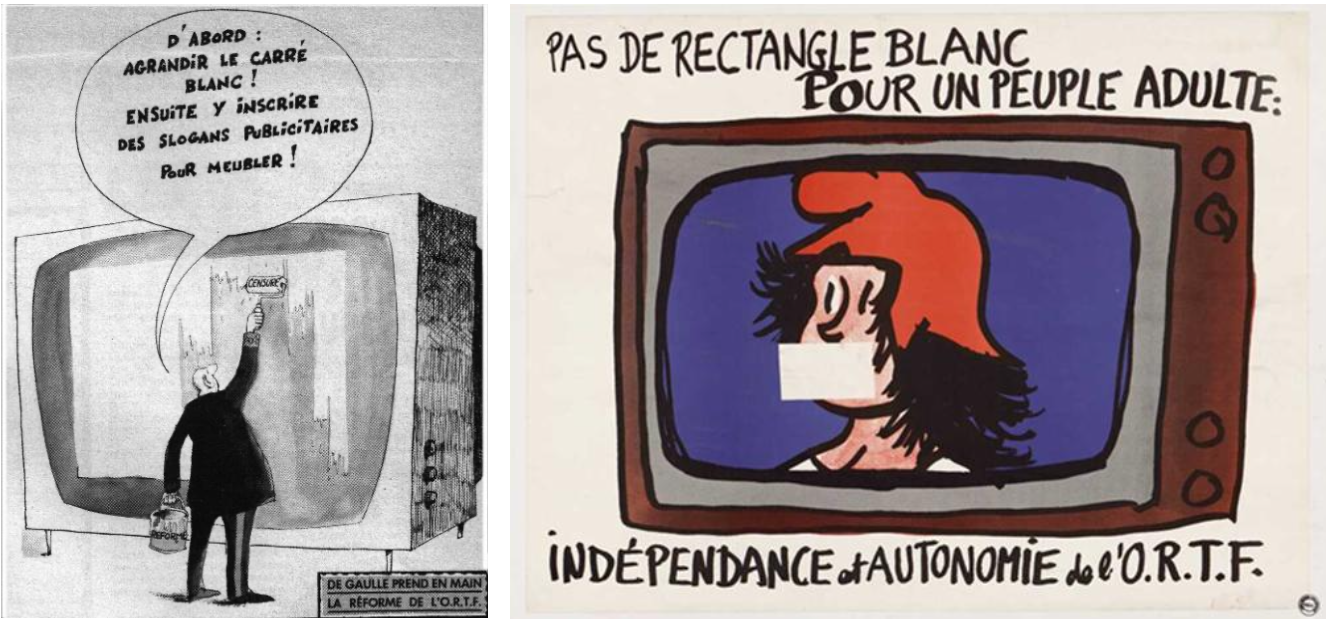
Images: Top on left-hand side: French cartoon of President de Gaulle which appeared in the right-wing weekly magazine Minute,
August 1968 “De Gaulle is depicted announcing: ‘First make the screen bigger, and then throw in some advertisements to furnish it!’ In the lower corner it reads: ‘De Gaulle takes control of reform at the ORTF’. The Office de radiodiffusion télévision française (ORTF), the French Radio and Television Broadcasting Office,” “De Gaulle’s paint roller was labelled ‘Censored’ and his paint can reads ‘Reform’ – which implies that while he was claiming to reform the ORTF, in fact he was censoring it.”;
Top on right-hand side: Jean Effel’s poster on censorship, ‘No White Rectangles for an Adult Population!’, June 1968: Depicts Marianne, the historic symbol of the French Revolution, complete with Phrygian cap, on television, her mouth taped shut by the famous white rectangle. The caption read: ‘No White Rectangles for an Adult Population!”
Both from: Victoria H. F. Scott; 2024; “Maoism, the French Posters of 1968 and the Secret History of Postmodernism”; p. 100;
Introduction
The youth are on the move over the whole world; they have reached a boiling point in several countries. This includes the youth in India, Spain, Germany, Ireland, Belgium, Albania… and many other countries. They are our future. This article focuses on events in France of September-October 2026. A comparison and contrast with events in Paris 1968 is made. We should recall that Paris 1968 did not result in any fundamental changes in French society.
Moreover, even between these years (1968-2026) there were a number of other student and university rebellions:
“The streets have repeatedly defied and checked governments since. In 1984 Mauroy fell from office after his attempt to curb private education unleashed a confessional mobilisation in defence of religious schools (of millions)…
In 1986 protests by hundreds of thousands of students… universities and lycées… forced Chirac to withdraw plans to ‘modernize’ higher education…
In 1995 Juppé’s schemes to cut and reorganise social security were met with six weeks of strikes…. ending in complete victory.. within little over a year he too was out of power…
In 1998 it was the turn of truckers, pensioners and the jobless to threaten Jospin’s regime…
In (2005) two young immigrants aged 15 and 17… were electrocuted fleeing police harassment outside Paris… the Banlieus… exploded.. targeting the most visible symbols of the consumer society from which they were excluded.. the insurgents torched cars in a pyre of social anger, amid violent clashes with police… three weeks later, some 9000 vehicles had gone up in flames… Scarcely had the last charred saloon been cleared than the universities and lycées rose in a massive wave of protest at government measures to make it easier for employers to hire and fire youth on a temporary basis – the so-called contrat première embauche, cascaded into a movement of such magnitude, this time with trade union support, lasting for upward of two months, that Chirac had to withdraw the plan…
The streets have France is the only major country in Europe where high school and university students have mobilised en masse, year after year, against governments of the day, creating a sub-culture of libertarian and solidaristic impulse likely to mark a generation..”
Perry Anderson; “The New Old World”; London 2009; p. 178; p. 191; p.213
That this is such a repetitive pattern gives rise to concerns for Marxist-Leninists. These include those listed below:
-A repeated spontaneous anger-venting on the streets has not led to fundamental change;
– A tendency to individual terrorism borne from an intense frustration of the young and the working class, retards the movement for effective change and gives fascist forces “cover” for repressions; and,
– There is still no mass Marxist Party, although a new social democratic force (La France Insoumise LFI) has superseded the old Socialist Party.
Even now, in France we see signs of an apparent hijack of the student movement and demonstrations by unnamed and unidentified persons; and a deliberately under-policed presence calculated to enable provocations:
“Authorities on Saturday (i.e. 17 October 2026) struggled to contain fires and looting by black-clad, hooded individuals. Stores were ransacked, city halls attacked, buildings set ablaze and rioters clashed with police in cities across the country…
Bruno Cautrès, a political scientist at Sciences Po.. said Saturday’s “apocalyptic scenes gave the impression that the state is no longer in control of the country, so this is an important experience that may affect how people vote”, Cautrès said. The most obvious immediate winner was Le Pen’s Rassemblement National, he added…
Several opposition politicians said the force deployed on Saturday only amounted to 10,000 officers, whereas during the height of the Gilets Jaunes protests police sometimes numbered above 60,000. The interior ministry said that number was incorrect but declined to give another figure.
Domestic intelligence services had predicted that some 100,000 people or so would turn out on Saturday, but the actual number was about five times higher.”
Sarah White and Leila Abboud; Emmanuel Macron faces political firestorm after riots”; Financial Times October 18, 2026
The history of May 1968 has not received adequate attention from Marxist-Leninists. The Encyclopaedia of Revisionism online carries only a brief article on the disintegration of French revisionism made by a Belgian writer (See “France – Before the 17th Congress of the CP (at: La Voix du Peuple April 10th 1964).
Here we: (1) review the current events of 2026; (2) re-examine the major predecessor event of 1968; and (3) reflect reasons for the failure of 1968 to effect meaningful changes.
Note on nomenclature:
French First Republic (1792–1804), lasting until the declaration of the First Empire
French Second Republic (1848–1852), deposing the July Monarchy and lasting until the Second Empire
French Third Republic (1870–1940), deposing the Second Empire and lasting until the Fall of France to Nazi Germany
French Fourth Republic (1946–1958), replacing Vichy France in the aftermath of World War II
French Fifth Republic (1958–present), since the 1958 French constitutional referendum
Wikipedia French Republics
MLRG.online 17 October, 2026; (NB: Text completed by 17 October 2026, events thereafter not covered)
- What is happening in France in 2026?
A chronic lack of facilities and funding for schools has led to spontaneously ignited massive school protests. These rapidly progressed to nationwide demonstrations and confrontations with the police. They began in a working-class suburban district of Paris – in the so-called ‘banlieus‘ – including Servan, St Denis. These are generally areas of working-class high-rise flats, often with a high density of immigrants. Here the tradition of fighting for rights is by necessity, of long standing:
“In 2005, Seine-Saint-Denis was the starting point for weeks of unrest on housing estates across France, leading to a state of national emergency being declared, after the death of two young boys hiding from police in an electricity substation. This week’s protests have shown that inequality and discrimination has not been addressed in the Paris suburbs and the mistrust between young people and police persists. Sevran’s Lycée Blaise-Cendrars, with more than 1,000 pupils, has been at the heart of protests about school conditions before. In 2024, students and teachers made a viral video about the state of classrooms, toilets and equipment.”
Angelique Chrisafis; ‘We’re not asking for luxury’: school protesters in Paris suburb feel abandoned by French state”; Guardian October 10, 2026
“Saint-Denis is in the country’s poorest department in mainland France, with nearly four in 10 residents in the suburb living below the poverty line, more than twice the national rate, and it has become a focal point for demonstrations. It is hard to recruit experienced teachers and turnover is much higher than elsewhere. ”
Adrienne Klasa and Leila Abboud; “Student protests rock Paris as 7,000 detained”: Financial Times, October 9 2026
The main demand underlying all is a sense that “Education is a right“:
“School is a right, not a privilege,” read a cardboard sign as Sophia listed the grievances of teenagers across France: a lack of state investment in education, overcrowded classes of up to 40 children in crumbling buildings, poor teacher pay, staff absences and an unequal system in which social background determined success. Other reasons for the protest included the opaque and difficult online system for university applications as well as the unbearable temperatures in classrooms during the heatwaves in May and June.”
Angelique Chrisafis “French police accused over war-like injuries to teenagers in school protests”; Guardian 16 October, 2026
While the poorest and most working-class districts of France have been especially hit, the themes have resonated across the whole country:
“Nationally, about 10 per cent of scheduled classroom hours go untaught largely because absent teachers are not replaced, according to the education ministry, an issue that has become a flashpoint for demonstrators.
“There is no equality in the education system. It is always us in the 93rd who get screwed, not like the nice neighbourhoods of Paris,” said Jamal, 15, using the departmental code for Saint-Denis.
A sharp decline in French maths and literacy scores in the OECD’s transnational Pisa study this year has fuelled the feeling that the public education system is broken. ”
Adrienne Klasa and Leila Abboud; “Student protests rock Paris as 7,000 detained”: Financial Times, October 9 2026
In fact, teachers have joined with their students – to protest but also to try to protect them from the police. The amount of the state spending on education is ranked at number 9th across the OECD countries,; but this falls to 15th place after teacher pensions are adjusted out.
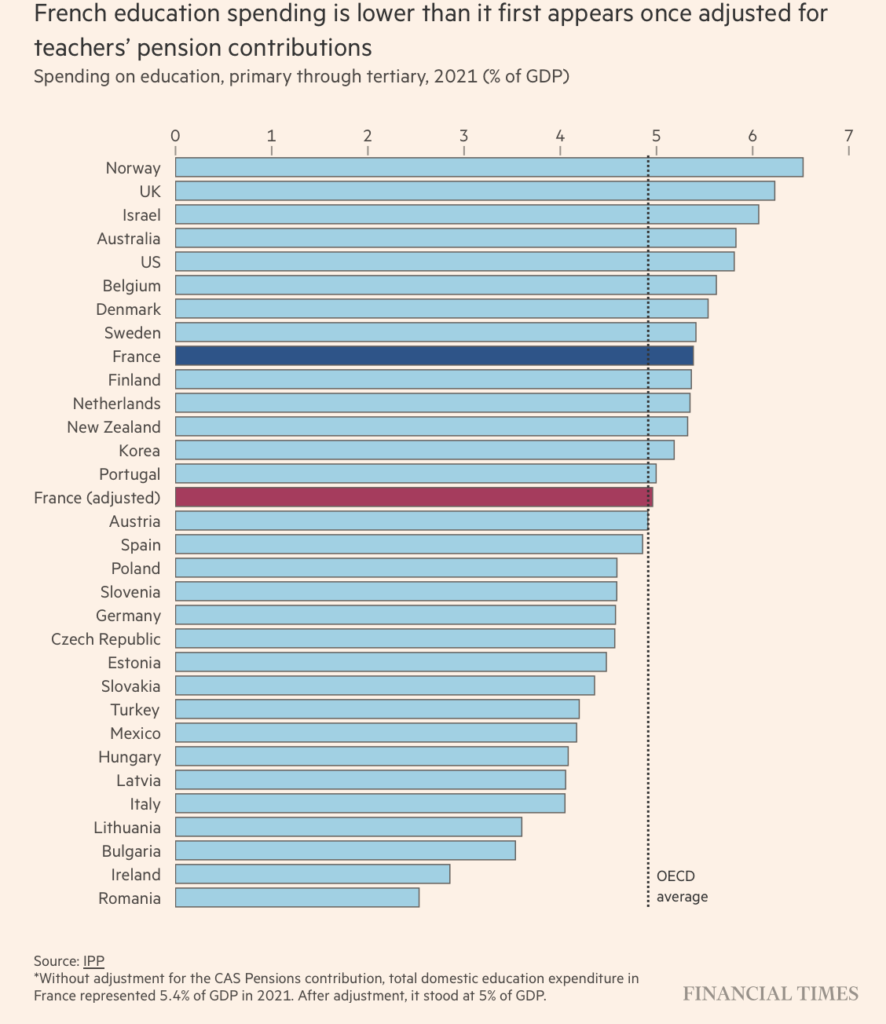
Adrienne Klasa and Leila Abboud; “Student protests rock Paris as 7,000 detained”;
Financial Times October 9, 2026
The terrible conditions in schools have sparked outrage:
“The biggest youth protest movement in the country in decades brought hundreds of thousands onto the streets across France this week, demonstrating against inequality in the French education system, decrepit schools, a lack of teachers and large class sizes. Hundreds of schools were blockaded, thousands of teenagers were arrested, and rights groups warned of alleged police brutality, with one child losing the use of eye and another losing a hand…
Mohammed and his classmates, often supported by their parents and teachers, have been at the frontline, barricading their school, the Lycée Blaise-Cendrars, which is in one of mainland France’s poorest départements, Seine-Saint-Denis. They have voted to continue their protests next week, taking their grievances to the local mayor, elected officials and education representatives. Many local politicians have supported their demands. Even the French prime minister, Sébastien Lecornu, conceded that teenagers had “legitimate” concerns.
Photos on the Sevran students’ phones showed broken classroom chairs, holes in walls, holes in ceilings, mould, buckets to catch leaks, faulty lights. They said basic needs weren’t met, with some toilets broken, others with no doors and often no toilet paper or soap. Video projectors and science equipment were lacking.”
Angelique Chrisafis; ‘We’re not asking for luxury’: school protesters in Paris suburb feel abandoned by French state”; Guardian October 10, 2026
The conditions are so appalling and obvious that even the Prime Minister, Sébastien Lecornu, was forced to agree that the demands are legitimate:
“The French prime minister, Sébastien Lecornu, had earlier attempted to calm the protests by accepting schoolchildren’s grievances as “legitimate” and saying the government must listen… Lecornu ordered ministers to tackle the students’ five major demands. These include organising the replacement of absent teachers, in recognition that pupils in some areas miss months of teaching because of staff absences – even in key exam years. Lecornu also called for a review of France’s lengthy school days, which are among the longest in Europe.
The government will also look at repairs to dilapidated school buildings. Children on blockades across France have described water leaking into classrooms during class, cockroaches, collapsing ceilings and unbearable heat in summer. Lecornu said ministers must come up with proposals by the end of the month.”
Angelique Chrisafis; “France braces for national day of school protests as boy loses hand”: Guardian 5 October 2026
Trade unions have joined with the students as have university students:
“Sophie Binet, the head of the left-wing CGT trade union, said the government had been late in offering to tackle the schoolchildren’s demands. She said the number of absent teachers who were not replaced had doubled in 10 years and class sizes were at a record high. “Amid such anger, a few measures just for show aren’t going to satisfy demands,” Binet said. She called for the government to instead stop all budget cuts as well as cuts to teachers’ positions.”
Angelique Chrisafis “France braces for national day of school protests as boy loses hand”: Guardian 5 October 2026
Upon how many workers join the struggle, will depend just how similar 2026 is to 1968. In the meantime matters may become derailed by acts of extreme vandalism – which whether by design or not – will precipitate reaction.
Have disrupters hijacked the demonstrations of legitimate grievances?
There is at least potential for – if it has not already happened – for a chaotic disruption. Potentially these might have been instigated by agent-provocateurs – although the considerable understandable pent-up anger is enormous:
“Thousands of black-clad and masked rioters hijacked broader peaceful protests by students and people marching nationwide against the high cost of living. Some 550,000 demonstrators are estimated to have turned out overall.
The scale of the destruction became clear on Sunday morning after clashes had subsided. The interiors of pharmacies and supermarkets were reduced to rubble in some parts of central Paris. Luxury storefronts were smashed in and hundreds of shops nationwide, from video games outlets to tobacco shops, were looted.
Rioters burned down the historic city hall in Limoges, and police clashed with rioters throwing projectiles and burning bins and cars throughout Saturday evening in central Paris.
“We’ve never seen this wave of violence, it was completely unprecedented,” said Étienne Guyot, the prefect — an appointed government representative — for the Rhône region that includes Lyon, on Sunday. A tourist office in the city was destroyed by a fire, and Guyot said that “looters and thieves” had “methodically ransacked a number of stores”.
“It had nothing to do with demonstrators airing their grievances,” he added.
Rioters were “hyper-organised” and in an “exalted, excited mood” and had sought to cause widespread damage, said Maurice Barate, prefect for the region around Limoges. ”
Sarah White; “France reels after ‘unprecedented’ violent riots”; Financial Times 18 October 2026
Whatever the origin of these events, the likelihood that they will bring down State repression on the working class is high. The timing is important to note:
“The violence comes six months ahead of a highly uncertain election to succeed President Emmanuel Macron, piling pressure on the government, which has been grappling with student protests over conditions in high schools while trying to pass a budget for next year in the face of bond market jitters about France’s ability to rein in its deficit.”
Sarah White; “France reels after ‘unprecedented’ violent riots”; Financial Times 18 October 2026
As well as an imminent election at a time of enormous financial strain for the French ruling class (see below), but a social democratic force is gaining momentum. The LFI led by Jean-Luc Mélenchon (1951- ) is being conveniently blamed for the violent turn. He throws the charges back:
“A political blame game is also under way, with Lecornu taking aim at far-left political party La France Insoumise and its leader Jean-Luc Mélenchon, a presidential contender, saying it needed to be more forceful in condemning the violence.
Mélenchon hit back, lauding the protests as largely peaceful, and said Lecornu was “responsible for the chaos . . . through incompetence”.
Sarah White; “France reels after ‘unprecedented’ violent riots”; Financial Times 18 October 2026
Some Marxist commentators view Mélenchon with considerable enthusiasm (John Mullen; “Ten years of La France Insoumise: a Marxist view”; Monthly Review on-line Oct 10, 2026). We view him as a left social democrat, formerly of the Socialist Party, who has gathered a mass into a left party – La France Insoumise (LFI or France Unbowed; or Rising France). We thus believe he should be supported in front work. But both he and his programme are not Marxist. Nonetheless currently he is a threat to Marine Le-Pen (1968-) and the fascism of the Rassemblement National (National Rally RN; or the National Front or FN).
In the absence of a large and organised Marxist-Leninist party, these current developments are unlikely to lead to more than the failed 1968. An understandable anger, but chaotically directed – will lead only to repression.
2. Parallels but differences with May 1968
In May 1968, Paris also exploded. This is on the minds of the French people today. As one demonstrator told the World Socialist Web Site (WSWS):
“At the blockade of Paris VIII University in Saint-Denis, Thomas told the WSWS: “We’ve reached a stage of general politicization that very clearly goes beyond trade union issues. There’s also the whole revolutionary imagination of May 68 that is starting to re-emerge. People are almost talking about a new May 68 … What people want, if we take up the imagination of May 68, is also the goals of May 68: to get rid of the government.”
V. Gnana and Alexandre Lantier; “French youth protests grow as political radicalization spreads”; WSWS 16 October, 2026
Currently, the scale of 1968 thus far has not yet been matched in 2026. In 1968, the student revolt was rapidly joined by the industrial working class:
“student revolt that began in a suburb of Paris and was soon joined by a general strike eventually involving some 10 million workers.”
Encyclopaedia Britannica on 16 October 2026 at Events of May 1986
2. Why did the universities and trade unions erupt in 1968?
General Charles De Gaulle (1890–1970) came to presidential power in France after the Second World War in 1946, dissolving the German-fascist installed collaborationist Vichy Third Republic. De Gaulle thus brought into being the Fourth Republic. His main goal at that time was to exclude the Communist Party of France (PCF) led by Maurice Thorez (1900-1964) from power:
“de Gaulle had one prime object – to contain the Communists – which he pursued with characteristic subtlety… the failure of the Communist take-over bid was the more remarkable in the atmosphere of French politics during the first year after the war..”
Alfred Cobban; “A History of Modern France Volume 3 1871-1962; London 1965; p.201-202
Having achieved that, de Gaulle tried to establish an autocracy. The failure of the PCF to combat this requires a separate examination.
De Gaulle now demanded that the Fourth Republic adopt a Presidential executive functioning, not a parliamentary executive. He failed to obtain this, and thus he simply vacated the stage for a while (Cobhan Ibid p.204). Meanwhile, he set up Gaulist movements in his place. He was confident he would be called back, and indeed in short order several governments fell. His opportunity came as the Socialist party was following a judicious “decolonisation” process.
French white colonists (colons – sometimes named pied-noir) in Algeria exploded in rage at France’s slow conversion of its colonies into neo-colonies. They mounted a coup in Algeria, which was even accompanied by a small uprising in Corsica. It became a threat to mainland France. As the crisis intensified in France, the right wing in France – and the reactionary colonists ensured de Gaulle came back into power as President. But now de Gaulle demanded extraordinary powers for the Presidency, got them and formed the Fifth Republic.
“After 1958 the new Fifth Republic re-bipolarized French political discourse after the multi-party confusion of the Fourth. (He) succeeded (with) the Gaullists in constructing a viable political Center-Right majority..”
George Ross; “Destroyed by the Dialectic: Politics, the Decline of Marxism, and the New Middle Strata in France”: Theory and Society, Jan., 1987, Vol. 16, No. 1 (Jan., 1987), pp. 7-38
De Gaulle had ambitions to make France the “leader” of Europe in opposition to the USA and Britain. But certainly by 1968, France as the “leader of Europe” – was an impossible vision in 1968.
“As the political and economic crisis of May 1968 revealed, France had neither the internal cohesion nor the financial resources to play the role of leader in what de Gaulle called “Europe from the Atlantic to the Urals.”
Encyclopaedia Britannica on 16 October 2026 at Charles de Gaulle
Nevertheless, by 1968 France had been transformed. At least some of this was due to the 5-year plans of the economist Jean Monnet (1888-1979). Monnet, together with Robert Schumann (1886-1963) were instrumental in moving visions of the European Economic Community towards reality. France’s peasantry was largely transformed into a proletariat, even though some of it considered itself a middle class:
“the magnitude of what happened to French society in the great post-war boom. In 1946, one third of the French labor force was in agriculture, by 1975 only 9 percent was. During the same period, the traditional petite bourgeoisie – the boutique of independent merchants – were reduced numerically by nearly 25 percent, artisans by nearly 33 percent. Even more significant was the rapid growth of salaried new middle groups in the same period – white collar workers by 90 percent, middle managers by 150 percent, engineers by 240 percent, teachers, social workers, and health care workers by 379 percent, professors and researchers by 460 percent.”
George Ross; “Destroyed by the Dialectic: Politics, the Decline of Marxism, and the New Middle Strata in France”: Theory and Society, Jan., 1987, Vol. 16, No. 1 (Jan., 1987), pp. 7-38
And yet this transformation had not been accompanied by adequate attention for the working class. In 1968, there was – as in 2026 – a very similar issue over lack of funding for the universities.
The ‘technocratic’ revolution had begun, and more students were being enrolled in conditions that were not adequately funded. Particularly in the so-called less elite universities – outside of central Paris. But on top of that was an evident arrogance of the ruling class and government:
“In the decade preceding May 1968, the French student population had nearly trebled, from about 175,000 to more than 500,000. It was an era of international “youth culture,” yet French society remained autocratic, hierarchical, and tradition-bound, especially in the eyes of French youth.”
Encyclopaedia Britannica on 16 October 2026 at Events of May 1986
Background events point to a relatively complete loss of confidence in the ruling class. The student population had rapidly expanded, but students were not given due credence. They were increasingly alienated. As seen above de Gaulle had taken the presidency demanding and obtaining extraordinary powers:
“As the May revolt erupted, de Gaulle was on the verge of celebrating his 10th year in office. He had acceded to power in 1958 via extra-constitutional means, because of the Fourth Republic’s disintegration at the height of the Algerian War (1954–62). French youth generally assumed that they were living under a quasi-benign political dictatorship. ”
Encyclopaedia Britannica on 16 October 2026 at Events of May 1986
The actual spark of 1968 was seemingly trivial, and revolved around the student leader Daniel Cohn-Bendit:
“the event that precipitated the May revolt seems fairly innocuous. In 1967, students at the Nanterre campus of the University of Paris had staged protests against restrictions on dormitory visits that prevented male and female students from sleeping with each other. In January 1968, at a ceremony dedicating a new swimming pool at the campus, the student leader Daniel Cohn-Bendit verbally attacked François Missoffe, France’s Minister of Youth and Sports, complaining that Missoffe had failed to address the students’ sexual frustrations. Missoffe then suggested that Cohn-Bendit cool his ardour by jumping into the pool, whereupon Cohn-Bendit replied that Missoffe’s remark was just what one would expect from a fascist regime.”
Encyclopaedia Britannica on 16 October 2026 at Events of May 1986
But this quickly spread:
“In March an attack on the American Express office in central Paris resulted in the arrest of several students. At a protest at the Nanterre campus a few days later in support of the students, more students were arrested, including Cohn-Bendit himself, …
In early May, … the dean of Nanterre shut down the campus … the students were barred from protesting at Nanterre, (so) they decided to take their grievances to the Sorbonne, in the heart of Paris’s Latin Quarter. On May 3 the rector of the Sorbonne formally requested that the police clear the university’s courtyard, …
mass arrests followed—undertaken (by) the CRS (Compagnies Républicaines de Securité), the national riot police – sparked violent resistance from bystanders, who began pelting the police with cobblestones removed from the streets and erecting barricades. The police responded with tear gas, clubbings, and more arrests…. The student leaders then proposed a major march and rally for May 10 to demand the reopening of the Sorbonne, the release of students who were still being held by the police, and an end to the intimidating police presence in the Latin Quarter.”
Encyclopaedia Britannica on 16 October 2026 at Events of May 1986
It was the subsequent escalation marked by a vicious police attack – the events of the “Night of the Barricades May 10–11, 1968” – which erupted into the student-worker alliance:
“police blocked the marchers’ path toward the Right Bank and the national broadcasting authority ORTF (Office de Radiodiffusion Télévision Française), the students again began removing cobblestones and erecting barricades for protection…
At about 2:00 in the morning of May 11, the police attacked, firing tear gas and beating students and bystanders with truncheons. The bloody confrontation continued … nearly 500 students had been arrested and hundreds of others had been hospitalized,…
public sympathy for the students, already considerable, increased. It was at this point that what had begun as a university-based protest movement for educational reform came to engulf the whole of France. The students’ own aspirations grew apace as the success of their movement seemed to open up new possibilities for radical change, including the dismantling of authoritarian political structures and the democratization of social and cultural institutions ranging from education to the news media and beyond. The next several days witnessed the largest wildcat general strike in French history, as millions of workers poured into the streets in support of the students as well as to set forth their own demands. During the course of the strike, scores of factories—including those of the French automaker Renault—were seized by workers.”
Encyclopaedia Britannica on 16 October 2026 at Events of May 1986
By the 13th May:
“a demonstration organized primarily by the Communist party and the Communist-controlled union (C.G.T.). They mobilized between 500,000 and 700,000 individuals. The most resounding of their slogans was “Ten years are enough!”
Mattei Dogan; “How Civil War Was Avoided in France”; Comparative Sociology,Volume 4, issue 1-2 ;2005
Such was the panic in the ruling class that President de Gaulle felt obliged to confer with the army outside France:
“During much of May 1968, Paris was engulfed in the worst rioting since the Popular Front era of the 1930s, and the rest of France was at a standstill. So serious was the revolt that in late May the French president, Charles de Gaulle, met secretly in Baden-Baden, West Germany, with General Jacques Massu, commander of the French occupation forces, to ensure Massu’s support in the event that his troops were needed to retake Paris from the revolutionaries.”
Encyclopaedia Britannica on 16 October 2026 at Events of May 1986
Nonetheless, with the use of brutality, and a very visible tank organising in public spaces – de Gaulle’s state overcame the ’68ers. Political groups of the left, including the Marxist-Leninist left – the latter largely of Maoist affiliation – were outlawed:
“Protests, occupations and skirmishes with the police continued intermittently, before finally petering out. Many political groups were outlawed by President Charles de Gaulle, such as la Fédération des étudiants révolutionnaires (Federation of Revolutionary Students), the La Jeunesse communiste révolutionnaire (the Young Revolutionary Communists), and the Marxist-Leninist Communist Party (Parti communiste marxiste-léniniste de France), many of whom were Maoists. Several leaders of the movement were jailed, others fled or were sent to Algeria. Five immigrant artists, two of whom were active in the poster workshops, were expelled from France.”
Victoria H. F. Scott; “Maoism, the French Posters of 1968 and the Secret History of Postmodernism”; 2024; p.199-200
The ideology of the 1968 movement
There is no doubt that the PCF had by this time become openly revisionist. This in a slow process progressively after 1947, during which it had lost the masses of France. It supported the Khruschevite 20th Party Congress. Then it had supported the suppression of the Hungarian rebellion against Khruschevite revisionism. Its rigidity led to suppression of internal discussion and intellectual silence. Over this period the equivocal stance by Louis Althusser (1918-1990) of the attacks of Khrushchev on China in the Sino-Soviet Debate had won him the adherents of the pro-Mao faction, who were heavily involved in the 1968 movement.
But also, the decay of the PCF had in turn precipitated the reaction often referred to as “Western Marxism“. We will examine this in detail shortly in another note. However the phenomenon is relevant to note here. It followed in large measure the intellectual prompts of Georg Lukacs (1885–1971). Lukacs played a part in the failed “Hungarian Revolution”. In this venture, the socialists were “invited” by the President to set up peacefully a “socialist Republic”:
“the President of the Republic, Count Mihaly Karolyi, related in his memoirs:
“I therefore proposed that. . I would charge the Social democrats, in conjunction with the Communists, to form a new Government; this proposal was unanimously accepted”.
(M. Karolyi: “Memoirs: Faith without Illusion”; London; 1956; p. 154).
“The Hungarian “Soviet Republic” of 1919″ 1978 Communist League; at Alliance ML
Lukacs’ main fame in philosophy includes claims that Marx the younger had discovered ‘alienation’ but had later somehow forgotten it in his economic explorations; and that Engels had subverted dialectics by claiming it could be found in nature.
It becomes highly pertinent to the Paris of 1968 as the intellectual milieu was now permeated by the intellectual heirs of this joint parentage. The parentage of first the loss of any legitimacy in the PCF with its pseudo-adherence to Marxism; and the legacy of Lukacs.
For Lukacs inspired those such as Jean-Paul Sartre (1905–1980), Henri Lefebvre (1901-1991), Cornelius Castoriadis (1922–1997), André Gorz (1923-2007) and many others. in turn this led to the philosophy of “self-management” or “autogestion“. It is true that Cohn-Bendit one main student leader, disclaimed Marcuse as a ‘mentor’- but he certainly acknowledged Sartre:
“Some people have tried to force Marcuse on us as a mentor; that is a joke. None of us have read Marcuse. Some read Marx, of course, perhaps Bakunin, and of the moderns, Althusser, Mao, Guevara, Lefebvre. Nearly all of the militants of the March 22nd movement have read Sartre…”
Arthur Hirsh; “The French left – A history and overview”; Montreal 1982; Cited p. 143;
By 1968 the rejection of most “standard” forms of Marxism amongst the alienated youth was widespread. There was a great attraction however to Maoism; and to autogestion especially led by Gorz. The latter espoused the “theory of a new working class, who was much alienated in their ‘white collar’ jobs. They required a philosophy of “gauchiste “uniting existentialism and traditional working class politics:
“workers self-management (autogestion) (was) the focus of the socialist movement.. dissolving the alienation that arises between managment and execution of work..”
Arthur Hirsh; Ibid p. 144.
These various strands were not able to withstand the force of the French state.
Police brutality and state censorship
Images below: On left, police removing posters and entering a student space “Faculty of Medicine at the Sorbonne July 8, 1968.” From Victoria H. F. Scott; 2024 Ibid p.4;. On Right: High-school students face off with riot police in Montpellier. Photograph: Horcajuelo Guillaume/EPA; From Angelique Chrisafis “French police accused over war-like injuries to teenagers in school protests”; Guardian 16 October, 2026
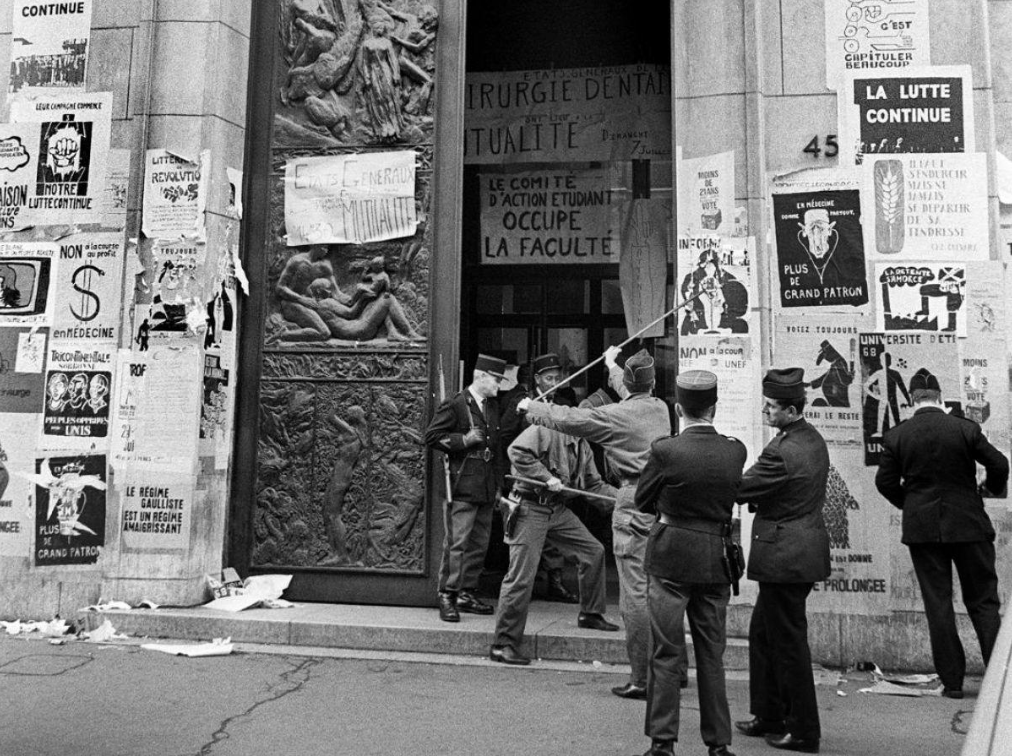
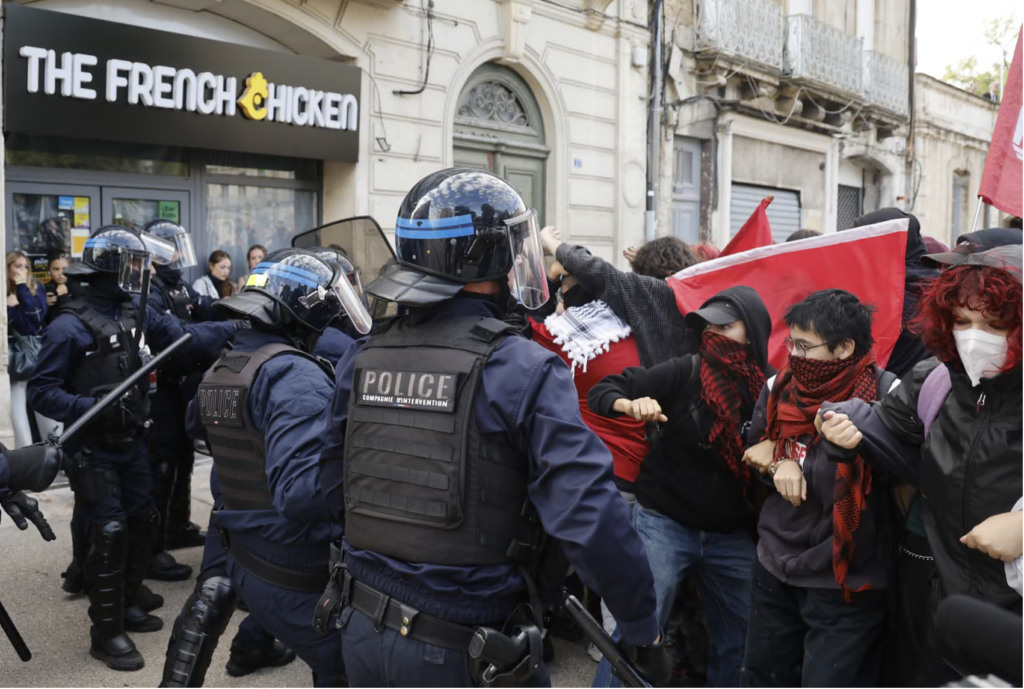
“The Algerian War was the cardinal issue for many leftists in France in the early 60s. Particularly because of the events of 1961 and 1962, when protestors were beaten to death by French police at two different related demonstrations. The first is known as the Paris massacre of 1961. It took place on October 17, when the French police attacked a demonstration of 30,000 Algerians, killing forty… The second is known as the Metro Charonne Massacre, which took place on February 8, 1962. Nine more people died at that protest. One can easily understand how these grotesque and tragic murders by the state could be read by the organised and unorganised left as a resurgence of fascism. These were the events that galvanized the French left and helped to advance Maoism in France at the beginning of the 60s. By the end of the decade, Vietnam and American imperialism were the leading political concerns. French Maoists used these issues to build and expand the Left, and they were good at it. However, in many ways the concept of a cultural revolution was their ace in the hole.”
In Victoria H. F. Scott; 2024; “Maoism, the French Posters of 1968..” Ibid; p.186; Cited on p. 196-7
Already in 2026 there were waves of arrests, and brutal attacks on children and young people (Guardian 5 October 2026). In total, the arrest numbers are large already by September:
“Since the school protests began in mid-September 2026, a total of 6,773 under-18s have been taken into police custody after they were arrested, the justice ministry said. For more than 1,000 of those children, no charges were brought; 2,190 are facing legal action and almost 2,000 were handed an alternative to further legal action, such as a citizenship course, without their case being heard at trial and without a conviction.”
Angelique Chrisafis “French police accused over war-like injuries to teenagers in school protests”; Guardian 16 October, 2026
In both 1968 and 2026, the policing before any street events was/is brutal.
“For several years, France has faced scrutiny over police use of explosive weapons, particularly after serious injuries were reported during the 2018-2019 gilets jaunes (yellow vests) street demonstrations, including allegations that people had lost eyes and had their hands and feet mutilated.
The current wave of protests has also led to lawyers raising concerns that an unprecedented number of children have been arrested and placed in police custody, with some lawyers reporting that teenagers said they were hit, humiliated or verbally abused during arrests.”
Angelique Chrisafis “French police accused over war-like injuries to teenagers in school protests”; Guardian 16 October, 2026
In both May 1968 and today, a crisis faced the young, and the established parties. In each case, both sides have waged a war of information. The Gaullists of the “Fifth Republic” in 1968 imposed censorship over radio and television. To which the youth and workers and other rebels responded with screen-prints and graffiti (See above):
“At the exact moment when important conduits of mass communications – radio, the illustrated press and television – were all receiving political pressure from the Gaullist regime, students, workers and others took over the art schools and professional schools and turned them into propaganda workshops. In an attempt to fill the vacuum left by the censorship of television and the illustrated press, a wave of graffiti and handmade posters, created in support of the general strike, flooded into the Latin Quarter…”
Victoria H. F. Scott; 2024; “Maoism, the French Posters of 1968 and the Secret History of Postmodernism”; p. 105
Today the advent of cellphones and instant messaging leaves the French government and its brutal police force exposed:
“Another boy, Eden, 14 – who had been near a school protest in Saint-Ouen-l’Aumône, north-west of Paris – suffered extensive facial injuries, including two fractures to his jaw, the loss of his bottom teeth and all his top teeth broken after he was allegedly hit by a shot from a grenade launcher. His lawyer, Elsa Marcel, said the shot from a grenade launcher was fired at close range, from a distance of 1.5 metres. “This is the equivalent of war weaponry,” she said. The family has filed a legal complaint for attempted murder.
Eden’s parents said he had gone to school but found it blockaded and had wanted to go home. Video footage appeared to show him facing three riot police officers. One officer hit out in his direction with a truncheon and Eden kicked in the direction of the police before a grenade shot was fired. An officer has been suspended and placed under official investigation.”
Angelique Chrisafis “French police accused over war-like injuries to teenagers in school protests”; Guardian 16 October, 2026
The Breaking of the 1968 Movement – The refusal of the Communist Party of France to support the movement
Arthur P. Mendel posed in an article the question, “Why did the 1968 movement stop”?
His answer is that it was the French Communist Party (PCF) that had effectively stopped the 1968 movement, when it was close to a sweeping societal change, in especial as the army was ‘wobbling’:
“In May, 1968, France was saved from revolution not primarily by de Gaulle and his generals but by the French Communist
Party. Nine million striking workers occupied the factories. Militants among the students and young unemployed workers had
proven themselves more than ready to play the role of vanguard at the barricades. The peasantry had begun to move from passiv
grumbling to direct action, fearful that the end of agricultural tariffs in July would further depress their hard lot. Even the middle class professionals, disenchanted with the hierarchical rigidities and the olympian paternalism of Gaullist society had risen to assert their rights to free expression and meaningful participation. All means of communication and transport and all financial agencies were either directly or indirectly under the control of the workers. At will they could have deprived Paris and other cities of food, water, fuel, electricity and gas.
Had the green light been given for revolution, for an “illegal establishment of a “popular government,” would de Gaulle, his
generals and his Champs-Élysées demonstrators have been able to stop it? The police had publicly expressed their resentment at being used against the students as well as their reluctance to test their strength against the striking millions and had even taken advantage of the crisis to press their own grievances. As for the army, trucks were used to collect the garbage and to provide a token replacement for suburban commuter trains and buses and its tanks roamed the outskirts of the city as de Gaulle threw down the gauntlet on May 30. But if that moment of truth had come, if the soldiers had been called upon to aim their rifles and machine gun at French students and French workers, would they have carried out the assurances that the generals had given de Gaulle during those crucial hours at Baden-Baden?…”
Arthur P. Mendel; “Why the French Communists Stopped the Revolution”; The Review of Politics, Jan., 1969, Vol. 31, No. 1 (Jan., 1969), pp. 3-27
The bosses were forced to meet with the trade unions. This was supported by the Prime Minister George Pompidou (1911-1974) ) woh had already the year before faced down a miners’ strike. An agreement was made by the Communist led trade union – the CGT – to get the workers back to work:
“the representatives of all the unions and those of the employers met with the prime minister on Saturday, May
25. This meeting lasted 36 hours, ending at 7 a.m. on Monday, May 27. An important agreement was reached one hour after the end of this meeting, the two most popular leaders of the C.G.T., Benoit Frachon and Georges Séguy, appeared before an assembly of 25,000 strikers at the Renault factory and set before them the terms of the agreement with the prime minister. They
stressed the importance of the concessions they had obtained, yet “the workers unanimously opted for the continuation of the strike” (Séguy, p. 117); consequently, the agreement was rejected. The Communist leaders were no longer in control of the situation. The news spread like wildfire throughout France, and in a large number of factories the assemblies of strikers decided in their turn to continue the strike.”
Mattei Dogan; “How Civil War Was Avoided in France”; Comparative Sociology, Volume 4, issue 1-2 ;2005
Again Mendel blames the PCF and its trade union the CGT for refusing to move forward, mesmerised by parliamentarism:
“Why did the Communist leaders do everything in their power to stifle all this, to break the wave instead of riding it at least to a
share of power? Why did they denounce the student militants and keep them from the workers instead of snaring them into a general upheaval as they so easily might have done? Why did their labour organization, the General Labor Confederation (CGT) oppose the general strike in the first place, accept at once Pompidou’s bread-and-butter concessions, and urge the workers to return to their jobs?…”
Arthur P. Mendel; “Why the French Communists Stopped the Revolution”; The Review of Politics, Jan., 1969, Vol. 31, No. 1 (Jan., 1969), pp. 3-27
An alternative viewpoint is that in reality the movement had no chance at success as they were “not organised”:
“At no moment did the leaders of the democratic left pose a real danger to the government. They had no organized force behind them. They were unable to mobilize significant masses in the streets (at the Charléty stadium the most visible were the anarchists, the Trotskyists, and other extremists). But they did have a certain audience in the country. … they represented 21% of the electorate. The slogan “Mitterrand-Kerensky,” shouted during the Gaullist demonstration on the Champs-Elysées…”
Mattei Dogan; “How Civil War Was Avoided in France”; Comparative Sociology, Volume 4, issue 1-2 ;2005
How did the leaders of the revolt lose the possibility of moving further? Dogan argues by adopting – or at least posing as – having an ultra-left approach:
“The prime minister suggested to a few television journalists that the three rebellious leaders be invited on television: Geismar, Cohn-Bendit, and Sauvageot. They fell into the trap the prime minister had adroitly set for them. In front of millions of dumbfounded spectators, they behaved like irresponsible utopianists who wanted to destroy the “consumer society.” A few days later one of them, when invited to join the demonstration organized by the Communists on May 29, replied “Only a march on the Elysée Palace would satisfy us” (Séguy, p. 131). The student movement forthwith ceased to enjoy the sympathy of the population, and its leaders instantly became fringe elements…
in anticipation of the Communist demonstration, had given the order that “the tanks at Satory should be brought nearer to Issy-les-Moulineaux,” a suburb of Paris (Pompidou, p. 190). ..
Were the leaders of the Communist Party really informed about the military preparations? It is highly probable that they were already informed by the evening of May 28.”
Mattei Dogan; “How Civil War Was Avoided in France”; Comparative Sociology, Volume 4, issue 1-2 ;2005
By 30 May, Pompidou had managed to get a resistant de Gaulle to dissolve the National Assembly. This allowed new elections for 23 June. It was made clear by very visible tank manouevres that the army was completely ready to drown the workers. The state initiated a wave of old-fashioned French nationalism where “800,000 supporters marched through the Champs-Élysées waving the national flag”. Workers were threatened by a “state of emergency” back to work. In the election that followed, a near sweep for the Gaullists was the result:
” In the election of the June 23 and 30, 1968, the people,… elected 353 Gaullist parliamentarians out of a total of 486. The Communists retained only 34 seats and the democratic left. Never in the existence of the Republic had the French people voted
in so great a majority in favor of one single party…”
Mattei Dogan; “How Civil War Was Avoided in France”; Comparative Sociology,Volume 4, issue 1-2 ;2005
The defensive argument of the French Communist Party Secretary General Waldeck Rochet, (1905–1983) as explained and cited by Luigi Longo (1900-1980) of the Italian Communist Party was this:
“the general secretary of the Italian Communist Party, Luigi Longo, gave a report to the Central Committee, in which citing the
French communist leader Waldeck Rochet, he wrote: “In advanced capitalist and well organized societies, it is childish to think that the change of the system could be achieved from morning to evening, by occupying during 48 hours public buildings, the police offices, the radio and television. The turning over of the advanced capitalist system in which the vital centers – economic, administrative, political, military, are strongly organized, could be only the result of a vast process . . . the Leninist law
about the maturation of revolutionary struggle takes into consideration not only the forces decided to act but also the popular forces . . . we are considering that the attitude of the French party has been conform to the real possibilities . . . we have always been guided by one major preoccupation: not to give to the Power the possibility to suffocate the struggle of the working classes” (report to the Central Committee of the Italian Communist Party, 1968, p. 33).”
Mattei Dogan; “How Civil War Was Avoided in France”; Comparative Sociology, Volume 4, issue 1-2 ;2005
But the problem looking back seems to be that there was no disciplined Marxist-Leninist force that held the influence of the students and the working class. The PCF was discredited, and it appears it’s own trade union forces openly rejected the conciliationism of the PCF leaders.
Some Conclusions
The underlying issues of how to organise in the absence of a disciplined central Marxist-Leninist force are universal. For example, similar “hijack” events are happening also in other areas, for example in Italy:
“In Milan, agitators fought police in the famed Piazza Duomo in the city centre, leading to 50 arrests, and smashed windows of several high-end stores. In Bologna, protesters clashed with police and ransacked shops near the train station, forcing the major rail hub to close.”
Sarah White; “France reels after ‘unprecedented’ violent riots”; Financial Times 18 October 2026
The task of organising Marxist-Leninist parties that can channel anger into an effective resistance to the state is urgently needed in all countries. However sincere and heartfelt the theories of ‘autogestion’ are, they cannot guide the movement.
The current French state has incurred a huge financial debt and is in crisis. Its ruling class is turning towards a form of fascism as represented by “rule of order” – Marine Le Pen.
French Marxist-Leninists must work in and with the forces of La France Insoumise – but they cannot rest there.