“Bonapartism” and Trump – a reply to Anthony Teso
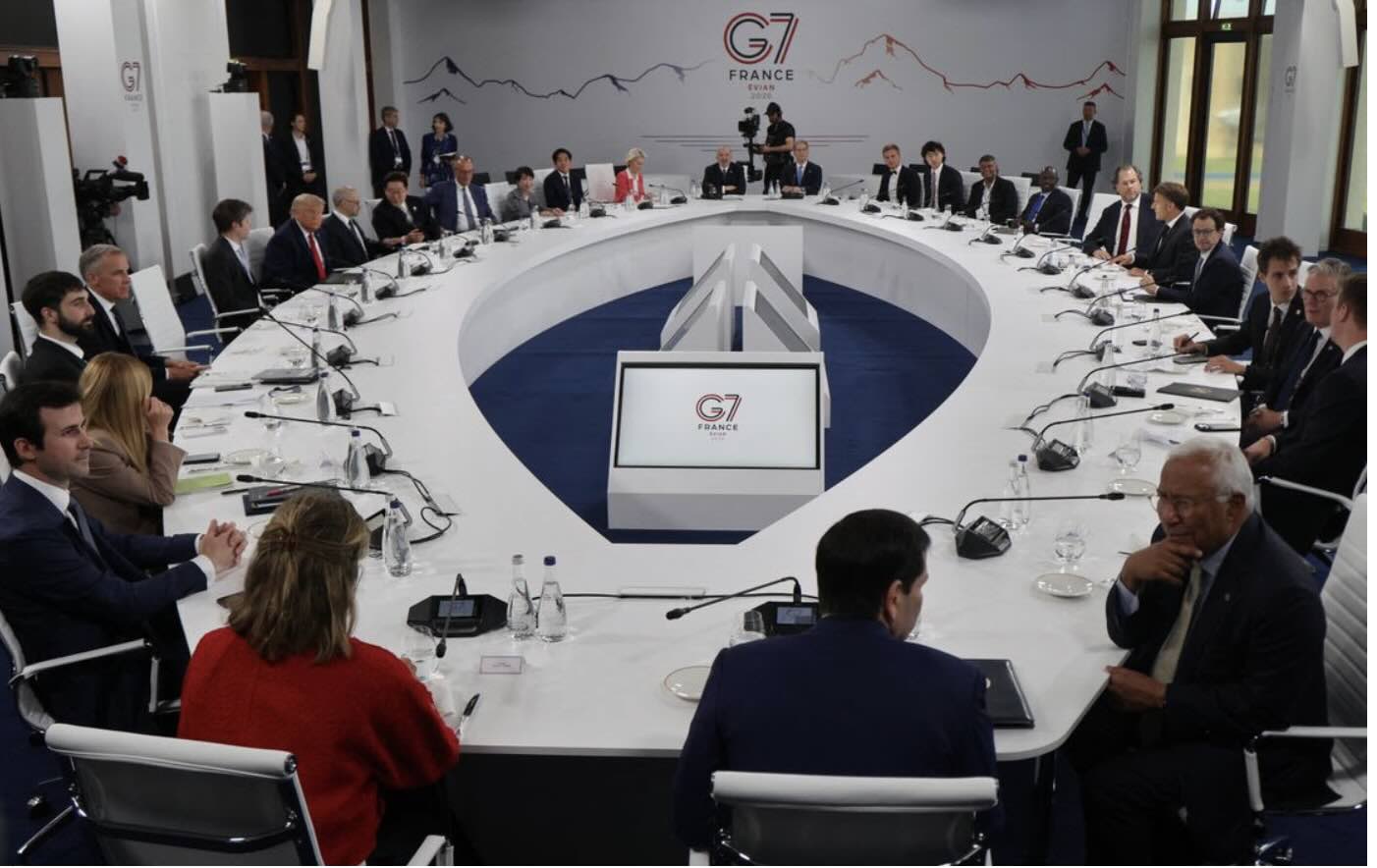
Image from https://www.axios.com/2026/06/20/ai-tech-moguls-g7?utm
Axios: “President Trump (upper left above) is flanked by OpenAI CEO Altman at his right and Google DeepMind CEO Demis Hassabis” at the G7…. The G7 host, French President Emmanuel Macron (upper right above), is flanked by Anthropic CEO Dario Amodei and Salesforce CEO Marc Benioff.” Ibid.
This image shows how close the working relationship is – between the visible rulers of some of the key capitalist countries and their newest generation of key capitalists. An obvious parallel is the working relationship between elements of financial capital and industrial capital and Hitler’s Nazi party.
“Bonapartism” in relation to Trump – a reply to Anthony Teso
July 14, 2026; published 19 July; minor edits of no analytical substance 20 July, 2026
- Introduction and scope of this article
Donald Trump became President of the USA for the second time in January 2025. A new situation faced the working class. But the left was splintered across its full spectrum, although it seemed ready to fight the Trump regime. Unfortunately, a united platform of struggle was somewhat slow to emerge. With the ICE attacks, a resistance from below was organised in several areas, especially in Minnesota.
Even by January 2026 the Left had still not even clearly categorised the nature of the Trump regime, let alone evolved a joint strategy to counter him. It is arguable whether even now in July 2026, a common viable strategy has been formed.
The main question the Left has faced was: “Was the Trump Government going to install a fascist regime?”
Some Leftists stated that Trump could not be a fascist, because “he had no fascist mass party” as in previous historical examples. Some argued there was still the “rule of law”; or that elections were still being held. In addition, it was widely believed that since there was no acute, overt threat from the working class, this ruled out the threat of fascism. MLRG.online took the position that in Italy a fascist party had come to power even after the defeat of the working class (See “Does the imposition of fascism always occur as a response to imminent socialist revolution?” 1976, previously entitled “The Nature of Fascism”; at MLRG.online August 2025).
As his recent new steps indicate, Trump is unlikely to be passive in accepting an electoral defeat in the midterm elections ( Zolan Kanno-Youngs, Nick Corasaniti , Dustin Volz; “Trump Brings Full Weight of Government to Bolster False Election Claims”; New York Times; July 17, 2026 )
How did the Trump government appear to MLRG.online? In the era of monopoly imperialism in a state of decadence and crisis, we do not believe the designation of “Bonapartism” is the appropriate way to view Trump. We view him as a modern fascist, as defined as follows:
““the open terrorist dictatorship of a reactionary ruling class, exercised through a fascist political party having a mass base. . .Fascism seeks to build its mass base primarily among the petty bourgeoisie and lumpen-proletariat, but extended as far as possible into the working class proper and its organisations”.
(Communist League: Theses on the Anti-Fascist United Front, in: “COMbat” March 1975; p.30); in “Does the imposition of fascism always occur as a response to imminent socialist revolution?” 1976, previously entitled “The Nature of Fascism”; at MLRG.online August 2025”
We were consistent from 2018 onwards in several articles, that Trump was a pro-fascist force. We argued that the ruling class of the USA was turning to Trump for leadership to attack workers in the USA; and to accelerate plans targeting China. The evident threat that Trump’s electoral challenge was met with showed a lack-lustre slow and clearly inadequate response by the Democrats. This suggested to us the ruling class had decided to ensure the installation of Trump. Our articles included:
What is Behind Trump – Is There Method Behind His Madness? (2018);
The USA 2024 Presidential Elections – Should socialists advocate election boycott? October 2024
Trump Takes Office – Goes Full MAGA”; January 22 2025
The Goals of Trump’s New Tariff Wars; March 14; 2025”
Hovering on the Brink of Fascism: What Happened in the November 5th 2024 USA Elections? December 1, 2025
Theses on Trump 2 and the USA Ruling Class, April 13, 2025.
The use of the term “Bonapartism” was particularly framed for countries where a large peasantry formed a significant reservoir of a rural and land-based bureaucracy. The term “Caesarism” was sometimes also used, although not by Marx – to denote the same phenomena by and large, by Antonio Gramsci.
Two writers recently challenged our views in a cordial exchange, as expressed on the e-list ‘Marx Mail’. An Appendix to this article contains the full correspondence. In brief there are two challenges:
The first charges us as being ‘conspiracists’ in maintaining that the elections of 2024 were thrown (See 2(i))
The second adds to the first – an argument that we ignore the “Trump moment of Bonapartism”; which has arisen from the “inability to govern” and an “autonomy of the state” (See 2 ii below).
Both arguments warrant a response, hence this article. Indeed we should thank the challengers for forcing us to reconsider the questions raised. Having re-considered we believe once again that the correct categorisation of Trump, in the era of decaying monopoly imperialist capitalism – remains fascism. As such – again – we believe he represents:
““the open terrorist dictatorship of a reactionary ruling class, exercised through a fascist political party having a mass base…”
“The Nature of Fascism”; at MLRG.online August 2025“
The specific criticisms are discussed (see (2). We also review selected authors on the question of “Bonapartism” (See section 3 below). That literature review starts with Marx and Engels, and proceeds to Lenin, Stalin, Antonio Gramsci (1891-1937); and finally Nicos Poulantzas (1936-1979). Thus, we omit here the Comintern (on which we have previously written: “Theses on Fascism”; London 1975; The Nature of fascism; London 1976), Klara Zetkin, and Trotsky. We leap historically from Gramsci to Poulantzas. Our author selection is driven only by the thrust of Teso’s challenge and time.
Since the interpretation of the term rests critically on Marx – our fuller reading of Marx’s two major works on France 1848-1851 is in a companion piece. (“Marx on Bonapartism – Reading Notes on “The 18th Brumaire” and “Class Struggles in France” MLRG July 2026).
Before commencing our piece, we should say that any differences on the exact terminology used to define Trump, are not of such severity as to limit joining with our critics, in joint fronts developing against Trump. However, Marxists have often aspired to be ‘scientists’ in regards to society. If that remains a goal, we should strive to be accurate.
MLRG.online July 14, 2026.
2. Two Criticisms of our formulation on Trump’s elections
2. (i) Conspiracy theory?
The First argument made states that we were ‘conspiracy theorists’. Others added that we made a “functionalist” argument.
To the core argument of ‘conspiracy theory’, we plead ‘guilty as charged’.
The image frontspiece for this article shows a very high-level meeting to which leading high technology executives were invited to meet with world political leaders. How could it be otherwise? We should assume they did not talk about golf or the weather.
We believe that, indeed, there was a ruling class conspiracy to enable Trump to gain office a second time. This ensured that the Democratic Party was unable to successfully get their candidate elected as President. We said the Democrats had ‘thrown’ the election. This was, we said, because the crisis of the USA ruling class was such that it needed – as a whole:
(i) to effect massive cuts in the standard of living of the working class; and,
(ii) to further confront the main competitors in the international sphere. These perceived enemies of the USA were the PRC and the European Union.
Those who charge us of ‘conspiracy theory’ give insufficient weight to the cunning and indeed – the intelligence – of the ruling class. These accusers generally dismiss this as a poor counter-argument. We suggest that they re-read Marx’s “Class Struggles in France”, to see the prior scale of contortions the bourgeoisie make to fool workers. Why do they think that such pre-planning does not occur now?
The deviousness shown by Trump and the “2025 Project” planners is not new. Marx encountered the same in the concerted and successful efforts to divide the working class from the petty bourgeois and peasants in 1848. He talked of deceptions to fool the petty-bourgeois that the working class was “anti-Republic”.
One example, was the events of April 16, 1848. Here the working class leaders held a rally to decide their candidates for the leadership of the National Guard. The working class faced a “very carefully calculated sham battle” to isolate them from the petty bourgeoisie; and label it as trying to “overthrow the Provisional Government, and proclaim a communist government“. Marx saw the whole thing as a “staged comedy“:
“April 16 was a misunderstanding engineered by the Provisional Government in alliance with the bourgeoisie. The workers had gathered in great numbers … to choose their nominees to the general staff of the National Guard. Suddenly throughout Paris, from one end to the other, a rumor spread as quick as lightning, to the effect that the workers had met armed in the Champ de Mars, under the leadership of Louis Blanc, Blanqui, Cabet, and Raspail, in order to march thence on the Hôtel de Ville, overthrow the Provisional Government, and proclaim a communist government. The general alarm is sounded – Ledru-Rollin, Marrast, and Lamartine later contended for the honor of having initiated this – and in an hour 100,000 men are under arms; the Hôtel de Ville is occupied at all points by the National Guard; the cry Down with the Communists! Down with Louis Blanc, with Blanqui, with Raspail, with Cabet! thunders throughout Paris. Innumerable deputations pay homage to the Provisional Government, all ready to save the fatherland and society. When the workers finally appear before the Hôtel de Ville, in order to hand over to the Provisional Government a patriotic collection they had made in the Champ de Mars, they learn to their amazement that bourgeois Paris has defeated their shadow in a very carefully calculated sham battle. … April 16 furnished the excuse for recalling the army to Paris – the real purpose of the clumsily staged comedy and for the reactionary federalist demonstrations in the provinces.”
The Class Struggles in France, 1848 to 1850; Part I The Defeat of June, 1848”; at Part 1 ‘Class Struggles’.
Our foes today are as adept and cunning. Instead of a “staged comedy”, in Trump’s case, they put on a real-life tragedy affecting millions of people. We should not disarm ourselves by under-estimating our enemy.
Even the Democratic Party’s own “autopsy” of its failures refuses to give even bare details in a “shoddy assessment“:
“The Democratic National Committee on Thursday released a nearly 200-page draft of an internal autopsy of what went wrong in the 2024 campaign, ending months of speculation…
The release was an extraordinary turn of events for the party, which all but trashed its own report as incomplete and inaccurate, releasing the document only after months of mounting headaches from keeping it secret…
Democrats spent the day contending with what most agreed was a shoddy assessment of the 2024 cycle…
The document itself was widely mocked. Atop each page was a bright red disclaimer that the D.N.C. “was not provided with the underlying sourcing, interviews, or supporting data for many of the assertions contained herein.” A page with the title “Executive Summary” was blank except for a note in red reading: “This section was not provided by author.
Particular facts included in the version that the committee released were highlighted in yellow and annotated as either unverified and inaccurate. There was no list of who was interviewed, no transcriptions and no notes, which made determining the veracity of the draft all but impossible, said a person familiar with the process.”
Shane GoldmacherReid J. Epstein and Lisa Lerer; D.N.C. 2024 Election Autopsy Reopens Wounds of Harris Loss”: New York Times at May 21, 2026.
We have previously written on several ruses of the imperialist ruling class of the USA. For example, the case of the Iraq War (“The “Setting-Up” of Iraq – Reprint from 1990”; June 24, 2025 MLRG.online); or the Trump Government in its goading of the working class (“Justifying” a military crackdown – Trump, Stephen Miller use ICE to provoke and goad”; MLRG.online June 10, 2025).
True – We have no ‘smoking gun document’ to give… But we ask those trusting progressives who convicted us of ‘conspiracy theory’ – What ruling class conspirators leave documents behind unless these are locked away for a statutory 50-100 years or so?
Reasoning must be used to deal with otherwise inexplicable patterns of facts. Our interpretation still makes sense to us. Otherwise, the very smart people, such as those leading the Democratic Party, would simply not allow a dementia burdened President Joe Biden to obstruct a sound, timely replacement. Nor would they demand an anti-Palestinian position on behalf of all officially sanctioned candidates. As did the very late-appointed, but quite mediocre, presidential candidate Kamala Harris. We do not believe the leaders of the Democratic Party are stupid.
Moreover, we ask: Just by how much do the imperialist goals of the Democratic Party differ from the Republican Party – on Israel? On China? On South America? The main objective now for the USA ruling class is to prepare for taking on China, up to and if needed, war. Both Republicans and Democrats agree on this.
That there are some differences between Democrats and Republicans on the benefits of some social reforms (for instance, Obamacare) is certainly true. It was on exactly this basis that we called for a policy of voting for the Democratic Party, notwithstanding.
However, we argue the ruling class has decided as a whole to focus on a forthcoming inter-imperialist war. Such reforms as for health care, are no longer needed by the ruling class as a whole. Hence Trump.
We believe it is naive to expect otherwise, and that denial of such reality only disarms the working class.
We move to the second charge.
2. (ii) Teso’s argument
Teso’s adds to the charge above of ‘conspiracy theory’, two other main charges:
(i) Firstly – MLRG.online pays insufficient attention to the “Bonapartist moment of Trump.”
(ii) Secondly – MLRG.online ignores the “relative autonomy of the state”.
A disclaimer: he also charges that we do not address adequately the question of the falling rate of profit. However in this reply we restrict ourselves solely to the political dimensions of his charges, and specifically the issue of ‘Bonapartism”.
Our initial response was brief and suggested the burden of proof was on Teso:
“… the central point you (i.e. Teso) seem to make is that of a certain ‘independence’ of all (or at least the main) elements of the ruling class in the current administration… in the meantime, it seems to me that your hypothesis critically depends upon:
i) Demonstrating that there was/is no overlap on the major issue of confronting China and the EU on the parts of the visible leading representatives of the DP and the RP.
ii) Demonstrating that there was/is no overlap on the central theme of razoring the welfare state – and not simply a question of the degree and method of doing this.”
Initial reply to Teso; see Appendix to this file.
Teso urges us to Nicos Poulantzos (1936-1979) and a “relative autonomy of the capitalist state“:
“Poulantzas formalized the point. The relative autonomy of the capitalist state is not a loophole but a condition of the state’s functioning, and authoritarian statism names a mutation internal to that state, the concentration of power in the executive and the decline of the institutions that once mediated among fractions. Autonomy is greatest, not least, when the dominant class is divided. The Theses invoke none of this. They present a class with a single program and a state that transmits it without remainder. There is, on their account, no Bonapartist moment in Trumpism, because there is no fissure for a Bonapartist moment to occupy.”
Teso Ibid; citing Nicos Poulantzas, State, Power, Socialism (London: NLB, 1978).
“Authoritarian statism names a transformation internal to the capitalist state, not the bourgeoisie’s acquisition of a single will”;
After some thought and discussions, our views of Bonapartism in relation to the pattern of Trump’s Presidency remain unchanged.
We do not believe the ruling class is fractured to the point of an “inability to govern in its own name.” Nor do we see an “improvising (of) a program of imperial transition“:
“Trumpism is legible as a Bonapartist form, an executive that has won extraordinary autonomy from a ruling class too fractured to govern in its own name, improvising a program of imperial transition that no fraction fully authored and that none can fully control.”
Teso Ibid.
We do not see the “improvisation of a program…” seen by Teso. What was the Project 2025 all about if not careful pre-planning?:
“Project 2025 (also known as the 2025 Presidential Transition Project) is a political initiative published in April 2023 by the Heritage Foundation with the goal of reshaping the U.S. federal government by consolidating executive power in favor of right-wing policies.”
Project 2025; Wikipedia accessed 10 July, 2026
We do not see that the forces contending now in the USA for the Presidency are in any opposing “balance” or “equality” – such that an “autonomous” state has arisen. We do see the old form of the Democratic Party breaking up – partly because the old leadership shares so many policies with the new Republican party under Trump. That is one reason why the formation of the “Democratic Socialist of America” is seeing a growth. What will happen to that growth is beyond our scope here (See July 2025).
3. i) The views of Marx
The crux of Teso’s argument rests on an interpretation of Marx’s texts. Teso states:
“The whole interest of Bonapartism as a category lies in the opposite premise. Marx did not describe the Eighteenth Brumaire as the bourgeoisie getting the executive it wanted. He described an executive that achieved independence because the contending fractions had fought one another to exhaustion and none could rule in its own name. The bourgeoisie accepted Bonaparte not as the expression of its coordinated will but as the price of its inability to coordinate. It surrendered the right to rule in order to keep the right to make money.”
Teso Ibid.
We dispute that “Marx did not describe the Eighteenth Brumaire as the bourgeoisie getting the executive it wanted..“ As Marx writes Louis Napoleon made “a moneylender Achille Marcus Fould… one of the most notorious of the high financiers” the Minister of Finance. How did this come to be, and what relationship did that have to a united bourgeoisie seeking out Louis Napoleon’s “Order”?
At this point we need to briefly recapitulate the core of Marx’s writings on 1848-1851.
One obvious thing, but it bears stating out loud. Namely, Marx’s analysis concerned an entirely different class terrain from today. Marx writes in his preface to “The 18th Brumaire” that “Bonapartistism” is not “Caesarism.” To make that error, he says, is a “superficial historical analogy” (Karl Marx; “The Eighteenth Brumaire of Louis Bonaparte” 1869; Marx’s “Preface”; at Preface MIA).
The term “Bonapartism” – in relation to a fully formed monopoly imperialist ruling class and its President Trump – is a similar “superficial historical analogy“. Jumping ahead of the narrative to Lenin, it forcibly reminds us of the remark:
“This kind of comparison is so frivolous that it is mere playing at historical parallels. In France in the sixties the epoch of bourgeois revolutions had long since come to an end, a direct clash between the proletariat and the bourgeoisie was already knocking at the door, and Bonapartism was the expression of the government’s manoeuvring between these two classes. It is ridiculous to compare that situation with contemporary Russia.”
V. I. Lenin; “A Liberal Labour Party Manifesto”; 1911; V. I. Lenin, Collected Works, 4th Moscow, 1968 p.320; Following David J. Romagnolo; as at Marxistleninists.org
Moreover, “Class Struggles in France” states that 1848-1849 was signified by “social relationships which had not yet come to the point of sharp class antagonism” (Marx, “Class Struggle in France”; Prefatory Remarks; at MIA Class Struggles in France. It is obvious that currently in the USA, “social relationships” have “come to the point of sharp class antagonism“.
Marx’s shows two new classes coming into maturity in 1848-1851 – the workers and the capitalists. They combined to topple the Louis Philippe ‘Orleanists’. This landed aristocracy was allied to the financial aristocracy. The bourgeoisie was divided, the industrialists were only “part of the official opposition”.
Republicans of the industrial bourgeoisie used the working class against the financier government. It “imagined their domination over the working class,” says Marx (MIA Class Struggles France Chapter 1). The working class, the small petty bourgeoisie, and the peasantry were in dire straits (France’s financial speculations; crop failures, potato blight, and an international trade crisis).
The workers were armed since the days of the fall of the Bastille, and they were a feared force. They rose and fired in the 1848 revolution to depose the government.(Ibid Part 1 ‘Class Struggles’) There was an outburst of republican clubs, debates newspapers.
But enthusiasm soon dampened as the working class realised the bourgeoisie was not granting workers their rights. They marched and set an armed mass siege at the Hôtel de Ville (City Hall) to ‘compel‘ ‘socialist concessions’( at Part 1 ‘Class Struggles’).
Quickly the bourgeoisie isolated the working class from the peasantry and the petty bourgeoisie. A lumpen Mobile Guard was formed to fight the workers. They then goaded the working class to rise to defend their gains. “The workers were left no choice; they had to starve or let fly… It was a fight for the preservation or annihilation of the bourgeois order.” (MIA Class Struggles France Chapter 1).But they were massacred.
In the fervid atmosphere the “Party of Order” formed, merging two Monarchist factions and two parts of the bourgeoisie. Its slogan were “Order, Property, Religion”. As tensions rose all wings of bourgeois ‘republicans’ supported the “Party of Order” which:
“…(united) all classes and parties… against the proletarian class as the party of anarchy, of socialism, of communism. They had “saved” society… (with) the watchwords of the old society, “property, family, religion, order,”… as passwords.” 18th Brumaire Part 1; at MIA 18th Brumaire
Blood-stained ‘republicans’ further suppressed the working class. For now, a parliamentary form of government held. In an election on December 10, 1848, the much-abused peasantry gave their vote for Louis Bonaparte as a President, over a cramped bourgeois republican parliament. Despite repressions, the workers remained a threat to the bourgeoisie.
Louis Napoleon used the ‘Party of Order’ to oust the remaining ‘republicans’ from effective power. Then he appointed a new Minister of Finance, the moneylender Fould. As a financial autocrat, he led speculation and corruption. Misery and poverty deepened even more. A renewed assault on the peasantry led to a new radicalisation. In March 1850, elections saw the peasantry, the petty bourgeoisie, and the working class joining together under the ‘Mountain’. They won in alarming numbers, even votes of army members.
It was this class alliance and its electoral success that frightened both the Party of Order and Louis Napoleon. They closed ranks together to further suppress the opposition. The bourgeoisie of all stripes closed ranks – Louis Napoleon and the Party of Order royalists joined together:
“With March 10, 1850, the constitutional republic entered a new phase, the phase of its dissolution. The different factions of the majority are again united among themselves and with Bonaparte; they are again the saviors of order – he is again their neutral man. If they remember that they are royalists, it happens only from despair of the possibility of a bourgeois republic; if he remembers that he is a pretender, it happens only because he despairs of remaining President.”
“Class Struggles” Ibid MIA at Chapter 3
It is quite true that the Monarchists and bourgeoisie of the “Party of Order” tried to best Louis Napoleon. As Marx writes, “thus the comedy was played” – just as now under Trump. But that is just the froth on top. At the end of the day, says Marx, “the breach of the commercial bourgeoisie with its politicians“:
“Far more fateful and decisive was the breach of the commercial bourgeoisie with its politicians. It reproached them not as the Legitimists reproached theirs, with having abandoned their principles, but on the contrary, with clinging to principles that had become useless.…
since Fould’s entry into the ministry the section of the commercial bourgeoisie which had held the lion’s share of power under Louis Philippe, namely, the aristocracy of finance, had become Bonapartist. …
the London Economist. In the issue of February 1, 1851, its Paris correspondent writes:
“Now we have it stated from numerous quarters that above all things France demands tranquillity…”
In its issue of November 29, 1851, the Economist declares in its own name:
“The President is the guardian of order, and is now recognized as such on every stock exchange of Europe.”
Marx K, 18th Brumaire; Chapter 6 at MIA 18th Brumaire chapter 6
Not only financiers but also industrialists were in favour of real “order“ – “angered by the squabbles of the parliamentary Party of Order”:
“The industrial bourgeoisie too, in its fanaticism for order, was angered by the squabbles of the parliamentary party of Order with the executive power.”
Marx K, 18th Brumaire; Chapter 6 at MIA 18th Brumaire chapter 6
With all respect, we believe that this paints a very different picture of Marx’s views from that seen by Teso:
“Marx did not describe the Eighteenth Brumaire as the bourgeoisie getting the executive it wanted. He described an executive that achieved independence because the contending fractions had fought one another to exhaustion and none could rule in its own name. The bourgeoisie accepted Bonaparte not as the expression of its coordinated will but as the price of its inability to coordinate.”
Teso Ibid.
We have presented our reading of Marx. But that close ally of his Engels also had something to say in addition.
3. (ii) Engels on Bonapartism
Later in 1866, Engels used the term “Bonapartist” in private correspondence to Marx. Engels says Bonapartism is the “real religion of the rule of the “modern bourgeoisie” who do not “have the stuff” to rule directly by itself unless there is an “oligarchy.” Says Engels in 1866:
“So Bismarck has brought off his universal suffrage stroke even though without his Lassalle. It looks as if the German bourgeoisie will agree to it after some resistance, for Bonapartism is, after all, the real religion of the modern bourgeoisie. It is becoming more and more clear to me that the bourgeoisie has not the stuff in it to rule itself directly, and that therefore, unless there is an oligarchy, as here in England, capable of taking over, for good pay, the management of state and society in the interests of the bourgeoisie, a Bonapartist semi-dictatorship is the normal form. It upholds the big material interests of the bourgeoisie even against the will of the bourgeoisie, but allows the bourgeoisie no share in the government. The dictatorship in its turn is forced against its will to adopt these material interests of the bourgeoisie as its own.”
Friedrich Engels to Karl Marx in Margate, 13 April 1866; from Karl Marx and Frederick Engels, Selected Correspondence; Moscow, 1975 at: Marxist Internet Archive
What this implies to us, is that the formula “Semi-dictatorship is the normal form” – is a “normal” course of events in capitalism. One whereby “the big material interests of the bourgeoisie (are upheld) even against the will of the bourgeoisie, but allows the bourgeoisie no share in the government.” This was the re-formulation by Lenin of the State as “the executive branch of the bourgeoisie.” Or as Lenin puts it:
“… the state arose from the need to hold class antagonisms in check, but because it arose, at the same time, in the midst of the conflict of these classes, it is, as a rule, the state of the most powerful, economically dominant class, which, through the medium of the state, becomes also the politically dominant class…”
V. I. Lenin; “The State And Revolution – The Marxist Teaching on the State and the Tasks of the Proletariat in the Revolution”; 3. “The State As An Instrument For The Exploitation Of The Oppressed Class”; p.14; Peking 1970; Following David J. Romagnolo as at Marxistleninists.org
It is true that even later in 1884, Engels uses a formula that seems to come closer to the one Teso proposes. Now he sees “exceptional” situations when state power balances various contending forces who are “nearly equal in force”:
“Exceptional periods, however, occur when the warring classes are so nearly equal in forces that the state power, as apparent mediator, acquires for the moment a certain independence in relation to both. This applies to the absolute monarchy of the seventeenth and eighteenth centuries, which balances the nobility and the bourgeoisie against one another; and to the Bonapartism of the First and particularly of the Second French Empire, which played off the proletariat against the bourgeoisie and the bourgeoisie against the proletariat.”
Frederick Engels; “Origins of the Family, Private Property, and the State IX. Barbarism and Civilization”; first published in 1884; from version at MIA
However, even apart from that redolent word “exceptional” – Were we on the eve of Trump’s second access to power anywhere near a situation of “warring classes so nearly equal in force”? Are we there now?
We surely do not believe that Teso equates the Democratic Party and the Republican party – as “classes”. Neither do we so equate.
3.iii). Notes on the limited application by Lenin and Stalin of the term “Bonapartism”
We do not propose to add much commentary to the following quotes in this section, as they pretty clearly speak themselves. We were looking for notions of an ‘independent state’ of the bourgeoise. Both Lenin and Stalin used the term “Bonapartism” very sparingly. On only one occasion we can find, Lenin also used the term in connection with what might be said to be a state of “equilibrium” between powers. More often both Lenin and Stalin used the term if they did – as a synonym for the word ‘force’:
In 1908, Lenin characterised the Tsarist Prime Minister Pyotr Stolypin (1862-1911) “Reforms” as “Bonapartist” – to cover the autocracy of the State with a “dressed up” but powerless Duma (parliament):
“The contradiction between the Black-Hundred autocracy, which virtually reigns supreme, and the window-dressing of a bourgeois “constitution” is revealing itself more and more obviously, as bringing with it the elements of a new revolutionary crisis. The autocracy was to have been covered up, dressed up, decked out with the help of the Duma; in effect, the Black-Hundred-Octobrist Duma, with every day of its existence, reveals, exposes, lays bare the true character of our state power, its clear class foundations and its Bonapartism.”
Lenin V.I.; The Assessment Of The Present Situation”; November, 1908; Collected Works, Moscow, 1963; Vol. 15, pp. 267-80; following David J. Romagnolo 1998 version; as at Romagnalo ; p. 271.
Lenin also used it to describe an otherwise unexplained force or event – something only possible by prior secret arrangements. As for example, the attempt to usurp power by Alexander Kerensky (1881-1970), who was briefly in 1917 the Chairman of the Russian Provisional Government:
“In the Soviets, the Socialist-Revolutionaries and Mensheviks have lost their majority. They therefore have had to resort to a fraud – they have violated their pledge to call a new congress of the Soviets in three months…
First of all, the Central Executive Committee was elected by the Soviets, and its refusal to deliver a report and relinquish office to the Soviets is a Bonapartist fraud…
Secret pacts with the Kornilov gang, secret hobnobbing (through Tereshchenko and Co.) with the imperialist “Allies”; secret obstruction and sabotage of the Constituent Assembly; secret deception of the peasants by way of service to Rodzyanko, i.e., the landowners (by doubling the price of bread) — this is what Kerensky is really doing. This is his class policy. This is his Bonapartism…”
V. I. Lenin; “Heroes Of Fraud And The Mistakes Of The Bolsheviks – 1917”; From V. I. Lenin, Collected Works, Moscow, 1964; Vol. 26, pp. 43-51; following David J. Romagnolo as at
Lenin is, of course, well aware that Engels had used the term to mark a period of “holding class antagonisms in check” – during a period of transition. This is a longer excerpt of an earlier quote given above:
Lenin citing Engels from “The Origin of the Family, Private Property and the State“, writes:
“Because the state arose from the need to hold class antagonisms in check, but because it arose, at the same time, in the midst of the conflict of these classes, it is, as a rule, the state of the most powerful, economically dominant class, which, through the medium of the state, becomes also the politically dominant class, and thus acquires new means of holding down and exploiting the oppressed class.” The ancient and feudal states were organs for the exploitation of the slaves and serfs; likewise, “By way of exception, however, periods occur in which the warring classes balance each other so nearly that the state power as ostensible mediator acquires, for the moment, a certain degree of independence of both.” Such were the absolute monarchies of the 17th and 18th centuries, the Bonapartism of the First and Second Empires in France, and the Bismarck regime in Germany.”
Such, we may add, is the Kerensky government in republican Russia since it began to persecute the revolutionary proletariat, at a moment when, owing to the leadership of the petty-bourgeois democrats, the Soviets have already become impotent, while the bourgeoisie is not yet strong enough simply to disperse them.”
V. I. Lenin; “The State And Revolution – The Marxist Teaching on the State and the Tasks of the Proletariat in the Revolution”; 3. “The State As An Instrument For The Exploitation Of The Oppressed Class”; p.14; Peking 1970; Following David J. Romagnolo as at Marxistleninists.org
However, Lenin also used the term in a simpler, almost non-technical form. As in his rebuttal to the Menshevik Julius Martov (1873-1923), attempts to “acquire power by formally legal means, but actually in defiance of the will of the people or of a party“:
“there was one phrase of Comrade Martov’s that I particularly liked. That was the phrase “Bonapartism of the worst type”. I find that Comrade Martov has brought in this category very appropriately. Let us examine dispassionately what the concept implies. In my opinion, it implies acquiring power by formally legal means, but actually in defiance of the will of the people (or of a party). Is that not so Comrade Martov? And if it is, then I may safely leave it to the public to judge who has been guilty of this “Bonapartism of the worst type”: Lenin and Comrade Y, who might have availed themselves of their formal right not to admit the Martovites, but did not avail themselves of it, though in doing so they would have been backed by the will of the Second Congress – or those who occupied the editorial board by formally legitimate means (“unanimous co-optation”), but who knew that actually this was not in accordance with the will of the Second Congress and who are afraid to have this will tested at the Third Congress.”
V. I. Lenin; “P. Little Annoyances Should Not Stand In The Way Of A Big Pleasure”; in “One Step Forward, Two Steps Back (The Crisis In Our Party)”; 1904 Collected Works, Moscow, 1965; following David J. Romagnolo; as at:
Stalin:
Stalin also uses the phrase – but only in order to denote a manner of force:
“The question of Bonapartism. On this question, the opposition betrays utter ignorance. By accusing the overwhelming majority in our Party of making attempts at Bonapartism, Trotsky demonstrates his utter ignorance and failure to understand the roots of Bonapartism.
What is Bonapartism? Bonapartism is an attempt to impose the will of the minority upon the majority by the use of force. Bonapartism is the forcible seizure of power in a party, or in a country, by the minority in opposition to the majority. But since the supporters of the line of the Central Committee of the C.P.S.U.(B.) constitute the overwhelming majority both in the Party and in the Soviets, how can anybody be so silly as to say that the majority is trying to impose its own will upon itself by the use of force? Has there ever been a case in history when the majority has imposed its own will upon itself by the use of force? Who but lunatics would believe that such an inconceivable thing is possible?
Is it not a fact that the supporters of the line of the Central Committee of the C.P.S.U.(B.) constitute the overwhelming majority in the Party and in the country? Is it not a fact that the opposition is merely a tiny handful? One can conceive of the majority in our Party imposing its will upon the minority, i.e., the opposition; and that is quite lawful in the Party sense of the term. But how can one conceive of the majority imposing its will upon itself, and by the use of force at that? How can there be any question of Bonapartism here? Would it not be truer to say that a tendency may arise among the minority, that is, among the opposition, to impose its will upon the majority? It would not be surprising if such a tendency did arise, for the minority, that is, the Trotskyist opposition, has now no other means of capturing the leadership except by resorting to force against the majority. So that, if we are to speak of Bonapartism, let Trotsky look for Bonaparte candidates in his group.”
The Political Complexion of the Russian Opposition Excerpt from a Speech Delivered at a Joint Meeting of the Presidium of the Executive Committee of the Comintern and the International Control Commission
September 27, 1927; Works, Vol. 10, August – December, 1927; Moscow, 1954
3.(iii). Summary of Gramsci’s views on Bonapartism, Caesarism and fascism
The usage of Gramsci is quite unique in our views, and differs a fair bit from what we have already discussed. But it retains a key link with Marx, on being specific to a situation and country – Italy; and a close association with a peasantry. To understand we need to dip into Gramsci of course. What we do here is of far less detail than. he deserves. We will attend to his elsewhere. This great Marxist became a darling of the ‘New Left’, but he is frequently mis-understood by him in our view.
A victim of Italian fascism in his final long onerous years in prison, Gramsci analysed closely what had brought Italian fascists to power. Some of his phraseology is Aesopian because of imprisonment and guards and censors directly scrutinising his work. This may also explain some of the “oscillations and contradictions”, described in Perry Anderson “The Antimonies of Antonio Gramsci” London 2020 edition: p.3.
For us, it is notable in relation to our theme that Gramsci is sometimes moving between “Caesarism” and “Bonapartism” – and sometimes “fascism” – without always being clear on the distinctions. However, it is quite legible as a specific application to Italy. Extrapolation beyond that – he repeatedly says, requires careful historical work. Nonetheless, he also makes more generalisable remarks.
Early Formulations following Marx’s 18th Brumaire
He formulated early on (1917) what would become one of his key concepts – after reading Marx’s 18th Brumaire. This was on the issue of an “equilibrium” or a balance of competing societal forces:
“In normal times there is an equilibrium of forces whose instability only shows up in very small oscillations. The more these oscillations become irregular and capricious, the more people say times are disastrous. When equilibrium tends to shift itself irresistibly, people admit that they have entered a period of new life.”
Antonio Gramsci; ‘The Watchmaker’ [‘L’orologiaio’], (Il grido del popolo , 18 August 1917 (CF, p. 281; HPC, pp. 36– 7); cited by Antonini, Francesca.; “Caesarism and Bonapartism in Gramsci : Hegemony and the Crisis of Modernity, Leyden, 2020; p. 52
By 1924, after the murder of Giacomo Matteoti (1885-1924), Gramsci was freely equating fascist Benito Mussolini (1883-1945) with being a Bonapartist:
“Mussolini was compared … (by) Gramsci directly to Louis Napoleon, whose figure and actions had been ridiculed… by Marx…”
Antonini, Francesca; “Caesarism and Bonapartism in Gramsci : Hegemony and the Crisis of Modernity”, Leyden, 2020; p. 34
Distilling the sense of ‘Balance” into a preliminary definition of fascism
But also now he had dissolved the term “equilibrium” into a “balance of forces”:
“What is Fascism? It is the most energetic and active part of the Italian petty bourgeoisie that wanted to resolve, for capitalism’s benefit and for its own benefit, the situation of the balance of forces that existed in 1920 and 1921 between capitalism and proletariat.”
Gramsci A; ‘Class Struggle’ [‘Lotta di classe’], L’Unità , 24 June 1924 (CPC, p. 191); as cited by Antonini, Francesca.; “Caesarism and Bonapartism” 2020; p. 57
And what was the “law” in the weighing and balances of power? Indeed, it was quite dispensible and un-important:
“When legality is not enough to guarantee the power of the bourgeois class, when the bourgeoisie suffocates within the limits of its law, it takes the initiative to violate it [legality]. That happened at the time of the Bonapartist coup d’État. That has occurred in all countries, where the working class, as a result of its growth in strength, has put forward its candidacy for power. And that has also happened in Italy in recent years.”
Gramsci A; ‘At the Basis of the Liberal Crisis’ [‘Alla base della crisi liberale’], L’Unità , 3 October 1924; cited by Antonini, Francesca.; “Caesarism and Bonapartism” 2020; p. 68-8
Closely before his imprisonment in 1926, Gramsci in 1924 had formulated his key thoughts on fascism in Italy. These state clearly that the proletariat was “too strong (for passivity… (but) uncertain, hesitant, inwardly weak”. This was the key factor for Gramsci that allowed the “forces of Italian fascism (to be) born.” Moreover, that force “was linked to all of the Italian peculiarity”. As follows:
“In Italy there was an unstable balance between the social forces in contention. The proletariat was too strong in 1919-20 to continue to subject itself passively to capitalist oppression. But, its organised forces were uncertain, hesitant, inwardly weak, because the Socialist Party was only an amalgam of at least three parties; because it was missing in Italy in 1919– 20 a revolutionary party well organised and ready to fight. From this unstable balance the forces of Italian Fascism were born, which was organised and took power with methods and systems which, if they had an Italian peculiarity and were linked to all of the Italian tradition and to the immediate situation of our country, nevertheless they had and have a certain resemblance to the methods and systems described by Karl Marx in the Eighteenth Brumaire of Louis Bonaparte, that is, with the general tactic of the bourgeoisie in danger, in all countries.”
Gramsci A; ‘Russia, Italy, and other Countries’, Gramsci, Antonio 1971, La costruzione del partito comunista. 1923– 1926 , edited by Elsa Fubini, Turin: Einaudi; cited by Antonini, Francesca. Caesarism and Bonapartism in Gramsci”; Ibid 2020; p. 59
In what lay the “Italian peculiarity”?
It lay in the countryside and in the nexus between the peasant and the rural bourgeoisie that became used to ruling it. The role of the intellectual coming from the petty and medium rural bourgeoise was for Gramsci, critical. In the “Southern Question,” he highlights:
“In Italy the peasant question, through the specific Italian tradition, and the specific development of Italian history, has taken two typical and particular forms – the Southern question and that of the Vatican…
Southern society is a great agrarian bloc, made up of three social layers: the great amorphous, disintegrated mass of the peasantry; the intellectuals of the petty and medium rural bourgeoisie; and the big landowners and great intellectuals…
In every country the layer of intellectuals has been radically modified by the development of capitalism. The old type of intellectual was the organizing element in a society with a mainly peasant and artisanal basis. To organize the State, to organize commerce, the dominant class bred a particular type of intellectual. Industry has introduced a new type of intellectual: the technical organizer, the specialist in applied science. In the societies where the economic forces have developed in a capitalist direction, to the point where they have absorbed the greater part of national activity, it is this second type of intellectual which has prevailed, with all his characteristics of order and intellectual discipline. In the countries, on the other hand, where agriculture still plays a considerable or even preponderant role, the old type has remained predominant. It provides the bulk of the State personnel; and locally too, in the villages and little country towns, it has the function of intermediary between the peasant and the administration in general…
The Southern intellectual mainly comes from a layer which is still important in the South: the rural bourgeois. In other words, the petty and medium landowner who is not a peasant, who does not work the land, who would be ashamed to be a farmer, but who wants to extract from the little land he has – leased out either for rent or on a simple share-cropping basis – the wherewithal to live fittingly; the wherewithal to send his sons to a university or seminary; and the wherewithal to provide dowries for his daughters, who must marry officers or civil functionaries of the State. From this social layer, the intellectuals derive a fierce antipathy to the working peasant – who is regarded as a machine for work to be bled dry, and one which can be replaced, given the excess working population.”
Gramsci A; “Notes on the Southern Question”; 1926; from “Selections from political writings (1921-1926)”, translated and edited by Quintin Hoare (Lawrence and Wishart), London 1978). at marxistleninists
Collectively, the above is very close to the later formulae he came to in the “Prison Notebooks.” Especially taking into account how carefully he had to guard himself in his written papers in prison. How does Gramsci relate to these overall themes in his most well-known articles on the theme, those of the “Prison Notebooks”?
The formulations of the Prison Notebooks
Firstly, the general condition Gramsci describes when talking of all of these themes, is one of a “crisis” :
“At a certain point in their historical lives, social classes become detached from their traditional parties… the traditional parties in that particular organisational form, with the particular men who constitute, represent, and lead them, are no longer recognised by their class (or fraction of a class) as its expression. When such crises occur, the immediate situation becomes delicate and dangerous, because the field is open for violent solutions, for the activities of unknown forces, represented by charismatic “men of destiny”.
From State & Civil Society “Observations on certain aspects of the structure of political parties in periods of organic crisis.”; in Antonio Gramsci; “Selections From The Prison Notebooks of Antonio Gramsci”; edited and translated by Quintin Hoare and Geoffrey Nowell Smith; NY and London 1971; p. 210 print; also at: uberty.org p.450; (Hereafter paging number given by print version only).
Secondly, how has this crisis arisen”? asks Gramsci. In general, this crisis comes about because of war; or “failure of the rulers to deliver” or an imminent “revolution”:
“because the ruling class has failed in some major political undertaking for which it has requested, or forcibly extracted, the consent of the broad masses (war, for example), or because huge masses
(especially of peasants and petit-bourgeois intellectuals) have passed suddenly from a state of political passivity to a certain activity… (that) add up to a revolution.”
Gramsci “Selections Notebooks” Ibid; p. 210
Thirdly, how would the crisis be resolved?
He cautions now carefully that the exact historical sequences are specific and must be detailed – “no country is the same, although the content is the same”. Nonetheless, he examines various outcomes of the crisis. These range from either where:
- the ruling class adjusting, retains power and crushes the enemy in an “organic and normal phenomenon” – when the “passage of troops of many different parties” come together under one banner that “resumes the needs of the entire class” (p.211).
or: - If that does not happen, outcomes requiring a “charismatic leader” – when “a static equilibrium exists (… (where) the decisive factor is the immaturity of the progressive forces); it means that no group, neither the conservatives nor the progressives, has the strength for victory, and that even the conservative group needs a master.”
It is in this context he describes a problem faced by the Italian ruling class after the First World War. That of the “rift between popular masses and ruling ideologies” when “a great variety of morbid symptoms appear“. Can that be “cured”, asks Gramsci – “by the simple exercise of force”?
His answer is “no”… but this is heavily qualified. He argues a “new arrangement” is often found avoiding “physical depression… (and) widespread scepticism”. The ruling class will generally adapt he says:
“The problem is the following: can a rift between popular masses and ruling ideologies as serious as that which emerged after the war be “cured” by the simple exercise of force, preventing the new ideologies from imposing themselves? Will the interregnum, the crisis … necessarily be resolved in favour of a restoration of the old ? Given the character of the ideologies, that can be ruled out — yet not in an absolute sense. Meanwhile, physical depression will lead in the long run to a widespread scepticism, and a new “arrangement” will be found — in which, for example, Catholicism will even more become simply Jesuitism, etc.”
Antonio Gramsci; “Wave of Materialism” and “Crisis of Authority”; in “Selections From The Prison Notebooks of Antonio Gramsci”; Ed; Hoare and Smith; 1971; p.275-6
Fourthly: What stratum of society is susceptible to the fascist or Bonapartist ideology – or was in Gramsci’s Italy?
The direct linkage to his earlier “The Southern Question” and the peasant question – is central to his further mechanisms of Bonapartism-Caesarism. He lays stress on the “bureaucratic careerist” who develops out of the exploitation of a peasantry – into what becomes later a ‘junior officer’ stratum:
“a widespread social stratum in whose economic life and political self-assertion (effective participation in power, even though indirectly, by “blackmail”) the bureaucratic career, either civil or military, is a very important element? In modern Europe this stratum can be identified in the medium and small rural bourgeoisie, which is more or less numerous from one country to another… The chronic poverty and prolonged labour of the peasant, with the degradation these bring,
are a primordial necessity for it.” Gramsci “Selections Notebooks” Ibid; p. 212-213
Indeed says Gramsci this applies to a “series of countries” – but he details especially Greece and Italy :
“In a whole series of countries, therefore, military influence in national life means not only the influence and weight of the military in the technical sense, but the influence and weight of the social stratum from which the latter (especially the junior officers) mostly derives its origin. This series of observations is indispensable for any really profound analysis of the specific political form usually termed Caesarism or Bonapartism.” Gramsci “Selections Notebooks” Ibid; p. 214-215
In another translation of the “Prison Notebooks”, he has this to say:
“The ‘military-bureaucratic class’, the rural bourgeoisie, enters the scene and uses military means to stifle the (more immediately dangerous) movement in the countryside. In this struggle, it finds a certain political and ideological consolidation; it finds allies among the middle class in the city (the role of students of rural origin living in the cities); it imposes its own political methods on the upper classes, which must make many concessions to it and permit the passage of specific legislation in its favor. In short, it manages to permeate the state with its interests (up to a point).”
Gramsci, Antonio 1992–, Prison Notebooks , edited by Joseph A. Buttigieg, translated by Joseph A. Buttigieg and Antonio Callari, New York nd given; as cited by Antonini, Francesca. Caesarism and Bonapartism in Gramsci”; Ibid 2020; p. 95
Notice the “permeation (of) the state with its interests (up to a point).” We shall return to this shortly.
Fifthly, for Gramsci, of course, in Italy, the peasant question was a central one. His translators and editors point out that the ruling class was a coalition of class forces:
“North Italian classes were led by their landlord allies to switch to a policy of total repression of the organized working class. (It is true that “agrarian fascism” did precede urban repression.)
“Absolute” hegemony within the ruling-class bloc, however, remained of course
with the urban bourgeoisie…”
Hoare and Smith in note to “Selections Notebooks” Ibid; p. 214; (Footnote 3)
In the context of such a crisis as described above, comes perhaps his most famous citation. This concerns an “interregnum” – where the “new cannot be born” – but there is a “wave of materialism” (interpretable as the wave of the working class and its party) the “crisis of authority”:
“That aspect of the modern crisis which is bemoaned as a “wave of materialism” is related to what is called the “crisis of authority”. If the ruling class has lost its consensus, i.e. is no longer “leading” but only “dominant”, exercising coercive force alone, this means precisely that the great masses have become detached from their traditional ideologies, and no longer believe what they used to believe previously, etc. The crisis consists precisely in the fact that the old is dying and the new cannot be born; in this interregnum a great variety of morbid symptoms appear.”
Antonio Gramsci; “Selections From The Prison Notebooks of Antonio Gramsci”;
Edited and translated Quintin Hoare and Geoffrey Nowell Smith; NY and London 1971; p.275-6
Sixthly, If force is to come, what is the form of the force, how does it vary? asks Gramsci. Gramsci certainly uses the term “Bonapartist”:
“Bonapartism is defined as ‘external coercive force’ [ coazione esterna ] and acceleration ‘through coercive means’ [ con mezzi coercitivi ]”
Antonini, Francesca; “Caesarism and Bonapartism in Gramsci”, Ibid 2020. p. 80
For him Caesarism is where there is an equipotent “balance” of force, which returns to his early phraseology:
“Caesarism can be said to express a situation in which the forces in conflict balance each other in a catastrophic manner; that is to say, they balance each other in such a way that a continuation of the conflict can only terminate in their reciprocal destruction. When the progressive force A struggles against the reactionary force B, not only may A defeat B or B defeat A, but it may happen that neither A nor B defeats the other– that they bleed each other mutually and then a third force C intervenes from outside, subjugating what is left of both A and B. In Italy, after the death of Lorenzo il Magnifico this is precisely what occurred…
Caesarism… always expresses the particular solution in which a great personality is entrusted with the task of‘arbitration’ over a historico-political situation characterised by an equilibrium of forces leading towards catastrophe.”
Prison Notebooks; Ibid p.219
But there is simply no recipe. For Caesarism can be either progressive or reactionary:
“There can be both progressive and reactionary forms of Caesarism; the exact significance of each form can, in the last analysis, be reconstructed only through concrete history, and not by means of any sociological rule of thumb. Caesarism is progressive when its intervention helps the progressive force to triumph, albeit with its victory tempered by certain compromises and limitations. It is
reactionary when its intervention helps the reactionary force to triumph – in this case too with certain compromises and limitations, which have, however, a different value, extent, and significance than in
the former. Caesar and Napoleon I are examples of progressive Caesarism. Napoleon III and Bismarck of reactionary Caesarism… ”
Antonio Gramsci; “Selections Prison Notebooks”; Ed Hoare and Smith; Ibid; 1971; p.219,
In fact, even more complicatedly, says Gramsci a “Caesar“ is not even needed:
“A Caesarist solution can exist even without a Caesar, without any great, “heroic” and representative personality. The parliamentary system has also provided a mechanism for such compromise solutions. The “Labour” governments of MacDonald were to a certain degree solutions of this kind; and the degree of Caesarism increased when the government was formed, which had MacDonald as its head and a Conservative majority.”
Antonio Gramsci; “Selections Prison Notebooks”; Ed Hoare and Smith; Ibid; 1971; p.220
Actually, “in the modern world” – all bets are off:
“In the modern world trade-union and political forces, with the limitless financial means which may be at the disposal of small groups of citizens, complicate the problem. The functionaries of the parties and economic unions can be corrupted or terrorised, without any need for military action in the grand style—of the Caesar or 18 Brumaire type.”
Antonio Gramsci; “Selections Prison Notebooks”; Ed Hoare and Smith; Ibid; 1971; p.222
Finally, let us consider briefly Gramsci’s view of the State. We cannot dwell too long on this, though books are written on this. But since we will end by landing upon Poulantzas, we should briefly us see what Gramsci says in this question:
“by “State” should be understood not only the apparatus of government, but also the “private” apparatus of “hegemony” or civil society? “
Antonio Gramsci; “Selections Prison Notebooks”; Ed Hoare and Smith; Ibid; 1971; p.261
We suggest that if this is so – in what way can the State be said to be “independent”? We leave this question to return to when we come to Poulantzas.
Gramsci makes a further, direct point about the State bureaucracy in relation to the advent of Caesarism-Bonapartism”. In regard to this point, first Gramsci makes the point that when a state directly intervenes it is simply as a ‘party’ – it reneges on any ’national’ commitment and thereby becomes just another “party”. When this happens its goal is to obtain a “a force of non-party men linked to the government by paternalistic ties of a Bonapartist-Caesarist type”:
“The State/government has a certain responsibility in this state of affairs: one can call it a responsibility, insofar as it prevented the strengthening of the State itself, i.e. demonstrated that the State/government was not a national factor. The government, in fact, operated as a “party”. It set itself over and above the parties, not so as to harmonise their interests and activities within the permanent framework of the life and interests of the nation and State, but so as to disintegrate them, to detach them from the broad masses and obtain “a force of non-party men linked to the government by paternalistic ties of a Bonapartist-Caesarist type”. This is the way in which the so-called dictatorships of Depretis, Crispi and Giolitti, and the parliamentary phenomenon of transformism, should be analysed.”
Antonio Gramsci; “Agitation and Propaganda”; in “Selections From The Prison Notebooks”; Ed Hoare and Smith; Ibid 1971; p.227-8
Again Gramsci is rightly, very grounded to the Italian specific history. For “transformismo” was as as editors Hoare and Smith point out, a term:
“… used from the 1880s onwards to describe the process whereby the so-called “historic” Left and Right parties which emerged from the Risorgimento (or unification of Italy – Wikipedia accessed 18 July 2026) tended to converge in terms of programme during the years which followed, until there ceased to be any substantive difference between them—especially after the “Left” came to power under Depretis in 1876… and the latter began to recruit his ministers indiscriminately from both sides of the parliament. The two main parties disintegrated into personal cliques and factions, which characterised Italian parliamentary life until fascism…. See G’s note entitled Il trasformismo: “Transformism as one of the historical forms of what has already been noted about ‘revolution-restoration’ or ‘passive revolution’, with respect to the process of formation of a modern State in Italy.”
Hoare and Smith Note, in Antonio Gramsci; “Agitation and Propaganda”; “Selections From The Prison Notebooks”; Ed Hoare and Smith; Ibid 1971; p.58.
Finally we should note Gramsci’s views on the relationship between real life classes-parties-personnel-State-leaders and the process by which “the bureaucracy became estranged from life”:
“”Classes produce parties, and parties form the personnel of State and government, the leaders of civil and political society. There must be a useful and fruitful relation in these manifestations and functions. There cannot be any formation of leaders without the theoretical, doctrinal activity of parties, without a systematic attempt to discover and study the causes which govern the nature of the class represented and the way in which it has developed. Hence, scarcity of State and government personnel; squalor of parliamentary life; ease with which the parties can be disintegrated, by corruption and absorption of the few individuals who are indispensable. Hence, squalor of cultural life and wretched inadequacy of high culture. Instead of political history, bloodless erudition; instead of religion, superstitition ; instead of books and great reviews, daily papers and broadsheets ; instead of serious politics, ephemeral quarrels and personal clashes. The universities, and all the institutions which develop intellectual and technical abilities, since they were not permeated by the life of the parties, by the living realities of national life, produced apolitical national cadres, with a purely rhetorical and nonnational mental formation. Thus the bureaucracy became estranged from the country, and via its administrative positions became a true political party, the worst of all, because the bureaucratic hierarchy replaced the intellectual and political hierarchy. The bureaucracy became precisely the State/Bonapartist party.”
Antonio Gramsci; “Agitation and Propaganda”; “Selections From The Prison Notebooks”; Ed Hoare and Smith; Ibid 1971; p.227-8
A partial conclusion on the immediate relevance of Gramsci’s thought to Trumpism, is that it is rather attenuated. There is no matrix for the bureaucracy of Gramsci, arising from a peasant-based rural bourgeois class.
5. Nicos Poulantzas on Bonapartism and fascism
The last author we will briefly consider here is Poulantzas. Our interest in this author arises largely from Teso’s endorsement. We have, in fact, previously cited Poulantzas but only in the 1990s, on the categorisation of the petty bourgeoisie in modern-day imperialist states. On this question, we had agreed with his analysis. But otherwise, we had some reservations.
We explore some of these below. We must be frank, to say at the outset, that we do not consider him as important for the current discussion – as are the prior authors. Those we have already discussed we had spent more time and ink upon.
The personal biography of Poulantzas is extremely informative to the positions he was to adopt. Hence, we start with this. Fortunately, some frank recorded interviews can orient us. (Biographical details are mainly derived from one of two recorded interviews by Stuart Hall (1932-2014). ( Stuart Hall; “Nicos Poulantzas; “State, Power, Socialism London: NLB, 1978; In ‘New Left Review’; London, I/119, January–February 1980).
Poulantzas was a student in Greece when he joined the Greek Democratic Alliance (EDA) which was “a broad, legal form of the then proscribed Communist Party” He continued studies in France, where he joined the Greek Communist Party. When this split after the Greek Colonels coup d’état in 1968 he joined the Greek Communist Party of the Interior. Influenced first by Gramsci, but then more by Jean-Paul Sartre (1905- 1980), he gravitated towards Louis Althusser (1918-1990). However, he remained in dialogue with Gramsci, though critical of him. Finally, he incorporated elements of the thoughts of Paul-Michel Foucault (1926-1984). He passed on… into a reformism as we shall see.
Poulantzas, Structuralism and Functionalism
Poulantzas is considered both by himself and others to be a “structuralist”. What does that mean? The academic Simon Blackburn (1944- ) compiled the “Oxford Dictionary of Philosophy” and states it is:
“A general intellectual movement whose headquarters have been in France, and whose heyday was in the 1960s. The common feature of structuralist positions is the belief that phenomena of human life are not intelligible except through their interrelations. These relations constitute a structure, and behind local variations in the surface phenomena there are constant laws of abstract structure. Thus superficially diverse sets of myth, or works of art, or practices of marriage, might be revealed as sharing the same pattern. Structuralism owes its origin to the work of Saussure in linguistics, and one form of the doctrine holds that all sign systems are linguistic in nature.”
Simon Blackburn; “A Dictionary of Philosophy (3 ed.)”; Oxford; 2016 accessed 18 July 2026.
To us it implies an abdication of the search for an individual aetiology or causation – in deference to the insistence that all is inter-related. Blackburn specifically also details the expression of this in Marxism, at least in regards to Althusser, about which the “Dictionary of Philosophy” says:
“Althusser… noted for dismissing the early work of Marx in favour of the later emphasis on dialectical materialism. This is seen through a structuralist filter, whereby interlocking combinations of political, economic, ideological, and theoretical structures and practices form objective determinants of resulting social forces. Althusser’s true Marx is therefore anti-empiricist, anti-humanist, and anti-historicist. Even in its time, this reinterpretation was severely criticized as divorcing Marx from the sphere of political activity.”
Simon Blackburn; “A Dictionary of Philosophy (3 ed.)”; Oxford; 2016 accessed 18 July 2026.
This complexity argues Althusser – and as we shall see, as does Poulantzas – makes an objective stand-alone structure of the State.
We also should understand the ancillary use of the charge of ‘functionalism’ by Teso in his original critique of MLRG.online.
What is functionalism? Firstly it is apparently something bad – and arises from a “post-Marxist” rejection of elements of Marxist theory. The late Gregor McClennan (1952-2026), a Marxist sociologist explains that it is counterposed to reductionism but is located at the equal and opposite pole:
“… rejections of the type of theory that Marxism is thought to represent, or as drastic temper-
ings of its explanatory scope, rather than being outright dismissals of substantive Marxist propositions and analytic concerns.post-Marxist critiques of historical materialism and class analysis tend to be couched … arguments for post-Marxism tend to hang more on pejorative characterizations of general conceptual effects/strategies such as Marxism’s alleged ‘reductionism’, ‘functionalism’, ‘essentialism’, and ‘universalism’…
the logic of reductionism involves accounting for some composite whole in terms of its (more basic) parts, whereas functionalism explains the significance of phenomena by conceiving them as elements or parts of a more complex structured whole. ‘Expansion’ rather than reduction is therefore the appropriate trope… ”
Gregor McLennan; “Post-Marxism and the ‘Four Sins” of Modernist Theorizing”; New Left Review; I/218 July/Aug 1996’; p. 53-74.
And more specifically, McLennan showed how the charge of “functionalism” is wielded as an anti-Marxist weapon, in examples given by McLennan – “education or the welfare state”. These help in defining it for the purpose of this article:
“does Marxism involve functional explanation, and is that such a bad thing anyway? It seems undeniable that Marxism does involve functional explanation. No recognizably Marxist account of the growth and significance of education or the welfare state, for example, could fail to situate
the phenomena to be explained—acts of governments, disciplinary strategies, pedagogic ideologies, categories of deserving welfare claimants, and so on—without reference to the reproduction of labour
markets and the distribution of resources and employment prospects characteristic of (particular phases of) the capitalist mode of production. That wider reference point contextualises and in some sense explains the emergence, persistence or rationale of the more concrete practices or
institutional arrangements…
some critics of Marxism have argued that all its variants are dubiously functionalist, because of their baseline reference to the objective ‘needs’ of the capitalist system. Typically, it is pointed out
that only people—and not systems—have needs. Marxism is thus rejected on the grounds of its overwhelming functionalist anthropomorphism.”
Gregor McLennan; “Post-Marxism and the ‘Four Sins” of Modernist Theorizing”; New Left Review; I/218 July/Aug 1996’; p. 53-74.
We do not find it un-reasonable to find ‘functionalist’ explanations of the devastation of real life structure such as the health care services for the working class. How does this tension about ‘functionalism’ play out?
The following exchange between Poulantzas and Ralph Miliband (1924-1994) in part of the later to be called “Miliband-Poulantzas Debates” – explains this well.
Miliband-Poulantzas Debates
The earliest of this back and forth took place in the pages of the UK-based “New Left Review”. Poulantzas critiqued Miliband’s book – “The State in Capitalist Society“; London 1969, which resulted in a longish exchange. Poulantzas claimed that Miliband ignored that “men” are simply “agents.. bearers – in the words of Marx – träger” of “objective structures”. The latter “objective structures” are “social classes and the State“:
“… A precondition of any scientific approach to the ‘concrete’ is to make explicit the epistemological principles of its own treatment of it… visible in the difficulties that Miliband has in comprehending social classes and the State as objective structures, and their relations as an objective system of regular connections, a structure and a system whose agents, ‘men’, are in the words of Marx, ‘bearers’ of it – träger. Miliband constantly gives the impression that for him social classes or ‘groups’ are in some way reducible to inter-personal relations, that the State is reducible to inter-personal relations of the members of the diverse ‘groups’ that constitute the State apparatus, and finally that the relation between social classes and the State is itself reducible to inter-personal relations of ‘individuals’ composing social groups and ‘individuals’ composing the State apparatus.“
Nicos Poulantzas; “The Problem of the Capitalist State”; New Left Review; 1969, Vol.58(58), p.67-78
Thus, for Poulantzas, it seems, the “objective structures” send forth their “agents” in the form of “men”. These act in a “specific internal unity” – that transcends their “class origin” and substitutes for it a “class position… they belong precisely to the State apparatus”:
“‘The relation between the bourgeois class and the State is an objective relation. This means that if the function of the State in a determinate social formation and the interests of the dominant class in this formation coincide, it is by reason of the system itself (p. 73). Similarly, the members of the State apparatus ‘function according to a specific internal unity. Their class origin – class situation – recedes into the background in relation to that which unifies them – their class position: that is to say, the fact that they belong precisely to the State apparatus and that they have as their objective function the actualization of the role of the State. The totality of this role coincides with the interests of the ruling class.’”
Nicos Poulantzas; “The Problem of the Capitalist State”; New Left Review; 1969, Vol.58(58), p.67-78
This criticism is what can be described as Poulantzas’ attack on “functionalism”. What does this mean in real every day terms? Thus imagine for example – a man like Elon Musk in his appointment as “Doge” by Trump to oversee the bureaucracy – is not acting in his “class origin situation” but as a person striving for “the actualization of the role of the State”…. Well, Miliband replies:
“… it is possible, in this field at least, to be so profoundly concerned with the elaboration of an appropriate ‘problematic’ and with the avoidance of any contamination with opposed ‘problematics’, as to lose sight of the absolute necessity of empirical enquiry, and of the empirical demonstration of the falsity of these opposed and apologetic ‘problematics’. Poulantzas declares himself not to be against the study of the ‘concrete’: I would go much farther and suggest that, of course on the basis of an appropriate ‘problematic’, such a study of the concrete, is a sine qua non of the kind of demystifying’ enterprise (needed)…”
Ralph Miliband; “The Capitalist State – Reply to N. Poulantzas“ New Left Review; I/59 Jan/Feb 1970
This criticism of a refusal to provide empirical evidence was/is frequently voiced by many critics of Poulantzas. It prompted him to make a major rewrite of one of his books, which we will address shortly.
Moreover, says Miliband, people are more than”functionaries’:
“his (Poulantzas) exclusive stress on ‘objective relations’ suggests is that what the state does is in every particular and at all times wholly determined by these ‘objective relations’: in other words, that the structural constraints of the system are so absolutely compelling as to turn those who run the state into the merest functionaries and executants of policies imposed upon them by ‘the system’. At the same time, however, he also rejects the ‘long Marxist tradition (which) has considered that the State is only a simple tool or instrument manipulated at will by the ruling class’. Instead, he stresses the ‘relative autonomy of the state’. But all that this seems to me to do is to substitute the notion of ‘objective structures’ and ‘objective relations’ for the notion of ‘ruling’ class. But since the ruling class is a dominant element of the system, we are in effect back at the point of total subordination of the state élite to that class; i.e. the state is not ‘manipulated’ by the ruling class into doing its bidding: it does so autonomously but totally because of the ‘objective relations’ imposed upon it by the system.”
Ralph Miliband; “Reply to N. Poulantzas“ NLR; I/59 Jan/Feb 1970
Before leaving this debate, we believe Miliband’s parting retort is critical:
“The political danger of structural super-determinism would seem to me to be obvious. For if the state élite is as totally imprisoned in objective structures as is suggested, it follows that there is really no difference between a state ruled, say, by bourgeois constitutionalists, whether conservative or social-democrat, and one ruled by, say, Fascists.”
Ralph Miliband; “Reply to N. Poulantzas“ NLR; I/59 Jan/Feb 1970
For now, we leave that debate – although there are several other points of interest. But to move on, another interesting question is how Poulantzas responded subsequently. A frequent criticism was a lack of “empirical” data – this obviously hit home to him.
Empiricial data on German fascism
Trying to address the charge that he was only offering theoretical frameworks, Poulantzas examined the history of German fascism. This was commendable. But even better would it have been it if greater care had been taken. Jane Caplan (1945- ) a historian of Germany history ( Wikipedia accessed 18 July, 2026), came to identify his “inaccuracy” as forming a ‘paradox’ in his work:
“(it is a) paradox that, in Poulantzas, extreme theoretical precision is combined with crude empirical
inaccuracy”.
Jane Caplan; “Theories of Fascism: Nicos Poulantzas as Historian”; History Workshop, Spring, 1977, No. 3 (Spring, 1977), pp. 83-100
It is not necessary to itemise all the historical inaccuracies that were identified by Caplan. But the architecture of her analysis is useful to consider:
“In general terms, Poulantzas’s object is to explain the process by which German fascism after 1933 became the means by which big capital established its hegemony within the power bloc, and achieved the status of ‘ruling class’ (the class whose political representatives occupy the dominant place on the political scene); at the same time he has to identify and explain the relative autonomy of the Nazi state. To do this, he must postulate a particular relationship between party and state, as well as a particular metamorphosis of the class relations of the party.
Poulantzas divides the period of Nazi rule after 1933 into two episodes, an initial and a stabilised stage. He argues that in the first stage, the petty bourgeoisie was established as the ruling class in the above sense, i.e. that the Nazi party was acting as the effective representative of the petty bourgeoisie on the political scene. The political representatives of the (politically incapacitated) fractions of capital were evicted from the political scene: the bourgeois parties were abolished, and their politicians were expelled from power. At the same time, the upper ranks of the state apparatus were, he says, ‘massively filled’ with petty bourgeois members of the NSDAP. In this sense, the petty bourgeoisie was also established as the ‘class in charge of the state.
At a later date, so Poulantzas argues, the first of these two forms of domination by the petty bourgeoisie was dissolved, i.e. it ceased to be the ‘ruling class’. In other words, the Nazi party and state leaderships ceased to function as the political representatives of the petty bourgeoisie – what Poulantzas calls ‘the representational tie’ was broken. However, the petty bourgeoisie still continued to act as the ‘class in charge of the state’, in the sense that it still provided the personnel for the state apparatus. Concomitantly, the NSDAP itself was reduced to a diversionary or integrationist vehicle for the petty bourgeoisie, and was politically subordinated to the state. Together, these changes in the relationship between party and state, and in the class relations of the party, marked the re-establishment of the dominant roles of big capital. Thus Nazism and monopoly capital had grown closer, but the relationship of the party with the petty bourgeoisie continued to ensure the relative autonomy of the state from big capital. This, then, was the so-called stabilised stage of fascism.”
Caplan Ibid.
The problem was that he “commits elementary errors” of dates on a necessary “rupture”- that is the:
“alleged rupture of the representational tie between party/state leaderships and the petty bourgeoisie as a class. The rupture is postulated as an unsubstantiated fact…
Yet in his account, Poulantzas commits elementary errors of dating that are bound to call his whole treatment into question. He writes that in 1933-34 ‘the last of the bourgeois politicians (von Papen, Hugenberg, von Neurath) were expelled from the government’ this is presented as an important illustration of the initial stage of fascism in power, i.e. the political eviction of the bourgeoisie. But the fact is that one of this trio, von Neurath (foreign minister), did not leave his ministry until 1938. Moreover, a significant group of other unmistakably bourgeois politicians survived up to this date, and even beyond it: Schwerin von Krosigk, Giirtner, von Eltz-Riibenach, Blomberg and Schacht. These men held, respectively, the ministries of finance, justice, transportation, armed forces, and economics/Reichsbank presidency – hardly a negligible list of political offices…”
Caplan Ibid.
This fundamental mistake led him into further errors, which we will not detail here. But Adam Tooze (1967 – ) in his economic history of the period, sets the matter quite straight and without even noting the omissions of Poulantzas – sohws him the red card. Here, Tooze makes it quiet clear there was – indeed – in that awful supposedly unacceptable word, a “conspiracy“:
“On Monday, 20 February 1933, at 6.00 p.m., a group of about twenty-five businessmen were summoned to attend a private meeting in the villa of Hermann Goering, now acting as president of the Reichstag, at which Hitler, the Reich Chancellor, was to ‘explain his policies’…
“The guests were an oddly assorted bunch. The invitees included leaders of German industry, men such as Georg von Schnitzler, second in command at IG Farben, Krupp von Bohlen, who was both head-by-marriage of the Krupp empire and the current chairman of the Reich industrial association, and Dr Albert Voegler the CEO of the Vereinigte Stahlwerke, the world’s second largest steel firm. But there were also a number of decidedly second-tier figures on the list. The businessmen were greeted first by Goering and Hjalmar Schacht.”
Chapter 4 Adam Tooze; “The Wages of Destruction. The making and the breaking of the Nazi Conspiracy”; 2007; New York; p.99
“Hitler left it to Goering to reveal the immediate purpose of the meeting. Since German business had a major stake in the struggle against the left, it should make an appropriate financial contribution.
‘The sacrifice[s]’, Goering pointed out, ‘would be so much easier . . . to bear if it [industry] realized that the election of 5 March will surely be the last one for the next ten years, probably even for the next hundred years.
’Krupp von Bohlen, the designated spokesman for the business side, … confined himself to stating that all present would surely agree on the need for the speediest possible resolution of the political situation. Business fully supported the goal of establishing a government in the interests of the German people. Only under a strong and independent state could the economy and business ‘develop and flourish’”.
Tooze Ibid; p. 100 Ibid;
“The meeting of 20 February and its aftermath are the most notorious instances of the willingness of German big business to assist Hitler in establishing his dictatorial regime. The evidence cannot be dodged. Nothing suggests that the leaders of German big business were filled with ideological ardour for National Socialism, before or after February 1933. …
But what Hitler and his government did promise was an end to parliamentary democracy and the destruction of the German left and for this most of German big business was willing to make a substantial down-payment. In light of what Hitler said on the evening of 20 February, the violence of the Machtergreifung should not have come as any surprise. Krupp and his colleagues were willing partners in the destruction of political pluralism in Germany. “
Tooze Ibid; p. 101
The end passages of Poulantzas
His own passages from the Greek CP through to Sartre and his colleagues had not ended. For he finally became a Eurocommunist, before his untimely death. He was quite open about this affiliation. He traced the reasons for this back to his experiences in the revisionist CP Greece (KKE):
“There were great difficulties in organising within Greece after the civil war (1946-49) and the dictatorship of the Colonels (1967-1974): the Communist Party was effectively banned throughout the whole of the postwar period up till 1974. Poulantzas also references the significant tensions that had emerged within the Greek left in 1968, one year after the Colonels’ coup, which had led to a split between the “dogmatic ‘Stalinist’ Greek Communist Party (KKE)” and the Communist Party of the Interior (KKE es). The split was broadly between those committed to the line of the party leadership abroad – KKE members in exile and in close relation to the Soviet Communist Party – and those in the Communist Party of the Interior, who, as Poulantzas notes, had moved towards the ‘Euro-Communist line’, and sought to articulate an alternative political strategy, a different democratic imaginary of and road to power.”
Nicos Poulantzas, Stuart Hall, Alan Hunt; “Interview with Nicos Poulantzas (April 1979)”;
in Soundings: A journal of politics and culture, Issue 86, Spring 2024, pp.71-91 at Project Muse
In his own words, Poulantzas described the Greek CP as follows:
“The Greek Communist Party of the Exterior, on the other hand, is one of the last Stalinist parties in Europe. I mean that in the strongest sense – in the sense of theoretical dogmatism, the total absence of internal democracy, and total dependency towards the Soviet Union.”
“Interview with Nicos Poulantzas (April 1979)”; Ibid.
We certainly dispute his use of the term “Stalinist” in reference to the Greek Party of the Exterior. But we have little doubt that indeed the party he described was “dogmatic” and lacking in “internal democracy”.
But Poulantzas went on, and repudiated both the dictatorship of the proletariat and with it most of the Leninist state theory. This was evident in his debates with Miliband. He argued that:
“It is very clear that as long as you are working with the conception of the ‘dictatorship of the proletariat,’ you are not going to be able to make a durable alliance with a partner who knows he is going to be eliminated during the transition to socialism when that dictatorship is implemented. So I think that revolutionary strategy towards democratic socialism requires the changes that have occurred in some Communist Parties of Western Europe… ”
Interview with Nicos Poulantzas (April 1979)”; Ibid.
The specific struggle against the Colonels in Greece, had led him away from the notion of confronting the military state in the way most leftists and progressives would think of:
“… the period of the Greek dictatorship. During that period, we had two lines in the Greek Communist Party of the Interior. One was the line of a (violent or less violent) frontal opposition to the dictatorship regime. The other line was one that thought that one could employ or utilise the internal contradiction between the fractions of the dominant class and the internal contradictions of the military regime. After six or seven years of dictatorship I began to grasp theoretically and politically that these conceptions of the military dictatorship were associated with some views held by Marxists about the state itself. The state is seen as a kind of closed place which can be taken only by an external type of strategy, whether it be the Leninist frontal type of strategy or the Gramscian type of the encircling of the state. In its place I began to think of the state as a condensation, a relation of forces, … At the same time I was beginning to see the significance that this could have for the strategy of opposition to the military regimes.”
Interview with Nicos Poulantzas (April 1979)”; Ibid.
The one area of Leninist theory he seemed to have not repudiated was that of the notion of “direct democracy of the Soviets”:
“It is clear to me that there is a crisis, and that crisis involves Leninism as such. … I think one of the big insights of Lenin, as a strategist, and in which I believe, is not Leninist centralism, it is that Lenin was a convinced supporter of the rank and file and of the direct democracy of the Soviets… This is the Lenin of The State and Revolution, which is the most important Lenin. I think this is the positive aspect of Lenin.
The negative aspect involves the whole question of the application and the theorisation of the dictatorship of the proletariat, which revolves around the total smashing of representative democracy… This includes What Is To Be Done?, which is an aspect of Leninism in which I do not believe any more. Further, I think that this conception of the party leads directly to the conception of ‘the State Party’ and then to statism.”
Interview with Nicos Poulantzas (April 1979)”; Ibid.
In his work on the ‘State, Power, Socialism’, he quickly states:
“‘… No general theory of the State is to be found in the Marxist classics’ and “ ‘the Marxist-Leninist theory of the State’ is a ‘stupendous dogmatism’.” p.20
He rejects the essential Marxist basis on the “determinant role of relations of production” although he offers the defence that he “has already included” this along with the “class struggle”:
“Do we believe or not in a determinant role of relations of production? And if we do, you are always going to be limited in the autonomy of politics in whatever way you can express it. The problem still remains: how to find the specificity and the autonomy without falling into the absolute autonomy of politics. It is the core of the Marxist problematic. Now, we can probably formulate it better, but this question of determination is the central core of Marxism…
Once you include class struggle and then you examine the relative autonomy of the state with respect to the dominant classes and to the class struggle, then the problem of economics is different. The question has two terms, politics and economics, which we have to clarify in advance. When I speak of the final determination by the economic I already include the relations of production of social classes and of class struggle. There is no ‘economy as such’ and then class struggle on another level. ”
Interview with Nicos Poulantzas (April 1979)”; Ibid.
We find this both vague and unsatisfying. It is nowhere near as crystallised and clear as Engels would put it in the letters to Borgius, in which he writes “We” – referring to himself and Marx:
“We regard the economic conditions as conditioning, in the last instance, historical development. But race is itself an economic factor. But there are two points here which must not be overlooked.
(a) The political, legal, philosophical, religious, literary, artistic, etc., development rest upon the economic. But they all react upon one another and upon the economic base. It is not the case that the economic situation is the cause, alone active, and everything else only a passive effect. Rather there is a reciprocal interaction with a fundamental economic necessity which in the last instance always asserts itself…
it is not true, as some people here and there conveniently imagine, that economic conditions have an automatic effect. Men make their own history, but in a given, conditioning milieu, upon the basis of actual relations already extant, among which, the economic relations, no matter how much they are influenced by relations of a political and ideological order, are ultimately decisive, constituting a red thread which runs through all the other relations and enabling us to understand them.”
Engels to Borgius; London, January 25, 1894 from Marx-Engels Correspondence 1894; at MIA Engels Borgius 1894.
In part conclusion on Poulantzas, we are not convinced on the question of an “independence” or “autonomy” of the state.
Conclusions
We are not convinced of the need to change our analysis as contained in “Theses on Trump 2 and the USA Ruling Class,” April 13, 2025.
We do not think the term ‘Bonapartist’ applies to a state which is still the most aggressive and revanchist of the 21st century neo-imperialisms.
We look forward to working with whatever progressive forces that wish to join in an anti-fascist unity against Trump and MAGA forces.
18 July, 2026.
APPENDIX:
Message 1: Anthony Teso on Marxmail:
The Class That Could Not Coordinate; A Reply to the MLRG Theses on Trump 2 and the USA Ruling Class
Anthony P. Teso
The Marxist-Leninist Research Group has issued a set of theses arguing that the second Trump administration executes a unified ruling-class project, a “re-set to a new imperialist order,” backed by “the overwhelming majority of the ruling class.”[1] The document has real virtues. It refuses the liberal consolation that Trump is an accident, it grasps that tariffs against China are the strategic center of gravity rather than mere caprice, and it assembles a genuinely useful dossier on the European fracture. Its weakness is theoretical, and the weakness is precisely the one a Marxist account of Bonapartism exists to correct. The Theses dissolve the autonomy of the executive into the will of capital, and in doing so they explain too much.
The unity thesis as inverted conspiracy
The argument’s load-bearing claim is that capital is a coordinated subject. The bourgeoisie faces three problems, the Theses say, and Trump is the instrument it selects to solve them. From this it follows, for the authors, that the Democrats did not merely lose in 2024 but were made to lose, that the campaign was “thrown” because the agenda “was best served by the Republican Party.”[2] This is functionalism in its purest form, and it is structurally identical to the conspiracy theory of the state that Marxists are supposed to reject. It converts contingent strategic failure into conscious design, and it endows the capitalist class with a unity of purpose and a capacity for coordination that the class does not possess and has never possessed.
The whole interest of Bonapartism as a category lies in the opposite premise. Marx did not describe the Eighteenth Brumaire as the bourgeoisie getting the executive it wanted. He described an executive that achieved independence because the contending fractions had fought one another to exhaustion and none could rule in its own name. The bourgeoisie accepted Bonaparte not as the expression of its coordinated will but as the price of its inability to coordinate. It surrendered the right to rule in order to keep the right to make money.
Poulantzas formalized the point. The relative autonomy of the capitalist state is not a loophole but a condition of the state’s functioning, and authoritarian statism names a mutation internal to that state, the concentration of power in the executive and the decline of the institutions that once mediated among fractions.[3] Autonomy is greatest, not least, when the dominant class is divided. The Theses invoke none of this. They present a class with a single program and a state that transmits it without remainder. There is, on their account, no Bonapartist moment in Trumpism, because there is no fissure for a Bonapartist moment to occupy.
The evidence cuts against the unity it is asked to prove
The Theses concede, in a single clause, “the repugnance of some of the ruling class” for Trump, and they name a real intra-class division over Ukraine. These are treated as residual exceptions to an otherwise settled unity. They are better read as symptoms that the unity thesis is doing more work than the facts will bear. The document’s own sources describe a tariff rollout that cratered equities, spooked the Treasury market, and was placed on a ninety-day “pause” within a week.[4] A class executing its considered common program does not improvise like this. A regime with substantial autonomy from a fractured class, lurching between the incompatible demands of old industry, the technology sector, and finance, each with sharply divergent exposure to China, improvises exactly like this.
Here, the Theses surrender their sharpest available weapon. If one begins from fractions rather than from a monolith, the chaos is not an embarrassment to be explained away but the central datum. The reshoring industrialists, the hyperscalers who depend on Chinese rare earths and on the very export markets the tariffs threaten, and the financial houses exposed to a bond-market revolt do not share a program. They share a regime that is trying, and visibly failing, to reconcile them. That is the phenomenon. The unity thesis cannot see it because it has already stipulated it away.
The rate of profit, asserted
The Theses ground their three problems in “the tendency for the historical falling rate of profit,” said to be “especially acute” for American capital. The tendency is named and then asked to carry the argument, but it is never measured, never specified, never connected to a mechanism. Which rate, computed on which stock of capital, over which interval? The law of the tendency, in Marx, is a law of countervailing tendencies, and to invoke the tendency without its counter-tendencies is to invoke a mood rather than a magnitude. A value-theoretic account would have to show the mediation between the falling rate, if it is falling, and the specific policy form of tariffs and state restructuring. The Theses leap from a gestural crisis to a concrete program with nothing in between. The leap is the place where the analysis should have been.
What the Theses get right, and why it does not need the frame
The strongest section is on Europe, and its strength is independent of the unity thesis. The Theses assemble, from Oren Cass and from the remarks of Rubio and Colby, a coherent picture of a deliberate American move away from the unipolar order toward a hub-and-spoke architecture, in which Washington leads a bloc of market democracies, concedes China a sphere, and demands balanced trade and exclusion of China as the price of the alliance.[5] This is real, it is documented from the New Right’s own mouth, and it is the most analytically valuable material in the document. It describes a strategy of imperial transition. It does not require, and is in fact weakened by, the premise that a unified bourgeoisie willed it into being. A strategy pursued by a state apparatus with its own personnel, its own doctrine, and its own relative autonomy is a more economical explanation than a class that secretly agreed to lose an election.
The Russia analysis deserves credit on its own terms. The Theses name the invasion of Ukraine “revanchist and imperialist,” which is more than most of the campist left will say, and they read the humiliation of Zelensky as a calculated use of Ukraine as bait to discipline the European Union. The instinct is sound. It belongs to a third-camp analysis the document does not otherwise hold, one that would refuse to launder any imperialism, Washington’s or Moscow’s, through the optic of a single coordinating villain.
Conclusion
The Theses are most persuasive where they are most empirical and least persuasive where they are most theoretical. The unity of the ruling class is asserted, the falling rate of profit is asserted, the thrown election is asserted, and in each case the assertion substitutes for the demonstration. The corrective is not to abandon the structural ambition but to recover the category the document discards. Trumpism is legible as a Bonapartist form, an executive that has won extraordinary autonomy from a ruling class too fractured to govern in its own name, improvising a program of imperial transition that no fraction fully authored and that none can fully control. That reading keeps everything the Theses get right, the China-centered tariff war, the European fracture, the assault on democratic rights, and it explains the one thing the unity thesis cannot, which is why a class supposedly in command of events keeps governing by lurch and reversal. A class that could coordinate would not need a Bonaparte. The proof that it cannot is sitting in the White House.
[1]Hari Kumar, “Theses on Trump 2 and the USA Ruling Class,” MLRG.online, April 13, 2025.
[2]Kumar, “Theses,” §§3 (“Ensuring the Democratic Party lost the election”), where strategic error is read as deliberate design.
[3]Nicos Poulantzas, State, Power, Socialism (London: NLB, 1978). Authoritarian statism names a transformation internal to the capitalist state, not the bourgeoisie’s acquisition of a single will.
[4]On the bond-market reaction and the April 9 “pause,” see the FT and NYT reporting the Theses themselves cite (April 7–13, 2025).
[5]Oren Cass, “Europe must choose between America and China,” Financial Times, April 13, 2025; Marco Rubio and Elbridge Colby as quoted therein.
Tony
Initial e-response to the list:
Hari Kumar; message Jun 16 #42059
Hello Tony:
Thank you for a careful read and critique – one that needs some careful reciprocal consideration on our part, in return.
And the central hypothesis you offer is eminently possibly true. This consideration is in play now with MLRG. I will confess it is a long time since I have read Poulantzas – and I will need to brush that up in all seriousness.
However the central point you seem to make is that of a certain ‘independence’ of all (or at least the main) elements of the ruling class in the current administration – if I understand your argument and I am not over-simplifying it:
“The whole interest of Bonapartism as a category lies in the opposite premise. Marx did not describe the Eighteenth Brumaire as the bourgeoisie getting the executive it wanted. He described an executive that achieved independence because the contending fractions had fought one another to exhaustion and none could rule in its own name. The bourgeoisie accepted Bonaparte not as the expression of its coordinated will but as the price of its inability to coordinate.”
Off the cuff – and thus not anywhere near a completed thought… But in the meantime, it seems to me that your hypothesis critically depends upon:
i) Demonstrating that there was/is no overlap on the major issue of confronting China and the EU on the parts of the visible leading representatives of the DP and the RP.
ii) Demonstrating that there was/is no overlap on the central theme of razoring the welfare state – and not simply a question of the degree and method of doing this.
Fuller considerations I hope will be not too long away. We will as I say get our heads around this.
Sincerely,