
On Ocalan’s call to disarm to the Kurdish national movement – republication and postscript on Iranian and Syrian Kurds
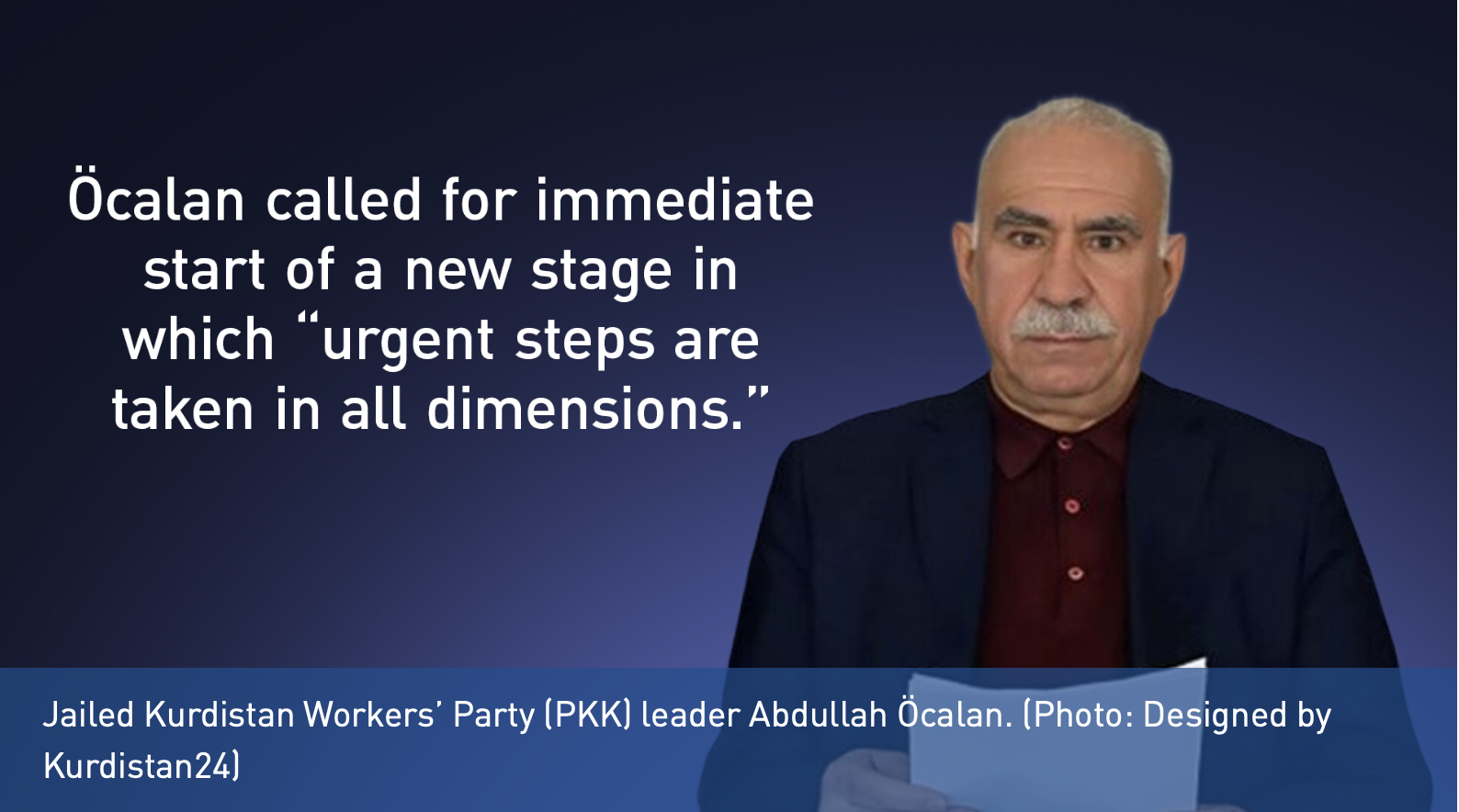
Picture via Kurdistan24 Net
On Ocalan’s call to disarm to the Kurdish national movement;
4 March, 2026
This is an original article from Turkish militants. It was translated and first published in France in October 2025; by Rassemblement des Organisé des Communistes Marxisme-Léninisme (ROCML); or Gathering of Marxist-Leninist Communists”. It bore the title “The past year and the “peace process” (at: ROCML ). It was first published in Turkish by Hasan Ozan İltemur, in Turkish at 17 October 2025.
It is of interest dealing as it does – with the process playing out in Turkey, and Erdogan’s continued collaboration with USA imperialism. It centers on the reactionary role of Abdullah Öcalan. Despite the imperialist war now going on, and the time it was first published in October 2025 – this article remains of interest.
However there are some changes to note. This is therefore updated as it relates to the Kurdish movements in Syria and in Iran, in a short Post-script given at the end. The potential role of the Iranians Kurds – and their possible joining with USA imperialism in its war on Iran – is also discussed in this postscript.
A short Appendix reprising some history of Öcalan is also provided.
Introduction
This article concerns the Turkish state and its manipulation of the “Partiya Karkerên Kurdistan” (PKK) or “Workers Party of Kurdistan” leader Abdullah Öcalan, and some resulting effects on Rojava and Syria. It bears on Öcalan’s most recent – and perhaps most dramatic service – on behalf of the Turkish dominant capitalist class led by Erdogan.
Naturally the Kurdish struggle has been a key part of the workers struggle in Turkey:
“The attitude of Turkey is especially important to the Kurds, since:
“well over half of the world’s 25 million to 30 million Kurds live in Turkey. The emerging statehood in the ‘South’ (north of Iraq) is, in effect, more vital to the Turkish polity than anything else in Iraq: Ankara’s biggest concern is no secret: the prevention of a Kurdish nation in northern Iraq. Turkish officials have long feared that a Kurdish state would incite their own Kurdish population leading to a possible uprising as Turkish Kurds express their solidarity with Iraqi Kurds realizing their long-lived dream of statehood.”
Ozcan, Ali Kemal. Turkey’s Kurds : A Theoretical Analysis of the PKK and Abdullah Ocalan, Routledge, 2005; p. 4
We have written previously about the convoluted and now centuries-long, history of the Kurdish people’s struggle for national rights. Some relevant linked articles by Garbis Altinoglu and by ourselves – are listed in the Appendix, which also gives a potted reprise on Öcalan’s past.
Simply put – the Kurdish struggle has been stymied even up till today.
Firstly because of the division of its territory and its peoples – between all the surrounding and enveloping (let us say suffocating) countries. Namely Turkey, Syria, Iran and Iraq.
Secondly because of the lateness in history at which the Kurdish bourgeoisie arrived on the historical stage.
Thirdly because of the compromising nature of the Kurdish bourgeoisie itself, many fragments of it were always opportunely looking for a short cut compromise. Whether with USA imperialism or any other.
Lastly because of the lack of a Marxist-Leninist party in the region.
We have not dealt with the most recent dramatic steps of Abdullah Öcalan. This republished article helps to rectify this omission. It also makes some needed connections to events in Syria.
Many will recall that Öcalan was captured and imprisoned in 1999 by the Turkish state assisted by the USA. Since then he has been held in isolation on the island Imrali.
As the ROCML say:
“Öcalan is the imprisoned leader of the PKK party [Partiya Karkerên Kurdistanê – PKK (Parti des travailleurs du Kurdistan) and his ‘Call of Öçalan’ was issued on 27 February 2025.
Appel d’Öçalan, 27 février 2025
In that speech of February 2025 he called for “surrender” and “dissolving” of the PKK:
“The PKK, the longest-running and most widespread rebellion and violence movement in the republic’s history, gained strength and support primarily through the closure of democratic political channels….
The inevitable outcome of extreme nationalist excesses—such as the pursuit of a separate nation-state, federalism, administrative autonomy, and culturalist solutions—fails to take into account the sociological realities of history.
I am calling for a surrender and I accept the historical responsibility for it…
I call upon you to convene your congress and make the decision to voluntarily integrate into the state and society. All groups must lay down their arms, and the PKK must dissolve. I salute all those who believe in coexistence and who heed my call.” (ROCML)
Certainly the details concerning the Turkish President Erdogan – after the USA and Israeli imperialist attack on Iran – are likely to have changed to an extent. As well, aspects of the situation in Rojava may have changed. We have already given a preliminary view of this imperialist war (USA and Israel Warmongers Launch Their Imperialist War on Iran MLRG.online March 1, 2026). However the fast pace of events in this war, makes updates necessary. We therefore add a short postscript to this article – dated 4th March 2025 – at the end.
To summarise then we carry three parts in this article:
i) The Turkish original article in English;
ii) A post-script describing ongoing repercussions of the imperialist war now on-going
iii) An appendix with links of prior articles on Kurdistan, and a short reprise on Öcalan’s history.
Part 1: The original article of the ROCML from Hasan Ozan İltemur 17 October 2025

I.
The past year and the “peace process” (“L’année écoulée et le “processus de paix” . . . )
Hasan Ozan İltemur; 17 October 2025
Translated from Turkish to French by ROCML.
The “process” was initiated by the statements of Devlet Bahçeli (leader of the MHP party (Milliyetçi Hareket Partisi – MHP (Party of National Action) in October 2024.This included the following:
“If the isolation of the terrorist leader is lifted, let him come and speak at the meeting of the DEM parliamentary group in the Turkish National Assembly and proclaim loudly and clearly that terrorism has completely ended and that the organization has been dissolved.”
[Anka Haber Ajansı, broadcast live on October 22, 2024; 51:14 – 52:20].
It was followed by the declaration and appeal of Abdullah Öcalan on February 27, 2025 (Editor – see above Introduction).
A year has passed since then. But nothing concrete has come of it. Even if it was a tactical maneuver, the decisions of the European Court of Human Rights and the Constitutional Court have not been implemented.
[On March 18, 2014, the European Court of Human Rights (ECHR) ruled that Abdullah Öcalan’s conviction to aggravated life imprisonment without the possibility of parole violated the European Convention on Human Rights (ECHR)]
Not a single prisoner sentenced to death has been released… Dilatory tactics, procrastination, stalling tactics, etc., have been the reality of this period. The presidential power has deliberately pursued a policy aimed at restricting the “process” to Imrali [the island of Imrali is where Ocalan is incarcerated in isolation] and the Presidential Palace and the Commission.
Devlet Bahçeli’s empty rhetoric and spectacles, prevents any democratic debate in the public sphere and hinders the Turkish people from engaging in the process democratically.
Bahçeli’s statement of July 21, 2025, reveals how the Palace perceives the process.
“The Palace” is used as a symbolic term for the political “Power” wielded by Erdoğan. Topkapi Palace was built on the orders of Sultan Mehmet the Conqueror (1432-1481). Each Ottoman sultan contributed to it through expansions, renovations, or transformations. Finally, in 1853, Sultan Abdülmecid I moved his court to Dolmabahçe Palace. Erdoğan had a new palace built in Istanbul, inaugurated in 2014, designated “Ak Saray” (“White Palace”). The building is characterized by its sheer scale.
Bahçeli stated that:
“the political and legal possibilities of the presidential system of government, with the theoretical and institutional principles it encompasses, make the consolidation of national unity and brotherhood possible and certain,”
The Palace alliance is advancing in the direction of protecting and perpetuating its own power. We should not expect the Palace to initiate a “peace and resolution process” that would thwart its plans. We will all see together whether the Palace’s calculations will be successful or not. We know that without the struggle of the people, it is impossible to budge fascism and capitalism in any way.
II.
We have written repeatedly that the religious fascist dictatorship places great importance on the credibility of its action plan in order to achieve its objectives. It is for this purpose that Bahçeli takes center stage. On September 12, 2025, Bahçeli’s statement that it was absolutely necessary to comply with Öcalan’s “decisions” and “instructions” as the “founding leader” is “interesting.” Let’s read it together:
“Wherever the PKK and its constituent parts are located, it is obligatory to submit to Öcalan, to respect him, and to act in accordance with his instructions. Distancing oneself is considered a takeover by certain circles outside of Öcalan. In this case, we maintain our determination to implement the decisions made by Öcalan.”
It is “interesting” that Bahçeli insisted on “Öcalan,” “Öcalan’s decisions,” “the founding leader“; and that “everyone must comply with the founding leader“. This in a context marked by rising threats of invasion against Rojava and the HSD (Hêzên Sûriya Demokratîk or Forces démocratiques syriennes FDS or Syrian Democratic Forces SDF).
The above statement reflects the disappointment of the State and the Palace, who have not obtained what they wanted in Syria, and their psychological warfare. According to Bahçeli, the State and the Palace believe that Öcalan’s statements imply that the autonomous administration and the SDF in Syria will dissolve and submit to the Hayat Tahrir al-Sham (HTS or HTŞ).
Bahçeli thus states it clearly: “He will not listen to Öcalan,” and all patriotic Kurdish civilian and military structures will be crushed and treated as terrorists. We emphasize that Bahçeli’s deceptive and laudatory propaganda regarding Öcalan is linked to multiple calculations.
Bahçeli’s threatening statements continue, accompanied by praise for the “founding leader.” However, we know that no serious measures have been taken in practice for a year. Duran Kalkan’s statements also reflect the current situation:
“Despite everything that has been done, there is no change on the western front”; and
“Bahçeli thinks he can fool us by talking about the ‘founding leader’”
See 14 October 2025, See Mezopotamya Haber and Further ; Also See
Öçalan’s isolation continues systematically. Visits by the delegations of HDP (Halkların Demokratik Partisi – HDP Peoples’ Democratic Party; known also as DEM (Peoples’ Equality and Democracy Party) to İmralı are permitted only under extremely controlled conditions.
(For details concerning the difficulties encountered by political parties associated with the Kurdish movement, see One; Two; Three )
Let us listen to Duran Kalkan :
“…There are some opposition parties. They have a partially positive approach. But the ruling power has not abandoned its mentality and its policy of denial and extermination of the Kurds. It does not recognize the existence of the Kurds. It does not call them “Kurds.” It does not talk about Kurdish rights. It does not acknowledge the existence of the Kurdish problem. It does not seek a solution. There is nothing positive in response to what we are doing. They are dragging out the commission, they are dragging out the discussions. We have absolutely no idea what will happen. The mountain will bring forth a mouse. In the end, they will adopt a new repentance law. Let’s say right now that if that’s the case, are you going to accept it? Are you going to blame yourselves? Do what you want. It will have no effect on a single person. In this mountain, no one can bring down the fighters, except for the freedom of the leader Apo [“Apo” – “oncle”, in Kurdish]. Even if they wait 40 years, they won’t succeed. Even if they say whatever they want, they won’t succeed. No one will do it, no one will make them do it. No one should expect that of us. We cannot do such a thing.”
Duran Kalkan
A few days ago, Bahçeli stated in a press release that everyone must comply with Öcalan’s declaration of February 27, 2025, and that anyone acting contrary to it was foolish and would be crushed. In this statement, he specifically targeted the HSD (or DEM) parties. It is constantly repeated that the HSD is acting against Öcalan’s declarations and decisions, and that the HSD and the autonomous region should dissolve and surrender immediately to either:
the HTS, or to the MSO (Milli Süriye Ordusu, or the Armée nationale syrienne – Syrian National Army – ANS) or to the MIT (Milli İstihbarat Teşkilatı – theTurkish Intelligence Agency).
A systematic propaganda campaign is also being waged to claim that the HSD acted in violation of the agreement signed on March 10, 2025 with the HTS. This agreement was reached in Damascus between Ahmed al-Sharaa, the interim president of Syria, and Mazloum Abdi leader of the Syrian Kurds (also known as General Kobani) – the head of the HSD or Syrian Democratic Forces SDF.
See, for example General Mazloum Abdi:
“During this sensitive period, we are all working together to ensure a transition process that reflects our people’s aspirations for justice and stability. We are determined to build a better future that guarantees the rights of all Syrians and responds to their aspirations for peace and dignity. We consider this agreement a real opportunity to build a new Syria that includes all its constituent parts and ensures good neighborly relations.”
Le Monde
This is a blatant lie. It was not the HSD that acted in violation of the October 10, 2025 agreement but rather the HTS, the Turkish state, and the presidential palace. As reported from Hassakeh (Syria), on the October 13, 2025 (AFP) – Mazloum Abdi, announced in an interview with AFP that he had reached an “agreement in principle” with the central government in Damascus on the integration of his troops into the Syrian security forces.
It was the HTS that violated the agreement signed on March 10, 2025 between General Kobani [i.e. Mazloum Abdi] and the so-called “President” al-Julani – now known as Ahmed Hussein al-Sharaa – in the presence of world public opinion and took no action whatsoever, quite the contrary. We wish to emphasize here the decisive role of Turkey and Erdoğan’s fascism.
[Abu Mohammed al-Julani was the name adopted by Ahmed Hussein al-Sharaa during his activities linked to ISIS (“Islamic State”). In January 2012, he founded al-Nusra alongside Abu Bakr al-Baghdadi, the leader of the Islamic State; in 2017, he merged al-Nusra with the broader Islamist organization HTS. After the fall of Bashar al-Assad’s regime, he reverted to his original name.
Let us remember that, immediately after the agreement, Al-Julani proclaimed a so-called “Constitution” under orders from the Turkish Palace and the Ministry of Foreign Affairs.
This “Constitution” is racist, chauvinistic, Islamist, based on the power of a single man and represents only Al-Julani and Erdoğan. Similarly, recently, sham “elections” were organized thanks to the alliance between Erdoğan and Al-Julani. Furthermore, Kurdish neighborhoods (Eşrefiye and Şeyh Maksut) and Kurdish positions have been attacked, particularly in Aleppo. With the support and guidance of Erdoğan, the Palace, and Turkey, the HTS and its gangs have perpetrated genocide against the Alevis and Druze.
The leader of HTS – al-Julani has no legitimacy among the Syrian people. Like Erdoğan, al-Julani derives his legitimacy from the Trump administration in the US. Yet al-Julani categorically rejects the will of the Syrian people, as well as that of the autonomous region and the HSD, which constitute the most organized force.
This is the situation, yet it is brazenly claimed that the HSD is not respecting the signed agreement. Moreover, this agreement was essentially an agreement between Turkey and HTS. HTS and Erdoğan’s regime were forced to sign the agreement under pressure from the USA, but not to implement it. Events have proven this. On the other hand, the HSD waged a fierce struggle to ensure the agreement’s implementation. Despite this, the fascism of Erdoğan and al-Julani manipulates public opinion by distorting reality.
The representatives of fascism and capital apply, as in all areas, the following policy: if you repeat a lie a thousand times, day and night, it eventually becomes believable (March 10, 2025 Agreement).
In this complex process, we see Bahçeli, presented as “the greatest democrat, the fighter for democracy,” adding an “opening to the Alevis” to his “opening to the Kurds.” Bahçeli, who declares, “The Kurds are ours, the Alevis are ours, we are Turkey,” thus embodies the essence and summary of this “us,” this “all of us“:
“Turkish nationalism is the guarantee of the independence of the noble and sacred Turkish people, the guarantee of the existence of its historical personality and its national identity.”
The message is clear! Bahçeli is a wolf in sheep’s clothing. It would be foolish to forget it. These “openings” are linked to the dictatorship, the Palace, the impasse in which the “republican coalition” finds itself, and its sordid, multifaceted calculations. But as with the Kurdish question, we also know that with the Alevi question, the capitalist state and the political regime have failed and need new maneuvers…
It may be unnecessary to reiterate, but let us recall nonetheless that Erdoğan, trained by the USA and the CIA, recently went to the White House, his place of pilgrimage, to obtain from Trump the “legitimacy” he desired. He gave a great deal in exchange for this “legitimacy” – we won’t go into details – but it became clear that he had sold himself as a friend of the US and Israel in order to implement the imperialist and Zionist colonialist plan for Palestine…
We also cannot forget Erdoğan’s emphasis on the fact that:
“While maps are once again being drawn in blood, as Israel moves its war front closer to Gaza in Lebanon, we are trying to strengthen our home front.”
The emphasis on “strengthening the home front” serves no other purpose than to guarantee the stability and continuity of Erdoğan’s religious fascism, to reshape all opposition forces deemed a threat by either neutralizing or directly crushing them, and to subject them to dictatorship. This policy brings neither peace nor democracy.
III
As can clearly be seen, the national and international actors involved in the ongoing process are seeking to steer it and define its agenda according to their class, strategic, and tactical interests. In both a strict and broad sense, the counter-revolutionary front is not working to democratize Turkey, but to mold it according to its own interests. The Kurdish question in the Middle East and in Turkey is also being addressed from this perspective…
In this context, Öcalan, from his point of view, aspires to a transformation based on bourgeois democracy and social reforms. He is exerting pressure in line with his own position.
The main motive for launching this process is the reshaping of the Middle East under the aegis of the US and Israel. This “restructuring” is linked to new developments that have taken place since the 1990s, and particularly since the 2000s. Within the framework of an international process in general and a regional one – the “Greater Middle East Initiative” (GMO), as launched by the US government of George Bush at the beginning of 2004, which proposed the rapid creation of a free trade zone between the USA and the Middle East.
These restructurings relate to the struggles for imperialist hegemony and competition, and to the redefinition of the balance of power at each stage of this process. We are all witnessing developments occurring on our doorstep, in Syria, Lebanon, Palestine, Yemen, Iran, Iraq… as well as the growing influence of Israel…
The fall of the “bipolar world“; the crushing defeat of the world revolution;
the proclamation by the USA of the 21st century as the “century of Americanism“;
the fall of the USSR and the frenzied partitioning of its spheres of influence by the USA, NATO, and the Western imperialist states; the decline of American imperialism;
the rise of the Chinese state;
the rapid transition to multipolarity and its rise; the intensification of “Eurasia” and “Asia-Pacific” strategies in the struggle for hegemony between imperialist states;
the vital geoeconomic, geostrategic and geopolitical importance of the “GMO” area in strategic struggles;
the specific weight of competition in the struggle for the establishment of American hegemony;
the rise of Israel;
the crushing defeats suffered by Iran and the “axis of resistance”;
the serious problems created by the collapse of the Syrian regime;
the ongoing operation aimed at bringing Iran and Iraq to their knees;
The national reality of the Kurdish people, divided into four parts, particularly the resistance led by the PKK, the Rojava revolution and the creation of a local Kurdish state, as well as –
the question of the “survival” of the palace for the Turkish ruling classes and the need to consolidate the “home front”…
This quick and incomplete summary shows that the “process” cannot and should not be approached within narrow limits, but rather is part of a broader context. In other words, the problem is quite complex and, at first glance, a democratic solution to the 100- to 200-year-old Kurdish question does not seem feasible at present. However, any democratic gains for Kurds that can be achieved during this process are very valuable.
The decline of Iran in the balance of power and the rise of the US and Israel;
the neo-Ottoman expansionist strategy and Turkey’s imperial pretensions, which clash with the alliance between the US, the West, Israel, and the Gulf states;
the crisis and impasse created by colonial policies against the Kurds, which have failed throughout the Middle East on the Turkish front;
the rise of social and political opposition;
the picture emerging with the substantial loss of power and retreat of the political regime based on the dictatorship of one man, the power of the palace.
In this context, the operation carried out by the religious fascist dictatorship to secure its power by conceiving, fragmenting, and crushing the political and social opposition through fascist terrorism. The CHP [I)], is forced to exceed the limits of “His Majesty’s Opposition”. The CHP, allied with the Palace, with Kılıçdaroğlu, the “Palace man,” pushed towards an internal crisis (Operation “Mutlak Butan,” the appointment of interim administrators to the provincial leadership and in the CHP’s municipalities), and even a split within the CHP. Kılıçdaroğlu during his tenure as CHP chairman, continues to support Erdoğan, presenting him as a reliable figure. The policy is aimed at guaranteeing Erdoğan’s “eternal presidency”; the maneuvers are aimed at manipulating the ongoing “peace” process to ensure the continuity of the political regime…
Öcalan, for his part, asserts that the Kurdish people have abandoned their demands for national independence, federation, autonomy, and even “culturalism,” and that they will now be content to engage in legal politics, demanding that the process be framed by appropriate legal and regulatory guarantees. This regression stems from Imrali-Öcalan’s political line.
Here we see that Imrali’s paradigm has also evolved, reverting to its lowest point. In this context, contrary to experiences of peace and conflict resolution around the world, Öcalan seeks to force the fascist colonialist dictatorship to accept a “democratic peace,” a “democratic solution,” and a “democratic republic” by immediately dissolving the PKK, ending the armed struggle, and abandoning the demand for recognition of the Kurdish people’s collective rights as a precondition. Öcalan emphasizes that the fundamental method for achieving this is “democratic negotiation.” He further asserts that “democratic negotiation” is the fundamental method and approach for resolving the problems of our time.
In this context, Öcalan believes that, if it materializes, the new stage (the stage of legal democratic political struggle) will build upon the rich historical legacy and accumulated material and political power, and that national rights will ultimately be obtained one way or another, thus framing the issue as a political imperative. Öcalan believes that his new paradigm and political style will also serve to preserve Rojava’s position/achievements in Syria. Öcalan’s statements, particularly his “Manifesto” of February 27, appear to have no other meaning.
The rhetoric surrounding the renewal of the Turkish-Kurdish alliance in the Middle East, aimed at making Turkey the region’s superpower, reflects the neo-Ottoman imperial policies of the Turkish presidential power, state, and ruling classes.
We wish to emphasize that the Kurdish national bourgeoisie, by submitting to Turkish capital, embodies a policy of “class change” and gaining influence through enrichment both in Northern Kurdistan and regionally. We would also like to add that what is said about the “millennial alliance and brotherhood between Turks and Kurds” is in reality a reactionary historical alliance between the Ottoman feudal state and local Kurdish feudal lords. Presenting these realities to the public while concealing them reflects a reactionary liberal attitude. Evaluating the objective benefits that the Kurdish and Turkish peoples have brought and could bring from living “under the same roof” for a long historical period is one thing. But sanctifying the reactionary historical alliance is quite another. It is right to evaluate the former, but it is wrong to sanctify the latter (the reactionary alliance).
IV.
The colonialist fascist dictatorship and the religious fascist regime of the Palace do not recognize the national democratic rights of the Kurdish people, nor do they seek to establish a dignified democratic peace and solution.
On the contrary, they seek to buy time by eliminating the Rojava guerrilla movement (“A Turkey without terrorism“);
dividing the national movement from within;
preventing the Kurdish people’s democratic movement from uniting with the mass anti-fascist movement developing in the West, using delaying tactics in line with the political calculations of the dictatorship and the Palace;
neutralizing the Kurdish people under the pretext of “negotiations“; and
attracting “conservative Kurds” into their ranks in order to perpetuate Erdoğan’s political regime.
The dilatory nature of the process also aims to consolidate Turkey’s influence in Syria, strengthen the power of the HTŞ, and consequently weaken and eliminate Rojava’s position. In other words, the “solution” policy of the presidential regime and its allies is based on preserving and reinforcing their hegemony in line with their primary objectives. The process presented by fascism and capitalism under the slogans “A Turkey without terrorism” and “Dialogue, negotiation, peace, solution” aims, far from creating a “democratic society,” to use the process for their own benefit and to strengthen an increasingly centralized power. On the one hand, they promote “peace” and “democratization,” while on the other, as reported by the media, they attempt, through new legal regulations, to seize significant municipal powers and bring them under the control of the presidential palace and its cabinet.
Let us note immediately that the fascist colonialist dictatorship will use every means at its disposal to eliminate Rojava’s position.
It also intends to use the “peace process” for this purpose… We are facing an even more arrogant “New Turkey” process, which aims to crush the political and social opposition and resistance movements within the country, and to eliminate Rojava externally, in order to act without hindrance both domestically and internationally.
Aside from the inconsistent statements of Thomas Barrak, the US ambassador to Turkey and Trump’s special representative for the Middle East and Syria;
the growing reactions of the Druze and Alevis, as well as of secular and secularized Sunni Arab populations;
the demands for autonomy and, to a lesser extent, independence from the first two groups;
and the determined resistance of the Rojava government to the plans and pressure of Turkey and the HTS have led,
particularly recently, to an intensification of threats of military intervention against Rojava by the Turkish fascist leadership.
The fact that Erdoğan’s threatening statements after his visit to the US took a relatively “moderate” form, and that the HSD commander, Mazlum Abdi, stated in his recent meetings with al-Julani and Damascus that “an agreement in principle had been reached,” should not be misleading. The political situation in Syria is very sensitive and fragile; Any significant political development could disrupt the existing balance and trigger new crises. It is a fact that Turkey occupies a substantial portion of Syrian Kurdistan (Rojava). It will not easily withdraw from the areas it occupies. The MSO and ISIS (Daesh), composed of hired killers from the HTS and Turkey, along with certain tribes, will not alleviate the pressure and siege exerted by the Palace on Rojava. It will also continue to maintain the threat of occupation… The negotiations conducted by Erdoğan at the White House, where he went to gain “legitimacy,” concerning the Kurds and Rojava, will become clearer in the coming months, particularly within the Syrian context.
It should be noted that even if Turkey wished to do so, it could not invade Rojava with its army in the near future, not only because Rojava would resist, but above all because the US (and Israel) oppose such an intervention to defend their own interests, thus preventing Turkey from acting. The fascist colonialist dictatorship is fighting to become the absolute master of Syria. This is linked to Turkey’s expansionist and neo-Ottoman strategy in the region, as well as its disastrous plans regarding the Kurdish movement and its strategy to stifle the Rojava revolution. And the Rojava question is a fundamental and paramount issue that will determine the fate of the process underway in Turkey. There is no doubt that the objective situation is different in Syria, where Turkey aspires to…
V.
We have discussed the process that has been initiated, but so far, neither the State nor the Presidential Palace has taken any concrete steps required by this process. First and foremost, Öcalan’s controlled isolation continues. The first step should have been to allow Öcalan to communicate and interact freely with the public under favorable conditions. The patriotic movement rightly emphasizes that the most important and priority issue is Öcalan’s freedom of movement and demands an immediate end to his isolation. While we may accept the Commission established without even obtaining legal guarantees within the Turkish National Assembly as a step forward, it is necessary to recall the following points:
The Commission was created with the aim of “liberating Turkey from terrorism.” The word “peace” does not even appear in the commission’s name (“National Commission for Solidarity, Fraternity, and Democracy”). The participation of the General Staff, the MSB (Millî Savunma Bakanlığı – MSB Ministry of National Defense), and the MIT in the commission meeting, along with their presentations and the limitations and confidentiality measures they imposed, clearly demonstrate that the commission is solely focused on the disarmament of the PKK and the guerrillas. From the outset, it is geared towards the survival and domination of the Palace and the state. The Kurdish Mothers summoned before the commission, supposedly tasked with resolving the so-called Kurdish problem, were not even allowed to speak in Kurdish, and their statements in Kurdish were not recorded in the minutes. The Commission has no authority over the “process.” It functions as a Palace committee.
As for the Parliament, presented as the solution, it exists in name only. It has no authority, no influence, and is merely an executor of the orders of the Palace and the “Coalition of the Republic.” The fact that the Turkish Parliament is called a “Parliament” does not mean that a real parliament exists. Everything now depends on Erdoğan.
With the “presidential system of government,” the Turkish Grand National Assembly‘s role as a fig leaf for capital has also been eliminated. The Constitution, the law, the legal system, the legislative power, the judicial power, and the executive power are all merely Erdoğan’s fascism. In the “one-man regime,” the Grand National Assembly is meaningless. However, in order to preserve the appearance of “democratic elections” and a “democratic parliament” in Turkey, this aberration called a “parliament” is maintained. The bourgeois regime and opposition continue to play this deplorable game. Therefore, if anything is to emerge in the name of “peace and a solution,” it will not be within the central parliament.
The creation of a committee within the Turkish Grand National Assembly was Öcalan’s proposal. Indeed, an illegal and powerless Commission has been created. However, we must not ignore the reality we have highlighted: this commission is a reflection of the “Turkey without Terrorism” operation led by the palace regime and its allies. The role that the HDP, the liberals, and the petty-bourgeois democrats have rather exaggeratedly attributed to this commission is misleading and serves the interests of the palace. It is, of course, impossible to oppose the commission, even if it was created formally, being used as a platform.
In this context, it is more important that the HDP, which sits on the commission and is the main interlocutor in the process on the legal political front, be able to use this platform as a means of addressing national and international public opinion with a consistent anti-fascist stance. The HDP is attempting to do this to some extent.
However, in this area, the HDP must be very careful to avoid excessive praise for fascist leaders. It must modify its rhetoric, which fosters dreams, generates unrealistic expectations, and goes beyond diplomatic courtesy and language. Clearly, this rhetoric, which creates inflated expectations, weakens the HDP’s anti-fascist position within the commission. It is right to use all fronts, including this interim commission, as a means of addressing and reaching a broad audience. Ultimately, the commission is also a battleground, and the important thing is to skillfully use this platform for democratic demands, particularly the national democratic demands of the Kurds, against the religious fascist dictatorship and the coup junta that rules it.
Acting timidly and passively under the pretext of “not compromising the process” is precisely what the capitalist state and the presidential palace want, and this is what is being imposed on the Kurdish people and the HDP. As in all areas, within the framework of the commission’s work, we must fight while remaining within the bounds of legitimacy.
But it is wrong to try to appear as highly peaceful. Diplomatic courtesy is also necessary on this platform, but the limits of this diplomatic “courtesy” must be clearly defined. We must not forget that it is not the government that must be convinced and whose trust must be gained, but the people. The ruling classes know very well what the Palace is doing… If the process and the work of the commission do not exceed the limits set by the fascist regime, it is clear that this situation will be detrimental to the people, especially the Kurdish people.
The commission will soon conclude its hearings. The MIT (National Intelligence Organization), the General Staff, and the Ministry of Foreign Affairs will participate in the closing meeting, and an assessment of the situation will be conducted. A report will then be submitted to Parliament.
The commission will only be able to play a more or less positive role in the name of “peace” thanks to the strength of the unified anti-fascist struggle of the peoples of Turkey, which will pave the way for it. In this context, the Kurdish people are in a position to play a leading role. The path can be opened by the emergence of the Kurdish patriotic movement, the HDP, in the name of “negotiation,” in collaboration with the legitimate, powerful, and massive anti-fascist movement developing in the West.
But it is clear that the actors are remaining on the sidelines on this issue, adopting a passive attitude, which is extremely dangerous and amounts to placing themselves in an ineffective position to counter the religious fascist plan.
Of course, this approach is drawing justified criticism from progressive and revolutionary public opinion. It is clear that the diplomatic front must be complemented by massive and sustained action, and that this course must be followed. This, among other things, will strengthen the “diplomatic front.” Failing to commit to this path for various reasons and adopting a lax attitude is in the interest of neither the Kurdish people nor any other peoples. While formulating these criticisms, we are aware that the Patriotic Movement and the HDP face particular difficulties.
Nevertheless, the Patriotic Movement and the HDP are fighting against racism, chauvinism, militarism, and oppression, and are facing considerable challenges. This anti-fascist resistance is invaluable; it must be supported, and we must fight side by side. Criticisms levelled at the HDP cannot be an obstacle to the development of the struggle based on the common ground of anti-fascist demands.
VI.
A statement will also be made regarding the position of the patriotic forces and the HDP in the face of the smear campaign and attacks waged by the fascist and religious regime of the palace against the CHP.
The CHP is the target of openly religious fascist terrorism. The operation to make the CHP, under Erdoğan’s leadership the pillar of Erdoğan and the political regime, takes place through a complex alliance.
This alliance was between Ergenekon, the nationalists, the Palace, and Kemal Kılıçdaroğlu’s clique, which goes far beyond a simple internal CHP problem. “Ergenekon” was the name used for a destabilization operation by generals against the AKP’s dominance (in 2010, another similar case, the “Balyöz” plan, emerged). At first glance, the composition of this “alliance” seems incongruous.
In 2007, the crackdown began against those associated with these alleged conspiracies, and more broadly against opponents of the ruling power. At the time, supporters of the exiled cleric Fethullah Gülen were also involved, working alongside the AKP. However, in 2013, following an investigation opened against Erdoğan, who was accused of corruption, he turned against Gülen. The “Ergenekon” affair was closed with the abandonment of legal proceedings, and a rapprochement between the AKP and the generals was able to take place.
Kemal Kılıçdaroğlu had been the leader of the CHP party since 2010 when he ran for president in 2023. His defeat to Erdoğan led to his replacement as CHP leader by Özgür Özel. Since then, the authorities have attempted to obstruct the CHP by intervening against its representatives, notably Ekrem İmamoğlu, who in 2019 was elected mayor of Istanbul, defeating the AKP candidate. In this context, Kılıçdaroğlu has taken a position that undermines the direction adopted by the CHP.
This wave of attacks is, in essence, directed against the proletariat and the people.
The game being played is also linked to this calculation. The policy of weakening the CHP aims to suppress democratic rights and freedoms, the right to vote and to stand for election, and to bring all sectors into line behind the palace. Yes, this operation and this attack aim to eliminate the CHP as Erdoğan’s rival. But they are also an expression of a policy that, through the CHP, seeks to intimidate and repress all oppressed groups and stifle any mass movement that might develop independently of the state and the palace.
Clearly, social psychology must be shaped accordingly. The religious fascist terrorism and dirty psychological warfare developed through the instrumentalization of the CHP aims to prevent people from uniting in the struggle; to neutralize patriotic forces; to isolate and divide the Kurdish people. And, therefore when the time comes, to easily crush the Kurdish struggle in the arena of isolation.
This wave of attacks is also an operation to prepare the “home front” for a possible occupation intended to crush the Rojava revolution and Kurdish autonomy. The only thing that will thwart the sinister plans that the regime in power at the palace wishes to implement both domestically and internationally, and pave the way for change, is the struggle of the people. It is clear that such a struggle cannot be expected from the CHP. It is essential that this struggle be led by patriotic and revolutionary political forces.
The Kurdish movement withdrew in the name of “peace” and “negotiations.” Law, justice, and the rule of law must prevail; the success of the operation to terrorize, discredit, and divide the CHP goes hand in hand with the policy of weakening the Kurdish people’s struggle, makes it controllable. While simultaneously suppressing growing social protest, the struggle of workers, women, and youth.
Capital favors the continuity of the political regime, accompanied by adjustments to the balance of power. The “People’s Alliance” is determined to continue its course with Erdoğan, who recently obtained authorization (“legitimacy“) from the US. The “People’s Alliance” (Cumhur İttifakı) is an electoral coalition composed of the AKP, the MHP and the Büyük Birlik Partisi (Great Unity Party).
One of the most important means of achieving this, and indeed the most important – is to bring the Kurdish people under control, to control them, etc., in the name of “peace.” In other words, the problem is not solely a Western issue. On the contrary, in this context, attacks, provocations, and the policy of collapse are a problem common to both East and West. Attitudes such as “this doesn’t concern us; where was the CHP while we were suffering fierce repression?” etc., are mistaken.
Such an attitude and position amount to abandoning to the CHP the masses who must be won over to the progressive, revolutionary, and patriotic cause. We must not allow ourselves to be sidelined by the CHP. The anti-fascist social reaction and the struggle of the masses cannot be abandoned to the CHP. The political realities concerning the red lines between the CHP and the regime must be constantly explained to the masses, but this must not, and must not, prevent opposition to the fascist terror of the fascist and religious power in the Palace, which also targets the CHP. This is also a very important and urgent way to reach the CHP’s working-class base.
The Kurdish movement and the HDP must persevere in their “third way” policy. They must consistently oppose the attack aimed at eliminating political and social opposition through the CHP. By withdrawing (essentially) from this policy, by limiting themselves to written or verbal statements, symbolic support, and a passive stance, it becomes impossible to adopt an active antifascist position against the terrorism targeting the CHP and to unite with the popular antifascist movement that has transcended the CHP.
This weakness is clearly manifested in the indifference of the patriotic press to developments targeting the CHP. This is also observed regarding the Israeli-Palestinian conflict, particularly in the context of the Palestinian genocide. This indifference extends to the struggle of the people. Likewise, they are seriously hindering the establishment of a legitimate, massive, and widespread popular movement that would unite around the demands for peace and democracy in both East and West. This attitude will come at a high price. If not today, then tomorrow. Should the process launched in the name of a “Turkey without terrorism” fail, the Kurdish movement will face a wave of violent attacks and will lose, or could lose, much of its capacity to retaliate through a broad, progressive, and combative alliance.
Erdoğan, who exudes malice in everything he does, released certain photos to the public on the day of the opening of the Turkish National Assembly, as part of a scheme he orchestrated with dishonest intentions. The CHP and Özgür Özel were exposed for pursuing a “policy of tension.” The photos shared with the public were intended to expose Özel and the CHP, who had not participated in the opening ceremony. On the other hand, these same photos presented Erdoğan as a “unifier, opposed to the politics of tension, sensible, mature, and constructive,” while he constantly feeds on the most despicable politics of tension.
Upon his return from the US, where he had gone to obtain authorization, Erdoğan declared in a speech on the plane: “This photo is the true image of Turkey. Some try to portray Turkey as a country divided into camps, in tatters, but the truth is the unity and cohesion that reign there. Those who are not part of this picture should sit down and reflect,” he threatened.
Following Erdoğan’s dirty trick, an article by columnist Abdulkadir Selvi was published in the newspaper Hürriyet. In his article titled “Erdoğan’s New Plan and Özgür Özel’s Politics of Tension,” published on October 9, 2025, Selvi writes:
“Erdoğan will fight to isolate the CHP in the new period. He will relentlessly attack the CHP. He will target Özgür Özel. He has called Özgür Özel a ‘puppet president.’ He will strive to sow discord between the CHP and other opposition parties. He will strive to leave the CHP alone in the opposition.”
It is clear that the process initiated by Bahçeli’s statement, which aims to neutralize the CHP, subjugate it, and align it with its policies, will continue intensively.
In the coming period, it will be essential to give due weight to the “third way” policy, which will not be limited to fine words but will translate into a genuine political stance. It is imperative to mobilize all available energies and resources within the framework of a unified collective struggle, and not to leave the CHP (Christian People’s Party) to lead the antifascist struggle and reaction on the social and political level.
Wherever it manifests itself, the narrow-mindedness and apoliticism that consist of saying “they’re tearing each other apart” when Israel attacks Iran, or “they’re tearing each other apart” when the Palace’s fascism attacks the CHP, or remaining indifferent to the ruthless genocide perpetrated by Israel in Palestine, are simply reactionary. We conclude our article by stating that this indifference and primitiveness are incompatible with antifascist coherence and even with a coherent bourgeois democracy.”
End of Article.
Part Two:
Postscript Following the February Imperialist war on Iran – written by MLRG.online
It is entirely within the overall war aims of the USA and Israel is to completely fragment Iran. As for so long now, the Kurds have been used as a pawn. This is happening again. This time the Iranian Kurds are being enticed:
“The CIA is preparing to arm Kurdish forces to incite an uprising against the Iranian government, according to reports.
US officials have held talks with Iranian opposition groups and with Kurdish leaders in Iraq to provide them with military support to help overthrow the Islamic Republic, several sources told CNN.
The plan would involve Kurdish militias taking part in a ground operation in western Iran in the coming days, a senior Iranian Kurdish official said.
“We believe there is a big chance now,” the source told the American broadcaster. The militias are expected to be aided by both US and Israeli support…
On Sunday, US president Donald Trump called Iraqi Kurdish leaders to discuss the US-Israeli strikes on Iran and offered options on working together, two US officials and a third person familiar with the talks told Axios.
By Tuesday, Mr Trump had spoken with the president of the Democratic Party of Iranian Kurdistan (KDPI), Mustafa Hijri, according to a senior Iranian Kurdish official.”
Maira Butt; “How Kurdish forces could be dragged into the growing US-Iran war by the CIA”: The Independent (London); at Wednesday 04 March 2026
Other reports from the New York Times today, indicate that those old Kurd comprador war-horses – Massoud Barzani and Bafel Talabani are also involved:
“This week, Mr. Trump asked two Iraqi Kurdish leaders, Massoud Barzani and Bafel Talabani, to enable Iranian Kurdish fighters based in Iraq to move into Iran, according to two Iranian Kurdish leaders and two Iraqi security officials.
One of the Iranian Kurdish officials said Mr. Trump had a separate call on Tuesday to discuss sending forces over the border with the head of one of those Kurdish groups, Mustafa Hijri, of the Kurdistan Democratic Party of Iran. All the officials spoke on the condition of anonymity because of the sensitivity of the issue.”
Erika Solomon, Julian E. Barnes, Christiaan Triebert, Parin Behrooz and Farnaz Fassihi; “Pro-American Kurdish Forces Are Preparing Possible Iran Incursion”; New York Times 4 March 2026.
If the Kurdish leaders in Iran and Iraq do Trump’s bidding, they will once more only fulfill Kurdish short term goals. Those dictated and allowed them by the USA. When push comes to shove – once more USA imperialism will leave them high and dry. Once again, the Kurds are largely led by bourgeois nationalists. Many of those those leaders have proven that they are in general faithful to the imperialists – maybe some younger ones simply fall for the same imperialist tricks time and time again.
Meanwhile, in Syria – there have been major changes since the article we carry from Turkey in our main piece – was first published.
But these changes confirm the overall thrust of the Turkish article as published by the French ROCML.
Since January big changes have taken place in Syria. We had previously written on the Syrian state after the fall of Assad in 2024 (Theses on the 2024 Re-emergence of the Syrian anti-Assad Revolution; Dec 23 2024; MLRG.online ). But since then the Kurds have had some set-backs:
“Dramatic changes in Syria in recent weeks have resulted in a major setback for Kurdish aspirations for self-rule. A rapid military offensive by the Damascus government seized northeast Syria from the Kurdish-led Syrian Democratic Forces (SDF), ending the autonomy Kurds had forged there during the civil war.
Having previously supported the SDF, the US did not intervene, reflecting its embrace of President Ahmed al-Sharaa’s Syrian Transitional Government (STG) in Damascus as its main partner in Syria…
The hastily agreed integration protocol of 18 January laid the way for a ceasefire, with the SDF capitulating on some of its previous demands, in particular to integrate into the Syrian military as a unit rather than as individuals.
Two days later, US Syria envoy Tom Barrack provided a rhetorical body blow when he publicly declared that ‘the original purpose of the SDF… has largely expired.’ He argued that Kurds in Syria should integrate into the Syrian state, cementing Washington’s backing of al-Sharaa’s centralizing vision for the country.
By the time a ceasefire was announced on 20 January, Damascus controlled wide swathes of new territory in eastern and northeastern Syria. Only the Kurdish heartlands around Qamishli and Hasakah and the symbolically important border town of Kobani remained in SDF hands.”
Winthrop M. Rodgers; “What recent developments in Syria mean for the Kurds”; Chatham House
However there are said to be:
“Several silver linings that could shape the future, although much depends on whether agreements between the two sides are implemented.”
Ibid. Chatham House
What are these?
“A subsequent agreement between al-Sharaa and SDF commander Mazloum Abdi on 30 January made some concessions to the Kurdish position.
In addition to establishing a permanent ceasefire, this second agreement established protocols for integrating Kurdish units into government institutions that reflect a compromise, with a military division consisting of three brigades of SDF fighters, plus a Kobani-specific brigade in the Aleppo division. While less than what the SDF wanted originally, it was better from their perspective than the 18 January version.
The agreement also called for the appointment of Kurdish officials in local and central government posts, including governor of Hasakah, and recognized Kurdish educational certificates. However, the control of oil fields, border crossings and Qamishli airport was handed to Damascus. “
Chatham House
Would Marxists agree with this analysis? The well known, long time Marxist Syria watcher is Michael Karadjis, who does largely agree:
“The agreement between the Syrian government and the Kurdish-led Syrian Democratic Forces (SDF) on January 30 brings about the integration of the SDF and the Democratic Autonomous Administration of North and East Syria (DAANES) into the Syrian state’s institutions. However, it contains a number of aspects which allow a degree of continued self-rule in the Kurdish regions:
For example, on the main issue which had divided the two sides since the March 10 integration agreement – whether the SDF military would integrate into the Syrian army on an “individual” basis or as a “bloc” – the outcome comes closer to the latter even if formally the former, in that a new army division, consisting of three brigades, will be created for the SDF to collectively ‘integrate into’ in Hasakah governate, while a new brigade for the SDF in Kobani will become part of the Aleppo military division.
The Kurdish Asayish internal security forces will be re-badged as part of Syrian public security, while continuing to patrol Kobani and Kurdish regions in Hasakah.
The Syrian army will not enter any “Kurdish areas,” or any “cities and towns” in Hasakah at all.
The SDF is to appoint the governor of Hasakah governate, the deputy Defence Minister and a number of other high posts, as well as select representatives from Hasakah and Kobani for the People’s Assembly, which had been left vacant last year.
While the civilian institutions of DAANES will be integrated into Syrian institutions, a number of provisions also imply some degree of ‘re-badging’ while maintaining the essence of the ‘autonomous administration’…
the degree of effective local decision-making, including the retention of the more progressive aspects of the Rojava project, could well be questions of interpretation and negotiation, rather than a flat suppression…
Taken as a whole, all of the above represents a picture that is so comprehensively superior to anything during the 60-year Baathist dictatorship or before regarding the Syrian Kurdish issue that it is simply night and day….”
Michael Karadjis; “Rojava, Kurdish autonomy & self-determination, and the hard problem of simple demographics: An essay of maps”; Syrian Revolution – Commentary and Analaysis; February 12, 2026
However Kardjis also points out that:
“However, for supporters of the Rojava revolution, that is hardly the point: during those revolutionary years, they made their own revolution, they contend, so the current agreement integrating the Autonomous Administration into the Syrian state is a setback – not from the Baathist past, but from what they achieved in the meantime.”
Ibid; February 12, 2026
“Ocalan himself, the Rojava project’s key inspiration. In a recent meeting between Öcalan and a commission of the Turkish parliament, he explained that the Kurds should find their place “through democratic self‑organisation within the existing framework” (whether in Turkey or in Syria); not only did this have nothing to do with secession, but it also “has nothing to do with federal autonomy.” In fact, he argued that a state needs both “central unitary powers and regional local democracy,” and that one cannot exist without the other. Far from ‘federalism’, this is an argument for a central state with decentralised power at the local level.”
Ibid. February 12, 2026
We await further developments.
March 4, 2026
Part 3: Appendix: A short summary on Öcalan
The PKK (“Partiya Karkerên Kurdistan” or “Workers Party of Kurdistan”) was formed in 1978. It was first known as the Kurdistan Devrimcileri (Kurdistan Revolutionaries). After this it had several more name changes. Following the capture of the organization’s leader Abdullah Öcalan, “the movement eventually converted itself from a ‘party’ to a ‘congress’ in its 8th ordinary congress, which ended in April 2002. The PKK became KADEK (“Freedom and Democracy Congress of Kurdistan”; Kongreya Azadya Demokrasya Kurdistan). Since the 1980s and especially in the wake of the start of guerilla warfare in Turkish (that is, Northern) Kurdistan in 1984, it had taken refuge in Southern Kurdistan establishing bases and mass support there.
From a Marxist-Leninist perspective, the main problem of the PKK can be summarised as one of a rank opportunism. It has moved in abrupt shifts from ultra-left to right. Soon after the PKK was established in 1978, an extremely sectarian line, was pursued. Especially in 1979 and 1980, the PKK launched physical attacks against almost all other revolutionary groups, including the TKP/M-L Harcketi and various Kurdish nationalist groups. Dozens, possibly hundreds of people, from different groups either died or were injured.
On October 13th, 1995, Öcalan sent a letter to US President Bill Clinton urging him to “exert his persuasive weight” on Turkey, and to assist in “stopping the massacre of a people.” In that letter, Öcalan also stressed that his party was “ideologically different from classical communist parties” and his party was:
“not insisting on changing the frontiers of Turkey and were not for secession from that country.”
At least from 1995, the PKK leadership was continuously underlining its aim to come to terms with Turkish reaction and imperialism in return for the simplest of democratic reforms, such as the recognition of the national identity of Kurdish people. It was systematically trying to assure them (i.e. Turkish reactionaries) of the PKK’s “peaceful” intentions and its readiness and eagerness to cooperate in maintaining “stability.” In an interview given in December 1995, Öcalan called on all political forces in Turkey to come to a “concensus”. He stated a collaborationist theme:
“We will call on the army, we will call on the bureaucracy. If you are in favour of a peace project with us, please come together. We will call on socialists, we will call on liberals. Let’s give an end to this foolish course of events; there exists a common ground. We can find a consensus, a conciliation; we all have our stake in this.”
(Ozgur Politika, 3 February 2002; Cited by Garbis Altinoglu in “A Proposal For A Revolutionary Way Out Of The Crisis; (Abridged from Turkish Document “Bunaluntlan Devrimci Cikis Onerisi”); in Alliance 50 December 2002; at: Alliance ML)
The Kurdish resistance inside Turkey, ended when Abdullah Öcalan was captured in February 1999, with the assistance of the CIA
( Tim Weiner, “U.S. Helped Turkey Find and Capture Kurd Rebel”; New York Times; Feb. 20, 1999; )
Yet – the PKK and Ocalan had already made – and would continue to make – major deals to hitch onto the USA tails. In 2000 Garbis Altinoglu pointed out:
“The PKK’s recent open collaboration with USA imperialism, has long been signalled.”
(Notes On The History Of MLKP And The Revolutionary Movement In Turkey By Garbis Altinoglu; Alliance Marxist-Leninist (North America) Number 35: August 2000; )
By July 2002 the PKK/KADEK leadership openly defended an American intervention in Iraq, and went so far as to criticize the Patriotic Union of Kurdistan (PUK) and the KPD for not giving full and whole-hearted support for an imperialist war against Iraq:
“KADEK, the vanguard of democracy, is fighting regional reaction. Ruling forces, who bear responsibility for the exacerbation of problems, do not approve of an intervention by the US and its allies in the region and attempt to prevent such an eventuality. Ruling forces in Turkey, Iraq, Iran, Syria and other countries of the region feel obliged to form an alliance among themselves in an attempt to prevent intervention. The PUK and the KDP, which represent the local power in Southern Kurdistan are vacillating on the question of supporting the intervention.”
“At the Root of the Impasse in Middle East Stand the Exhausted Regimes”, Serxwebun”; (“Independence”), July 2002
By March 2013, now in jail Öcalan unilaterally declared a ceasefire between the PKK and the Turkish state. From about 2004, he had declared himself no longer a Marxist-Leninist – but a follower of Murray Bookchin – an anarchist. He called for Democratic confederalism – or a “system of popularly elected administrative councils, allowing local communities”.
For our prior works on Kurdistan and Syria please find these:
– A Short Marxist-Leninist History of Syria – to 2016 (MLRG.online 2018)
– Theses on the 2024 Re-emergence of the Syrian anti-Assad Revolution (MLRG.online December 2024)
– Theses on Kurdistan – A Marxist-Leninist Framework, Part One (2019; MLRG.online re-published December 2024)
– Theses on Kurdistan – A Marxist-Leninist Framework, Part Two (2019; re-published January 2025)
For some prior works by the Turkish Marxist-Leninist Garbis Altinoglu please find a partial Archive at MIA:
and also via pages of Alliance ML under letter T in Index for Turkey :
The Hizbullah of Turkey Hizbullah Alliance ML 2000
History of MLCP And the Revolutionary Movement MLCP Alliance 2000
Summary of the Ordeal in Turkish Prisons; Prisons Alliance 2000
Turkish Expansionism & The Imminent USA War against Iraq Alliance 49
Turkey – Who Is Behind Istanbul Bombing November 2003? Alliance ML 2003 Istanbul Bombing
Turkish Revolutionary Movement; Suicide Tactics Turkish Revolutionary Crisis 2002 Suicide tactics Alliance
Kurdistan in the Iraqi-USA war Kurdistan Alliance ML As clouds gather 20023
‘Thank You, Mr. Bush’ – The New Situation Alliance ML Mr. Bush
Posted MLRG.online March 4, 2026


