The “Blue Wave” of 2026: A Marxist-Leninist Assessment
The dust has now settled enough to judge the November 3 U.S. midterms adequately. Generally speaking, the popular vote registered a repudiation of Trump and Trumpism on a scale few predicted. We and most of the left had feared that would precipitate the Trumpite suppression of the vote. We had warned of three methods the Republicans were actively moving to suppress the vote (“USA Elections – Strategies to Fix a win,” 5 October, 2026 MLRG.online).
Surprisingly, Republican plans for voter suppression did not materialize in this cycle. Most likely it became overwhelmingly clear that the volume of anti-ICE and anti-inflation votes was so high that the MAGA forces backed down. Now, as Democrats celebrate, Republicans fume, and “progressives” contemplate their respective roles in government and reform, we ask what the new political landscape means for working people moving forward. The measures the Trump government has taken have not been rescinded, but are either held in reserve or continue in full force.
The midterm elections were a mass repudiation of Trump and Trumpism, and it must be said plainly that the working class won a victory – denying the ruling class both the Democratic victory it could have managed and the MAGA line it likely preferred. This victory was about breathing space, not power, though. The means of suppression and redistricting remain on the books, ready for redeployment in 2028, and Trump is already maneuvering, with the elevation of the ultra-right ghoul Stephen Miller to Chief of Staff being the clearest sign yet. What the new landscape means for working people turns on whether that interval is used, which is the question now at hand.
Lesson One: Voter suppression was postponed, yet not entirely defeated.
In the lead-up to the 2026 midterms, Trump issued multiple executive orders aimed at discouraging or preventing voters from casting ballots. These efforts were largely blocked by temporary court decisions, denying them effects on turnout in the most recent election cycle. But they remain latent threats, although they continue to be contested.
Listed below is a summary of where Trump’s most significant voter-suppression measures stand in the courts:
| Measure | Summary | Status |
|---|---|---|
| Anti-mail voting order | In March, Trump directed the U.S. Postal Service to change handling of mail ballots. USPS then ruled states must use new envelopes with trackable bar codes; or refuse to deliver ballots to voters. | This measure was challenged in lower court by multiple organizations, some related to the Democratic Party. The Supreme Court blocked the changes before the midterms and the matter now returns to the lower courts. |
| Trump’s order for state citizenship lists | Trump instructed the Department of Homeland Security (DHS) to work with the Social Security Administration to create lists of verified U.S. citizens eligible to vote in all 50 states. | The Electronic Privacy Information Center (EPIC) sued DHS and the U.S. Citizenship and Immigration Services over the lists. This prevented significant impact from the order. The matter is currently before a U.S. District Court judge. |
| Trump’s initiative to compile a national voter roll database | Department of Justice (DOJ) forced states to turn over unredacted voter rolls that contain sensitive voter information. | A suit filed by a nonpartisan activist group slowed this process. A U.S. District Judge determined that the Trump Administration exceeded its authority in collecting voter rolls but the DOJ plans to appeal. |
| Trump’s use of taxpayer funds for political ads | In the run-up to the midterms, Trump ordered the administration to spend federal money on propaganda ads promoting himself and his policies. | Groups including the Democratic National Committee filed lawsuits to end the practice; a temporary restraining order was granted, but Trump groups continued using funds for advertising. Litigation remains pending. |
Hutzler, Alexandra. “The Midterms Are over, but Trump’s Legal Assault on Voting Continues. Here’s Where Those Cases Stand.” Democracy Docket, 11 Nov. 2026, www.democracydocket.com/news-alerts/the-midterms-are-over-but-trumps-legal-assault-on-voting-continues-heres-where-those-cases-stand. Accessed 15 Nov. 2026.
What, then, is the lesson of the table above? Simply that the danger – and the possibility – of voter suppression lives on. The 2026 election was not won against these measures; it was won in spite of them. The masses were mobilized in such considerable numbers that it was too risky to deny the election by legal shenanigans. For working people, the conclusion is direct: The franchise cannot be secured by entrusting it to Democratic lawyers and federal judges, whose interventions are temporary by design. Only the political mobilization of the class itself secures their vote. We return to this below.
Lesson Two: Gerrymandering was overcome by mobilization of the Black vote.
The MAGA legislative endeavors appeared to be a sure bet to alter the predicted outcomes in key districts along racial and socioeconomic lines.
Approximately one month before the election, the Financial Times explained:
“The gerrymandering rush was prompted by a US Supreme Court ruling that will make it harder for voters to challenge new maps in federal court. The case, Louisiana vs Callais, centres on the 1965 Voting Rights Act, a civil rights era law that sought to end race discrimination in the electoral system.
[…]
Trump started an arms race last year by pushing Texas Republicans to redraw that state’s maps mid-cycle, and the Democrats responded by redrawing maps in states that they controlled.
In the longer term, new maps could lower African American representation and reduce the election of Democrats in Republican states and vice versa.
Wiggins, Kaye. “How the Supreme Court Greenlit America’s Gerrymandering Battle.” Financial Times, 2 Oct. 2026, www.ft.com/content/eca506e0-da1a-48b4-a4eb-2d30f0f50307. Accessed 15 Nov. 2026.
The MAGA blitz on redistricting was broad in scope, but even its initial effort was not completely effective.
“In total, nine states held elections in 2026 under new House maps, and attempts to redraw the congressional lines in other states fell short. Virginia Democrats were dealt a setback when the commonwealth’s Supreme Court invalidated a Democrat-led redraw that voters had approved via a referendum. Similarly, the U.S. Supreme Court blocked Republicans from using a redrawn map in Missouri, which voters rejected via a referendum on Election Day. Efforts to adopt new maps in Republican-led Indiana, South Carolina and Georgia also came up short.
McIntire, Mary Ellen. “How Redrawn House Districts Voted in the Midterms.” Roll Call, 4 Nov. 2026, updated 10 Nov. 2026, rollcall.com/2026/11/04/redistrcting-republican-house-seats-midterm-elections/. Accessed 15 Nov. 2026.
In all, Republicans attempted mid-cycle redistricting in twelve states, enacting new maps in eight of them, drawn to produce a net gain of nine House seats. With California’s Democratic counter-redraw, nine states in all used new maps.
McIntire’s tally shows how far the outcome fell short of the nine-seat target; the four states with the largest intended gains (Texas, Florida, North Carolina, Ohio) all failed to turn Republican. North Carolina alone cost MAGA the five congressional seats it had held, while the only two maps that delivered as designed (Tennessee and Louisiana) both came from the Supreme Court’s Callais ruling.
Post-election analysis by advocacy groups indicated that people of color moved the proverbial needle up and down the ballot, confounding Republican efforts to divide and conquer the electorate. Getting the Black vote out was the key to blocking MAGA, especially in Mississippi, Georgia, and North Carolina. Getting the Latino vote to move against ICE-MAGA was critical to turning the tide in Texas.
According to the Asian and Pacific Islander American (AAPI) Vote, Black, Latino, and Native American voters overwhelmingly favored Democratic candidates in the election (APIAVote, 5 Nov. 2026). People of color constitute a crucial proportion of the American electorate.
“Compared with their 2024 presidential vote, every group of voters of color shifted toward Democrats in House races by significant margins: Latino voters by 14 points, AAPI voters by 9, Black voters by 8, and Native American voters by 6, compared with 4 points among White voters.
In the 50 most competitive House districts, voters of color backed Democratic candidates by wide margins, led by Black voters (85-13) and Latino voters (67-31).”
“2026 Midterm Election Voter Poll Shows How and Why Voters of Color Opened the Floodgates for Historic Wave Election, Ushering in an Unprecedented Slate of Diverse Candidates for Governorships and Congress.” APIAVote, 5 Nov. 2026, apiavote.org/2026-midterm-election-voter-poll-shows-how-and-why-voters-of-color-opened-the-floodgates-for-historic-wave-election-ushering-in-an-unprecedented-slate-of-diverse-candidates-for-governorships-and-congr/. Accessed 15 Nov. 2026.
This pattern held not only for the House, but also for the votes for Senate and governors:
“Voters of color backed Democratic candidates for Senate and governor by margins similar to their House vote, while white voters favored Republicans in both.
In Senate races:
Black voters supported Democrats 87-10
AAPI voters supported Democrats 63-32
Latino voters supported Democrats 63-33
Native American voters supported Democrats 58-39
White voters supported Republicans 54-41In governor’s races:
Black voters supported Democrats 84-12
Latino voters supported Democrats 67-30
AAPI voters supported Democrats 61-34
Native American voters supported Democrats 57-39
White voters supported Republicans 50-46
APIAVote, ibid.
However, the main problem remains – the codified redistricting remains on the books for future elections. Indeed, gerrymandering prevented an even greater massacre of the Republicans. Since between 4-7 seats were preserved for the Republicans in this way:
“…do Democratic gains mean the Republican effort backfired? Did Republicans lose more seats in 2026 than they would have had they left the maps alone?
Our preliminary estimate is no, the Republican effort didn’t backfire. In fact, Republicans still gained anywhere from four to seven seats as a result of the new maps, even if they didn’t pay off as Republicans hoped.”
Cohn, Nate, and Eve Washington. “Did the Redistricting Wars Backfire on Republicans? In a Word, No.” The New York Times, 13 Nov. 2026, www.nytimes.com/2026/11/13/upshot/gerrymanders-midterm-elections-republicans.html. Accessed 15 Nov. 2026.
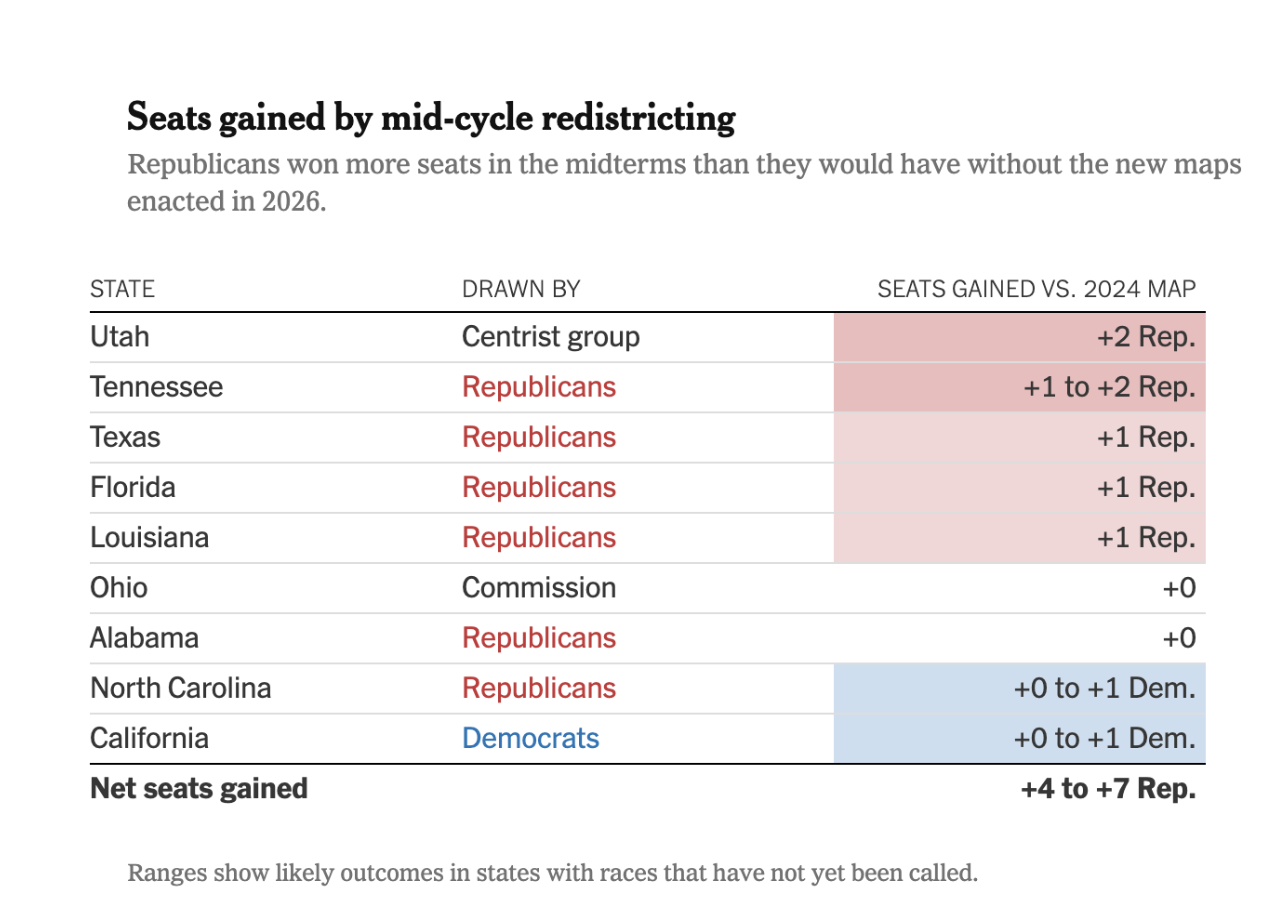
Cohn and Washington, ibid.
The gerrymandered districts will likely feature prominently in future elections for House seats.
“Of course, all of this could work out differently in 2028. In a more competitive year, Republicans might be favored to win back the seats they failed to pick up this cycle. Similarly, Democrats wouldn’t be favored to win those light-red districts in New York, Utah and Arizona.
But even if the new maps fail to yield the decisive gains that Republicans had hoped, gerrymandering would still give the Republicans a meaningful structural advantage. And this cycle, that structural advantage made a major difference.”
Cohn and Washington, ibid.Thus, the present averting of gerrymandered electoral strongholds is a temporary reprieve from voter marginalization in key contested races. So not the direct suppression of voting, but a structural arrangement that eliminates the value of the vote itself. This provides openings for planning and organization. But it is far from a means to end MAGA fascism in the present or in the future.
Lesson Three: American voters rejected smear tactics.
The Texas Experience
The tactics of personal insults, harassment, and degradation have been hallmarks of the development and ascendancy of Trump and Trumpism. Two Republican campaigns that leaned heavily into this strategy suffered epic failures at the polls. American voters are weary of petty insults masquerading as political substance.
In the Texas race for U.S. Senate, Trump-endorsed Republican Ken Paxton and his allies leaned heavily on personal ridicule. They peppered Democratic rival James Talarico with childish names (“Freako Talarico”). Trump dubbed the Democratic candidate “Tala-Freak-O” at a Corpus Christi campaign rally.
Ackerman, Allyson. “Talarico and Paxton Hurl Insults Before Texas Polls Open.” Chron, 3 Nov. 2026, www.chron.com/texas/article/paxton-talarico-campaign-last-words-22508736.php. Accessed 18 Nov. 2026.
Talarico largely dismissed these schoolboy tactics, even turning them to his advantage by appropriating “Talafreako” for tongue-in-cheek campaign merchandise. Talarico won, and the insult-first campaign became a cautionary example rather than a model.
Paloma, Natassia. “‘I’m a Talafreako’: Talarico Turns Trump Insult into Campaign Shirts.” USA Today, 14 Sept. 2026, www.usatoday.com/story/news/state/texas/2026/09/14/talarico-embraces-talafreako-nickname-with-campaign-shirts/91745920007/. Accessed 18 Nov. 2026.
The Ohio Experience
Techno-fascist and DOGE architect Vivek Ramaswamy lost to Dr. Amy Acton, the former Director of Ohio’s Department of Health and a political novice. Ramaswamy’s defeat will surely be regarded as one of the most significant miscalculations in modern American politics.
Over the summer and early fall, Ramaswamy’s attacks on Acton had grown intensely personal, criticizing her medical competency and accusing her of substance abuse issues. In late October, his attack ad targeted Acton at an intimate level, generating shockwaves. It featured the estranged mother of Amy Acton, calling her daughter a liar and urging Ohioans not to vote for her. Ms. Acton has said that she has not spoken to her mother since she was 12 years old, when she was removed from her mother’s custody after her stepfather was arrested and charged with raping her.
Epstein, Reid J., and Campbell Robertson. “How Vivek Ramaswamy’s Ruthless Ad in Ohio Divided Republicans.” The New York Times, 24 Oct. 2026, www.nytimes.com/2026/10/24/us/politics/vivek-ramaswamy-ad-ohio-amy-acton.html. Accessed 18 Nov. 2026.
The ad was badly received by the full political spectrum:
“The backlash was swift and brutal. Even Republicans criticized the Ramaswamy camp, with those in contested races scrambling to distance themselves from the ugliness. Ohio’s sitting governor, Mike DeWine, called the ad “deeply, deeply troubling,” and incumbent Republican Senator John Husted, who was defeated in a hotly contested race of his own, expressed reservations regarding the television spot. But Donald Trump and J.D. Vance defended Ramaswamy and his tactics, encouraging him to stand firm. Ramaswamy initially followed their lead and doubled down, spending millions in airtime for the ad.
Epstein and Robertson, ibid.
By October 30, Ramaswamy relented to public criticism and pulled the ad, but not before losing the support of critical allies and supporters.
“Ohio governors past and present, alumni of Ramaswamy’s Catholic high school in Cincinnati and others had urged him to pull it down.”
Carr Smyth, Julie. “Ramaswamy Pulls Attack Ad Featuring Amy Acton’s Estranged Mother.” AP News, 30 October 2026, apnews.com/article/ohio-ramaswamy-ad-acton-mother-365745259579371f41122b184254fdde. Accessed 18 Nov. 2026.
Not only did Acton win on November 3, but Sherrod Brown unseated Republican John Husted for Senate and political newcomer Kristina Knickerbocker defeated Republican Mike Turner, a 12-term incumbent and political fixture in Southwest Ohio. Turner placed direct blame on Ramaswamy for the loss.
Turner told CNN the ad was “a lightning strike at the end” with “an impact up and down the ticket in all the races.”
McCracken, Ford. “Republican Turner says Ramaswamy ad sunk his reelection in Ohio.” The Hill, 11 Nov. 2026, thehill.com/homenews/campaign/6213680-turner-blames-ramaswamy-ad-ohio-loss/. Accessed 22 Nov. 2026.
Ohio was legally required to redraw its congressional maps ahead of the midterms, and the new lines should have put two Democratic-held seats into jeopardy. But both of those incumbent Democrats won reelection, and Republicans lost three other seats not originally thought to be in play.
McCracken, ibid.
Lesson Four: Capital bankrolls both political parties.
The 2026 midterms saw an astronomical infusion of capital into the political arena on both sides, but Republicans outspent Democrats.
“Political advertisers spent a record $12.06 billion during the 2025-26 elections, making it the first time a midterm cycle outspent a presidential cycle, according to a report from advertising intelligence company AdImpact released Tuesday.
[…]
The elections also marked the first time in over a decade that Republicans have outspent Democrats on advertisements, according to AdImpact.”
Marangi, Catriona. “Republicans Outspent Democrats for First Time in over a Decade in Record 2026 Midterm Election Political Ad Blitz.” CNBC, 17 Nov. 2026, www.cnbc.com/2026/11/17/2026-election-political-ad-spending.html. Accessed 19 Nov. 2026.
But while campaign spending is increasing, accountability is decreasing. Tech builders and Super PACs contributed much of the funds this cycle. But “dark money,” which is difficult to track, comprised a significant portion of total spending.
The New York Times counted at least $1bn that has already been spent by dark money groups by the end of August. “Dark money” is composed of organizations such as 501(c)4 non-profits, which are groups that are not required to disclose their donors at all, since they are not supposed to have political activity as their primary purpose. (Those rules are often flouted in spirit, if not in practice.) This dark money spending is increasingly widespread in even lower-profile races across the country, and during primary contests. The Brennan Center’s recent number crunching estimated that dark money groups account for an unprecedented 29% share of the top 40 donors and that $699m is largely untraceable.
Sweet, Jacqueline. “Who Funded the Midterms? Inside US Elections’ Historic Bipartisan Spending.” The Guardian, 2 Nov. 2026, www.theguardian.com/us-news/ng-interactive/2026/nov/02/who-funded-midterms. Accessed 19 Nov. 2026.
Of course, while the specific sources of dark money have proved difficult to trace, the general source of the capital is plain enough: the ruling class, deploying it in service of its own needs.
For Marxists-Leninists: Broader Conclusions
The midterm election results are a legitimate barometer of mass opposition to Trump and Trumpism – and this opposition is growing. It must be said unequivocally that the working class won a victory – they denied the ruling class either a standard old-time Democrat victory or the Republican MAGA line.
But these results ultimately measure the coherent political organization of a Democratic Party frantically shifting “left” to become a more credible social-democratic force. It is notable that many of the candidates that won had been promoted by the DSA. Our views of the DSA have been made clear previously (See “Battle Lines: The Democratic Party Establishment Versus the ‘Democratic Socialists,'” MLRG.online, 4 September 2026). The number of mayors claiming to be socialist has escalated from 1 (Mamdani) to at least 3. Candidates openly espousing pro-Palestinian forces and supported by the DSA organization won impressively, as in Michigan with Abdul El-Sayed. The historic win in Mississippi of Scott Colom – the first Black person to win a U.S. Senate seat there since Reconstruction (Blanche K. Bruce, seated 1881) – represented a historical political milestone.
This all has a two-fold origin. Undoubtedly, a starting re-awakened political consciousness of the working class – hating the evident, stinking Republican corruption; the ICE strategy; the unaffordability crisis. And they organized on this wave. But it also reflects a very adept strategy of the more far-seeing members of the DP that then needed to shift left. The best sections of the DSA have provided support for this.
Whether the insights of the best of the DSA will swing the older sections of the DP remains far from obvious. Marxists-Leninists will say no. Already a string of cavings is visible. The blatant failure to use the Senate proposal of impeachment for Hegseth as a debate on the wars; the failure to prevent the Speaker of the House falling to Hakeem Jeffries with no struggle (Ferris, Sarah. “Hakeem Jeffries overwhelmingly wins House speaker nomination despite threats from ultra-progressives.” CNN, 18 Nov. 2026, edition.cnn.com/2026/11/18/politics/hakeem-jeffries-house-democrats-leadership-elections/. Accessed 22 Nov. 2026.); the likely forthcoming victory of Chuck Schumer as Senate Majority Leader for yet another term. Many more are coming. However, to expose the best of the DSA as having social-democratic illusions requires working with them and not sectarian behavior from Marxists-Leninists.
Indeed, there remains much for the American working class to stand against, including extrajudicial executions in American streets and on the high seas, crimes committed against the people of Venezuela and Cuba, the protracted imperialist war against Iran, and America’s complicity in Israel’s genocide of Palestinians.
Nevertheless, the schism in the American electorate remains deep following over a decade of MAGA’s politics of division, and the victory of many Democratic candidates does not imply a mandate for the Democratic Party. Sentiment toward both parties remains at record lows for the present era. In fact, the majority of Americans still viewed the Democratic Party unfavorably despite voting its candidates into office.
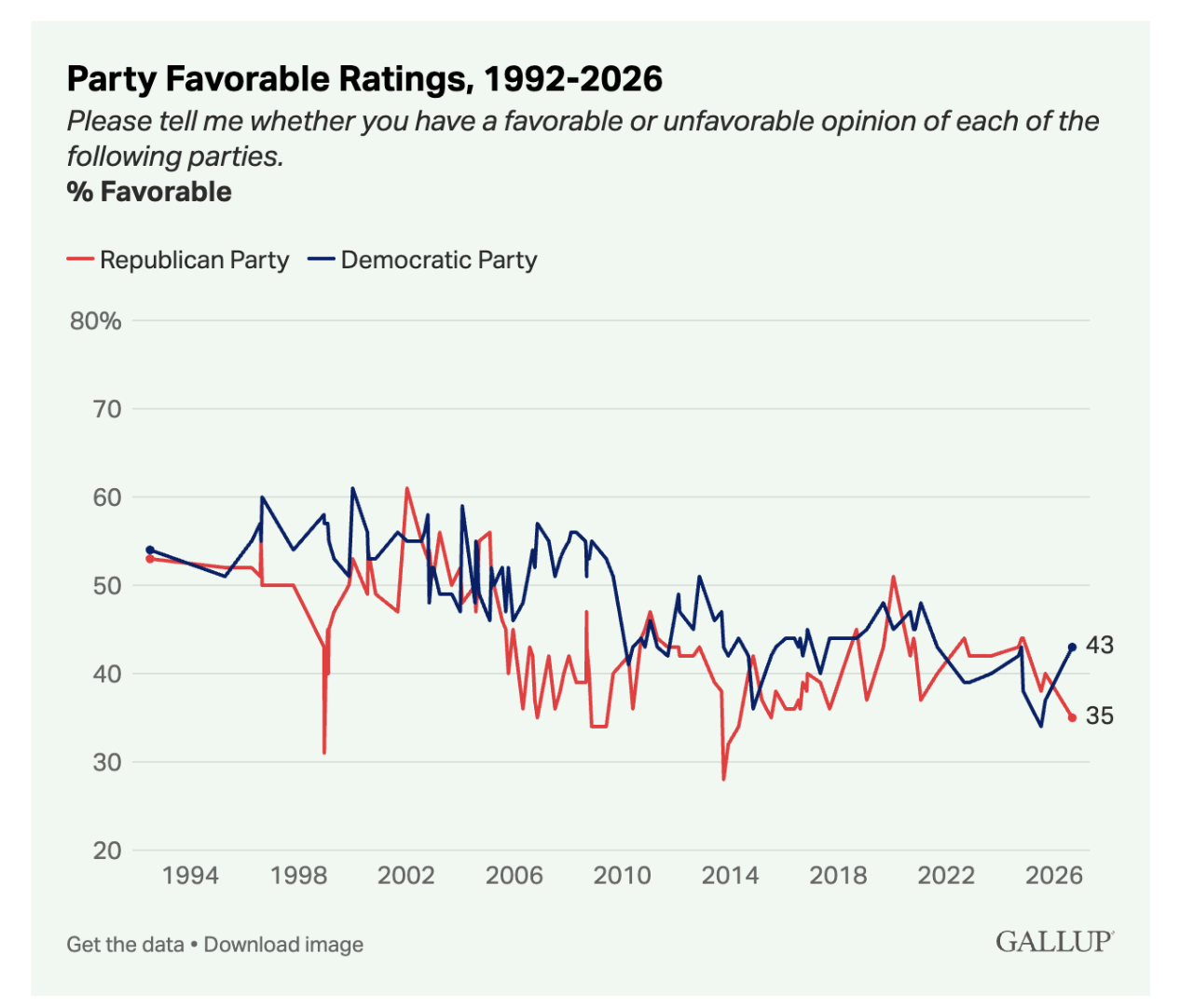
Brenan, Megan. “Democrats Have Advantage on Party Image and Issues.” Gallup, 13 Oct. 2026, news.gallup.com/poll/715523/democrats-advantage-party-image-issues.aspx. Accessed 19 Nov. 2026.
Electoral repudiation is not a full class consciousness; the crossroads that the American working class currently faces is real precisely because the alternative has not yet been built. As we have consistently asserted, only a united front guided by the principled leadership of Marxists-Leninists can effectively – and credibly – oppose the leviathan of present-day fascism in America. The working class, which counts Democratic voters among its ranks, is a legitimate ally in such a united front. But Marxist-Leninists should possess no illusions that Democratic politicians are faithful class allies in the long run.
As we have shown, the Democratic Party is a willing ally of the Republicans when it comes to opposing and attacking anything that is remotely “socialist.” See also: “Battle Lines: The Democratic Party Establishment Versus the ‘Democratic Socialists’,” MLRG; September 4, 2026) and “‘Bonapartism’ and Trump” – a reply to Anthony Teso (MLRG; July 19, 2026). It is notable that on the main issues today, the DP continues to push Trump to do more, not less. For example, on China, the Democratic Party criticizes Trump for being too favorable to China. On Iran, they urge even more hawkishness.
The lessons of the midterm elections reduce to a simple takeaway. The results registered a genuine and growing mass repudiation of Trump and Trumpism, and they won working people breathing space. But breathing space is not victory, and space is not power. Further, the machinery of suppression and redistricting remains on the books, ready for redeployment in 2028.
Trump’s response – that is, his political strategy in the wake of this setback – is only just materializing. One of his first maneuvers after the election was to further elevate Stephen Miller, this time to the position of Chief of Staff. It is well-established that Miller is the architect of Trump’s most draconian policies to date, and Miller himself has already branded the Democratic Party “a domestic extremist organization.”
Weissert, Will, and Moriah Balingit. “In His Words: Stephen Miller Is an Immigration Hardliner and a Bombastic Critic of Democrats.” PBS NewsHour, 7 Nov. 2026, www.pbs.org/newshour/politics/in-his-words-stephen-miller-is-an-immigration-hardliner-and-a-bombastic-critic-of-democrats. Accessed 20 Nov. 2026.
Miller has also spoken menacingly of the American “left” in dehumanizing language that echoes the sentiments of 1933 Germany:
“One of the hallmarks of leftwing violence and terrorism is its completely pretextual and disingenuous appeal to civil liberties in an effort to shield its own violence,” he said. “This is the tactic that the left always uses to try to protect itself from facing criminal punishment. It is essential that we are wise enough and strong enough to understand that these appeals must fall on deaf ears.
“When the leftist protests that we are violating his rights, understand that he is lying to try to persuade people who are not closely following the political scene that some injustice has been perpetrated against him. We must stay the course and be completely unflinching in the pursuit of justice against these enemies of civilization.”
Roston, Aram. “‘Enemies of Civilization’: Top Trump Officials Launch Sweeping Attack on Left.” The Guardian, 16 July 2026, www.theguardian.com/us-news/2026/jul/16/political-violence-event-trump-marco-rubio. Accessed 20 Nov. 2026.
J.V. Stalin, in his 1934 conversation with H.G. Wells, noted that “obsolete classes” do not voluntarily yield their positions. Further:
“The rich experience of history teaches that up to now not a single class has voluntarily made way for another class. There is no such precedent in world history. The Communists have learned this lesson of history. Communists would welcome the voluntary departure of the bourgeoisie. But such a turn of affairs is improbable; that is what experience teaches. That is why the Communists want to be prepared for the worst and call upon the working class to be vigilant, to be prepared for battle.”
Stalin, Joseph V. “Marxism Versus Liberalism.” 23 July 1934. Works, vol. 14, Lawrence and Wishart, 1978. Marxists Internet Archive, www.marxists.org/reference/archive/stalin/works/1934/07/23.htm. Accessed 20 Nov. 2026.
The same is true of the American bourgeoisie with its MAGA-infected core. It will not yield voluntarily to the working class.
To this end, the prospects afforded by MAGA’s setback at the ballot box must not be squandered. Speaking to the Russian Communist Party (Bolsheviks) in 1920, Lenin discussed the strategic opportunities available to the Bolsheviks following the Brest-Litovsk treaty of 1918.
“We made use of the interval history had accorded us as a breathing-space in order to consolidate ourselves to a degree that would make it impossible to vanquish us by military force.”
Lenin, V. I. “Speech Delivered at a Meeting of Activists of the Moscow Organisation of the R.C.P.(B.).” 6 Dec. 1920, Collected Works, vol. 31, translated by Julius Katzer, Progress Publishers, 1965, pp. 438-59. Marxists Internet Archive, www.marxists.org/archive/lenin/works/1920/dec/06.htm. Accessed 20 Nov. 2026.
He further explained:
“Opportunism means sacrificing fundamental interests so as to gain temporary and partial advantages.”
Lenin, ibid.
It is therefore critical that Marxist-Leninists learn from recent experiences as well as historical precedent and provide the critical leadership and action needed to not only end MAGA fascism but to lead the way to the eventual liberation of working and oppressed people everywhere.