
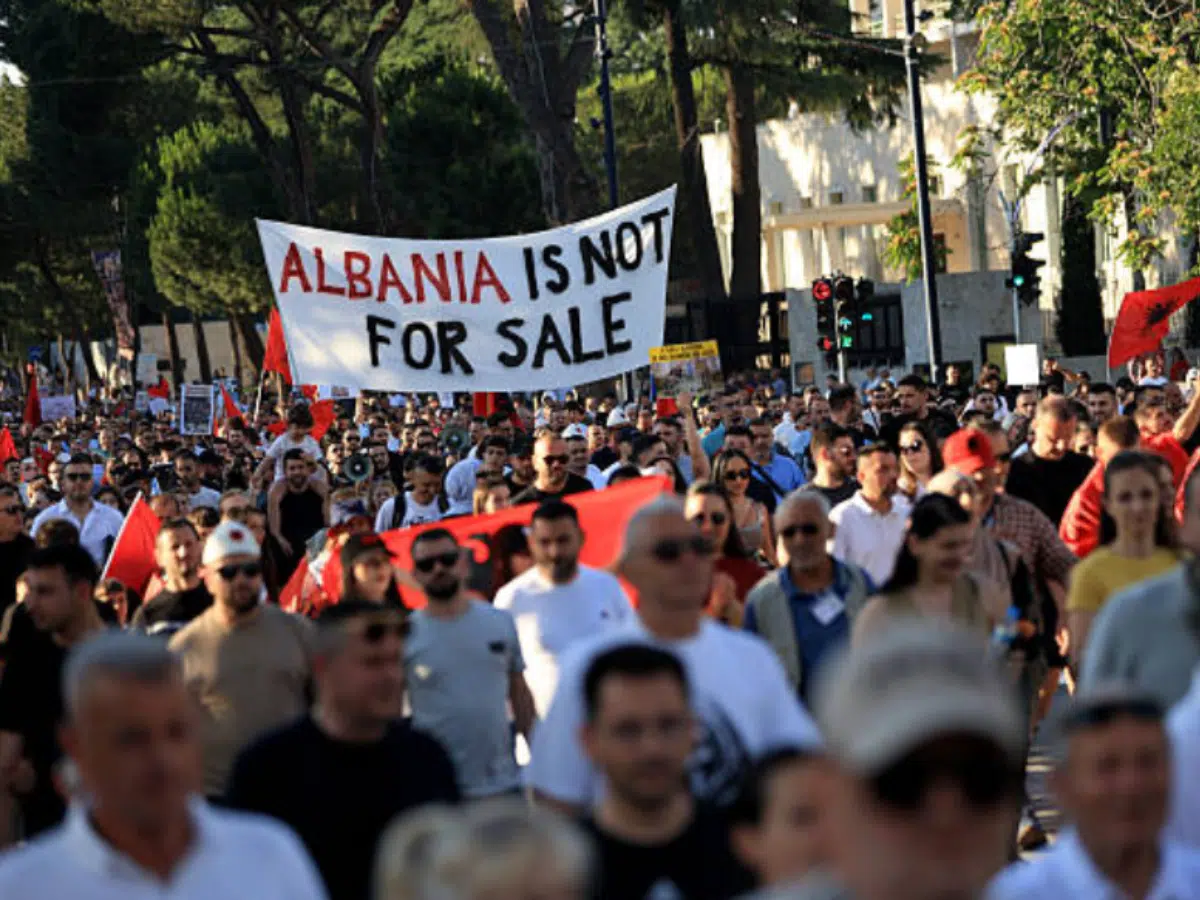
The New Albanian National Popular Movement – The Flamingo Revolution
Image: From Grace; “Albania ‘Flamingo Revolution’ protests against Trump-Kushner tourism developments gain pace”; June 26, 2026 at The Canary, UK
THE NEW ALBANIAN NATIONAL POPULAR MOVEMENT – The Flamingo Revolution
By Dr. Laver Stroka
Part One
On May 23rd of this year (2026), a massive popular protest began in Zvërnec, Vlora (Albania). It is now spreading beyond the country’s borders – wherever Albanians reside – reaching Europe, the Americas, Canada, Australia, and elsewhere. Ordinary people, burdened by severe economic hardship, have suddenly taken to the streets, demanding the removal of the ruling class – which has held power for 35 years – from the political stage. They are confronting a powerful propaganda machine that serves a bloodthirsty bourgeoisie – a class devoid of any moral or national sentiment. At the heart of this movement lies a patriotic determination to save our sacred lands – soil sanctified over millennia by the blood of worthy sons – which a group of treacherous scoundrels is handing over to foreigners. These traitors use foreigners as a shield to perpetuate their own rule, while encouraging and facilitating a silent exodus from our national territories. This entails a drastic reduction in investments across villages and towns – offering only superficial, token projects that fail to improve living standards in any meaningful way – while depopulating two-thirds of the territory to pave the way for the arrival of foreigners, facilitated by secret, unconstitutional agreements. This entire 35-year policy has been designed to drive the Albanian workforce out of the homeland.
What has this design wrought?
The destruction of modern industry, advanced agriculture, and the national defense system;
the handover of natural resources – both subterranean and surface – as well as highly profitable energy assets, to foreign entities (following failed attempts to blow them up in 1990);
the dismantling of educational, cultural, museum, archaeological, and historical systems;
and even the distortion of the origins of Albanian Polyphony – which has forced patriotic ethno-folklorists into endless legal battles – All the above constitute an anti-national policy.
This has brought the people to a breaking point, exhausting a patience that had lasted for fully 35 years. The spark for this popular uprising was the mistreatment of the residents of Zvërnec, who found their access to their own land blocked – land that was suddenly enclosed by fences and placed under the guard of private security personnel, acting on behalf of undisclosed foreign owners. This was part of a clandestine government project to hand over this protected environmental area – the most significant of its kind in the Mediterranean and in Albania, serving as a natural habitat and food source for 3,000 to 7,000 flamingos year-round – along with dozens of other sites. An even greater transgression is Prime Minister Edi Rama’s plan for the island of Sazan – a location of such strategic importance in the Mediterranean that it could be compared to the Strait of Hormuz – which he intends to hand over to President Trump’s son-in-law, Jared Kushner, for the purpose of “strategic investments.”
This secret deal by Edi Rama – along with various others involving Israeli “investors” and the drafting of laws that run counter to the national interest – was the final straw. He goes so far as to publicly declare that “Albania is a reserve country for the Israelis” or that “Orikum is a creation of the Israelis,” while also planning a massive museum for Jews in Vlora – an effort that seeks to erase the patriotic, historical memory of this heroic city, where Albania’s independence was proclaimed in 1912.
The new Albanian National People’s Movement against the political class that has ruled for 35 years – led by the traitors Sali Berisha and Edi Rama – is taking on the characteristics of a genuine revolution of historical significance, provided it is not sabotaged by the “fifth column” of the national and international bourgeoisie, which could deploy all the financial, media, military, and police resources at its disposal. “Albania is not for sale!”, “Resign!”, “Rama to prison, Berisha to prison!“, and “The youth demand a revolution!” – these are the calls that have shaken Tirana.
Below, we present the definition of the word Revolution – a term frequently heard being chanted by the large crowd of protesters:
A revolution is a radical and rapid change in political, economic, social, or technological structures. It represents an upheaval that brings about a transition from an old system to a new one. The word derives from the Latin term “revolution” (a rotation, a complete turn). This concept encompasses several key areas:
- A political and social revolution is characterized by a profound change in the form of governance, often accompanied by protests or conflicts aimed at toppling a regime. Example: The French Revolution (1789) led to the fall of the monarchy and the establishment of a republic.
- Industrial and technological revolutions transform the way humanity produces goods, communicates, or lives, marking a new era of development. Example: The First Industrial Revolution in the 18th century marked the transition from manual labor to mechanical production.
- Scientific and cultural revolutions involve sudden and profound changes in ideology, philosophy, art, or the understanding of science. Unlike evolution – which is a slow and gradual transformation – a revolution is characterized by an immediate, qualitative leap; this is precisely what young Albanians now hope to achieve, supported by the broad masses of the people, both within and outside the homeland.
Part Two
Throughout world history, revolutions have been carried out by peoples at moments when the exploitation and impoverishment of the broad masses – compounded by the ruthless oppression and injustices inflicted by a ruling political class through a regressive system – have become unbearable. The localized protests that occurred over the years – involving mine workers, oil workers, farmers, and livestock herders in various districts, all directed against the exploitation of their labor and the disregard for their fundamental rights. All these served as the initial signals of growing discontent. Over time, these protests spread geographically, encompassing diverse segments and groups within the population. Yet, their demands fell on the deaf ears of those in power; while the authorities occasionally offered minor concessions, they never truly addressed the underlying grievances. This “game” of loosening and tightening the reins has created nothing more than a fragile, fleeting “calm.” The “democratic” system of governance has grown increasingly harsh, justifying the exploitation of the masses and the enrichment of a class of oligarchs – all of this bolstered by a well-funded, soulless propaganda machine, whose members find happiness only within their own private circles.
The transfer of power from one party to another is presented as the “right solution” within this rotten multiparty system – a cycle that has inflicted profound destruction upon Albania over the last 35 years. This corrupt and criminal form of governance serves only those in power and the sycophants awaiting their turn for office, allowing them to recoup the income they lost while the opposing side held the reins of power. None of them give any thought to what they might actually do for the homeland or the Albanian people.
Albania has reached a critical low point, transforming from a country that was once industrially and agriculturally advanced into a backward, quasi-feudal state. With education, healthcare, culture, and national defense in a wretched state – compounded by meager wages and pensions, and a profound sense of existential insecurity – any hope the people might have had for the future under this system has been extinguished.
Currently, according to INSTAT, over 40% of the population lives at a subsistence level, while 20% lives in abject misery. This has led to mass emigration, leaving more than two-thirds of the nation’s villages and towns deserted as people flee in search of their daily bread. Under these circumstances, the revolt has spread even to the middle classes. The sale – by those who have held power since 1990 – of our sea and our sacred land, sanctified over millennia by the blood of our most worthy sons and daughters, constitutes the most macabre crime and the greatest act of national betrayal.
This has brought anger and hatred to a boiling point, stirring everyone who possesses even a single drop of Albanian blood; consequently, the eruption of popular protests has become the only path to salvation for the nation’s future. Faced with this National Popular Revolt, its sworn enemies have united, launching attacks through every propaganda channel and any other means at their disposal. To them, Albania is worth less than a lucrative, corrupt deal, a privilege, a villa, a piece of territory seized unjustly, a gifted property, or an ally who enables them to retain power.
The slogans emerging from such a mass of people may not always be the most appropriate, but they represent the expression of the sincere emotions of ordinary people who possess Albanian blood. Naturally, the “fifth column” is doing everything in its power to incite incidents and provide ammunition to political opponents. Despite opposition from this corrupt, anti-national regime, the core objectives of the protest are gaining firm ground – objectives that serve the majority, the broad masses of the Albanian people, both within the homeland and abroad, including in Germany, Austria, Italy, England, the USA, Canada, Australia, and elsewhere.
Selfish individuals, careerists, fraudsters, and unprincipled opportunists are attempting, through various means, to sow division within the broad ranks of the protesters. Fortunately, the movement consists primarily of the youth and the working class – groups that have already proven their strength in popular revolutions. Some seek to transform this movement into a political party. However, this is a grassroots movement, not a party faction; it encompasses a wide spectrum of people, regardless of their regional origins, political convictions, or religious beliefs. Existing political parties are eager to co-opt the movement – to turn it into a party – with the aim of extinguishing the protest and preserving their continued monopoly over governance.
The slogans of this popular movement – which bears the hallmarks of a National Popular Revolt – are:
“Albania is not for sale!”
“We will no longer leave our homeland in your hands!”
“The spirit of Prizren 1978 is here in Tirana!”
“No luxuries – we need hospitals!”
“The people have declared you ‘Non-Grata’!” “
For 35 years, we have not been represented by this political class!”
“A New Albania, a New Albania!”,
“We defend our national pride; we will not back down!”,
“KLA, KLA!”
“Avni Rustemi – a change of the system!”,
“We want decent wages, pensions, and housing!”,
“The criminal and corrupt government does not serve the people – it serves the oligarchs!”,
“Now or never!”, “How beautiful it is to be Albanian!”,
“You have emptied out the countryside!”,
“The youth demand a revolution!”…
This situation marks a broader reflection on the Enverist era – a period that has been reviled daily by the political establishment over the last 35 years. During this time, songs glorifying the most illustrious leader of the Albanian nation, Enver Hoxha, have circulated on social media and YouTube more than ever before. Among other sentiments, these songs express gratitude toward him with lines such as:
“You brought Albania into the light,
you neither stole from it nor sold it…”
unlike those who seized power after 1990.
Part Three
Today, we live in an era of imperialism and revolution, in which a predatory and exploitative system employs every maneuver and tool to carve up nations and their national wealth for the benefit of global superpowers. War has become its primary instrument; it incites local and regional conflicts that are intolerable to the overwhelming majority of humanity – the oppressed and the exploited – who aspire to build a new society where the exploitation of human beings is brought to an end once and for all. The cumulative global economic cost of the wars currently unfolding in Ukraine and the Middle East has surpassed $1.5 trillion. This figure encompasses direct military expenditures, the destruction of infrastructure, and systemic shocks to the global economy – enriching arms manufacturers to a staggering degree, while simultaneously lowering the standard of living for the broad masses of the population.
The corporation RTX saw its net income rise from $4.77 billion in 2024 to $6.73 billion in 2025, while its total revenue exceeded $88.6 billion. The war in Ukraine and the long-term threat perceived from Russia have driven the European bourgeoisie toward rapid and aggressive rearmament. According to the Stockholm International Peace Research Institute (SIPRI), arms sales revenue for the world’s 100 largest manufacturers reached a record figure of $679 billion. Excluding Russia, 23 of the 26 major European defense companies recorded significant revenue growth, totalling over $151 billion.
Approximately 4.5 million people have been displaced from their homes, facing severe economic, health, and social hardships, while hundreds of thousands of others have lost their lives. Profound upheaval has also emerged in neighboring countries and beyond, where people have fled in a desperate attempt to survive. The world finds itself at a stage where the question of revolution and the liberation of peoples has become an issue demanding resolution. The struggle of the broad popular masses against the bourgeoisie is a fundamental and relentless conflict – one that continues unabated, with participation growing ever greater each year.
Two great social forces now stand opposed to one another. On one side is the capitalist-imperialist bourgeoisie – the most barbaric, cunning, and bloodthirsty class known to history. On the other side is the working class – a class entirely deprived of the means of production, yet one that constitutes the most progressive segment of society: the class that thinks, creates, works, and produces, while remaining denied the fruits of its own labor. The bourgeoisie gathers around itself the most malevolent, regressive, and criminal forces, while the working class strives to unite all progressive and revolutionary forces under its banner. However, for this struggle of the broad masses to be crowned with success, they must be organized; they must establish their own vanguard – a leadership capable of raising the consciousness of the masses in the fight to seize state power and build a new society, free from exploiting classes and warmongers.
Revolution erupts and unfolds at the weakest link in the capitalist chain; for it to triumph, the appropriate objective and subjective conditions must exist, and the precise moment for its outbreak must be identified. It is essential that, once it begins, the broad masses – led by a patriotic vanguard imbued with a proletarian spirit – remain determined and prepared to carry it through to the end. A revolution is undertaken by the people of a given country when an objective revolutionary situation has emerged, characterized by:
- Widespread discontent and indignation among the masses toward the ruling classes, who merely pass power from one to another without bringing about any change in governance that serves the interests of the common people.
- The impoverishment and unbearable suffering of the broad, oppressed masses.
- A significant intensification in the activity of the broad masses – driven by the aforementioned factors – which leads them to undertake actions of historical significance.
In other words, this reality can be expressed as follows: a revolution is impossible without a nationwide crisis that encompasses the entire society of a country (or beyond). One should not wait for the government to fall on its own; rather, it must be overthrown at all costs.
However, not every revolutionary situation necessarily leads to a revolution. In many instances – such as in Germany during the 1860s and 1870s, or in Russia during the periods of 1859–1861 and 1879–1880 – revolutionary situations failed to transform into full-fledged revolutions. This occurred due to the absence of the “subjective factor” – that is, a sufficiently high level of awareness and readiness among the masses to bring it about.
The education and mobilization of the broad masses play a decisive role in the development of this subjective factor. This process fosters awareness among the youth and the working class regarding the conditions in which they live, the oppression and exploitation they face, the barbaric laws of the bourgeoisie, and the absolute necessity of a revolution as a means to overthrow an order that breeds enslavement.
The alignment of the Albanian intelligentsia living abroad – evidenced by a statement signed by more than 120 academics in support of a “New Albania” – marks a significant moment of reflection and progress, both on a European and a global scale. Prominent non-Albanian figures have rightly expressed high regard for the People’s Revolution in Albania, viewing it as a valuable lesson for other peoples and governments across the world. In this way, the impoverished strata will react with such intensity that even the wealthy – the ruling bourgeoisie, itself shaken by various internal and external contradictions – will find it difficult to continue governing as before. When these conditions are met, when both objective and subjective factors, which are interconnected, are present, it becomes possible for a revolution not only to erupt but also to triumph.
The revolutionary headquarters must take comprehensive and proactive measures to ensure it is never caught off guard, to avoid being left disarmed at these decisive moments. At moments when the bourgeois state, backed by a bloodthirsty national and international oligarchy, is prepared to commit any kind of crime. Protests in other countries and on other continents in support of this revolution serve as an encouraging impetus for the broad masses, while simultaneously exerting pressure on the international allies of the bourgeoisie – allies who are terrified by the revolution. The current situation is revolutionary, and the world is heading toward major upheavals. It is like an erupting volcano – a scorching fire destined to consume the very ruling classes that oppress, exploit, and incite wars. Today’s world is in the grip of a severe crisis – economic, political, financial, military, ideological, and moral. This ongoing crisis, which has shaken the entire structure and superstructure of the current world order, has rendered the general crisis of the capitalist system even deeper and more acute.
The consequences of the current crisis are undoubtedly grave and devastating, particularly in the economic sphere. Rising prices – and inflation in particular – have become a highly convenient tool in the hands of monopolies and the capitalist state for shifting the heavy burden of the crisis onto the shoulders of the broad masses.
Under the pretext of curbing inflation, capitalist states increase taxes on the income of the working masses and freeze their wages, while simultaneously lowering taxes on the profits of monopolies, devaluing the currency, and so on. These measures are directed against the working class; they intensify exploitation and significantly lower the standard of living. The prolonged economic crisis has worsened the living conditions of the working class and the peasantry, making life increasingly difficult for them. Meanwhile, the poor become even poorer, while the rich become even richer. The gap between the poor and wealthy strata of society—as well as between developed and underdeveloped capitalist nations—continues to widen.
The bourgeoisie and the ruling clans are compelled to frequently rotate the personnel within their governing teams, with the aim of deceiving the workers and fostering the hope that a new team will be better than the previous one – that it will improve the situation, and so on. This entire deception, carried out continuously and on a large scale, is cloaked in false slogans about freedom, democracy, and the like – especially during election campaigns. Simultaneously, the bourgeoisie strengthens its brutal instruments of coercion – the army, the police, the secret services, and the courts – to impose its dictatorship upon every movement and endeavor of the working class. Yet, all these political and military tools are merely temporary stopgap measures; they do not – and can never – heal the wounds of this capitalist system, which finds itself in a critical state.
Over the last 35 years, the “new” and “old” bourgeoisie – whether in power or in opposition – have concocted various forms of disinformation to subjugate the masses; this, in turn, has influenced the everyday behavior of certain segments of the population who lack a clear political background. Such manifestations of this propaganda appeared from time to time during the protest, incited by right-wing provocateurs. The latter chant slogans like, “Those who have governed for the last 35 years are the children of communists!” and other similar claims. However, these assertions did not gain traction among the majority of protesters. Because those who have held power since 1990 – whether right-wing anti-communists or the so-called “left” (who style themselves as European-style socialists) – have absolutely no connection to the Party of Labour or the “people’s power” that governed Socialist Albania for 45 years.
Part Four
The popular revolution (the “Flamingo Revolution”) in Albania – which has already garnered worldwide recognition, from both the left and the right, for the level of civility demonstrated by thousands upon thousands of people of all ages (with youth predominating), for the clearly articulated demands against the regime and its 35-year history of anti-people and anti-national policies, and for the steadfast commitment and mobilization of every patriotic Albanian, wherever they may live or work, both at home and abroad – represents a new development in world history.
The slogans raised included:
“The youth demand a revolution!”,
“A new Albania!”,
“Albania is not for sale!”,
“Rama, resign!”, “Your end has come!”,
“A regime of crime!”,
“A police force of crime!”,
“A parliament of crime!”, and
“Annul the anti-national and cronyism concession laws!”
These have mobilized an ever-growing number of patriotic citizens, despite the media and legal intimidation, as well as the unprecedented violence unleashed by the regime’s police against protesters over the last few weeks. This revolution entered a new phase when 200 courageous young people peacefully surrounded the “parliament of crime,” only to be met with violence from the regime’s police. The arrest of nineteen of these young people deepened the revolutionary situation even further.
The ruling political class has become increasingly aggressive and threatening – casting aside any pretense – driven by a profound sense of fear. They even sought talks with the “elite”, an elite they aim to cultivate alongside their own servile lackeys. The protesters’ unwavering insistence on their five core demands has foreclosed any possibility of manipulation, exposing every new maneuver for “dialogue” for what it is. There was a barrage of accusations and smears claiming that the ranks of the protesters have been infiltrated by agents or intelligence networks from Iran, Russia, Greece, and elsewhere.
The “Flamingo Revolution” is not the work of any single political party; it is the uprising of an oppressed people. That is a people exploited to the core, robbed, and deceived for 35 consecutive years; a period that has impoverished the majority while enriching a clique of oligarchs who serve corrupt officials. This was clearly evidenced today by media outlets that remain in the service of the government, aligning themselves against the people in revolution. The only television station that has consistently and accurately covered the Albanian National People’s Revolution is “News 24”. A stance that made “News 24” a target of the government, which has imposed restrictive and punitive measures against it; actions that have been widely condemned by the public.
A “fifth column”- infiltrated into the broad ranks of the protesters by the anti-communist governing parties and the secret service – seeks to sow division by steering the movement off its intended course. They attempt to denigrate the heroes of the Anti-Fascist National Liberation War (LANÇ) and the Kosovo Liberation Army (KLA), while simultaneously propagating chauvinistic slogans – such as the call of the Balli Kombëtar:
“Albania for the Albanians, death to traitors!” –
alongside others like:
“Down with communism!” or
“Down with the ‘patronazhistë’ (political informants)!”
This is occurring at a time when the people have united in protest – regardless of religion, region, or political ideology (communists, Ballists, democrats, or socialists) – around a single national cause: the salvation of the Homeland, which is being put up for sale to so-called “strategic investors.” The organizers must not allow this “fifth column” to achieve its goal of fostering passivity and internal conflict. Such outcomes serve the very political class (the Socialist Party and the Democratic Party) responsible for creating this critical situation over their 35 years of rule. They are desperate to provoke an armed conflict, reminiscent of 1997, to incite anarchy, killings, theft, and arson, all in an attempt to cover the tracks of their crimes. Citizens, remain vigilant! Victory over this rotten, anti-people, and anti-national political class is certain – provided that we remain steadfast, united, and undefeated!
Part Five
Thirty-five years of accumulated hatred have now erupted into fire and flames across the cities of Albania. For more than five months – a period of protests known as the “Flamingo Revolution” – hundreds of thousands of Albanians, both within the country and abroad (including the diaspora in the West, Europe, North America, etc.), have put forward the following non-negotiable demands:
- The removal of the government (the resignation of the Prime Minister and the current administration).
- The establishment of a transitional government to manage the interim period and state institutions.
- Constitutional reform aimed at guaranteeing a representative democracy, a strong parliament, and an executive branch that is fully accountable to both the parliament and the citizens.
- Reform of the Electoral Code to ensure that members of parliament are elected directly by the citizens, rather than being appointed by party leaders.
- The establishment of clear and strict criteria for the financing of political parties, with the aim of ensuring transparency and preventing the influence of clienteles.
In October, with the start of the new academic year, students – joined by high school pupils and other residents from both cities and rural areas – gave fresh momentum to the protests. Together with their lecturers, they boycotted classes and took to the streets of the Albanian capital, Tirana, demanding better conditions, access to quality education, and employment opportunities upon graduation. The demonstration began on October 13 in front of the Ministry of Education, as a continuation of the “Flamingo Revolution.”
Police forces from various units clashed with the protesters, employing tear gas, high-pressure water cannons, rubber bullets, and unprecedented levels of violence to disperse them. Two new long-range water cannon vehicles were also deployed against the demonstrators. Numerous arrests and physical injuries – including acts of violence against women and young children, both on the streets and inside police stations – sparked deep outrage among the protesters and the general public, leading to even more intense actions directed against central state institutions and the police.
On October 14, a portion of the Ministry of Education building was set ablaze. The Prime Minister’s Office, the Parliamentary Presidium, the Ministry of Finance, and the Ministry of the Interior, the Ministry of Justice, the Municipality, several police stations, and various businesses in the vicinity – including a number of commercial banks – were attacked with fireworks, improvised Molotov cocktails, and hard objects. The public is deeply outraged by the corrupt system and is demanding radical change. Similar incidents also took place in several other districts, including Korça, Vlora, Durrës, Elbasan, Lezha, Kukës, and Shkodra.
The government’s latest decision rewards police officers confronting protesters with a monthly salary five times higher than usual (€2,500), while imposing unprecedented fines on protesters and the parents of minors (amounting to 25–50 times the value of a monthly pension). It aims to intimidate citizens by creating a fascist-style climate of terror. Furthermore, these measures include imprisonment and restrictions on the right to travel abroad, as well as on other rights guaranteed by the Constitution. Nevertheless, young people, students, and academics have opposed the government’s decision, raising their voices in protest and filing formal complaints with the Constitutional Court and other institutions, both domestically and internationally.
In the final three weeks of 2026 alone, over 300 people were arrested in Tirana – a significant number of whom are minors aged 15–17. Similar violence and terror have been employed in various regions to intimidate the population. Most of these individuals were arrested following street protests, or were seized from public venues or their own homes, where they were subjected to inhumane mistreatment by police officers—some in plain clothes, others in uniform but unidentifiable. A large percentage of those arrested were subsequently found innocent by the country’s courts.
Prime Minister Edi Rama’s repeated calls for “dialogue” with the protesters – made in the wake of police terror and barbaric violence – ring entirely hollow. The protesters have categorically rejected these overtures, viewing him as untrustworthy, deceitful, and a traitor to the national interest – a man who serves foreign powers, the mafia, and organized crime. His dismissal of the directors of all major state agencies has further exposed this cunning deceiver. Meanwhile, the West remains silent, with the exception of a few isolated voices in the European Parliament and the United States.
According to the protesters, the revolution continues and will not cease until the government is toppled, Prime Minister Rama resigns, and the political class that has dominated for 35 years – a source of misfortune for the Albanian people and the nation – is removed from the political scene.
Dr. Laver Stroika; 7 November 2026


