Update on the USA-Israeli Imperialist War on Iran
An update on the imperialist war launched by USA and Israel on Iran – Oil and the Hegemony of the Dollar – etro-Imperialism;
by Mike B. and Hari Kumar for MLRG.online; May 14, 2026
Introduction
We have discussed the onset of the USA-Israeli attack upon the state and peoples of Iran before (See:
“USA and Israel Warmongers Launch Their Imperialist War on Iran,” March 1, 2026; at MLRG.online, and
“The USA-Israeli imperialist war of aggression reveals European contradictions”; March 5, 2026 at MLRG.online ).
The war fatalities to date
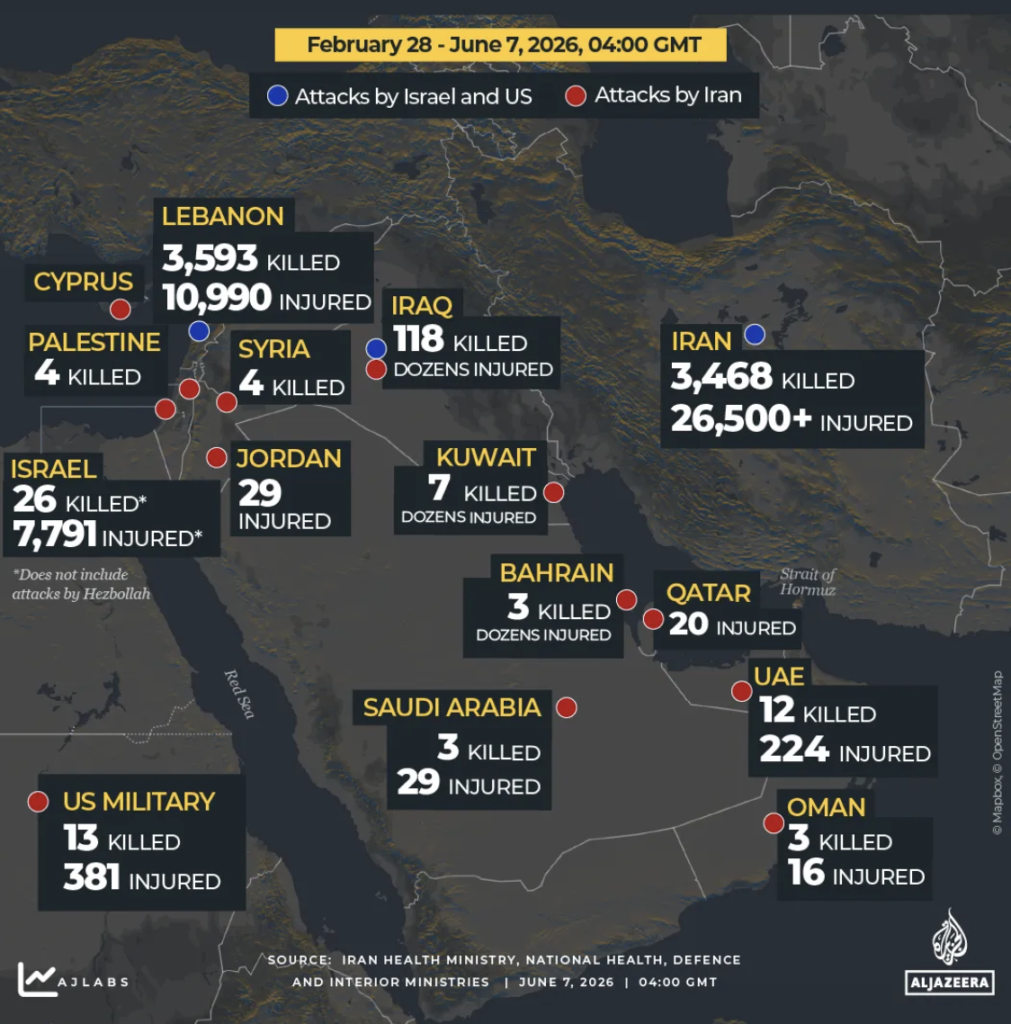
The war thus far has led to an estimated 7,000 deaths up to June 7, 2026:
“At least 7,000 people killed. More people have now been killed in Lebanon than in Iran, the war’s original target. Preliminary figures show at least 3,593 people confirmed killed in Lebanon, 3,468 in Iran and 29 in Gulf states, with 26 Israelis and 13 US soldiers also killed in Iranian attacks since the start of the US-Israel war on Iran.”
Duggal and Chugtai – See following reference:
A geographical summary can be seen in the following graphic (from Hanna Duggal and Alia Chughtai; “Iran war 100 days: How the conflict impacted Iran and the world“; 7 June 2026 at Al Jazeera)
In addition, the war has unleashed an untold misery for the Iranian people, the Lebanese people, and a blockade of the Straits of Hormuz for weeks now. The latter in turn has led to economic effects on the world’s people, which has already been dire. But it appears that despite all that has been thrown at the theocratic state of Iran – the latter has not buckled. Its leadership appears to be united in withstanding the assault.
Meanwhile the USA has made repeated attempts to exit the war with some ‘saving of face’.
To this end, Trump repetitively claims a non-existing ‘victory’.
Yet again, the Trump Administration has issued a new and familiar ultimatum to Iran: Sign a “deal” that favors U.S. interests or face total annihilation. Active bombing resumed on June 10, and the following morning, Trump threatened a more intensive onslaught, including a new threat to seize Kharg Island, a critical link in oil production and distribution. Hours later, Trump walked back his menacing comments, suggesting a diplomatic breakthrough is near:
President Donald Trump trumpeted a “great settlement” that could resolve the war with Iran, suggesting it would be finalized in the coming days.
He said he anticipated a signing ceremony for the document soon, potentially in Europe, to be attended by Vice President JD Vance.
“The documents are in pretty final shape, so we’ll see,” he said during an event in the Oval Office on Thursday. “We’ll see.”
“That should be done pretty quickly,” he continued.
“Iran War and Trump Administration Live Updates.” CNN, 11 June 2026, https://www.cnn.com/2026/06/11/world/live-news/iran-war-trump-israel-hnk. Accessed 11 June 2026.
Despite months of talk by the bourgeois press regarding a “cease fire” and a “fragile peace,” echoes of war continue to ring out throughout the Middle East since the shooting war began in February. The Lebanon invasion by the Israeli forces enables the Israeli government to further complicate any peace. Despite supposed cease-fires in Lebanon, the Israeli forces blithely carry on airstrikes, land attacks, and forced removals of civilians from their homes. A reprise of the Gaza behaviour of utter Israeli terror, ignoring any scraps of paper claiming a “cease-fire”.
The Trump Administration, largely through Trump’s own public statements, regularly asserts that a “deal” is near while U.S. forces pound targets in Iran on a regular basis. Meanwhile, Israel continued to attack the people of Lebanon despite a so-called “cease fire”. We do not even mention the “non-cease-fire” in Gaza. The bluster, bombing, and brinksmanship – and outright violations of all agreements – follow a predictable pattern of the USA and Israel. This is “diplomacy” in the current age of petro-imperialism.
The meaning of the term Petro-Imperialism
Increasingly progressive reports use the term “petro-imperialism” to describe the USA’s form of current-day imperialism. What does this term mean, or how might it be defined? Christopher Doran gives a working definition in “Petrodollar Imperialism”:
“Known by a variety of other terms, including ‘dollar hegemony’,‘dollar dominance’, the‘dollar Wall Street regime’ and‘exorbitant privilege’, petrodollar imperialism is the theory that the US primary position in the world economy is due to the fact that since 1944 oil has been almost exclusively priced in American dollars. This means that every country in the world that imports oil (the vast majority of the world’s nations) has to have immense quantities of dollars in reserve. Because they are US dollars, they are invested in US Treasury bills and other dollar interest-bearing securities that can be easily converted to purchase dollar-priced commodities like oil. This is what allows the US to run up trillions of dollars of debt; the rest of the world simply buys up that debt in the form of US interest-bearing securities. This system can only function if oil exporters refuse to accept anything other than American dollars for payment. With few exceptions, oil exporters have done this since the early 1970s, when the US Nixon Administration successfully negotiated with Saudi Arabia…”
Christopher Doran; “Petrodollar Imperialism”; in Ness, Immanuel and Cope, Zak (Editors); “The Palgrave Encyclopedia of Imperialism and Anti-Imperialism”; London 2021; p.2189. Found at: Palgrave
We have previously noted this tie to the US dollar of petroleum resources; and the link of petro-dollars to the inflation crisis of the Thatcher years (“Crisis In Capital And Their Solution – Free Trade And Protectionism In Developed Countries”; In Alliance (Marxist-Leninist) Number 3, Alliance ML October 1992 )
The use in this way of payments to the USA is also linked to the coming off of the gold standard – and using the dollar as the currency of record. It enabled the USA to run a massive deficit financing with huge debts. This great injection of money supply in the USA, fuelled inflation, which in turn was transferred to the European economies, who now were subsidising the USA deficit. There was, of course, resentment. As the then French President Giscard d’Estaing put it:
“It is rather remarkable that the war in Vietnam, a localized conflict of a very special nature involving a great power and a small power, could have such far-reaching effects on world economic equilibrium… Any other country that was faced with a balance-of-payment deficit of this magnitude would have been obliged to take steps to restore balance, whereas the US was not obliged to do so; the method of financing its deficit exempted it from having to restore equilibrium and it was therefore a system which caused considerable inequality in the interplay of monetary power…”
Alliance ML October 1992 Cited from Michael Hudson: Global Fracture, the new International Economic Order. New York, 1977; p. 31.
The application of this term ‘Petro-imperialism’ has resonance with events in Iran, even up to the present war.
However the term petro-imperialism has some present-day relevance regarding Iran. Discomfort and outright anger at the dollarisation of currency flows worldwide, with the attendant benefits to the USA had grown. As Doran puts it as follows, the BRICS (An acronym for Brazil, Russia, India, China, and South Africa) first tried to prevent this:
“At an international meeting of the BRICS, Brazil, Russia, India, China and South Africa openly declared that they want the dollar’s dominance to end: Recognizing that the international financial crisis has exposed the inadequacies and deficiencies of the existing international monetary and financial system, we support the reform and the improvement of the international monetary system, with a broad-based international reserve currency system providing stability and certainty. (Sanya Declaration 2011)”.
Christopher Doran; “Petrodollar Imperialism”; in Ness, Immanuel and Cope, Zak (Editors); “The Palgrave Encyclopedia of Imperialism and Anti-Imperialism”; London 2021; p.2195. Found at: Palgrave
But the limits of the BRICS movement were soon exposed (See “Mr. Scholz goes a-wooing BRICS – the meaning of multipolarity”; Red Phoenix Mar 4, 2023; at 4 March 2023 Red Phoenix ).
Nonetheless, there have been continued attempts to form differing networks. Iran became involved because of its oil production, and its being placed under sanctions by the USA. As Doran explains, Iraq under Saddam Hussein had previously attempted the same – just before the Iraq invasion. Though only writing in 2019 before the military attacks upon Iran, Doran implies that similar events lie ahead:
“Iran in recent years has also successfully and directly challenged the US dollar as the exclusive global currency for all oil transactions, with the direct assistance of Russia, China, and others. It began in 2005, when Iran announced it would form its own International Oil Bourse (IOB), the first phase of which opened in 2008. The IOB is an international exchange that allows international oil, gas, and petroleum products to be traded using a basket of currencies other than the US dollar. Then in November 2007, at a major OPEC meeting, Iran’s president Mahmoud Ahmadinejad called for a‘credible and good currency to take over US dollar’s role and to serve oil trades’ (China Daily 2007). He also called the dollar ‘a worthless piece of paper’ (BBC News 2007). The following month, Iran (consistently ranked as either the third or fourth biggest oil producer in the world) announced that it had requested all payments for its oil be made in currencies other than dollars (Reuters 2007).
The latest round of US sanctions target countries that do business with Iran’s Central Bank, which, combined with the US and EU oil embargoes, should in theory shut down Iran’s ability to export oil and thus force it to abandon its nuclear programme by crippling its economy. But instead, Iran is successfully negotiating oil sales by accepting gold, individual national currencies like China’s yuan, and direct bartering involving China, India, and Russia, among others (Doran 2012).
By accepting and encouraging countries to pay for its oil in currencies other than the US dollar, Iran has deliberately taken the same action that, according to Petrodollar Warfare (Clark 2005), led directly to the US invasion of Iraq. Like Iraq
pre-invasion, Iran is not a member of the World Trade Organisation, has not had any dealings with the IMF since 1984, and does not have any debt with it or the World Bank. Like Iraq before it, the US and its oil companies are cut out of any future oil development in Iran. Like a post-sanctions Iraq, Iran has the potential to be the dominant power in the region and to provide development assistance on a vastly different model to that imposed by the WTO (World Trade Organization), World Bank, and IMF.”
Christopher Doran; “Petrodollar Imperialism”; in Ness, Immanuel and Cope, Zak (Editors); “The Palgrave Encyclopedia of Imperialism and Anti-Imperialism”; London 2021; p.2196. Found at: Palgrave
Hence, we agree that when explicitly linked to the dollar reserve currency the term “petro-imperialism” has some validity. It however, underplays the other manifold aspects of imperialism. And for the USA, the major force of the capital markets and the newly burgeoning Artificial Intelligence and high-tech industries. Thus we still prefer the term imperialism. In a limited way, we will use the term however – of “petro-imperialism”.
The USA wars in today’s world
Petro-imperialism in the present context is manifested through escalating campaigns of force through which imperialist powers assert pressure and control over petroleum reserves, as well as the means of extraction, refining, and the infrastructure necessary for transportation and distribution. The manipulation of markets, whether through overt force, economic sanctions, or the threat of force, likewise furthers the cause of petro-imperialism.
There is precedent for to Trump-era petro-imperialism:
“A clear historical example of this “might makes right” approach is the Anglo-American cartel that controlled world oil from roughly the 1920s until the 1970s. The “Seven Sisters” cartel, made up of the seven U.S. and British oil firms Exxon, Mobil, Chevron, Texaco, Gulf, Shell, and BP, didn’t just dominate oil markets through superior business practices. Their business interests were backed by the military might of their home governments, often brutally. Producing countries that attempted to assert control over their own resources faced economic threats, political coercion, or worse.”
Colgan, Jeff D. “Trump Made a Clear Choice: Return to Petro-Imperialism.” Good Authority, 5 Jan. 2026, Good Authority. Accessed 11 June 2026.
The United States has been the principal imperial aggressor on the world stage since the end of World War II. But the current U.S. administration embraces militarism and imperialism with unrestrained fervor. As we explained in May in “Trump Administration’s Knives Out for Cuba,” the Trump Administration’s foreign policy reflects the predatory nature of imperialism, bent on repression and plunder to support the economic and strategic interests of U.S. monopoly capital.
As we noted on April 17 in MLRG.online “Only a pause in the latest Imperialist War Against Iran,” the Trump Administration’s brazen attack on Venezuela – which included the capture AND imprisonment of Venezuelan President Maduro – was motivated in large part by aspirations of seizing Venezuelan oil reserves. And naturally, then, the withholding of that oil from China.
According to the 2025 OPEC Annual Statistical Bulletin, Venezuela possesses the highest volume of proven oil reserves:
Rank Country Proven Oil Reserves (Billion Barrels)
1 Venezuela 303.22
2 Saudi Arabia 267.20
3 Iran 208.60
4 Canada* ~163
5 Iraq 145.02
Organization of the Petroleum Exporting Countries. “OPEC Members’ Proven Crude Oil Reserves.” Annual Statistical Bulletin 2025, OPEC, 2025, OPEC Digital Publications. Accessed 11 June 2026.
Of the five countries cited above, both the Kingdom of Saudi Arabia and Canada are longstanding U.S. allies. Iraq fell to American interests as a result of the second Persian Gulf War (2003-2011). This leaves Iran as the only nation in the list that is not yet within the U.S. sphere of influence.
Further:
“Since the Trump administration came to power in January 2025, the United States has taken military action against seven countries, namely, Iran, Iraq, Nigeria, Venezuela, Syria, Yemen, and Somalia — five of those have been oil-producing countries, which is statistically highly unlikely to be a coincidence. It’s less than 1% likely actually, because oil-producing nations are relatively rare in the world. So, the fact that the US has hit five out of seven of them suggests that the global oil industry is very much a generator or, or at least an amplifier of, international conflict.
Das, Srijana Mitra. “‘America’s Petro-Imperialism in Iran Has Already Hiked US Fuel Cost by $20 Billion.’” The Economic Times, 16 Apr. 2026, . Accessed 12 June 2026.
Indeed, as the U.S. struggles to subjugate Iran, the mounting consequences of the conflict extend far beyond the combat arena.
“Disruptions in the Strait of Hormuz are sending shockwaves through the global energy system.
Vulnerable economies are on the front line: of 75 economies – least developed countries (LDCs) and small island developing states (SIDS) – 65 depend on imported oil.
For these countries, rising energy prices will translate into higher costs and difficult trade-offs between covering fuel bills and investing in essential public services. This will affect nearly 1 billion lives.”
Strait of Hormuz Disruptions: The Burden of Oil Price Shocks on Vulnerable Economies. United Nations Conference on Trade and Development (UNCTAD), 2024,
While the Trump Administration is not swayed by suffering in other parts of the world, Trump’s constituents struggle with the consequences of the continuing conflict in Iran. Oil prices – and perhaps most importantly to American voters, gasoline prices – surge with every new onslaught. Moreover, America’s strategic oil reserves can no longer compensate for disruptions in the market.
“America’s emergency oil reserve is dropping toward levels not seen since the 1980s, as the United States rapidly drains its supplies to stabilize global energy markets rattled by the war with Iran.
According to the latest report from the Energy Information Administration (EIA), the U.S. has 365.1 million barrels of oil sitting in the Strategic Petroleum Reserve (SPR) in the week ending May 22, compared to 374.2 million a week prior and down by over 50 million barrels since the conflict began on February 28.
This drawdown has already brought the SPR to its lowest level since April 2024. And at the current pace, GasBuddy analyst Patrick De Haan predicts that the reserve is days away from reaching levels last touched in August 1983—when it was still in the initial “fill-up” stage.”
“U.S. Emergency Oil Reserve Approaching All-Time Low.” Newsweek, 3 June 2026,
Russia’s ongoing war against Ukraine has also brought considerable strain to oil markets as Russia’s oil facilities are increasingly targeted by air attacks.
“Ukraine has launched coordinated drone attacks on Russian energy infrastructure across multiple regions overnight.
The most significant strike hit Taganrog, Rostov Oblast, where a major port fire broke out after drones hit a tanker, fuel tank, and administrative building, Russia’s RIA Novosti state media agency reported.”
“Ukraine Drones Strike Russian Oil Facility as Kyiv and Moscow Trade Blows.” Al Jazeera, 30 May 2026,
“Strikes on Russia’s oil industry, a key source of funding for the war, have become frequent occurrences.”
(Ibid)
“Ukrainian drones hit an oil terminal in St Petersburg and a warship in dry-dock at a nearby naval base, hours before Vladimir Putin’s showcase economic forum got under way in the city, in a clear attempt to embarrass the Kremlin chief.
“The attack on Putin’s home city, location of his own ‘Davos’ – a glitzy annual economic forum designed to attract foreign investment – comes as both sides dial up strikes against each other in their more than four-year-old war with no imminent end in sight.”
“Ukrainian Drones Strike Oil Terminal in St. Petersburg as Putin’s Davos Gets Under Way.” Reuters, 3 June 2026,
With oil featuring prominently in two current major conflagrations – along with Trump’s brazen embrace of petro-imperialism as geopolitical strategy – more serious disruptions are on the horizon.
“… a recent analysis suggests that the world oil system will start to experience “operational stress” sometime in June. Operational stress “is the point at which the system begins to experience significant functional strain: price volatility becomes extreme, rationing of refined products begins in the most exposed markets, and the margin for error in supply chain management drops to near zero.” This analysis takes into account ongoing strategic petroleum reserve releases around the globe and states that “[e]ven full deployment of strategic reserves buys weeks, not months, at current drawdown rates.”
Cobb, Kurt. “The Countdown to a Major Oil Price Surge Has Begun.” OilPrice.com, 8 June 2026
Should the present strain on oil supply grow in the manner suggested above, the petro-imperialist campaign will only grow more desperate and more deadly. A clear parallel exists with regard to the current U.S. hostilities against Iran and the American war of aggression against Iraq. Addressing the Gulf conflict in 2003, Alliance-ML formulated an assessment of imperialist war that remains equally valid in the present;
“This immoral, and illegal war was all about imperialist expansion, and it was largely driven by the parlous economic condition of USA imperialism. Until in both the USA and UK – and in the competitor imperialist and neo-imperialist countries like France, Germany, China and Russia – there exist Marxist-Leninist parties to lead the workers to socialist revolution, these war conditions will escalate.”
Alliance-ML. “It’s the Economy That Drives Imperialist War.” American Marxist-Leninist Review, Apr.–May 2003, ml-review.ca/aml/PAPER/APRILMAY2003/ItsEconomyDrivesImpWar.html. Accessed 12 June 2026
The situation since 2003 has become even more dangerous. As we remarked in April (MLRG.online “Only a pause in the latest Imperialist War Against Iran,” ):
“The war cannot be understood outside of key facts. These center on the declining hegemony of the USA related to its relatively declining profit base; and the relative rise of China’s economic, military and political influence.”
In 2022 we argued that :
“In today’s world, any war is unlikely to be a localized affair. It inevitably becomes part of the international rivalry between the imperialist nations. As these become wars for power and markets – whatever was the initial spur – they become unjust wars between (at least) two sides.”
“Theses at a time of an obvious attempted re-division of world ‘spheres of interest’” Originally written 2022, then at MLRG.online 2022;
We did not contest that the USA remained in 2022 still the “currently dominant imperialism”. But we put the issue of its erosion by competing imperialisms into centre view.
A much-vaunted “deal” between the U.S. and Iran is reportedly in the works, although both sides are disputing details of the agreement, and even the timeline to its execution.
President Donald Trump on Friday insisted that the terms of a war-ending deal that have been circulating in Iranian state media “have NOTHING to do with the terms that were agreed to, in writing.”
[…]
“What they said, including their weak and pathetic statement on having a deal, bears no relation to the truth,” Trump said in an angry Truth Social post Friday morning, slamming the Iranians as “very dishonorable people to deal with.”
“With them, there is no such thing as dealing in good faith,” Trump wrote.
He also decried what he described as Iran’s “totally rebuffed Drone attack last night” against Indian ships that were leaving the Strait of Hormuz.
Earlier Friday, India’s Ministry of External Affairs summoned Jason Meeks, deputy mission chief at the U.S. Embassy in New Delhi, regarding “continuing attacks by U.S. naval forces on commercial vessels carrying Indian mariners in the Gulf of Oman.”
Thus, even if a document is ultimately produced and ratified by each side, it is highly unlikely that such an instrument will produce binding results, particularly given the above-noted pattern of hostilities thus far. Moreover, until the real terms of Trump’s petro-imperialist agenda are met – namely, the complete control of Iran’s reserves, production, and distribution- the threat of further aggression shall remain imminent.
We encourage readers to express solidarity with the oppressed people in the crosshairs of imperialist aggression and to promote opposition to imperialism in all its forms by sharing these sentiments:
U.S. hands off Iran!
Resist imperialism! No blood for oil!
End U.S. military aggression worldwide!