Only a pause in the latest Imperialist War Against Iran
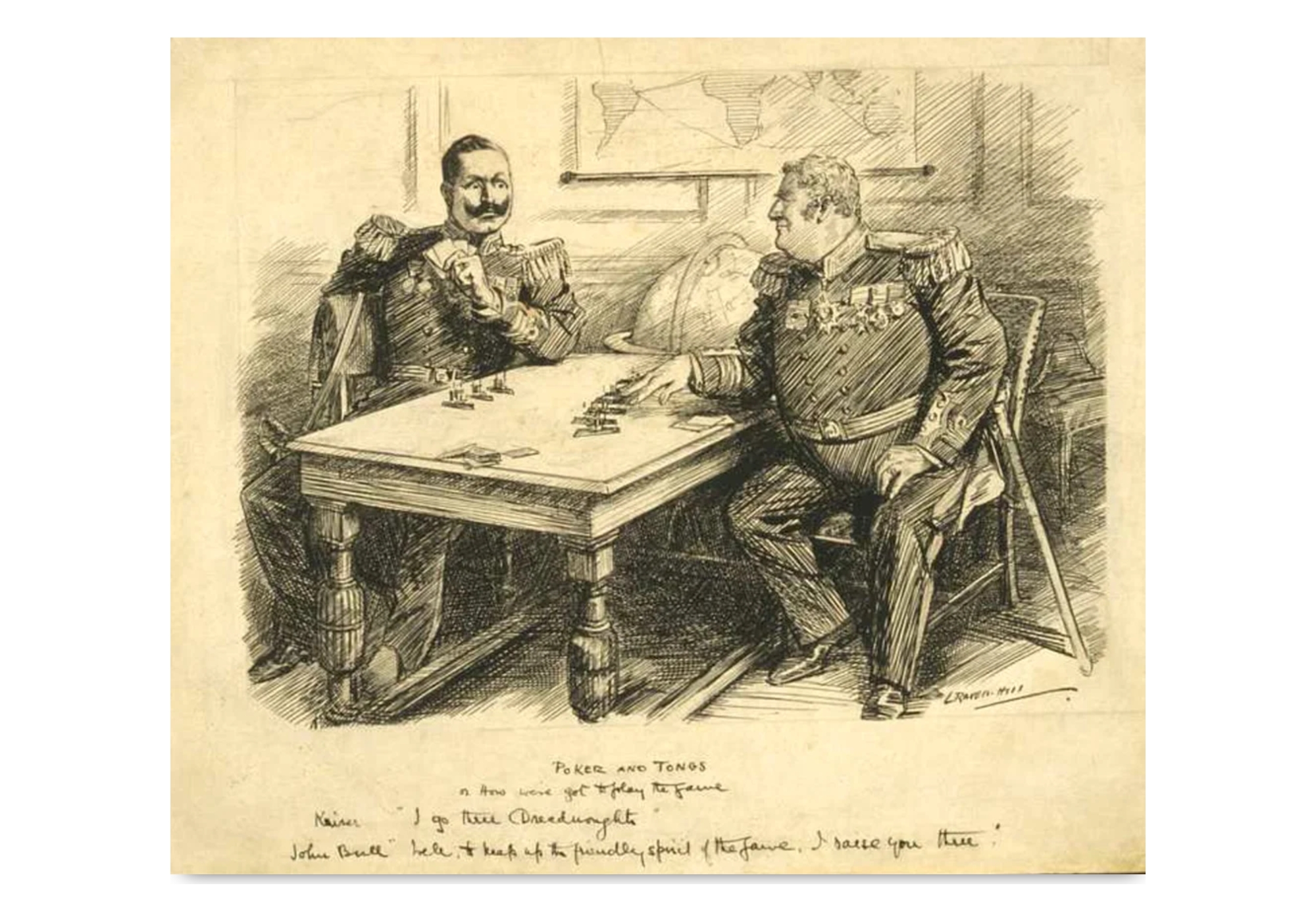
Image: As we undergo a new arms race internationally, this cartoon reminds us of the previous arms race – this is the Anglo-German battleship arms race before 1914: Poker and Tongs at World History
Caption reads: Kaiser: I go three Dreadnoughts (battleships)… John Bull: Hell, to keep up the friendly spirit of the game, I raise you three.
Brief Pause In The Latest Imperialist War Against Iran 10 April, 2026
Introduction
It is still early in the supposed ceasefire in the Imperialist war of the USA and Israel on Iran, some 40 days after the start. We see this only as a pause. Even if the immediate war of aggression against Iran is halted shortly, this will be only a short-term pause in the challenges to the USA hegemony. At the time of completion of this article (12 April), indeed, the first reports are a failure to agree to proceed with further negotiations at this stage.
Are these events part of an ever-growing move to a new world war? Do the prior World Wars carry lessons for Marxists, socialists, and progressives today?
The regrettably small international anti-war movement has met with overall support from the masses of virtually all countries – except those in Israel. But we lack a unified anti-war movement of the type of the Zimmerwald movement in which V.I. Lenin was so pivotal.
Editors MLRG.online posted 12 April; Note a postscript was added 13 April.
Table of Contents:
-
- Start and progress of the war – a brief recap
- The context of international wars in the era of late imperialism
- The context of the current USA-Israeli war on Iran
- An evolving consensus on the dangers of a new World War
- Summary and implications for Marxist-Leninists
- Postscript – tying it all back to resource battles between USA and China
1. Start and progress of the war – a brief recap.
On February 28, 2026, a furious wave of destruction and killings was unleashed on the people of Iran by the states of USA and Israel. Since this was unleashed after negotiations were abruptly halted by the USA leaving Iran in the lurch, deception was key to the USA and Israeli strategy.
Independent Western diplomatic observers, including Britain’s National Security Adviser, Mr. Jonathan Powell, noted that the Iranians had come very close to meeting all demands when the USA suddenly walked out:
“… Jonathan Powell, attended the final talks between the US and Iran and judged that the offer made by Tehran on its nuclear programme was significant enough to prevent a rush to war… Powell thought progress had been made in Geneva in late February and that the deal proposed by Iran was “surprising”, according to sources.
Two days after the talks ended, and after a date had been agreed for a further round of technical talks in Vienna, the US and Israel launched the attack on Iran… the talks represented by Donald Trump’s son-in-law, Jared Kushner, and Steve Witkoff, Trump’s special envoy on several issues…
A former official who was briefed on the Geneva talks by some of the participants said, “Witkoff and Kushner did not bring a US technical team with them. They used Grossi as their technical expert, but that is not his job. So Jonathan Powell took his own team. “The UK team were surprised by what the Iranians put on the table,” the former official added. “It was not a complete deal, but it was progress and was unlikely to be the Iranians’ final offer. The British team expected the next round of negotiations to go ahead on the basis of the progress in Geneva.” That next round of talks was due to take place in Vienna on Monday 2 March, but never happened. The US and Israel had launched their all-out attack two days earlier.”
Patrick Winotur and Julian Borger; UK security adviser ‘attended’ US-Iran talks and judged deal was within reach” Guardian 17 March 2026
Not for the first time USA-Iranian negotiations had been simply a ploy while bombing plans were set into motion by the USA and Israel. The war began with the targeted assassination of key Iranian personnel – the first being Ayatollah Ali Khamenei, the supreme leader of Iran. Both the USA and Israel closely collaborated on these crimes. Shortly, waves of bombardments hit Iran. The assaults on Iran were followed shortly by massive attacks upon the people of Lebanon. Our immediate slogans against this war were:
“Halt the unjust war against the People of Iran!
End USA and Israeli brutal domination over the countries of the Middle East!
The Iranian People must have the freedom to decide their leadership!”
MLRG.Online; “USA and Israel Warmongers Launch Their Imperialist War on Iran” With notes on the class character of the Iranian theocratic state.;
MLRG.online March 1, 2026;
See also: What is behind the massive, savage attack upon Iran? 23 June, 2025. MLRG.online 23 June 2025.
To date, the Iranian and Lebanese death tolls loom large over any assessment:
“Death tolls: The Human Rights Activists News Agency said at least 1,701 civilians, including 254 children, had been killed in Iran as of Wednesday. Lebanon’s health ministry on Friday said that at least 1,953 people had been killed in the latest fighting between Israel and Hezbollah, including 357 in a wave of Israeli strikes on Wednesday. In attacks attributed to Iran, at least 32 people have been killed in Gulf nations. In Israel, at least 20 people had been killed as of Monday. The American death toll stands at 13 service members.”
Aaron Boxerman et al; “Iran War Live Updates: U.S. and Iran Hold Historic High-Level Peace Talks”; New York Times 11 April 2026 at NYT 11 April
That leaves to one side the systematic targeted killing of Iran’s leadership and the massive destruction of civilian and military infrastructure.
The USA and Iran fully expected that, after the enormous losses inflicted on the state of Iran, the Iranian state would collapse. To the surprise of both the Genocidal Masters – USA President Trump and Prime Minister Netanyahu of Israel – the Iranian state refused to capitulate. This led to fury in the camp of the Genociders. Bellicose threats were repeatedly deepened and deadlines extended. In his final ultimatum of this phase, Trump issued a nakedly genocidal, barbaric threat to “destroy Iranian civilisation“. Only to then back down, claiming victory as negotiations loom.
These have started in Islamabad, Pakistan – but were fraught from the start – especially as:
i) Israel continues to bomb Lebanon and claims the ceasefire does not cover Lebanon;
ii) Iran’s demands, which thus far remain onerous for the USA and Israel: including the Iranian right to enrich uranium; its right over the Straits of Hormuz with likely toll duties on all foreign ships; refusal to dismantle missile silos; cancellation of USA-led international sanctions and release of sequestered funds; war reparations.
The dangers of USA and Israeli aggression in this illegal and immoral war warrant deeper characterisation from our movement.
How should Marxist-Leninists view these events?
2. The context of international wars in the era of late imperialism
For Marxists-Leninists, international wars are “barbarous and brutal”:
“Socialists have always condemned war between nations as barbarous and brutal.”
V.I.Lenin, “Socialism and War: The Attitude of the Russian Social-Democratic Labour Party Towards the War “The Principles of Socialism and the War of 1914–1915” in “The Attitude of Socialists Towards Wars; at Marxist Internet Archive
Nonetheless, our attitude historically has differed from that of pacifists or anarchists. The latter usually try to ‘compartmentalise’ war away from class struggle, to abstract it:
“But our attitude towards war is fundamentally different from that of the bourgeois pacifists (supporters and advocates of peace) and of the Anarchists. We differ from the former in that we understand the inevitable connection between wars and the class struggle within the country; we understand that war cannot be abolished unless classes are abolished and Socialism is created; and we also differ in that we fully regard civil wars, i.e., wars waged by the oppressed class against the oppressing class, slaves against slave-owners, serfs against land-owners, and wage-workers against the bourgeoisie, as legitimate, progressive and necessary.”
V.I. Lenin; “Socialism and War: The Attitude of the Russian Social-Democratic Labour Party Towards the War “The Principles of Socialism and the War of 1914–1915” in “The Attitude of Socialists Towards Wars; at MIA – Lenin Archive
Refusing to render war as abstract, Lenin said, “we Marxists” try to understand each war in its social class complexity:
“We Marxists … deem it necessary historically (from the standpoint of Marx’s dialectical materialism) to study each war separately. In history there have been numerous wars which, in spite of all the horrors, atrocities, distress, and suffering that inevitably accompany all wars, were progressive, i.e., benefited the development of mankind by helping to destroy the exceptionally harmful and reactionary institutions (for example, autocracy or serfdom), the most barbarous despotisms in Europe (Turkish and Russian). Therefore, it is necessary to examine the historically specific features of precisely the present war.“
V.I.Lenin, “Socialism and War: The Attitude of the Russian Social-Democratic Labour Party Towards the War “The Principles of Socialism and the War of 1914–1915” in “The Attitude of Socialists Towards Wars; Lenin Archive Socialism and War”
3. The context of this war
The war cannot be understood outside of key facts. These center on the declining hegemony of the USA related to its relatively declining profit base; and the relative rise of China’s economic, military and political influence.
In 2022 we argued that :
“In today’s world, any war is unlikely to be a localized affair. It inevitably becomes part of the international rivalry between the imperialist nations. As these become wars for power and markets – whatever was the initial spur – they become unjust wars between (at least) two sides.”
“Theses at a time of an obvious attempted re-division of world ‘spheres of interest’” Originally written 2022, then at MLRG.online 2022
We did not contest that the USA remained in 2022 still the “currently dominant imperialism”. But we put the issue of its erosion by competing imperialisms into centre view. Including Russia:
“We do not challenge… the primacy of the USA as the currently dominant imperialist nation… However, it is too often coupled with a serious distortion. This minimises the rampant imperialist behaviours of other countries, most latterly Russia… Those who minimize the imperialist actions of Russia undermine the working peoples of all countries and an international solidarity.”
“Theses at a time of an obvious attempted re-division of world ‘spheres of interest’” Originally written 2022, then at MLRG.online 2022
We argued that the USA’s main competitor forces were the Peoples’ Republic of China and the European Union (EU):
“1. The main problems facing the USA ruling class today
The three main problems that the USA ruling class currently faces to ensure its profit streams are:
(i) The profound lack of a manufacturing base in the USA
(ii) The tendency for the historical falling rate of profit is especially acute for the ruling class of the USA currently
(iii) The increasingly fervid competition with two major opposing blocks – the EU and China.”
“Theses on The Trump 2 Administration and the USA Ruling Class: A re-set to a new imperialist order”; MLRG.online 13th April, 2025
4. An evolving consensus on the dangers of new World War
It is now commonplace to find in the bourgeois news, discussions of whether we are in pre-world war scenario. This was previously dismissed as alarmist talk.
Some have suggested that the Second World War is a point of comparison. However, that war involved a unique dynamic, where the imperialist powers tried to ensure that Hitler destroyed the USSR. The Molotov-Ribbentrop Pact crucially delayed that Hitlerian assault on the USSR, and was one of the determining factors that prevented the Hitlerite takeover (See 2026 reprint MLRG.online).
Today, there is no socialist state anywhere. But in contrast to the Second World War, there are ominous parallels today to the First World War (WW1) of 1914-1918. The Balkans were the fodder for the imperial empires and the want-to-be empires then. Similar in fact, to the Middle East over the last 40 years or so. The comparison is not far-fetched.
The setting has evolved now to the point where the previously dubious can easily see the scenario. At its starkest, we should ask ‘What are the similarities and differences?’
i) Demise and decadence of hegemonic states presaging loss of hegemony and/or breakup:
In WW1, four empires were in various states of disintegration or failure:
The Ottoman empire; the Dual Hapsburg Austro-Hungarian Empire; the Tsarist Russian Empire; and finally the still dominant but faltering British Empire.
Currently, the USA hegemonic empire has been faltering in a long decline since the loss of the Vietnam War.
(ii) Rising economic rivalry
Prior to WW1 there was a patient but gearing-up to challenge – in the United States of America; and an especially hungry Germany.
Currently the PRC is binding its time, but its power is rapidly increasing. Meanwhile, the EU is being urged by its own leading members to federate rather than rely on its current confederation (See Mario Draghi: The Foundations of New Europe” ; 02/02/2026; Groupe d’etudes geopolitique; at École normale supérieure Paris )
(iii) Curtailed but stuttering short wars
WW1 The long run up to WW1 from 1900 right up to 1913 should be better known. A common misconception is that the start of WW1 was the incident of July 28, 1914, when Gavrilo Princip, a Yugoslav nationalist, assassinated Archduke Franz Ferdinand of Austria-Hungary in Sarajevo. But even as late as 2008 Austria-Hungary seized Bosnia-Herzogovina.
The long time-lines can be appreciated in standard accounts, including Margaret MacMillan: The War that Ended Peace – The Road to 1914, Toronto 2013; and Ed: Alexander Anievas: “Cataclysm 1914 : The First World War and the Making of Modern World Politics, Brill Leiden, 2015)
Currently In essence, the USA – Israeli project has had a long timeline, as many, including ourselves, have discussed.
Both in the run-up to WW 1 and currently, there was a long history of doomed to fail negotiations .
(iv) An ever-widening circle of countries are drawn in
In WW1 even as late as 1917 in the war itself, new participants were being drawn in. It was only in 1917 that the USA joined in.
Currently, all countries of the world are affected by virtue of the energy crisis and resulting economic turmoil. The exacerbation of the international capitalist crisis is obvious. Beyond the 3 leading antagonists – the USA, Israel, and Iran, the circle has widened to include all the countries of the Gulf and Lebanon. Also in the immediate vortex are Turkey, Cyprus, parts of the EU and the UK. Ukraine has become an active participant exporting its drone technology and resources, while Japan is being roped in by the USA. On the pro-Iranian side, thus far, Russia and China (Mark Mazzetti, Eric Schmitt, Julian E. Barnes; U.S. Intelligence Shows China Taking a More Active Role in Iran War NYT 11 April 2026 at NYT- 11 April ) have given support to Iran.
5. Summary and implications for Marxist-Leninists
The evident failure of the negotiations between Iran and the USA – was predictable from the start. The common mistake of imperialist war mongers is to under-estimate the resolve of the enemy. Not only were leading USA Army strategists counselling Trump that this was an unwinnable war. But many independent military and strategic scholars of the caliber of John J. Mearsheimer were calling it from the very start an unwinnable war. In his latest substack post, he writes today:
“On 10 April 2026, I was on Breaking Points talking about why Trump cannot win against Iran if he goes up the escalation ladder and why his only exit option is to concede defeat. Now that the 11-12 April 2026 US-Iranian negotiations in Islamabad have failed, Trump has decided to escalate and impose a naval blockade on the Strait of Hormuz. This is not going to cause Iran to surrender. How can it? After all, Iran is facing an existential threat and it is winning the war. In fact, blockading Iran is going to have devastating effects on the global economy, which is already in a world of hurt. Trump is only increasing the speed at which the Titanic is heading toward the iceberg.”
John J. Mearsheimer; “Escalation Will Not Work for Trump; April 12, 2026; at John’s Substack
In order not be mistaken, it is necessary to re-state our view of Iran – we do not believe that it is anything other than a theocratic, oppressive, anti-working class and anti-women state. Iran’s leadership stands at the pinnacle of a class society that carries a façade of a reactionary theocracy. In reality, the strands of power are firmly held by a militarised sector together with the “bonyads”. These are charitable trusts and they co-control Iran’s economy. The end of the debilitating Iran-Iraq Wars, which were in large part assisted by USA foreign imperialism, left a weak state. The old merchant (bazari)-bonyad state was slowly transformed under the guise of the clerics into a military-bonyad controlling complex. (For further detail, see “USA and Israel Warmongers Launch Their Imperialist War on Iran – with notes on the class character of the Iranian theocratic state. MLRG.online 1 March 2026 ) It should not be forgotten either that the Iranian theocratic rulers saw fit to
However, it is for the women and men, workers and toilers of Iran to decide their own fate. Hands off Iran!
The Iranian theocracy has not been above collaboration with the USA in the past. In the aftermath of the USA war on Iraq, the USA ensured that they left in place a weak Iraqi government. But it under-estimated the Shi’ia opposition to a USA military presence in Iraq. Simply put, Iraq became a killing-zone for USA forces on the ground. Undoubtedly USA directly negotiated with Suleimani and Quds and Iran. The USA benefited from Suleimani, to ‘control’ the Iraqi Sh’ia. (See Qassem Suleimani – Leader of the Iranian Quds Militia Assassinated 2020; On the Brink of Another War – the Trump Presidency Assassinates Iranian Leader”; reprinted at MLRG.online April 2024
Nonetheless – once more, Hands off Iran!
The problem for Marxist-Leninists today is that they cannot muster the united strength to be able to convincingly update Lenin’s call:
“Down with the tsarist monarchy, which has drawn Russia into a criminal war, and which oppresses the peoples! Long live the world brotherhood of the workers, and the international revolution of the proletariat!
V. I. Lenin; “Appeal on the War”: August 1915; Lenin Collected Works, Progress Publishers, [197[4]], Moscow, Volume 21, pages 367-369.
Is it not time that those who call themselves Marxist-Leninists – regardless of exact flavour – should unite under a renewed ‘Zimmerwald’ manifesto?
6. Postscript – tying it all back to resource battles between USA and PRC – China – rare earths vs oil
The centralising theme of the increasingly tense struggle between the USA and China becomes ever more and more clear. We had already drawn attention to the battle for oil and rare earth resources in 3 differing parts of the world.
(i) The “Malacca Straits” dilemma was posed in those words by former Chinese President Hu Jintao:
“The vulnerability of China’ s oil supply through the Strait of Malacca was highlighted when former Chinese President Hu Jintao termed it as the ‘ Malacca Dilemma’ . In other words, the steady supply of oil through sea lanes to China was contingent on the narrow Strait of Malacca to being open and free for navigation.”
Anasua Basu Ray Chaudhury & Pratnashree Basu (2016) Meeting with China in the Bay of Bengal, Journal of the Indian Ocean Region, 12:2, 143-160.
Cited in Bay of Bengal – Naval Cauldron of China versus USA – Behind the drama of Sheikh Hasina’s flight from Dakka
Bay of Bengal – A Naval Cauldron Pitting China versus USA” ; 23 August, 2024 MLRG.online; See MLRG.online Ibid
While Bangladesh was developing a “deepening dependency on India, at the very same time Bangladesh’s government has been developing a co-dependency on China.” We estimated that a “secret agreement was made to share the spoils of Bangladesh between India and China.” This was to involve the “Maritime Silk Road” and the protection of the oil route from Iran to China:
“The concept of the “Maritime Silk Road’ has been therefore heavily promoted since October 2013, by China’s President Xi Jinping.”
(Mohd Aminul Karim; “China’s Proposed Maritime Silk Road: Challenges and Opportunities with Special Reference to the Bay of Bengal Region; Pacific Focus, Vol. 30, No. 3 (December 2015), 297–319; See MLRG.online Ibid)
Hence the joint development between Bangadesh, India and China of a new naval base in the Cox Bazaar and Chittagong area:
“Bangladesh’s Prime Minister Sheikh Hasina inaugurated a $1.21- billion China-built submarine base last year. Located at Cox Bazaar off the Bay of Bengal coast, the base can house six submarines and eight warships simultaneously. China’s bolstered relationship with Bangladesh, especially in naval cooperation, stems from the 2002 Defense Cooperation Agreement, covering military training and defense supplies.”
Saqlain Rizve; “China-Bangladesh Military Exercises Signal Shifting Geopolitical Landscape”; The Diplomat May 6, 2024; cited in See MLRG.online Ibid
It was those implications that inspired the USA coup in Bangladesh pre-empting joint plans between the PRC and to build a major new Chinese funded Port on the Bay of Bengal.
“Secondly the USA demanded concessions from Hasina to secure a base in the Bay of Bengal to counter China. The site was to be St. Martin’s island – but Hasian refused to allow this.
“Bangladesh’s strategic position between India and China has always been a delicate balancing act. Hasina’s growing ties with China, particularly through the Belt and Road Initiative, raised concerns in Washington. Her refusal to entertain the idea of a U.S. naval base on St. Martin’s Island further strained relations with the U.S., leading to accusations of political manipulation by external forces.”
Geeta Mohan “India Today; 14th August 2024; Cited in MLRG.online Ibid).
(ii) Trump’s tariff wars and China’s rare earth export ban retaliation
The aims of the Trump tariff wars were to return as much manufacturing to the USA home geography (“reshoring”); increase profit as maximally as possible from the revenues raised; and limit as much as possible the growth of its competitors. That entailed a. restriction of high tech chips. Even more pivotal was the European-Dutch monopoly on Ultraviolet lithography – a critical new tool for semi-conductors. The USA moved to block a Dutch sale to China:
“ASML, a Dutch company and the sole manufacturer of the extreme ultraviolet lithography machines without which cutting-edge semiconductors cannot be made, had been on the verge of shipping a $150 million machine to a Chinese customer. However, Secretary of State Mike Pompeo personally lobbied Dutch Prime Minister Mark Rutte, and the machine was never shipped.”
Guy Laron; “Resource Competition With China Lay Behind Trump’s Iran War” April 12, 2026 originally at Jacobin; reprinted at Portside.
However, previously we noted China’s counter response included both counter-tariffs, but also a policy of using its near 100% monopoly of finished rare earth minerals. this was a major ‘card’ that the Chinese state held. They are essential for the computer, communications and chip industries:
“Automobiles, electric battery sector, and tariffs… related to the development of computer technology and the change in energy supply is the shift of automobile industrial development into the battery-based rechargeable Electric Vehicles.
This has prompted the surge in tariffs in several world markets. While this move largely started in the USA, the European Community has readily joined this lobby. Undoubtedly it is aimed at China and its ability to translate low cost labour into a competitive alternative to the USA and European automobile industries. As part of the tariff package has come the restrictions on chip technology that are being urged by the USA. Again the target is mainly China.
China of course is hitting back. One advantage it has is a near-monopoly on key components, including dysprosium. A “rare earth.. it is highly heat resistant… (and) increasingly important for advanced semiconductors“:
“In a series of steps made in recent weeks, the Chinese government has made it considerably harder for foreign companies, particularly semiconductor manufacturers, to purchase the many rare earth metals and other minerals mined and refined mainly in China….”
In: “Theses on The Trump 2 Administration and the USA Ruling Class: A re-set to a new imperialist order
13th April, 2025“; MLRG.online October 28, 2024 ; Citing Keith Brasher, “China Tightens Its Hold on Minerals Needed to Make Computer Chips”; New York Times 26 October, 2024)
This battle was brought into a renewed prominence on 13 April 2025 by China’s counter-move:
“Beijing has suspended exports of certain rare earth minerals and magnets that are crucial for the world’s car, semiconductor and aerospace industries.. .
China has suspended exports of a wide range of critical minerals and magnets, threatening to choke off supplies of components central to automakers, aerospace manufacturers, semiconductor companies and military contractors around the world.
Shipments of the magnets, essential for assembling everything from cars and drones to robots and missiles, have been halted at many Chinese ports while the Chinese government drafts a new regulatory system. Once in place, the new system could permanently prevent supplies from reaching certain companies, including American military contractors.
The official crackdown is part of China’s retaliation for President Trump’s sharp increase in tariffs that started on April 2.
On April 4, the Chinese government ordered restrictions on the export of six heavy rare earth metals, which are refined entirely in China, as well as rare earth magnets, 90 percent of which are produced in China. The metals, and special magnets made with them, can now be shipped out of China only with special export licenses.”
“Theses on The Trump 2 Administration and the USA Ruling Class: A re-set to a new imperialist order
13th April, 2025“; MLRG.online October 28, 2024
(iii) Back to oil – Venezuela and the capture of Maduro by USA imperialism
We discussed the capture of Maduro as being driven by two main factors:
“the two core background themes behind the current USA attack upon Venezuela is:
(i) To seize the oil reserves of Venezuela.
(ii) Restricting pro-Chinese developments in South America and furthering an anti-Chinese war”.
The Capture of Nicolaus Maduro and the current strategy of USA imperialism; at MLRG.online April 12, 2026
Oil economists point out that:
“the American take over of Venezuela threatens the interests (including substantial debts) built up there in recent years by China. Some estimates put the scale of Chinese investments and debts at more than $ 100 bn… says Nick Butler Energy Economist. Visiting Professor Kings College London; in “Venezuela – was this a coup for oil ?”… and Marc Rubio is cited by the Financial Times as “nuancing”’ his boss:
“Rubio has tried to nuance his boss’s remarks, outlining a three-step process – stabilisation, recovery and transition – and placing more emphasis on the need for a return to democracy over time. Washington is also determined to remove the Cuban, Iranian, Chinese and Russian presence from Venezuela.” FT; 19 January 2025; See in
“Very Slowly Some World Leaders Grow a Spine – Trump’s Arrogant Claims over Greenland and Europe’s Response”; 22 January 2026; MLRG.online
(iv) Firmer links made of anti-China thrust of the USA-Israel war on Iran
The importance of Iranian and Venezuelan origin oil for China has been immense:
“The independent refineries clustered (at Shandong), known as teapots… began receiving import licenses only in 2015, when Beijing broke its state monopoly on oil purchases… Within a decade, they had become a quarter of China’s entire refining capacity, the engine of a provincial economy worth nearly ¥10 trillion, with hundreds of thousands of jobs running from the plant floor through logistics, chemicals, and ancillary services. Shandong’s refinery complex plays a crucial role in the Chinese economy, yet it runs on a very particular kind of fuel.
The secret was sanctions. When the United States cut Iran and Venezuela off from Western buyers, it inadvertently created a supplier class selling at steep discounts to whoever would take delivery without asking too many questions. The teapots asked none. Iranian and Venezuelan heavy crude arrived relabeled as Malaysian, Omani, or Indonesian, rebranded after ship-to-ship transfers in international waters by tankers running with their transponders dark…. By 2025, US-sanctioned crude from Iran and Venezuela accounted for roughly 17 to 18 percent of China’s total oil imports.”
Guy Laron; “Resource Competition With China Lay Behind Trump’s Iran War” April 12, 2026 originally at Jacobin; reprinted at Portside.
The USA-Israeli plans on Iran certainly entailed capture of oil fields. The Israelis had long planned a bypass pipeline avoiding Hormuz:
“Netanyahu’s original proposal from 2017 envisioned a seven hundred -kilometer pipeline route from the Saudi port of Yanbu through Jordan to Eilat, and from there through the existing Eilat-Ashkelon pipeline directly to the Mediterranean, bypassing Hormuz and Bab-el-Mandeb entirely. The usage fees — estimated at hundreds of millions of dollars annually — would flow to the Israeli treasury, while the oil would flow to Europe.”
Guy Laron; “Resource Competition With China Lay Behind Trump’s Iran War” April 12, 2026 originally at Jacobin; reprinted at Portside.
Trump favoured a more direct capture. The goal being for the USA not so much new oil sources – but to deny China the source of oil:
“Delcy Rodríguez, Maduro’s vice president, had stayed in place after her boss was seized, becoming Washington’s compliant interlocutor for Venezuelan oil. Trump wanted the same arrangement in Tehran: a pliable successor regime that would cooperate on production and pricing. “It’s all about installing someone like a Delcy Rodríguez,” an administration official told reporters. Trump himself told the Financial Times at the end of March: “To be honest with you, my favorite thing is to take the oil in Iran…
Helen Thompson, a political economist at the University of Cambridge… concluded: “If we go back to that strategic security report from last autumn, it is clear that energy abundance, as the Trump administration likes to call it, is both an aim and it is also a means of engaging in geopolitical competition…
Trump himself, asked in late March about the Hormuz closure, was blunter still: “We don’t need the Hormuz Strait. We have so much oil, our country is not affected by this.”
Guy Laron; “Resource Competition With China Lay Behind Trump’s Iran War” April 12, 2026 originally at Jacobin; reprinted at Portside.
Naturally things get ratcheted up: China looks even more to Russian oil via new pipelines; China builds its own lithographic machines using former Dutch ASML engineers; and the USA moves on rare earths:
“China’s latest five-year plan, released in early March, calls for advancing “preparatory work for the central route of the China-Russia natural gas pipeline,” a diplomatic term for Power of Siberia 2, a 2,600-kilometer pipeline from Russia’s Yamal Peninsula to China via Mongolia…
Simultaneously, in a high-security compound in Shenzhen, Chinese engineers working under false identities and restricted phone access are testing a prototype of an extreme ultraviolet lithography machine. The machine, built by former ASML engineers recruited with signing bonuses of up to $700,000, fills nearly an entire factory floor. It has not yet produced working chips, but it may do that by 2030. The direction is unmistakable: China wants the United States, as one source put it, “100 percent kicked out of its supply chains…
The Trump administration convened fifty-four countries at a Critical Minerals Ministerial in February, signing bilateral frameworks with eleven nations and mobilizing over $30 billion in loans, investments, and loan guarantees …
The Trump administration invested $1.6 billion in USA Rare Earth, an Oklahoma firm controlling deposits of the heavy rare earths most critical for defense technologies. As Commerce Secretary Howard Lutnick explained: “This investment ensures our supply chains are resilient and no longer reliant on foreign nations.”
Guy Laron; “Resource Competition With China Lay Behind Trump’s Iran War” April 12, 2026 originally at Jacobin; reprinted at Portside.
Too close again with the same question: “Is it not time that those who call themselves Marxist-Leninists – regardless of exact flavour – should unite under a renewed ‘Zimmerwald’ manifesto?”
Postscript end 13 April, 2026