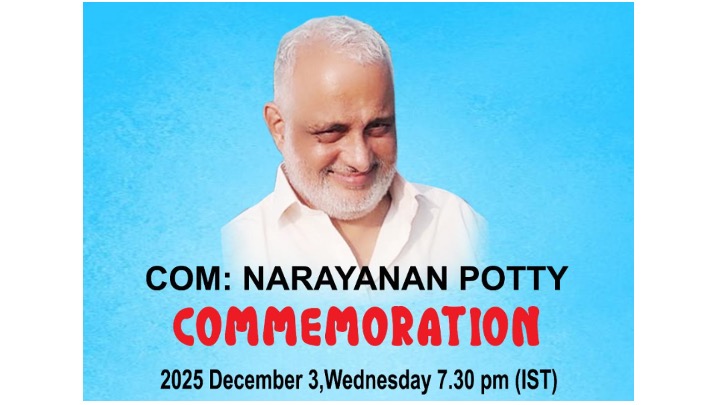
Commemorating the Life of the Indian Marxist-Leninist K. Narayanan Potti
Introduction
We were privileged to work closely with a comrade of the ‘Center for Marxist Studies’ in Kerala, India – K. Narayanan Potti (aka Potty) Most regrettably, he died recently following a sudden fatal illness. This cut short a close fraternal relationship with MLRG.online. We were honoured to be a part of a commemoration for him held by his comrades in Kerala. In this issue, we carry three pieces.
The first is the commemoration of his comrades in the ‘Center for Marxist Studies’, which outlines K.N.Potti’s remarkable Marxist-Leninist career and his service to the proletariat and toiling peoples of India. This was written by T.Narayanan Vattoli.
The second is a written version of a speech lasting about 15 minutes, on the subject of Stalin. It was given in his honour at the celebration and commemoration of his life by Hari Kumar.
The third is what we believe was the last formal piece written by Comrade K.N. Potti. It is on the Naxalite movement and was spurred by the recent murder of one of its leaders. It was written at the request of MLRG.online, and it was promptly written and sent to us by Cmde Potti. Unfortunately, publication was delayed at the MLRG.online end, due to the burden of work. We sincerely regret that Cmde Potti did not have the chance to see it published. We had more joint work, which we will attend to over time.
In conclusion, while Comrade K.N.Potti is gone, the work of MLRG.online and that of the Center for Marxist Studies in Kerala – goes on. We are confident that his comrades will be able to shoulder the duties that he had to leave behind him.
1. T. Narayanan Vattoli for the ‘Center for Marxist Studies’ – commemorates Comrade K.N. Potti (Potty)
Comrade K.Narayanan Potty’s sudden demise on 17th November, 2025 was a shock to his comrades and friends in Kerala. He was 64, and only recently he was diagnosed as a liver patient. He looked healthy and energetic as usual when we met a few months ago at Aluva, Kerala in a regular Marxist Study Camp organised under the aegis of the Centre for Marxist Studies. After the surgery, his condition rapidly deteriorated, and we lost a rigorous learner and activist in the field of Marxist philosophy.
Com. Potty was actually an inspiration to those who are interested in Marxism. He was a fast learner and could memorise well the things he studied. Com. Potty was an ardent admirer of Stalin. Actually, he introduced us to many valuable books on Stalin, especially those of American historian Prof. Grover Furr.
When com. Potty returned after a long political hibernation of more than 35 years, he was in a high spirit and asked us to take appropriate measures to publish books on the recent revelations about com. Stalin. It was because of his insistence and constant inciting persuasion we established a humble publishing house named Proletarian Publishers.
1. Stalin’s Struggles for Democratic Reforms. (Translated by Ramachandran Chenichery)
2. Khrushchev Lied. (Translated by 5 comrades, including com Potty)
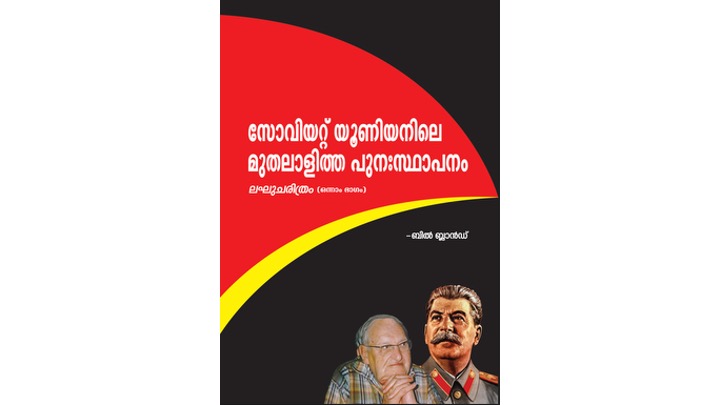
1. Restoration of Capitalism in USSR by W.B. Bland (Concise edition)
2. On Jewish Question by Karl Marx
3. Stalin and the Tactics of Peoples ‘ Democratic RevolutionWithin a period of about 3 years of his efforts, the Malayalam language happened to get 5 Valuable Marxian books. Marcello Musto ‘s The Last Years of Karl Marx also is expected to be published within one or two months. This book also was also introduced to us by Com Narayanan Potty. The book is translated by T.Narayanan Vattoli.Com. Narayanan Potty became acquainted with the Marxian line of thinking when he was 17 years old, i.e., in 1978. He was then a student at the University College, Thiruvananthapuram. He was a brilliant and inquisitive student and quite naturally came into contact with Socialist Unity Centre of India (SUCI – Now re-Christened as SUCI (Communist), the party that claims that it is the only genuine communist Party in India, and its students’ win,g All India Democratic Students Organisation (AIDSO). The party called upon the cadres to wage an uncompromising struggle inside and outside the party.Com. Potty tried to follow the revolutionary path professed by its founder leader Shibdas Ghosh, who is eulogised as one of the foremost Marxist thinkers of the World, and organised a party unit in Nedumangad, his native place in Thiruvananthapuram district. Com. Potty dedicated himself to building up the party and he persuaded his brother and sister towards the party and they also became party workers . But his party work and connection lasted only for a period of 7 years, and in 1985 he left the party, raising some serious allegations against the top leadership of the Kerala State party. Thus, the dedicated revolutionary became the ardent foe of the party.
The event of leaving the party affected Com. Potty deeply, and a paradigm shift occurred in his life . He was driven to the path of spiritualism and his attention was focussed in the study of the Sanskrit language and Vedic literature. The circumstances transformed him into a Hindu Priest and he involved himself following specific rituals and practices unique to Hindu faith. For more than 35 years, he tried to have spiritual fulfillment. Actually quite accidentally he happened to meet some of his old comrades who had also left SUCI because of different reasons.
T Narayanan Vattoli Received December 8, 2025
2. Synopsis of short commemoration talk for Comrade Potti (aka Potty) given by Hari Kumar; at the function organised by the Center for Marxist Studies 3rd December 2025.
We are discussing and celebrating the life of Comrade Potti. I wish to thank the comrades of the ‘Center for Marxist Studies’ for enabling my participation in this event to honour Cmde. Potti.
I want to express my deep condolences to his family and the Center for their loss. Of course, given his achievement, the Marxist-Leninist movement also suffered a great loss.
But I will dwell on the topic that had led him to contact me out of the blue. I believe that is what he would have wanted, actually. In a short note about 5 years ago, he asked if I could help him trace more writings of Cmde W.B.Bland, as he was interested in further exploring his work on Stalin. We quickly formed a bond and agreed we needed to further collaborate.
It is natural then that these few words of mine take as a theme the attacks on Stalin.
I will therefore briefly consider some anti-Stalin allegations arising after the 20th Party Congress of the CPSU(B):
(i) Was there a cult of personality?
(ii) Role of heavy industry in socialist transition?
(iii) Did Stalin naïvely proclaim the end of class war?
(i) The Charge – Stalin created a cult of personality around himself
This was one core of Nikita Khrushchev‘s “revelations” and charges at the 20th CPSU(B) Party Congress. But the charges did not emanate from him alone.
The initial response of Mao Zedong to the death of J.V. Stalin was remarkable in its praise of Stalin:
“It was with boundless grief that the Chinese people, the Chinese government, and I myself learned the news of the passing away of the Chinese people’s closest friend and great teacher, Comrade Stalin. This is an inestimable loss, not only for the people of the Soviet Union, but for the Chinese people…
The victory of the Chinese people’s revolution is absolutely inseparable from Comrade Stalin’s unceasing care, leadership, and support of over thirty years…”
Mao Zedong “Telegram to the USSR on Stalin’s Death”, March 6, 1953”;
People’s Daily, March 7, 1953; at Mao ZeDong Reference Archive, at Marxist Internet Archive
Yet this was not to last. Six years later, the sounds emerging from China were as though lifted direct form the not-so “Secret Speech” in Moscow:
“But when any leader of the Party or the state places himself over and above the Party and the masses, instead of in their midst, when he alienates himself from the masses, he ceases to have all-round, penetrating insight into the affairs of the state…
Stalin took more and more pleasure in this cult of the individual and violated the Party’s system of democratic centralism and the principle of combining collective leadership with individual responsibility. As a result, he made some serious mistakes: for example, he broadened the scope of the suppression of counter- revolution; he lacked the necessary vigilance on the eve of the anti- fascist war; he failed to pay proper attention to the further development of agriculture and the material welfare of peasantry; he gave certain wrong advice on the international communist movement, and, in particular, made a wrong decision on the question of Yugoslavia.”
Editorial, “The Historical Experience of the Dictatorship of the Bourgeoisie”; Peking: Foreign Languages Press, 1959; ‘Stalin’s Place in History’; MZ Selected Works Volume 7 5th April, 1956;
Of course, it is true that there was indeed a ‘Cult of Personality’ built around Stalin.
But it was not built by Stalin. To the contrary, it was built by such as Karl Radek and Khrushchev. This has been described since 1976 by W.B. Bland in a number of articles. In his ‘Address to the Sarat Academy’ in London in 1999. Bland pointed out that:
“There was indeed a ‘cult of personality’ around Stalin. A leading communist cried at the 18th Congress of the Party in March 1939:
“The Ukrainian people proclaim with all their heart and soul
‘Long live our beloved Stalin!’
Long live the towering genius of all humanity, our beloved
Comrade Stalin!”
The speaker was Nikita Khrushchev!
It was Khrushchev, to,o who coined the term ‘Stalinism’ and began to call
Stalin ‘Vozhd” — the Russian equivalent of the German ‘Fuhrer’, Leader.”
‘Stalinism’ – An Address to the Sarat Academy in London
on 30 April 1999 by Bill Bland; at https://www.marxists.org/archive/bland/1999/04/stalinism.pdf
Actually, numerous accounts in various ways showed that Stalin was hostile to this cult:
“In fact, Stalin himself opposed and ridiculed this cult. For example, when in February 1938 someone wanted to publish a book entitled ‘Stories of the Childhood of Stalin’, Stalin wrote typically:
“I am absolutely against the publication of ‘Stories of the Childhood of Stalin’. The book abounds with a mass of inexactitudes of fact, exaggerations and of unmerited praise . . . But the important thing resides in the fact that it has a tendency to engrave on the minds of Soviet children (and people in
general) the personality cult of leaders, of infallible heroes. This is dangerous and detrimental.
I suggest we burn this book”.
‘Stalinism’ – An Address to the Sarat Academy in London
on 30 April 1999 by Bill Bland; https://www.marxists.org/archive/bland/1999/04/stalinism.pdf
More recent data since Bland’s death amply corroborates this. The edits and extensive rewriting and re-working of the draft for the “Short History of the CPSU(B)” makes this clear. The modern day editors of a volume exploring Stalin’s editing of the original text, express in several places their astonishment. As for example here:
“He also cut dozens of paragraphs and scores (i.e 20s) of references to himself and his career … Such cuts, which even deleted his own pre-revolutionary career in the Transcaucasus … had the effect of concentrating historical agency around Lenin and the Bolshevik movement and central institutions.”
Eds Brandenberger D and Zelenov M; “Stalin’s Master Narrative – A Critical Edition of the History of the CPSU(B) a Short Course”; Yale 2019; p.13; p.44
Naturally, the question is why was this cult built?
Stalin was quite aware this was happening and he believed it was “with the aim of discrediting him at a later date”. Says Bland:
“Why should the revisionists have built up this ‘cult of personality’ around Stalin?
It was, I suggest, because it disguised the fact that not Stalin and the Marxist-Leninists, but they — concealed opponents of socialism — who held a majority in the leadership. It enabled them to take actions — such as the arrest of many innocent persons between 1934 and 1938 (when they controlled the security forces) and subsequently blame these ‘breaches of socialist legality’ upon Stalin.
Stalin himself is on record as telling the German author Lion Feuchtwanger in 1936 that the ‘cult of his personality’ was being built up by his political opponents (I quote:) “…with the aim of discrediting him at a later date.”
Clearly, Stalin’s ‘pathological suspicion’ of some of his colleagues, of which Khrushchev complained so bitterly in his secret speech to the 20th Congress, was not pathological at all!
Bill Bland Stalin: “The Myth and the Reality”; at https://www.marxists.org/archive/bland/1999/x01/x01.htm
If this strikes the reader as being improbable, consider Stalin’s own expressed view about the revisionist economic planner Nikolai Voznosensky:
“Unlike other associates who mask disagreements by either agreeing or pretending to agree among themselves before coming to me, Voznesensky, if he is not agreed, does not agree on paper. He comes to me and expresses his disagreement. They understand that I can’t know everything and they want to make of me a rubber stamp. I pay attention to disagreements, to disputes, why they arose, what is going on. But they try to hide them from me. They vote and then they hide. … That is why I prefer the objections of Voznesensky to their agreements.”
J.V.Stalin in V. Khlevnyuk, Sovetskaia Ekonomicheskaia Politika na Rubezhe 40-50 Godov i Delo Gosplana (working paper, Florence, Italy, March 2000), 13;
Cited by Paul Gregory: “Political Economy of Stalinism Evidence from the Soviet Secret Archives”; Cambridge 2004; p. 19
We should recall what role Voznosensky played:
“In 1948-9, during Stalin’s lifetime, a serious attempt was made to initiate precisely the same kind of economic reform — one that would have led to the restoration of an essentially capitalist society in the Soviet Union — which happened under the Brezhnev regime…
The “economic reform” of 1948-9 led by Nikolai Voznosensky — Chairman of the State Planning Commission since 1937 and Deputy “Prime Minister” since 1939 … (who) demanded that the prices of commodities should be “market prices”, “based on their values or “prices of production” (i.e by Marx – cost of production plus an average profit).
He emphasised “cost accounting” (based on the profitability of individual enterprises and industries) in the organisation of production, together with that of economic incentives in the form of bonuses to the personnel of enterprise.”
W.B. Bland “The Leningrad Affair Appendix 3 from Restoration of Capitalism in the Soviet Union“; Wembley 1980; https://www.marxists.org/archive/bland/1980/restoration-capitalism-soviet-union/appendix-3.htm
As Stalin wrote in his last full work that we know of:
“It is sometimes asked whether the law of value exists and operates in our country, under the socialist system. Yes, it does exist and does operate. Wherever commodities and commodity production exist, there the law of value must also exist… Does this mean that … the law of value … is the regulator of production in our country…? No it does not. Actually, the sphere of operation of the law of value under our economic system is strictly limited and placed within definite bounds…”
Stalin JV: Economic Problems of Socialism in the USSR” Peking 1972; at
https://www.marxists.org/reference/archive/stalin/works/1951/economic-problems/index.htm
(ii) Role of heavy industry in socialist transition?
Discussion of Voznosensky leads directly to the question of the USSR economic plans (or 5-year plans) and the role of heavy industry versus light industry. Here I will only point out that Stalin’s view was in direct contrast to that of Mao. Stalin advocated the primacy of heavy industry over light industry:
“The national economy … cannot be continuously expanded without giving primacy to the production of means of production.”
J.V.Stalin “Economic Problems of Socialism in the USSR”; February 1952; London 1986; p.316.
Mao, in contrast criticised Soviet development to 1953, saying it had laid a:
“lop-sided stress on heavy industry to the neglect of agriculture and light industry.”
Mao Ze Dong April 1956; ‘Selected Works’ Volume 5; Peking; 1977; p.285;
(also see Chapter 9 Bland; “Selected Works W.B. Bland Volume 1” 2025).
This was not a minor disagreement but a fundamental one. As Stalin pointed out that leading newspaper of the British ruling class the Financial Times rebutted the attacks of the more crass bourgeois economists the world over during the Five-Year plan:
“The opinion of the British bourgeois newspaper, The Financial Times:
“The progress made in machine construction cannot be doubted, and the celebrations of it in the press and on the platform, glowing as they are, are not unwarranted. It must be remembered that Russia, of course, produced machines and tools, but only of the simplest kind. True, the importation of machines and tools is actually increasing in absolute figures; but the proportion of imported machines to those of native production is steadily diminishing. Russia is producing today all the machinery essential to her metallurgical and electrical industries; has succeeded in creating her own automobile industry; has established her own tool-making industry from small precision instruments to the heaviest presses; and in the matter of agricultural machinery, is independent of foreign imports. At the same time, the Soviet Government is taking measures to prevent the retardation of production… such basic industries as iron and coal endangering the fulfilment of the plan in 4 years. The one thing certain is the enormous plants now being established guarantee a very considerable increase in the output of heavy industries.”
J. V. Stalin; “Joint Plenum of the C.C. and C.C.C., C.P.S.U.(B.) 1 January 7-12, 1933”; “The Results of the First Five-Year Plan Report Delivered on January 7, 1933”; Works, Vol. 13, 1935 Moscow, p. 168 ; or at: https://www.marxists.org/reference/archive/stalin/works/1933/01/07.htm
Stalin did not draw this emphasis on heavy industry out of thin air – he derived it from Lenin:
“We have Lenin’s directives on this subject also:
“The salvation of Russia lies not only in a good harvest on the peasant farms—that is not enough; and not only in the good condition of light industry, which provides the peasantry with consumer goods—that, too, is not enough; we also need heavy industry … Unless we save heavy industry, unless we restore it, we shall not be able to build up any industry; and without it we shall be doomed altogether as an independent country … Heavy industry needs state subsidies. If we do not provide them, then we are doomed as a civilised state — let alone as a socialist state” (see Vol. XXVII, p. 349)
“No. If we see to it that the working class retains the leadership of the peasantry, we shall be able, by exercising the greatest possible economy … to use every kopek we save to develop our large-scale machine industry, to develop electrification, the hydraulic extraction of peat, to finish the construction of Volkhovstroi, etc.
“In this, and this alone, lies our hope. Only when we have done this will we, speaking figuratively, be able to change horses, to change from the peasant, muzhik, horse of poverty, from the horse of economy adapted to a ruined peasant country, to the horse which the proletariat is seeking and cannot but seek—the horse of large-scale machine industry, of electrification, of Volkhovstroi, etc.” (see Vol. XXVII, p. 417)”
J. V. Stalin; “Joint Plenum of the C.C. and C.C.C., C.P.S.U.(B.) 1 January 7-12, 1933”; “The Results of the First Five-Year Plan Report Delivered on January 7, 1933”; Works, Vol. 13, 1935 Moscow, p. 177; 179 https://www.marxists.org/reference/archive/stalin/works/1933/01/07.htm
(iii) The allegation by Western Maoists following Mao that Stalin neglected the class struggle
Martin Nicolaus wrote for The “October League” USA – the influential “Restoration of Capitalism in the USSR”; Chicago 1975; (David J. Romagnolo for ‘Marx2Mao’; found at MIA at http://www.marx2mao.com/Other/RCSU75.html#s3)
This became a widely disseminated and important text for Marxist-Leninists. In an interesting review of how Khrushchev came to power and went on to destroy the socialist state, Nicolaus gives many useful facts.
But he unmistakably “lays the blame” on Stalin for allegedly ‘having dropped the class struggle’:
“There in a nutshell Yao has put the cardinal mistake made by the Soviet Communist party during the period when Stalin was its leader. They did not dig away fast enough the political-economic-social “soil” that was engendering a new bourgeoisie and did not perceive the danger it posed until the initiative had already slipped out of their hands. A closer look at these problems is in order.”
Nicolaus; “Restoration of Capitalism in the USSR”; Chicago 1975; Ibid; p.41
Expanding on these, Nicolaus goes on to preach that the Bolsheviks under Stalin had lost “revolutionary vigilance”:
“In short, the problems within the Soviet party were larger than the presence of a few opportunists. There was a dulling of the fine edge of revolutionary vigilance that would have uncovered the opportunists and caused their downfall. Sincere and dedicated proletarian cadre failed to unmask the bourgeois elements among them, and even united with them to a certain extent, because they themselves had become infected with bourgeois moods.”
Nicolaus; “Restoration of Capitalism in the USSR”; Chicago 1975; Ibid; p.54
Of course this follows Mao’s line and his rationale for the attack on his own party the CPC in the ‘Great Proletarian Cultural Revolution’.
That this was not an individual aberration of Nicolaus, can be seen in the equally widely distributed text named “Red Papers #7″ or “How Capitalism Has Been Restored in the Soviet Union and What This Means for the World Struggle (RP7)’ by The Revolutionary Union the Revolutionary Communist Party USA.; 1974 USA. At: https://www.marxists.org/history/erol/ncm-8/red-papers-7/index.htm.
This is an equally interesting text with many facts. Nicolaus and the RCP launched polemics on each other. But there was much agreement between them, going beyond their sectarian polemics. Hence the RCP also goes on to pin an alleged blame for the loss of the socialist USSR … on Stalin:
“ln his classic work, Dialectical and Historical Materialism, Stalin put forward the erroneous thesis that in the Soviet Union, “the relations of production fully correspond to the state of the productive forces.” (Stalin, Dialectical and Historical Materialism). This tended toward the abandonment of conscious revolution and encouraged the masses to view the simple development of production as the answer to all difficulties…
Because of these errors Stalin failed, almost from the beginning, to develop the means and forms for the workers themselves to be increasingly involved in initiating and working out the planning process and not just fulfilling its tasks.”
Red Papers 7; Ibid p.21; at https://www.marxists.org/history/erol/ncm-1/red-papers-7/ch2.pdf
To refute these allegations of these influential Maoists in the USA it is simply sufficient to examine Stalin’s own writings. In brief Stalin reminded the proletariat and peasantry of the USSR that:
“We must bear in mind that the growth of the power of the Soviet state will intensify the resistance of the last remnants of the dying classes. It is precisely because they are dying and their days are numbered that they will go on from one form of attack to another, sharper form, appealing to the backward sections of the population and mobilising them against the Soviet regime.”
J. V. Stalin; “Joint Plenum of the C.C. and C.C.C., C.P.S.U.(B.) 1 January 7-12, 1933”; “The Results of the First Five-Year Plan Report Delivered on January 7, 1933”; Works, Vol. 13, 1935 Moscow, p. 216 https://www.marxists.org/reference/archive/stalin/works/1933/01/07.htm
“these People’s Commissariats are more infected than others with the disease of red tape. Decisions are made, but not a thought given to checking their fulfilment, to calling to order those who disobey.”
J. V. Stalin; “Report to the Seventeenth Party Congress on the Work of the Central Committee of the C.P.S.U.(B.)”; January,1934; Works, Vol. 13, 1930 Moscow, 1955; p. 335 https://www.marxists.org/reference/archive/stalin/works/1934/01/26.htm
In closing, I emphasise that Comrade K.N.Potti and MLRG.online shared a very common view on the politics of the defence of Stalin, and the current situation facing the world’s proletariat, peasants, and toiling poor. Again, the condolences of MLRG.online to his comrades in Kerala and his family.
NB: This is not a verbatim transcript, but it is my own memory of what I talked about on 3 December 2025. It only partially differs – in the extent of the specific quotes from Nicolaus and comments on the RCP (USA). Each other of the other quotes given here, was explicitly noted and references given, in the talk.
The following shows the book published as a Malayalam translation of W.B. Bland’s “Restoration of Capitalism in the USSR”.
3. Naxalite Armed insurgency of Ultra-Left Maoists in India a menace and dangerous threat to the working class movement in India.
By Narayanan Potti K; received May 28, 2025.
An official declaration of at least 27 Maoists, having been killed in an encounter, has been released as follows:
May 21, 2025: “Chhattisgarh: 27 Naxalites Killed In An Encounter; PM Modi Hails Security Forces For Remarkable Success”:
“In Chhattisgarh, 27 Maoists have been killed in an encounter with security forces in Chhattisgarh today. Top Naxal leader and CPI Maoist general secretary Basav Raju is among those killed. A reward of about one crore rupees was declared for him. Security forces have recovered a large number of weapons and other Maoist material along with the bodies of all the Maoists killed from the spot. A jawan of District Reserve Guard-DRG was martyred in the encounter.
Prime Minister Narendra Modi has expressed pride at the success of country’s security forces for their remarkable success in the operation against Maoists at Chhattisgarh today. In a social media post, Mr Modi said government is committed to eliminating the menace of Maoism and ensuring a life of peace and progress for country’s people.
Our correspondent reports that on receiving intelligence inputs about the presence of a large number of Maoists along with a member of the Central Committee and Polit bureau of Naxalites in the Abujhmad area of Narayanpur district of Chhattisgarh, teams of District Reserve Guard of four districts – Narayanpur, Dantewada, Bijapur and Kondagaon started a joint operation about two days ago. Despite the difficult geographical conditions of this area and many other challenges, the security forces carried forward this decisive operation with full commitment.”
(https://www.newsonair.gov.in/over-20-naxalites-killed-in-an-encounter-with-security-forces-in-chhattisgarh-today/)
The term “Naxal” originated from the village of Naxalbari in the West Bengal district of Darjeeling, where the movement began in 1967 under the leadership of Charu Majumdar (aka Mazumdar) and Kanu Sanyal. Naxals or Naxalites – believe that violence wreaked by various so-called Maoist communist guerrilla groups will destabilize the state. This, they believe, creates revolutionary opportunities.
According to India’s home ministry, “more than two-thirds of Maoist-related violence” is now restricted to only 10 districts of the country. However, media reports also reflect that Maoists are well entrenched in at least 68 districts. The movement could not be quelled despite tall claims by Indian authorities over the past 53 years. The Indian home ministry has a whole division dedicated to dealing with the movement.
Charu Mazumdar is given credit for making the Naxalite movement (“left-wing extremism”) a practical reality. He started the movement as a “revolutionary opposition” in 1965. The world came to know of the movement in 1967 when the Beijing Radio reported “peasants’ armed struggle” at Naxalbari (Silliguri division of West Bengal). In July 1972, the police arrested Charu Mazumdar. They later tortured him to death on the night of July 27-28.
The Naxalite ideology has great appeal for marginalised strata (particularly dalit and adivasis) of India’s caste-ridden society. The aim of the Naxalites, as contained in their Central Committee’s resolution (1980) is to create a revolutionary base area in a:
“Homogenous contiguous forested area around Bastar Division (since divided into Bastar, Dantewada and Kanker Districts of Chhatisgarh) and adjoining areas of Adilabad, Karimnagar, Khammam, East Godavari Districts of Andhra Pradesh, Chandrapur and Garchehiroli district of Maharastra, Balaghat districts of Madhya Pradesh, Malkagiri and Koraput districts of Orissa would comprise the area of Dandakarnaya which would be liberated and used as base for spreading peoples democratic revolution’.
Naxalites want to carve out an independent zone extending from Nepal through Bihar and then to Dandakarnaya region extending upto Tamil Nadu to give them access to the Bay of Bengal as well as the Indian Ocean’. Several pro-Naxalite revolutionary bodies (People’s War, the Maoist Communist Centre and the Communist Party of Nepal) merged their differences (October 15, 2004) to achieve their sea-access aim.”
Amjed Javed “Maoist Naxalbari movement in India”: in (https://moderndiplomacy.eu/2020/02/03/maoist-naxalbari-movement-in-india/)
There has been a huge effort by the Indian state to counter this effort by the Naxalites:
“India’s home minister promised (October 20, 2004) that 50 battalions of ‘India Reserves’, employing 50, 000 personnel, would be raised to meet the ‘Naxal terror’_ He stated that ‘till November 30, 2004, 420 civilians and 98 security forces personnel were killed in Naxalite violence in 10 States, against 410 civilians and 94 security forces personnel during 2003’. Despite (the) lapse of so many years, Indian government has not been able to uproot the movement.”
(Ibid)
The Naxalite Movement openly declared armed guerrilla fighting to overthrow the Indian state and government and to annihilate policemen and military soldiers. In realit,y they are anarchist ultra-left adventurist groups who use the cloak of Marxism. Using that cloak, they declare themselves as followers of Mao.
But at this juncture, the warnings of Lenin and Stalin against such ultra adventurism is to be remembered at this moment to understand the enormous damage that has been created against the growth of a real working class revolutionary movement in India. Stalin advised the leaders of the Indian communist movement in 1951 that:
“For the working class: local strikes, branch strikes, political strikes, the general political strike as the doorway to an uprising, and then the armed uprising as the highest form of struggle. It is therefore impossible to say that partisan war is the main form of struggle in the country. It is also untrue to assert that civil war in the country is in full swing. In Telangana land was seized but it proves little. This is still the beginning of the opening of the struggle but it is not the main form of the struggle from which India is still distant. The peasant needs to learn to struggle on the small questions – lowering lease rents, lowering the share of the harvest which is paid to the landlord etc. It is necessary to train the cadres on such small questions and not speak at once of armed struggle. If you begin a broad-armed struggle, then serious difficulties will arise at your end as your party is weak.”
(Stalin JV; from “Record of the Discussions of J.V. Stalin with the Representatives of the C.C. of the Communist Party of India Comrades, Rao, Dange, Ghosh and Punnaiah 9th February 1951’ Revolutionary Democracy; Vol. XII, No. 2, September 2006; at https://www.revolutionarydemocracy.org/rdv12n2/cpi2.htm)
This focus of Stalin’s upon really meaningful working class action as opposed to “adventurism” was not new. In 1927, he cited Lenin’s experience in 1917 warning against Bagdatyev adventurism – and explained why Lenin took the stand he had:
“The Chinese were also beneficiaries of the liberation of Manchuria by Soviet and Mongolian troops. India had no such benefits and it had to compensate for this by organising the support of an armed working class.
“A strict distinction must be drawn between a formula as a perspective for the immediate future and a formula as a slogan of the day. It was precisely on this point that the group of Petrograd Bolsheviks headed by Bagdatyev came to grief in April 1917, when they prematurely put forward the slogan “Down with the Provisional Government, All Power to the Soviets.” Lenin at the time qualified that attempt of the Bagdatyev group as dangerous adventurism and publicly denounced it.”
Why?
Because the broad masses of the working people in the rear and at the front were not yet ready to accept that slogan. Because that group confused the formula “All Power to the Soviets,” as a perspective, with the slogan “All Power to the Soviets,” as a slogan of the day. Because that group was running too far ahead,exposing the Party to the threat of being completely isolated from the broad masses, from the Soviets, which at that time still believed that the Provisional Government was revolutionary.”
J. V. Stalin Notes on Contemporary Themes July 28, 1927; Works, Vol. 9; Moscow, 1954; at https://www.marxists.org/reference/archive/stalin/works/1927/07/28.htm
This episode was also described in the “Short History CPSU(B)” as follows:
“During the demonstration, a small group of members of the Petrograd Party Committee (Bagdatyev and others) issued a slogan demanding the immediate overthrow of the Provisional Government. The Central Committee of the Bolshevik Party sharply condemned the conduct of these “Left” adventurers, considering this slogan untimely and incorrect, a slogan that hampered the Party in its efforts to win over a majority in the Soviets and ran counter to the Party line of a peaceful development of the revolution.”
(Stalin CPSUB Short History p. 187; Moscow 1939; or at Chapter 7 section 2 – https://www.marxists.org/reference/archive/stalin/works/1939/x01/ch07.htm)
“The revolutionary indignation of the Petrograd workers and soldiers boiled over. On July 3 (16) spontaneous demonstrations started in the Vyborg District of Petrograd. They continued all day. The separate demonstrations grew into a huge general armed demonstration demanding the transfer of power to the Soviets. The Bolshevik Party was opposed to armed action at that time, for it considered that the revolutionary crisis had not yet matured, that the army and the provinces were not yet prepared to support an uprising in the capital, and that an isolated and premature rising might only make it easier for the counter-revolutionaries to crush the vanguard of the revolution. But when it became obviously impossible to keep the masses from demonstrating, the Party resolved to participate in the demonstration in order to lend it a peaceful and organized character.”
(Stalin CPSUB Short History; Ibid p.193-4; or chapter 7 section 3 at: https://www.marxists.org/reference/archive/stalin/works/1939/x01/ch07.htm)
So the genuine Marxists in India should condemn the dangerous act of ordinary tribal people and innocent cadres being butchered regularly due to the dangerous clash between armed forces of the Indian state and a band of armed cadres who constantly engage in terrorist adventurous activities.
Narayanan Potti K; sent in email dated May 28, 2025