Frida Kahlo, the art of a stymied progressive
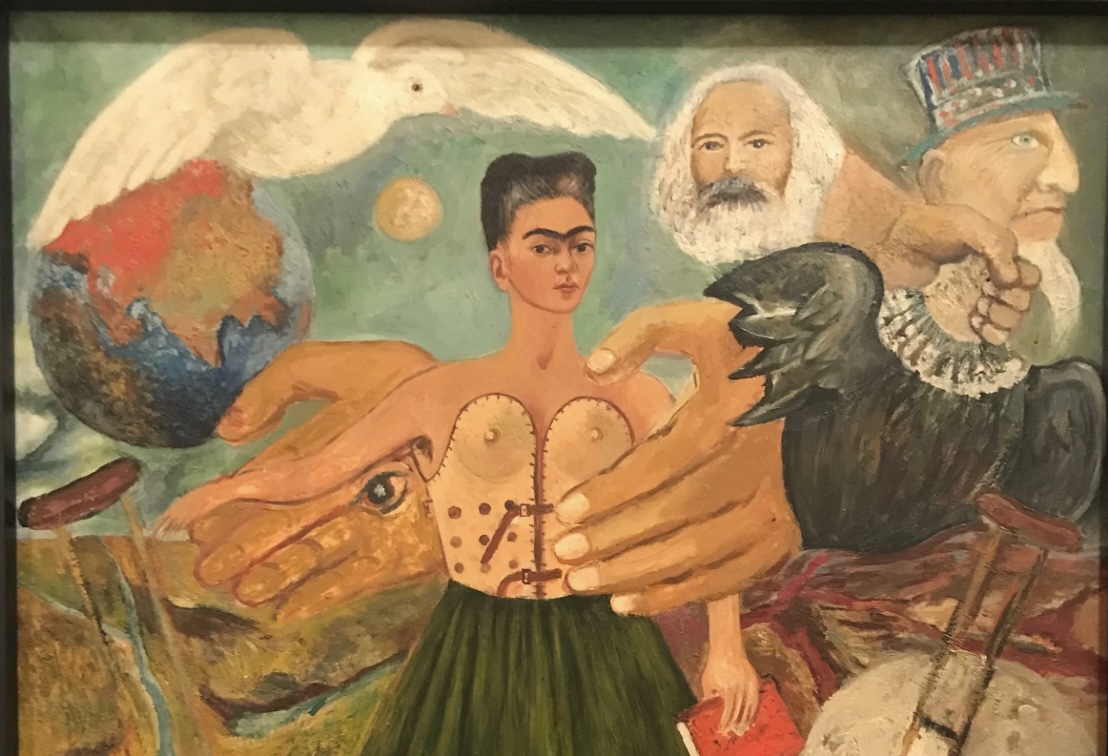
Frontspiece – A part of one of the last pieces Kahlo made in her life in 1954. By then she was reduced by severe chronic pain to bed, assuaged by heavy medications. The picture is called “Marxism Will Give Health to the Sick“ here
Frida Kahlo, the Art of a Stymied Progressive – An Exhibition Review
Introduction
Progressives are fascinated by the art of Mexican artists Frida Kahlo (1907–1954) and her husband Diego Maria Rivera (1886-1957). In this article we focus on Kahlo, stimulated by the “Tate Modern” in London UK, and its current exhibition – “Frida: The Making Of An Icon”. This is open until January 3, 2027, at an entry of Pounds Sterling 25.00 (See Tate Modern 2026 ).
The word “icon” is completely appropriate in discussing Kahlo. As the feminist art historian Nancy Deffebach, puts it:
“Like Che Guevara’s, her face is recognized by multitudes, many of whom have little or no knowledge of her work and ideas.”
Deffebach, Nancy; “María Izquierdo and Frida Kahlo: Challenging visions in modern Mexican art”; Austin – University of Texas, 2015; p. 4
This exhibition contains approximately thirty pictures by her, and a number of works by others who were influenced by her. It can be recommended – in spite of some significant omissions in interpretation. The exhibition makes the claim that it:
“… introduce(s) her ‘many selves’ – the dedicated wife, the intellectual, the modern artist, and the political activist.” See Tate Modern 2026
It is worth seeing this exhibition, if only to see those of her works presented. This article reviews some aspects of Kahlo’s life and works. Her personal life details of course formed her art, a truism to be said of any artist. But perhaps it is especially true of Kahlo because two seamless strands go throughout her work. The tragedy of her injuries sustained at an early age, and the consequences of marrying the tempestuous and womanizer Diego Rivera – were the two “catastrophes” of her life.
Some modern feminists have dismissed this line of thought, seeing it as a means to demean her art. But this narrative is difficult to ignore. It may not be the only lens by which to see Kahlo’s work, but it is one that is impossible to sideline. After all the descriptive word “catastrophic” was that of Kahlo herself. In 1929 she named those two structural issues in her life in a very revealing statement:
“In Cuernavaca, Frida experienced a miscarriage three months into her first pregnancy. This devastating event was topped shortly thereafter when she discovered Diego had been having an affair with one of his female assistants. At this point, she uttered her most quoted remark to the effect that she had experienced two catastrophes in her life: the first being hit by a tram. The second was Diego.”
Souter, Gerry. Frida Kahlo, Parkstone International USA; 2011; ISBN: 978-1-78042-292-3; p.43
Together these two “catastrophes” led her into a long, intense need to examine and portray herself with some dignity and reckon with her life dilemmas. Moreover her life and artistic responses took place in the crucible of the 1910-1920 Mexican Revolution and its long stalled passage. This article does not detail the history of the Mexican Communist Party. However a small vignette is given of the “Mexican Revolution” of 1910-1920. We discuss here the following themes.
-The success and failure of the exhibition
-Kahlo’s Medical ailments and limits of medical understanding in her lifetime
-Kahlo’s identity as a Mexican and socialist
-The Mexican themes in her art
-The relationship of Kahlo and Rivera with the Communist Party of Mexico
Conclusions
In a related article, we will shortly give some “Brief Notes on Mexican history”, to place Frida Kahlo and Diego Rivera in context. Pending a later article, only some sparse but salient details of Mexican history are noted. In addition this article specifically does not discuss the monumental art of Diego Rivera, again awaiting a future article.
The success and failure of the exhibition
Does the Exhibition live up to the claims it makes in the title – “The making of an icon“? To an extent, the exhibition does address its title. It succeeds in showing the currently fashionable and marketed version of Kahlo. However it largely avoids her own views of being a communist. Instead it is content to portray a woman artist struggling against some norms of bourgeois society. The Exhibition presents Kahlo as a feminist and ‘surrealist’ artist, who also bent gender lines. While a little coyly, it hints at the many sexual relations with both men and women that Kahlo engaged in. It does also show effectively how Kahlo embraced the indigenous culture of both colonial and pre-colonial Mexican.
But if it does not discuss explicit links to communism, it cannot dig into whether she wanted a fundamental re-structuring of society, or whether she showed this in her art. In choosing not to discuss this, it minimises any communist identity of Kahlo. Without discussing Kahlo’s communism, the exhibition leaves her as a feminist, bisexual woman subverting gender lines.
Is this view justified? Was this decision right for the organisers of the exhibition – to essentially ignore her adherence to any communist viewpoint? I believe the tack taken by the Tate Exhibition is overly simplistic, although clearly she is not as Rivera was – more overtly socialist. We recognise that Rivera objected to the label of ’socialist realism’. Nonetheless, as opposed to Kahlo as a communist artist, the Tate depicts her as a ‘surrealist’ ‘rebel’.
This overall view (surrealist) is a poor fit. Moreover there are important gaps in the Tate’s portrayal. I believe it could have been far more explicit about how such labels were attached to her. Getting beyond seeing her as a commercialised ‘icon’ of a rebel, requires placing her more in the context of her life events.
For she was not a surrealist in her own understanding. She had been dubbed as ‘surrealist’ by Andre Breton (1896–1966), but she denied the affiliation. She was quite explicit about this, and detested most of the surrealist artists (“coocoo lunatic sons of bitches“) she was to meet on her visit to Paris. She made an exception for Marcel Duchamp (1887-1968) who helped deal with the French customs bureaucracy to clear her paintings.
In any case, what was surrealism? According to Breton it was a joining of dream and the everyday world”:
“According to the major spokesman of the movement, the poet and critic André Breton, who published The Surrealist Manifesto in 1924, Surrealism was a means of reuniting conscious and unconscious realms of experience so completely that the world of dream and fantasy would be joined to the everyday rational world in “an absolute reality, a surreality.”
“Surrealism – art and literature”; Britannica accessed 2 September 2026
Kahlo professed:
“I never painted dreams, I painted my own reality.”
Cited by Zamudio-Taylor from ‘Mexican autobiography” in Time, April 27, 1953”; Ibid; p.31
Her famous self-portraits were the “reality” she talked about. As the art historian David Craven points out:
“Kahlo used the self-portrait (around fifty-five of her approximately 200 paintings are “self-portraits”) to situate herself at the … crossroads of the politically engaged, the personally probing, and the socially radicalizing”;
David Craven; “Art and Revolution in Latin America 1910-1990”; Yale 2002; p. 44
Another description for her art, rather than a poorly fitting label of “surrealist,” might be – seeking a self-identity, a reflection of herself as a Mexican. For mostly she was simply unable to be more than a very personal artist. While much of her resulting work is nonetheless quite affecting and startling, it largely remains anchored to her own personal ‘devils’ or struggles. This is moving at a personal level, and is not meant as a put-down. She would have likely agreed with that assessment, as we shall see shortly. If any ‘surrealism’ was involved, it was as a re-working of Mexican traditions of the ‘votive’ or the ‘retablo‘, which is discussed below. It seemed exotic to Breton, but had links with the society Kahlo lived in and identified with.
Kahlo’s Medical ailments and limits of medical understanding in her lifetime
Kahlo’s medical history cannot be minimised. At age 7 years Kahlo had poliomyelitis, which left her with permanent damage to her right leg and foot. But then on top of this, she was 18 years of age when she became severely injured in the tram accident she refers to as the first of her two ‘catastrophes’. It was this that of necessity, actually brought her to art. For her, it was an existential matter of survival. After all she was immobilised with plaster casts from the neck down to her pelvis, for almost a year. As she wrote to a friend, Carlos Chávez:
“I began to paint twelve years ago during the convalescence from an auto accident that forced me to lie in bed for more than a year. All those years I always worked with the spontaneous impulse of my emotions, I have never followed a school… I expected from work only the satisfaction that the act of painting gave me and of expressing what I could not in any other form… As my themes have always been my sensations, my states of being, and the profound relations that life has produced for me, I have frequently objectified all these in portrayals of myself that have been the most sincere and real that I have been able to do and thus express what I felt for myself and about my surroundings”;
Kahlo to Carlos Chávez October 1939, Escrituras, p.156-157; Cited by Victor Zamudio-Taylor; “Frida Kahlo, Mexican Modernist”; in “Frida Kahlo” Exhibition Catalogue Minneapolis 2007; p. 17
She died on July 13, 1954. In her bedside table was found a “large cache of Demerol vials”. That is hardly surprising given her pain levels. Her friends disagreed on whether she would have taken a suicidal dose. As she neared her death – crippled by pain, and the failure of doctors to be able to provide effective treatments – she wrote a completely honest self-assessment in her 1953 “autobiography”:
“My paintings are well-painted, not nimbly but patiently. My painting contains in it the message of pain. I think that at least a few people are interested in it. It’s not revolutionary. Why keep wishing for it to be belligerent? Painting completed my life. I lost three children and a series of other things that would have fulfilled my horrible My painting took the place of all this. I think work is the best.”
Souter, Gerry. Frida Kahlo, Ibid; p.154
How had it come to this end? Kahlo’s litany of awful medical burdens was alarming.
“In 1946, a German physician, Henriette Begun, composed a clinical history of Kahlo. Its entry for September 17, 1925 reads:
“Accident causes fractures of pelvis (11), fractures of third and fourth lumbar vertebrae, three fractures of the right foot, dislocation of the left elbow, penetrating abdominal wound caused by an iron hand rail entering the left hip, exiting through the vagina and tearing left lip. Acute peritonitis. Cystitis with catheterization for many days. Three months bed rest in hospital. Spinal fracture not recognized by doctors until Dr. Ortiz Tirado ordered immobilization with plaster corset for nine months… From then on has had sensation of constant fatigue and at times pain in her backbone and right leg, which now never leaves her… “
Souter, Gerry. Frida Kahlo, Parkstone International, 2011; p. 23
She was then confronted by her physical limitations for the rest of her life, and gave up thinking of studying medicine. Then after her marriage to Rivera, she had a miscarriage in the USA:
“In the fourth month of her pregnancy, July 4, 1932, Frida miscarried… She continued to hemorrhage on the way to the Henry Ford Hospital and spent much of the day disgorging clots of blood and tissue that had been her child. “I wish I was dead!” she wailed in despair. “I don’t know why I have to go on living like this!”
Souter, Gerry. Frida Kahlo, Parkstone International, 2011; p. 56
Very likely she had a chronic pain condition nowadays called ‘fibromyalgia’:
“Dr. Leonardio Zamudio… has her complete medical records. The latest diagnosis is she suffered: …posttraumatic fibromyalgia. This prevalent syndrome is characterized by persistent widespread pain, chronic fatigue, sleep disorders, and vegetative symptoms, and by the presence of chronic, tender points in well-defined anatomic areas. The concept of fibromyalgia clinical entity as we know it today was probably unknown to most physicians of the early 20th century. The diagnosis explains her chronic severe widespread pain accompanied by profound fatigue. It also explains the lack of response to diverse forms of treatment. The onset of fibromyalgia after physical trauma is well-recognized.”
Souter, Gerry; Ibid: p.83
This led her to be in excruciating pain which became the increasingly dominant theme of her life:
“In 1944, Frida Kahlo created two significant windows into to her persona. She painted “The Broken Column” and began a diary that she continued until her death. If anyone needs to understand her suffering during the last years of her life, viewing the Column and reading her diary dispels any questions. The downward spiral of her health kept a gaggle of doctors busy. The pain in her right foot had become virtually constant and the need for permanent relief, not drugged respite that impaired her ability to paint, became a constant quest. A Doctor Alejandro Zimbron decided a steel corset would ease the pain and give her back support. With it in place, she began fainting and lost 13 pounds in six months. The pain was still there. Zimbron added spinal injections to the treatment. She experienced excruciating headaches. A year later, in 1945, Doctor Ramiriz Moreno diagnosed syphilis and began blood transfusions. The pain continued and syphilis was never proved. Zimbron tried again with a traction device that hung her face-down suspended by her chin from the ceiling to relieve stress on her spine. With sandbags laced to her feet, she hung there for three months, painting for at least an hour each day.”
Souter, Gerry; Ibid; p. 143
While this description is long, we believe it is key to understanding her. The picture “The Broken Column” expresses a portion of the pain she endured – and her bravery confronting it.
Her identity as a Mexican and socialist
But there is far more than only her medical background to both her and her art. Kahlo had identified early as a socialist:
“socialism and the uplifting of the masses… To her these two concepts were abstractions … but she remained a committed and vocal Communist for the rest of her life. She even substituted the 1910 start of the Mexican Revolution for her birth year, 1907, as an affirmation of her commitment to revolutionary ideals…”
Souter, Gerry. Frida Kahlo, Parkstone International, 2011; p. 16
Perhaps it is fairer to say however, that rather than a communist, she was first and foremost a Mexican nationalist. Her German father had become a pioneering modernist photographer in Mexico – marrying a Mexican mestiza woman (of mixed racial ancestry, usually mixed European and Native American ancestry). He possibly first inspired her into a love of indigenous and folk art, and of image making including photography. Frida Kahlo had a complicated relationship to her mother, but linked her mother to the peoples of the world:
“Thanks to the people of the Soviet Union, to the people of China, Czechoslovakia, and Poland and to the people of Mexico, above all, to those of Coyoacan where my first cell was born, which was conceived in Oaxaca, in the womb of my mother, who was born there, married to my father, Guillermo Kahlo – my mother Matilde Calderon, dark-skinned Tinker Bell from Oaxaca”.
Cited by Brie Lee; “Kahlo the Communist: Frida’s politics, and why the commercialisation of her legend is apocryphal“; at December 4, 2024; from Frida Kahlo, et al., The Diary of Frida Kahlo; An Intimate Self-Portrait (New York: H.N. Abrams, 2001), 149-150.
As we saw, she claimed the date of her birth as 1910:
“She was born in 1907 but claimed (it was) … 1910 in order to make it coincide with the outbreak of the Mexican Revolution..”;
Victor Zamudio-Taylor; “Frida Kahlo, Mexican Modernist”; in “Frida Kahlo”Exhibtion Catlogue Minneapolis 2007; p. 16
We assess what is meant by the “Mexican Revolution” in a related piece (See ). But first we turn to Kahlo’s art. The inspiration of Mexican rural and pre-colonial art and pre-Columbian art, was common to many. A close friend of hers was María Izquierdo (1902–1955). Both of them, and Rivera, as well as others felt the need to express “Mexican-ness”:
“Kahlo’s appreciation of folk art was generational, something she shared with her Mexican contemporaries. It was part of the Mexican Renaissance’s valorization of pre-Columbian culture and popular art forms… involving the production of a national narrative. Encompassing diverse politics and ideologies, mexicanidad was formulated by the post-revolutionary intelligentsia, who sought to create discourses and a a social imaginary around Mexico as a modern nation based on its rich history and its indigenous and mestizo cultures”;
Zamudio-Taylor; Ibid; p. 23
Both the two women artists “usually avoided politics in art”, and were more focused on “personal” politics:
“In an environment in which artistic and political discourse associated the nation with
masculinity, Izquierdo and Kahlo negotiated female identity in their work in ways that
involved significant dissent from prevailing views. Izquierdo and Kahlo supported the
parts of artistic discourse that they agreed with; these were different for each artist, but
they included an appreciation of Mexican popular culture and the valorization of indig-
enous traditions. They resisted other aspects of nationalist rhetoric, especially the glo-
rification of male heroes. Both artists usually avoided politics in art, except in the sense
that “the personal is political,” though Kahlo created a few political images at the end of
her life.”
Deffebach, Nancy; “María Izquierdo and Frida Kahlo: Challenging visions in modern Mexican art”; Austin – University of Texas, 2015; p. 3
But Izquierdo and Kahlo were cool in their relations to each other, and they were philosophically very different:
“During Izquierdo’s formative years as an artist, she was in a committed romantic relationship with the painter Rufino Tamayo (1899-1991). Izquierdo and Tamayo were among the visual artists allied with the ‘Contemporáneos’, an avant-garde literary group that believed in art for art’s sake and took an international approach to art. Kahlo’s marriage to Rivera in 1929 linked her socially to the muralists and other artists who thought that art should advance leftist political and social agendas and celebrate Mexican identity.”
Deffebach, Nancy; 2015; Ibid p. 6-7
But, they were both up against a very ‘macho’ and male-dominated art world. By the late 1920s that had become formalised into the so-called Muralist Movement.
José Vasconcelos Calderón (1882-1959), is sometimes called the “cultural caudillo” of the Mexican Revolution. He had been a follower of Francisco Ignacio Madero González (1873-1913), but after the latter’s assassination went into exile. Returning later, he joined the ‘Constitutional” wing of the anti-Porfira Diaz (1830–1915) multi-headed alliance. This was led by General Álvaro Obregón (1880-1928) who formed the government and was President 1920-1924.
As the head of the Secretariat of Education from 1920, José Vasconcelos Calderón commissioned Diego Rivera, José Clemente Orozco (1883-1949), and David Alfaro Siqueiros (1896-1974) to paint the inner walls of many important public buildings including the National Palace in Mexico City. In effect, he helped create the Mexican muralist movement.
The thrust of that movement in the arts was created by the Escuela Mexicana or “school of Mexican Artists”:
“the so-called escuela mexicana (Mexican School), … the muralists and artists working in other media who shared their ideas about art. The goals of these artists were first expressed in the “Manifiesto del Sindicato de Obreros Técnicos, Pintores y Escultores” (Manifesto of the Technical Workers, Painters, and Sculptors Union). The manifesto was probably written by David Alfaro Siqueiros and was signed by Siqueiros, Diego Rivera, José Clemente Orozco, and
five other artists in December 1923 and published in El Machete in June 1924. It valorized
indigenous traditions, exalted monumental art, rejected easel painting, and advocated
using art to overthrow bourgeois individualism. The manifesto argued that artists needed
to maintain an ideological focus while society is in a transitional phase between the destruction of the old order and the establishment of a new order….
It praised the Mexican people, especially “our natives,” and recognized “the physical and spiritual existence of our race as an ethnic force.” The manifesto proclaimed: “The art of the people of Mexico is the greatest, healthiest spiritual expression in the whole world, and its indigenous tradition is simply the best of them all.””
Deffebach, Nancy; “María Izquierdo and Frida Kahlo: Challenging visions in modern Mexican art”; Austin – University of Texas, 2015; p.1-2
Consistent with the goals of many nationalist movements, the Manifesto was thus explicitly nationalist. But clearly it veered off into national chauvinism. But from the Government’s viewpoint the muralists allowed them to help educate the largely peasant-based population:
“The muralist movement was supported by the Mexican government, served didactic purposes, and promoted nationalism. The audience that the muralists wished to reach included peasants and workers, who had a high rate of illiteracy. To communicate with this audience, the muralists narrated Mexican history in visual form through panoramic images on the walls of government buildings. Many of the murals created in the 1920s bear witness to the recent Mexican Revolution…”
Deffebach N; 2015 Ibid; p. 9
While Izquierdo and Kahlo were not of the Muralist school, they were influenced by the same nationalist ideal of being rooted in Mexico. The two leading women putting a personal politics were joined by many other women artists, including:
“… photographers Tina Modotti and Lola Álvarez Bravo and the painters Rosario Cabrera, Cecilia Calderón, Olga Costa, Dolores Cueto, Nahui Olín, Aurora Reyes, Rosa Rolando, and Isabel Villaseñor. (and)… Between 1939 and 1943 the European surrealists Leonora Carrington, Kati Horna, Alice Rahon, and Remedios Varo…”
Deffebach Nancy Ibid; p. 3
Kahlo flamboyantly adopted the dress of Mexico, in especial of the region of Tehuantepec:
“As an affirmation of mexicanidad she wore traditional Mexican clothing: rebozos (shawls), huipiles (sleeveless blouses or shifts), long skirts, and especially the regional clothing of Tehuantepec.”
Deffebach Nancy Ibid; p. 11
Some modern feminists such as Deffebach challenge the depiction of Kahlo as a feminist activist:
“Some people consider Kahlo a feminist heroine; however, other than the images she painted, scant evidence survives to indicate that she participated in the movement for female emancipation in Mexico.”
Deffebach Nancy Ibid; p. 31
She was, of course, a member of the Mexican Communist Party between 1928-1929. It was probably the Italian photographer and communist activist and agent of “Red Aid’ – Tina Modotti (1896–1942) who “brought Frida into the Communist Party” (Margaret Hooks; Tina Modotti”; London 1993; p. 164). Her theoretical positions on positions outside of art are not clear. But it seems she largely followed Rivera’s positions, who himself adopted a pro-Trotsky stance.
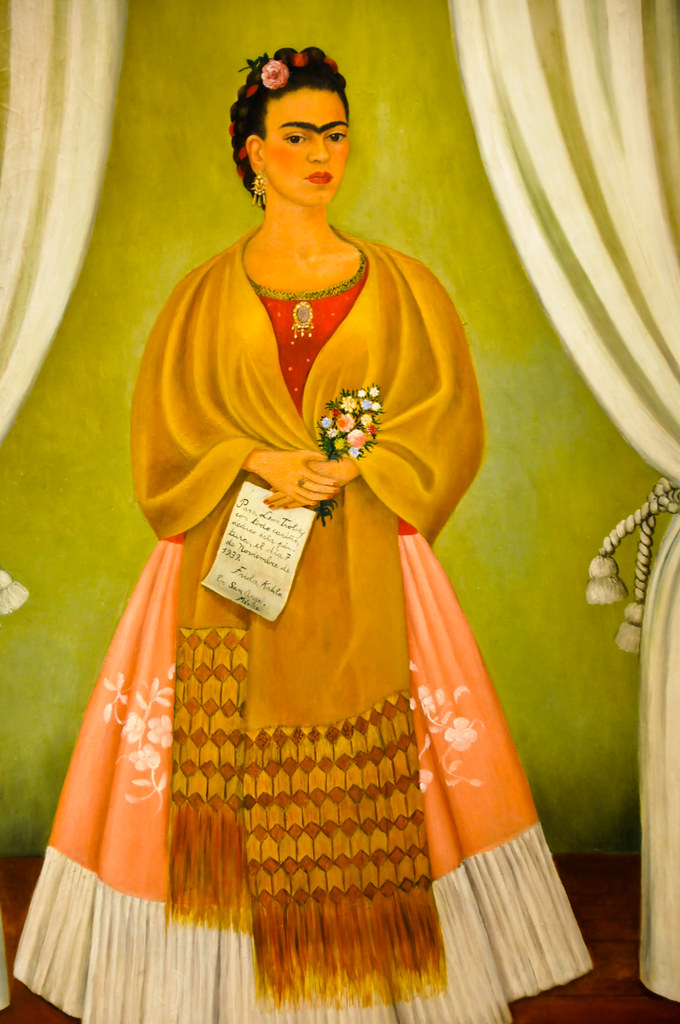
After Trotsky came to Mexico following his self-exile, he lived with the Kahlo-Rivera couple. Kahlo had a short lived affair with Leon Trotsky and gave him a self-portrait of herself in 1937 (“Self Portrait for Trotsky” accessed 2 September 2026). At “Rivera’s request,” she rejoins the CP Mexico in 1948. One of the last paintings she did was in 1954, a portrait of Stalin with herself sitting next to it ( “Self Portrait with Stalin accessed 2 September 2026). (See below figures). After her death, her coffin lies in state at the Palacio de Bellas Artes, draped with a hammer and sickle – although perhaps this may have been Rivera’s wish. How are these conflicting loyalties reconciled? 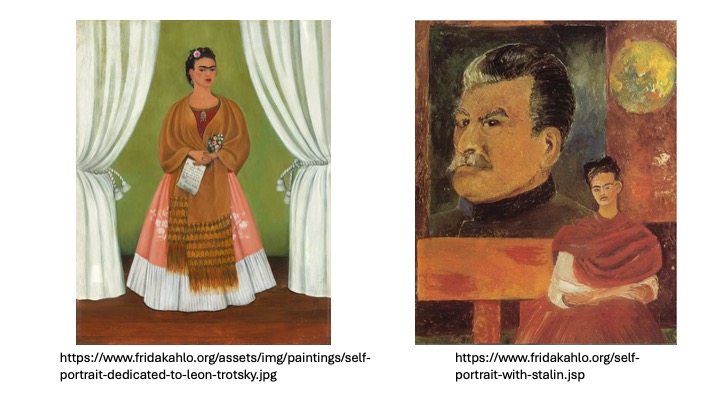
I believe that, in all likelihood, her communism was one of a non-ideological stamp. She was sincerely for people’s rights, freedoms and prosperity. I think it is far from clear whether she had a more specific communist ideology or what it was. Her ideology was not definable as either Trotskyist or Marxist-Leninist, in my view. But a progressive nationalist – who thought of herself as a communist or socialist – she certainly was. There is no doubt that she had conviction about the role of Marxism. This is clear from her final paintings which included the frontspiece above, entitled “Marxism Will Give Health to the Sick“ here
The Mexican themes in her art
While her history with Marxism is minimised, the exhibition amply details her espousal of Mexican indigenisme and local themes. Some traditional dresses are found in the first rooms. The relationship of her art to Mexican religious themes of votive paintings is made clear, and is a central element of her art.
The “votive object” is placed in a religious manner in places considered sacred. These are widely found in Mexico and were a tradition spread by the Spanish colonists:
“ex voto,” “retablo” or “lámina,” … are… paintings of religious images to give thanks for a miracle or favour received … The offering of such items has more immediate precedence in both the Mesoamerican and European lines of Mexican culture, but the form that most votive paintings take from the colonial period to the present was brought to Mexico by the Spanish. As in Europe, votive paintings began as static images of saints or other religious figures which were then donated to a church.”
“Votive paintings of Mexico”; at Wikipedia accessed 1 September 2026
“Retablos of the are small paintings, usually produced on pieces of tin that commemorate a traumatic event. and. Retablo means “behind the altar” and comes from the Christian-Mexican religion. Three components make up a retablo painting: a depiction of an event, the vision of the Virgin of Guadalupe, and text that describes the event. The paintings are commissioned from professional retablo painters, a 150 year-old tradition that almost died out in the first quarter of the 20 th century.”
Souter, Gerry 2011 Ibid; p. 47
A particularly good aspect of the exhibition shows that it was not only Kahlo and Rivera alone who were reworking the pre-colonial indigenous themes of Mexico. Several other artists were exploring similar themes. Echoes of earlier Mexican visions of death and life, may have mislead Breton to announce Kahlo as a “surrealist”:
“Frida reached back into her own heritage, stripping away the religious context and using only the narrative elements. She also resurrected the Mexican traditional skeleton that represented the celebration of death from her “Day of the Dead” revelries. In Coyoacan, shops and homes were hung with grinning skulls and skeletons. Skulls made of candles glowing hot in the night. sugar were gobbled up by Mexican children wearing fright masks as families remembered their dead and the continuity of life with gaiety… “
Souter, Gerry, 2011 Ibid; p. 47
One self-portrait was cited by Brie Lee as specifically illustrating this very conscious self-identity with Mexico. This is the one known as (See “Roots” (accessed 2 September 2026 ) from 1943:
“Frida Kahlo’s 1943 painting Roots (p.c.), when read in regard to Kahlo’s politics, nationalism and unique take on the maternal body, exemplifies the artists subtle employ of her political ideologies, which manifest themselves in subject matter often read on a purely biographic or psychological level. Kahlo’s painting Roots is at first glance a ‘primitive’ self-portrait of a dream-like, Surrealist quality. Depicting the artist in a simple, traditional dress, with her long, dark hair loose around her shoulders, Kahlo paints herself lying on her side, propping her head up with her arm which itself rests on a white pillow. With her typical hard stare framed by her bold unibrow, Kahlo appears surrounded by the rocky plains of a parched land. Completely enveloped in the deserted landscape by a high horizon line and a flattening of the picture-plane, Kahlo’s body takes up nearly a third of the work. What strikes the viewers’ attention foremost, however, is the clean-cut hole taking up most of her torso, from which one spots a set of vines that are growing at the base of her neck, spindling out of her hollowed torso into the dry landscape. In following the twisting vines, it appears as if lines of blood are leaking out from each leaf’s veins, taking with them Kahlo’s own life-force. A confronting painting, it is typically read as the embodiment of Kahlo’s dashed wishes to carry her own child. However, through our understanding of Kahlo’s unique political nature, it can likewise speak to her post-revolutionary nationalism.
The dry, parched land upon which Kahlo rests may act as the symbolic representation of the results of the civil war, leaving the motherland of Mexico corroded and slashed, worn away by the formidable force of combat. In Kahlo’s traditional costume and outright rejection of western expectations of beauty, the artist positions her native-coded body within the very natural landscape from which she herself sprung. In an effort to revitalize the land ravaged by hatred and greed, Kahlo transforms her own body, her very heart and blood, into organic, sprouting vines…”
Brie Lee Ibid; “Kahlo the Communist…”; at December 4, 2024;
In the exhibition, the closest we see of Kahlo’s professed communist foreground in the exhibition are perhaps two exhibits. First is the painting of her stay in the USA in 1933. She called the USA “Gringolandia” and a traditional dress there is hung, surrounded by modern clutter. In the bottom part, a collage shows unemployed workers being approached by a column of armed troops. The Church stained glass windows are adorned with $ signs.
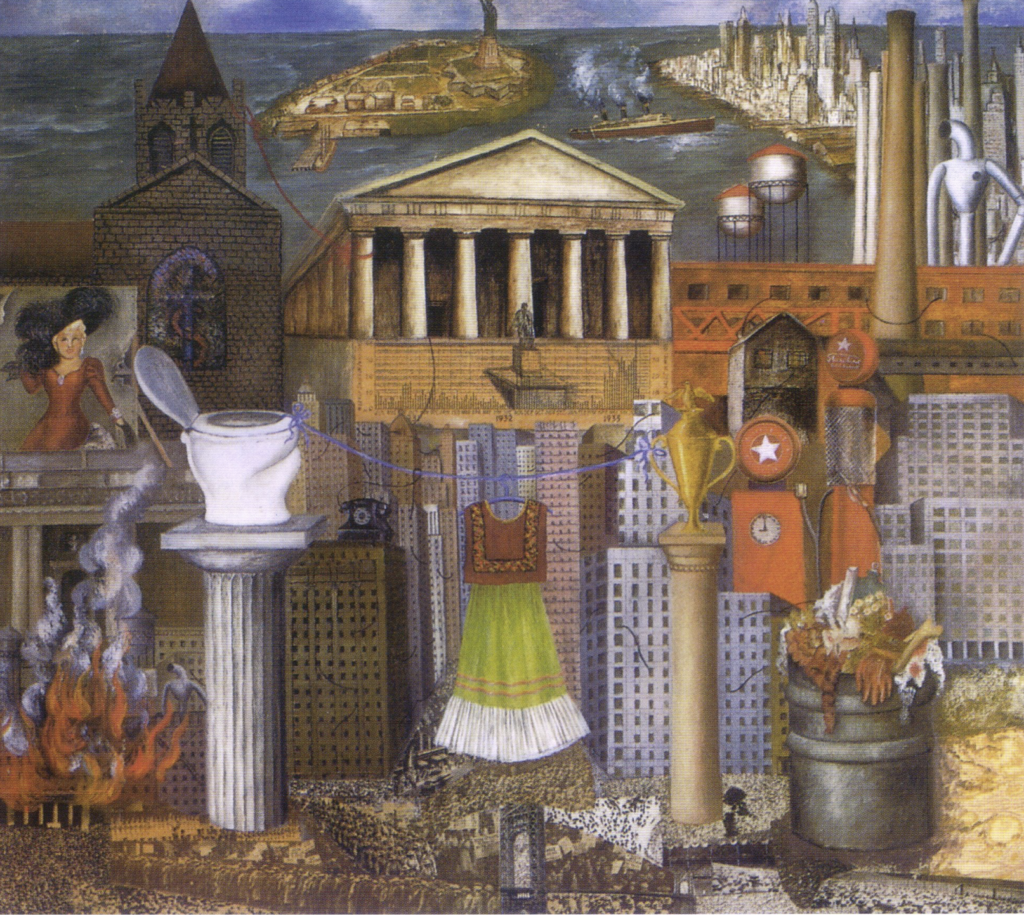
My Dress hangs there” 1933; From: Artchive
Also to be seen is one of the plaster corset she decorated herself with a hammer and sickle.
I think however, that both of these items are shown, without serious discussion of her relationship to Marxist movements.
Perhaps the salient point about the 1910-1920 Mexican Revolution that the exhibition fails to note, or put into context is this:
“The capitalist class that was in power at the beginning the Revolution was the same class in power at its end. A different part of that same class, the capitalist faction from northwestern Mexico, established state power at the end of the Revolution in 1920.”
Rodríguez, Miles V.; “Movements After Revolution: A History of People’s Struggles in Mexico”;
Oxford University Press, 2022; p.6
We will shortly expand on this point in a related piece.
Her relationship with the Mexican Communist Party (PCM)
We noted that Tina Modotti had directly bought Kahlo into the party, but Rivera was already a member. Kahlo’s direct involvement in the affairs of the PCM, seems to have be insignificant as compared to the role played by Rivera. Therefore, only a brief survey of Rivera’s activity in the PCM is given here. Since it seems she took her positions from his, this seems reasonable.
Rivera had already reached fame as a muralist by the early 1920s. But he was criticised by the PCM for his non-discriminating habit of painting for any client – so long as they had money. This came to a crisis point when the USA Ambassador cultivated him. Even though Rivera was on the Central Committee of the PCM, he was willing to accept such patronage:
“December 1930, Rivera received a commission from the United States Ambassador Dwight Morrow to execute a series of murals – The History of Cuernavaca and Morelos, Conquest and Revolution – at the Cortes Palace in Cuernavaca, south of Mexico City. Frida accompanied Diego and established their quarters in Morrow’s weekend house.
Souter, Gerry; Ibid 2011; p. 40
This ultimately is one reason for his departure from the party. Bartram D. Wolfe (1896-1977) then a Comintern member, and later a well known follower of Trotsky says that he convinced him to resign from the party in 1925. Wolfe argued he should focus even more on his painting (Bartram D.Wolfe, “The Fabulous Life of Deigo Rivera”: New York 1963; pp. 225-230). Rivera did resign, but he was then readmitted in 1926 only to be then exiled.
Other related issues of opportunism were apparent. In March 1929, the PCM was declared illegal by the government. Yet after this, Rivera still accepted the directorship of a government arts body – the Academy of San Carlos (Patrick Marnham; “Dreaming With His Eyes Open – A life of Diego Rivera”; Berkley California 1998; p.213). He was “booted out” of the PCM, and Frida left also. They remained progressive but outside of the party:
“By this time, the Communist Party had its fill of Diego Rivera. Though he had held office in the party and showed solidarity at their rallies, his casual acceptance of commissions from capitalists went against the grain of the conservative ideologues. In 1929, he was booted from the party and, demonstrating her loyalty to him, Frida quit too. Neither abandoned the goals of Communism and continued to espouse its anti-capitalist causes, but their support came from the sidelines.”
Souter, Gerry. Frida Kahlo, Ibid 2011”: p. 43
It is also true that Rivera, at the same time, was out of favour with the government, which, apparently by now – well away from its need to project a ‘socialist’ face, was “tired” of murals with workers:
“At the close of the 1920s, Mexico’s political climate shifted again and Diego found himself caught in the middle of an ideological battle. Not only was he persona non grata at Communist Party Headquarters, but the government had grown tired of seeing socialist themes peering back from “historic” murals popping up all over the country. Feeling the heat on the back of his neck, Rivera accepted some commissions in San Francisco and packed up his brushes and Frida and headed for the United States.”
Souter, Gerry. Frida Kahlo, Ibid 2011”: p. 43
In addition at this time the Comintern criticised the PCM for its support of the Mexican government of Portes Gil (Jane Degras “Documents of the Comintern”; Volume 3; London 1971; p.70). To some extent it is possible that Rivera was made the scapegoat by the rest of the PCM leadership. The larger story of the PCM and the relationship to the Mexican government will be take up separately.
Ideologically, Rivera certainly sided with Trotsky in the Trotsky-Stalin split in the international communist movement. This may have been why his visit to the USSR was curtailed. Later, in fact, he was pivotal in getting Trotsky admitted otherwise to Mexico after Trotsky’s self-exile from the USSR:
“Diego Rivera was a committed Trotskyite. Though he had been kicked out of party, he joined Trotsky’s Fourth International, lending his prestige to this Trotsky organization that stated in their 1936 Olso Convention:
“The working class of the U.S.S.R. has been robbed of the last possibility of a legal reformation of the state. The struggle against the bureaucracy necessarily becomes a revolutionary struggle. True to the traditions of Marxism, the Fourth International decisively rejects individual terror, as it does all other means of political adventurism. The bureaucracy can be smashed only by means of the goal-conscious movement of the masses against the usurpers, parasites and oppressors.”
Aware of Trotsky’s nine years of peripatetic wanderings in search of safe haven, Diego petitioned Mexico’s President Lázaro Cardenas (1934-1940) to give sanctuary to the revolutionary on the run. Cardenas granted permission providing Trotsky didn’t interfere with the Mexican government’s internal affairs. On January 9, 1937, Trotsky watched the wooden gangplank lower onto the dock at Tampico, Mexico… On the dock, looking back at (Natasha) and Leon, were smiling Trotsky supporters, party functionaries – and Frida Kahlo.”
Gerry. Frida Kahlo, 2011 Ibid; p.84
Rivera’s involvement in Trotsky’s affairs appears to have overlapped with discussions with USA government officials about the activities of the PCM. According to William J Chase’s investigation, at any rate. After the May 24, 1940 attempt on Trotsky’s life led by Siqueiros, Rivera fled Mexico to the USA with assistance from the USA government:
“… on May 24, 1940, the muralist, communist and Spanish Civil War veteran David Alfaro Siqueiros and a group of about twenty armed men stormed Trotsky’s compound in an effort to assassinate him. The attempt failed although one of the bodyguards, Robert Sheldon Harte, was kidnapped and subsequently murdered.
In the aftermath of the attack, anxiety gripped the Trotsky compound. Diego Rivera was no less anxious for his life. Shortly after the attack, Rivera contacted the U.S. Consulate and asked for a Border Crossing Card to allow him to enter the U.S. The Consulate agreed to press his case in Washington, and within a week an Immigration and Naturalization Service (INS) Board of Special Inquiry convened in Brownsville, Texas for the exclusive purpose of considering Rivera’s application, which was promptly approved.
Given Rivera’s former membership in the PCM, his brief sojourn as a Trotskyist, and his generally radical, albeit often changing, political views, one might wonder why Rivera received such official courtesy. The most likely answer is that in the previous eighteen months, Rivera had publicly and secretly given information about the PCM and Mexican labor organizations both to the press and American consular officials in Mexico.
The first known instance occurred in September 1938, when Rivera gave to correspondents
in Mexico the names of alleged communists working in the Mexican government. After the invitations to Trotsky and Rivera to appear before the Dies Committee became public knowledge in December 1939, Rivera, unlike Trotsky, stated that, when he testified, he would reveal “the extensive activities of Stalinist agents in Mexico and other countries in Latin America…”
From January 1940, Rivera met regularly and secretly with American consular officials and provided them with information about communist organizations and objectives in Mexico, PCM affiliations among the Spanish refugees, alleged PCM-Nazi collaboration, the internal politics of the PCM, alleged PCM and Nazi agents working in the Mexican government, communist agents working in Mexico, and “alleged financial aid given by John L. Lewis’ CIO to Mexican Labor Organizations.”95 When the PCM leadership at its April 1940 meeting charged that Rivera was one of the “visible
leaders” of “a group of agent provocateurs” who were leaking information to American officials and the press, they were not wrong.”
William J.Chase; “Trotsky in Mexico: Toward a History of His Informal Contacts with the U.S. Government, 1937-1940”: Published as “Trotskii v Mekcike. K istorii ero neglasnykh kontaktov s pravitel’stvom SShA (1937-1940)” (“Trotsky in Mexico: Toward a History of His Informal Contacts
with the U.S. Government, 1937-1940″), Otechestvennaia istoriia, 4 (July/August 1995),
76-102.
That he decided later to re-join the Mexican Communist Party – PCM, and Frida with him – raises a lot of questions about his own real political convictions. None of that has any bearing on his art, which remains relevant for the Mexican rural toilers and the Mexican working class. It does, however, also raises questions about the nature of the CP Mexico, which for now we defer.
The relevance of all this with the Kahlo exhibition is to reiterate that Kahlo was a supporter of the PCM. But her main works and passions were far more related to aspects of nationalism. It was Rivera who was more involved with the PCM at an organisational level.
Conclusions
The details of Frida Kahlo’s life show that she was more than only an artist of self. But it has to be admitted that she explored who she was, in her art – for the whole of her life. She may be considered a fierce exponent of Mexican nationalism in her art. While the Tate shows this in its choice of materials, it fails to discuss this in relation to her politics overall. More discussion of these questions would improve the exhibition.
But it is recommended for Marxists to visit if they have an opportunity. We have not examined the catalogue. However, writings on Frida Kahlo are abundantly available. The power of her work is evident when standing before her canvases.
Both Rivera and Kahlo were active in the period immediately after the so-called ‘Mexican Revolution” of 1810 is not clear. They showed typical nationalist features in their art. At points, Rivera transcended that into clearer expressions of communist ideology, as in his famous murals. Kahlo also showed a broader understanding of what Marxism had for the Mexican people. But this was less prominent than her nationalism and her self-exploration.
Did they understand it as part of a rather protracted democratic revolution – or did they mistake its character as being in part “socialist”? I do not think either misunderstood this. Maybe it could have translated more clearly.
For MLRG.online 6 September, 2026