Idealist proposals for change in the “Age of Information”
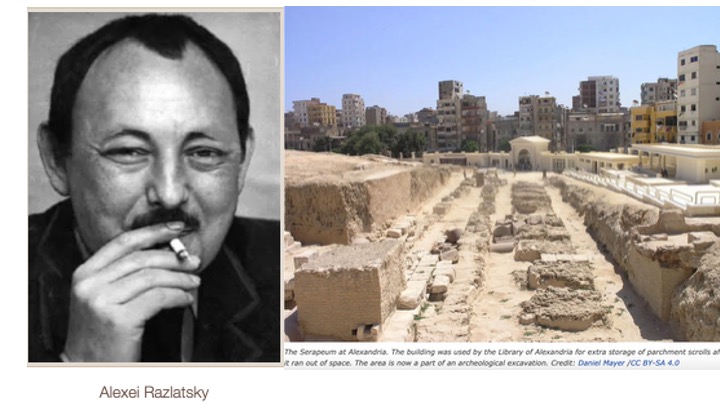
Images; on left from Alexei Razlatsky; https://afoniya.wordpress.com/2013/07/; on right from Patricia Claus; “Ancient Library of Alexandria One of Greatest Treasures of Mankind”; at Greek Reporter 17 August 2025
Idealist proposals for change in the “Age of Information”
A response to Ben Seattle’s proposal for “Spartabase”
March 14, 2026
The prelude to this article
On 13 January, 2026 we presented “Views of Marx and Engels on Revolutionary Organisations.” MLRG.online 13 January 2026. The grounds for this article were clearly stated as being to resist those building a wall between Marx-Engels and Lenin on the party:
“The article is spurred by discussions on the Marx Mail forum list. Arguments were recently put there, suggesting that Lenin’s views on party contradicted those of Marx and Engels…
In reality the argument that there are major differences between Marx-Engels and Lenin upon the party, is not novel…
Attempts to divide Marx and Engels from each other are frequent and were discussed previously. But attempts to divide them both from Lenin are also frequent. Perhaps latching onto the enormous body of economic and historical materialist theory from Marx and Engels is more comfortable for some – than the insistent drive to organise in Lenin.”
Views of Marx and Engels on Revolutionary Organisations; MLRG.online 13 January 2026.
This was our main goal. While re-stating our commitment to Marxist-Leninist principles of party, we noted in passing that a “discussion on the party is over-due.”
Ben Seattle takes this up, writing that MLRG.online calls for what he terms as a “bullshitist party.”
Many leftists go through an immaturity where they mistake a slurring phrase as an action. Some grow out of it, others do not. MLRG.online need not take this personally, as Seattle extends the charge – to a rejection of all “isms” and “ists” – all including Marxism and Leninism – as “mini-religions”.
We were aware of his website (Ben Seattle), but had no reason to parse it especially. Particularly after detecting a certain arrogant tone; and a tendency to engage in rather prolonged polemics with whosoever will take issue with Seattle’s statements. However Seattle urged us several times to consider his response to our article noted above.
In this consideration, we largely focus on two documents from Seattle.
First, his capstone of a long-ish essay on what he believes is a new paradigm of information resource, for revolutionaries. This also contains a mini-history of the Marxist movement. This can be found here at Spartabase
Second, his justification of this essay in a rejection of even mild criticism proffered by correspondents on the Marx Mail site. This is freely available at Ben Seattle Mar 11 #41070.
We note there are two major fault-lines that run through his writing and thoughts. We therefore discuss only those. We are aware that with more time to turn stones upside down, others could be found. However – we stay with what we perceive as the two major obvious problems:
First Seattle claims that his own main goal is the construction of what he calls the “Spartabase”. This we will argue – is an idealist construct of conceptualising revolution.
Second is the already noted rejection of “ism” and ‘ists’ – including socialism, Marxism, Leninism – and… what else?
Ben Seattle’s two major fault-lines general positions
Faultline One: “The most important database in the world”
The above words as taken from his own writing indicates that Seattle’s main proposal is very far from modest. Perhaps the original germ is laudable, and could be considered a simple aim. That of increasing information available to militants. But it rapidly escalates into a vertiginous ambition:
“A universal public database will be our weapon of mass transparency. Digital infrastructure will bring consciousness to the independent movement of the working class. In our current century of information war, a universal public database of articles, comments, tables and tags, accessible by all using democratic algorithms, will bring transparency, consciousness, class politics and self-organization to the working class, assist in the liberation of Palestine, and lead to the overthrow of the rule of capital.”
First page – first figure
We applaud sincere efforts to “overthrow the rule of capital”. Yet this method he proposes seems at core, to be a database alone.
This public database will – he says – bring a vital ingredient to workers: “Digital infrastructure will bring consciousness to the independent movement of the working class.” This is a “consciousness” that comes from an outside “digital infrastructure”.
In a piece of especially fanciful prose, he then wants to transport us in a “time machine” back and forth through time. The purpose of this is to allow him to give us an abbreviated history of progressive movements:
“Something new under the ancient sun.
This essay will describe the most important database in the world. This database will likely be created in the decades ahead, and will become a weapon of unimaginable power in the hands of activists. To understand what this database will be (and will do) we need to step into a time machine – and set the dial back to 1789 – when Louis 16th – the king of France, ran out of money. To get more money – Louis called all of the important people of France together for a big meeting. To make a long story short–things got out of control -and Louis got himself fed to the guillotine.”
Chapter 1 The French Revolution creates the modern world;
All this seems to be an extension and a more refined version of what Ben Settle has written before.
Let us move past the hyperbolic fancy of a time machine. What else does Seattle offer the working class? Seattle rejects any “isms”. This is expressed clearly in a lengthy ‘explanatory’ note to Marxmail. Here Seattle castigates what he calls “isms” – they are all “bubbles“. Here he explains his “bubble” theory of Marxism and of Leninism – and offers he claims a “sober” way forward:
“I have long noted that many (if not most) of us have a history of building bubbles of various kinds rather than confronting the difficult challenges of our time. What is a “bubble“? It is an ideology (kind of a mini-religion) which offers us comfort. We can call these bubbles “marxism” or “leninism” or whatever–but that does not change their nature.”
“I have given quite a bit of thought to the needs of our time and concluded that there are specific things we can do (beyond what is being done now) to move things forward. In particular, we cannot continue to (essentially) ignore the potential of the (still emerging) revolution in digital communications. We need to look at this in a sober way.”
“But many do not want to think about my proposals. New thoughts can be uncomfortable. Many prefer the comfort of their bubbles. And (of course) everyone has the right to remain in their bubbles, if that is what they want, and I respect this right.
However–when I read most “ism” or “ist” words–what I actually see–is bullshit from well-meaning people who don’t know any better. So, I viewed Hari’s post as calling for serious discussion about building a “bullshitist party”.
So I challenged Hari to rewrite his post in plain english rather than relying on bubblespeak which has no actual meaning. And I contrasted my proposal (for simple steps towards a public information platform) to his empty words.
In response, Hari suggested that he might reply if I laid out my proposal in a lengthier and more formal way. Hari had actually put quite a bit of work into the article that was included in his post–and I respected this. For this reason, I accepted his challenge.”
Ben Seattle; “Spartabase (reply to Mark and David)“; March 11, 2026; Ben Seattle Mar 11 #41070.
We believe the core of Seattle’s proposal is pure Idealism. We can only assume that this label of “Idealism” does not ruffle him – it is after all ‘just another “ism”.
What do we mean by this label of Idealism? Under the umbrella term of “Idealism” are a variety of philosophies. These in general propose that the “Idea” comes first – and that it is this that drives the world. Indeed some Idealists at its extreme end are driven to insist that thought is the reality. This viewpoint is of course opposed to materialism – which proposes the reverse. Materialists argue to the Idealist that it is reality which drives thought. The two are at stark odds as can be seen below (unpublished philosophical primer 2020).
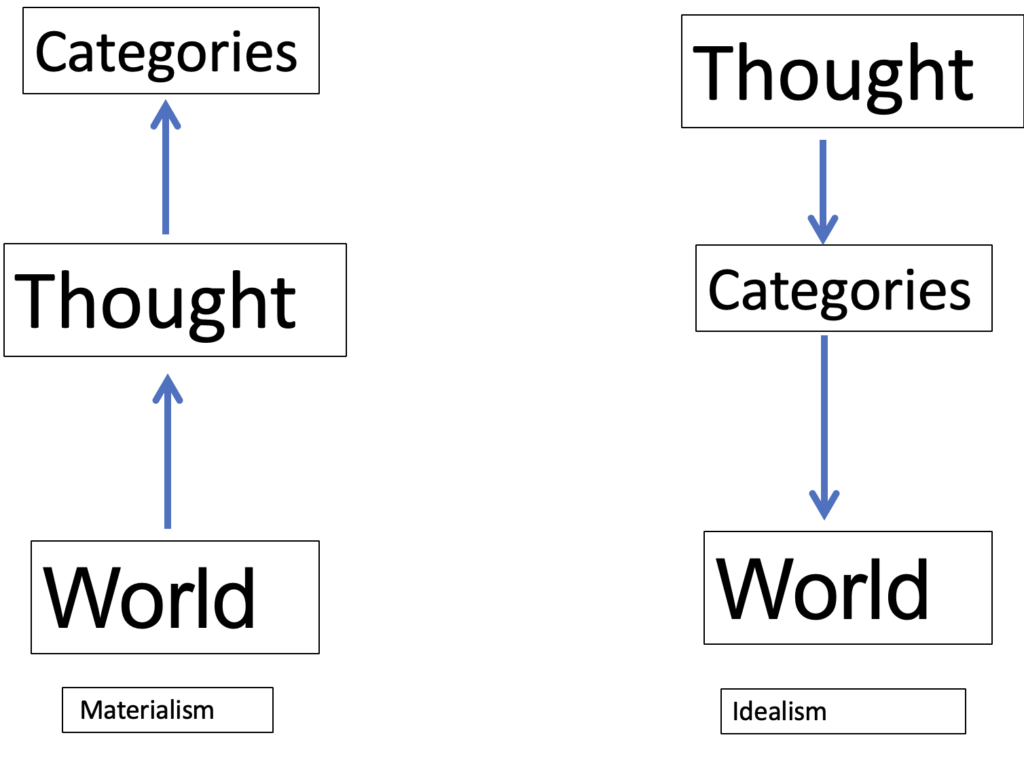
For Seattle, the Information Data Base is supreme. It is the driver, it stands alone – it:
“will bring transparency, consciousness, class politics and self-organization to the working class”.
Ibid; Spartabase
Apparently – in Seattle’s view – the working class does not learn from the class struggle. But instead, “it – Spartabase” “brings class politics to the working class”. But as all can see on a daily basis, the working class confronts the presence of “class politics” every day. The class encounters “class politics” and feels it in all interactions with the employers and the state. But by and large the class does not have the tools to confront it in a meaningfully organised manner. Nor to the working class’s own perception – has it yet lost any chance of improvements without revolution. It thinks it has a way out of its desperation – still. Despite the daily manifestation of the State’s power and intimidation. Entering into confrontation with the state is not easy, it is not a light decision. The worker’s illusions are only shed in reality, not in in an abstract “Spartabase”.
Maybe “it” – this database Spartabase – is composed of fragments of actual matter (for example news about events) but it is a passive repository. It is not given an active framework in Seattle’s current framing.
We will not dwell overlong on Lenin’s concepts in “What is to be Done“. Of course, Seattle will dismiss these anyway as “semi-religions”. However the question of “consciousness” is not seen by Lenin in an abstract form, such as Seattle’s presentation. Lenin views it as a confrontation between bourgeois ideology and socialist ideology:
““the only choice is — either bourgeois or socialist ideology. There is no middle course (for mankind has not created a “third” ideology, and, moreover, in a society torn by class antagonisms there can never be a non-class or an above-class ideology). Hence, to belittle the socialist ideology in any way, to turn aside from it in the slightest degree means to strengthen bourgeois ideology. There is much talk of spontaneity. But the spontaneous development of the working-class movement leads to its subordination to bourgeois ideology, to its development along the lines of the Credo programme; for the spontaneous working-class movement is trade-unionism, is Nur-Gewerkschaftlerei, and trade unionism means the ideological enslavement of the workers by the bourgeoisie. Hence, our task, the task of Social-Democracy, is to combat spontaneity, to divert the working-class movement from this spontaneous, trade-unionist striving to come under the wing of the bourgeoisie, and to bring it under the wing of revolutionary Social Democracy.”
Vladimir Ilyich Lenin; “What Is To Be Done? Burning Questions of our Movement”: II The Spontaneity of the Masses and the Consciousness of the Social-Democrats B. Bowing to Spontaneity. Rabochaya Mysl at MIA.
Yes that meant for Lenin going beyond a “spontaneous”, “only trade union consciousness” – but “workers… have a part in creating socialist ideology”:
“We have said that there could not have been Social-Democratic consciousness among the workers. It would have to be brought to them from without. The history of all countries shows that the working class, exclusively by its own effort, is able to develop only trade union consciousness, i.e., the conviction that it is necessary to combine in unions, fight the employers, and strive to compel the government to pass necessary labour legislation, etc… “
Vladimir Ilyich Lenin; “What Is To Be Done? at A. The Beginning of the Spontaneous Upsurge; at https://www.marxists.org/archive/lenin/works/1901/witbd/ii.htm at MIA.
But for Lenin, this did not exclude workers as “They take part, however, not as workers, but as socialist theoreticians, as Proudhons and Weitlings”:
“This does not mean, of course, that the workers have no part in creating such an ideology. They take part, however, not as workers, but as socialist theoreticians, as Proudhons and Weitlings; in other words, they take part only when they are able, and to the extent that they are able, more or less, to acquire the knowledge of their age and develop that knowledge. But in order that working men may succeed in this more often, every effort must be made to raise the level of the consciousness of the workers in general; it is necessary that the workers do not confine themselves to the artificially restricted limits of “literature for workers” but that they learn to an increasing degree to master general literature. It would be even truer to say “are not confined”, instead of “do not confine themselves”, because the workers themselves wish to read and do read all that is written for the intelligentsia, and only a few (bad) intellectuals believe that it is enough “for workers” to be told a few things about factory conditions and to have repeated to them over and over again what has long been known.”
Vladimir Ilyich Lenin; “What Is To Be Done? Burning Questions of our Movement”: II The Spontaneity of the Masses and the Consciousness of the Social-Democrats B. Bowing to Spontaneity. Rabochaya Mysl at MIA.
Seattle’s concept simply dresses up in 21st century motifs an old “rationalist” myth. One that still captivates many liberal people – somehow, “Truths” will out and that will lead to re-ordering. All is quite tidy. Indeed it is not unlike that of the drive behind the great ancient Library of Alexandria – which was supposed to be a “universal library” of truths:
“The “Letter of Aristeas” of the 2nd century bce reveals that the institution was conceived as a universal library:
‘Demetrius…[Demetrius of Phaleron, a member of the Peripatetic school and a former Athenian politician… ] had at his disposal a large budget in order to collect, if possible, all the books in the world;…to the best of his ability, he carried out the king’s objective. (Letters 9–10).”
Mostafa El-Abbadi, Britannica Editors; “Library of Alexandria”; Encyclopedia Feb. 16, 2026 at Britannica 2026
Seattle’s “Spartabase” – provides the information – the truth. And somehow – then comes a “self-organization” of the masses. What need for any paltry isms such as party-ism? QED.
Essentially how does Seattle see this playing out in 2026? By the use of social media:
“We will briefly survey the key problems the working class must overcome – but first – let’s consider that the four movements I listed above (i.e. “Occupy movement in 2011; in the Black Lives Matter movement in 2020; in the movement against the ongoing genocide in Palestine, and in the recent resistance against Trump’s ICE thugs in Minneapolis, where an army of activists armed with cell phones used social media…” – Ed) – all have in common the use of social media to bring to millions the truth that our ruling class is desperate to conceal. The emergence of transparency. A new force is emerging in the world–courtesy of the development of the productive forces. This force is called transparency. Transparency is destined to become a weapon in the hands of the working class with power beyond imagination. The revolution in digital communications is (so to speak) steadily releasing vast and ever-increasing amounts of oxygen into the atmosphere, setting the stage for an eventual explosion of stellar magnitude.”
Ibid SpartaBase p. 27
Granted for now social media allows an element of interaction between activists. However Seattle leaves out any potential of states to control those means of communication which is already happening. For example:
“Iran’s digital repression model is distinct from, and in some ways more dangerous than, China’s “Great Firewall.” China built its digital ecosystem from the ground up with sovereignty in mind, creating domestic alternatives like WeChat and Weibo that it fully controls. Iran, by contrast, is building its controls on top of the standard global internet infrastructure.
Unlike China’s censorship regime, Iran’s overlay model is highly exportable. It demonstrates to other authoritarian regimes that they can still achieve high levels of control by retrofitting their existing networks. We are already seeing signs of “authoritarian learning,” where techniques tested in Tehran are being studied by regimes in unstable democracies and dictatorships alike… (as in) the most recent shutdown in Afghanistan.”
Bruce Schneier; “Why Tehran’s Two-Tiered Internet Is So Dangerous”; 27 February 2026; at “Schneier on Security”
As has been pointed out these considerations apply to the present ‘democratic states’ also:
“Far less explicit controls are needed when capital dominates the Internet as it does in the US. The most visited sites, the most followed influencers, and the most used PC and smartphone apps are under the control of big capital, which also directs practically all the US tech industries. We should assume that US government police and spy agencies record our every use of the Internet. For over a quarter century, the US government has collected the “metadata” of who is contacting what, from where, and for how long; furthermore, unencrypted connections gives the US government access to the content of the message, but metadata alone is sufficient to construct a social network of who is talking to whom, when and how much. That data alone is useful to federal police and intelligence agencies. Shutting off the Internet today would shut down the stream of surveillance data that is collected at each step along an Internet path, from Internet routers to the final social media and website destinations.
Unfortunately, the left has learned to substitute social media for democratically-operated coalitions. Most left organization today cannot function without Internet apps and services. Some on the US left have talked about doing a “dry run shutdown” of Internet services for their organizations to test how well a groups can adapt when we are as unplugged as the people in today’s Iran. But under today’s conditions in the US, the capital-subsumed Internet is serving the system quite well.”
“Internet censorship vs hegemony”; Marx Mail 15 March, 2026 Message number 41117
So this is a taste of Seattle’s take over of the Information world. What about this thing that itches him so, this grievance Seattle has about “isms” – what else does this itch reveal?
Faultline Two: A rejection of all “isms” including Marxism
Seattle’s own justifications and rebuttals of any minor criticism is contained in the email correspondence already shown. We believe it sheds a lot of light on both his style, and his underlying notions.
We saw Seattle’s lengthy ‘explanatory’ note, his “bubble” theory of Marxism and of Leninism. To remind us of his general tack – all is against “ism/ist religions”:
“I also needed to give a quick summary of the theoretical and organizational work of Marx and Lenin–as well as the context of their times. However – this does not mean that my essay should be viewed as primer on “Marxism and Leninism” because (as noted) this would end up being a primer on “bullshitism”. Marx was not a Marxist. Lenin was not a Leninist. And the people who talk the loudest about the ism/ist religions generally have the least to contribute.”
So he needs he says, “to summarise” Marx and Engels without giving a “primer on Marxism and Leninism as this would end up being a primer on “bullshitism”.
Ben Seattle; “Spartabase (reply to Mark and David)“; March 11, 2026; Ben Seattle Mar 11 #41070.
This is profound. But more is to follow. In his reply to some relatively straight-forward and polite commentary to his oeuvre – his arrogance over-flows. For example one Mark B responded to the “Spartabase” proposal with this:
“In describing the Russian Revolution, you (i.e. Ben Seattle) write that the “… working class never actually ruled the country (except in name). Instead, a new kind of state capitalist regime emerged (run by a new ruling class).” You don’t define state capitalism or defend this characterization of the RSFSR or USSR; you don’t even offer a reference to more developed analysis.”Ben Seattle; “Spartabase (reply to Mark and David)“; March 11, 2026; Ben Seattle Mar 11 #41070.
Naturally, Seattle has no time for such paltry things as definitions. Seattle’s response to Mark B tells us what a quagmire we must stand in if we follow Seattle:
“Mark’s observation is correct. I do not define state capitalism, defend my characterization, or offer a reference to more info on this topic.
Mark implies (but does not actually say) that I should have done these things. Why should I have done these things? Mark cannot be bothered to spell this out – which means that his implication hangs in the air like a fart.”…
“But there are a lot of things my essay does not do. For example, my essay does not discuss the theory that our entire world is resting on the back of a giant tortoise… The giant tortoise theory (and–Stephen Hawking tells those of us who were wondering on what the tortoise stands–it is “tortoises all the way down”) is more useful than cult theories of “actually existing bullshitism” or “degenerated workers’ states”.
Ben Seattle; “Spartabase (reply to Mark and David)“; March 11, 2026; Ben Seattle Mar 11 #41070.
This is possibly a reference to ancient Hindu mythology or alternatively, Confucian references to the wise tortoise. But who knows? At any rate, all and any such theories are it seems, superior to the “cult theories” of “actually existing bullshitism” or “degenerated workers’ states”.
Seattle now states in his self-justificatory note to Marx Mail far more explicitly than he does in his capstone article “Spartabase” (Why did this not emerge in the capstone itself one wonders?) – what or who is the source of his inspiration. It is a “Russian theorist” named Razlatzki:
“My essay does not confine itself entirely to the analysis that Russia became state capitalist. My essay includes a mention (without naming him) of the views of Razlatzki – a Russian theorist who held that the economic and political system in the Soviet Union was actually a form of feudalism. The feudal features of these kinds of states were especially pronounced and visible during the great famine in China in 1959-61.”
Ben Seattle; “Spartabase (reply to Mark and David)“; March 11, 2026; Ben Seattle Mar 11 #41070.
We do not propose to debate the putative “feudal” nature of the Soviet Union. Seattle displays here either a provocation or simple foolishness. Who knows? More on Razlatzki….
Seattle is consistent – for such thought strands are not new for him, they seem to date back to at least 2007. He simply reiterates his own previous themes. Others have dealt with him in some depth, that is ‘Communist Voice’ has. Readers of MLRG.online will know that we support Stalin. So we obviously differ markedly from Joseph Green of ‘Communist Voice’, who castigates both Trotsky and Stalin. But on the matter of Ben Seattle we appear to be in some sort of agreement with Communist Voice.
As can be seen from his own prior correspondence with ‘Communist Voice’, Seattle’s rejection of those “bubbles” of “Marxism” and “Leninism” are entirely in keeping with his explicit earlier rejection of the term “socialism” and “communism”. All these, you see – according to Seattle – are “cargo cults”….
In rebuking an article by ‘Communist Voice’, he explicitly repudiates both the terms “socialism” and “communism” in 2007. In 2007 he says he instead wishes to use the term “proletarism”:
“And the political trends… which claim to uphold “socialism” would not be able to explain what “socialism” means if their lives depended on it. There is no one to uphold this word. There is zero.
I advocate a decisive break from this word and am in favor of the proposal by Russian revolutionaries (who organized underground groups of workers to struggle against the abuses of the Brezhnev regime) to use a new word, “proletarism”, to describe our goal: the historical stage in which the proletariat runs society. The analogy here is how, in 1914, Lenin advocated abandoning the phrase “social-democracy” as hopelessly corrupted in the eyes of workers after nearly all the social-democratic parties supported the mutual slaughter of worker against worker known as the first world war. The terms “socialism” and “communism” are, similarly, after many decades of unimaginable corruption, something of a lost cause.”
Open letter of Ben Seattle against the CVO (November 18, 2007; ) at: Communist Voice
Who was Razlatzki? For one who preaches transparency so much, it is surprising that Seattle is not more forthright about it.
Razlatzki was with Grigory Zinovyevich Isayev, a co-founder of the Party of the Dictatorship of the Proletariat – which according to Wikipedia professed a Maoist ideology. This is corroborated at Alexei Razlatsky.
We were ignorant of this person. We remain unclear about the exact ideology espoused by Razlatsky. No doubt we will be further enlightened. But in the meantime, “Communist Voice” carries some further data of interest to this discussion.
It seems that Razlatsky coined the term “proletarism”. Frankly at the moment we can do no better than refer to CV’s response to Ben Seattle, which outlines some of the actions of Razlatzki :
“But what is this new goal of “proletarism”? … We will have to examine the views and practices of the proletarists.
Well, the main theorist of this group of Russian activists was A. B. Razlatsky, who died in 1989. Grigorii Isayev was thus left as the practical leader of this trend, and he became prominent in the Russian strike movement against the Yeltsin regime in the late 1990s. The proletarists gained support rapidly in a major strike in the city of Samara, and the proletarism group led the Samara Stachkom (strike committee). But the proletarism trend wasn’t able to consolidate that support, which seems to have fallen away as quickly as it had developed. … since 2000 or 2001….
Now, there was originally a good deal of excitement about Isayev and the proletarism group, precisely because they continued to stand for communism while opposing the revisionist KPRF (Communist Party of the Russian Federation – the successor of the old state-capitalist party) and denouncing the facade of communism in the old USSR (at least, for the period after Stalin). They were spirited activists. On the other hand, as we shall see, it does seem that their views were quirky; that they didn’t understand the economic basis of the post-Stalin regimes which they denounced; and that they had a rather simplistic idea of the class struggle and proletarian organization. …
activists should have a chance to examine the proletarist views and practices before being pressured to follow them.
Let’s start examining their views and practices by looking at their relation to the class struggle:
In 2000… Isayev and the proletarists opposed the struggle against the reactionary labor law reform of the Putin government. Indeed, they didn’t just stand aside from this struggle: they denounced it…
What was the labor law reform and why was it important? Recall that Vladimir Putin was Russian President Yeltsin’s hand-picked successor. Yeltsin resigned at the end of 1999 so that Putin could go into the presidential elections of 2000 as an incumbent. In power, Putin immediately pressed two issues: he restarted the war against the Chechens, and he stepped up pressure against the Russian workers with his plan for labor law reform. …
Putin’s proposals (as we wrote i.e. CV):
“would allow 12-hour days and 56-hour weeks; give the OK to child labor; eliminate protections for women with small children; cut maternity leave in half; eliminate the need to obtain trade union consent for firing, work schedules and workplace norms; and so forth. This labor code, approved by the IMF, would establish the type [of] workplace relations that capitalist bosses love.” …
Putin’s labor law reform not only proposed miserable conditions, but removed any legal basis for workers to fight back for their own demands. …
The labor law reform would become law in 2002, with provisions even worse than originally proposed.”
Communist Voice
Conclusion
We choose to stay in the world of Marxism-Leninism. Seattle has chosen his own bubble.
We do not have either Seattle’s faith in the power of social media, nor his apparent faith – although this is somewhat hidden – in picking up the mantle of either Razlatsky or his “proletarism”. Those are Seattle’s guiding principles. We forego the opportunity to examine in detail, his distorted potted history of the world as contained in his Magnum Opus. However, we wish him much luck in his endeavour for an open website of information relevant to the workers and toilers struggles.
March 15, 2026