British Neo-Imperialism (Reprint)
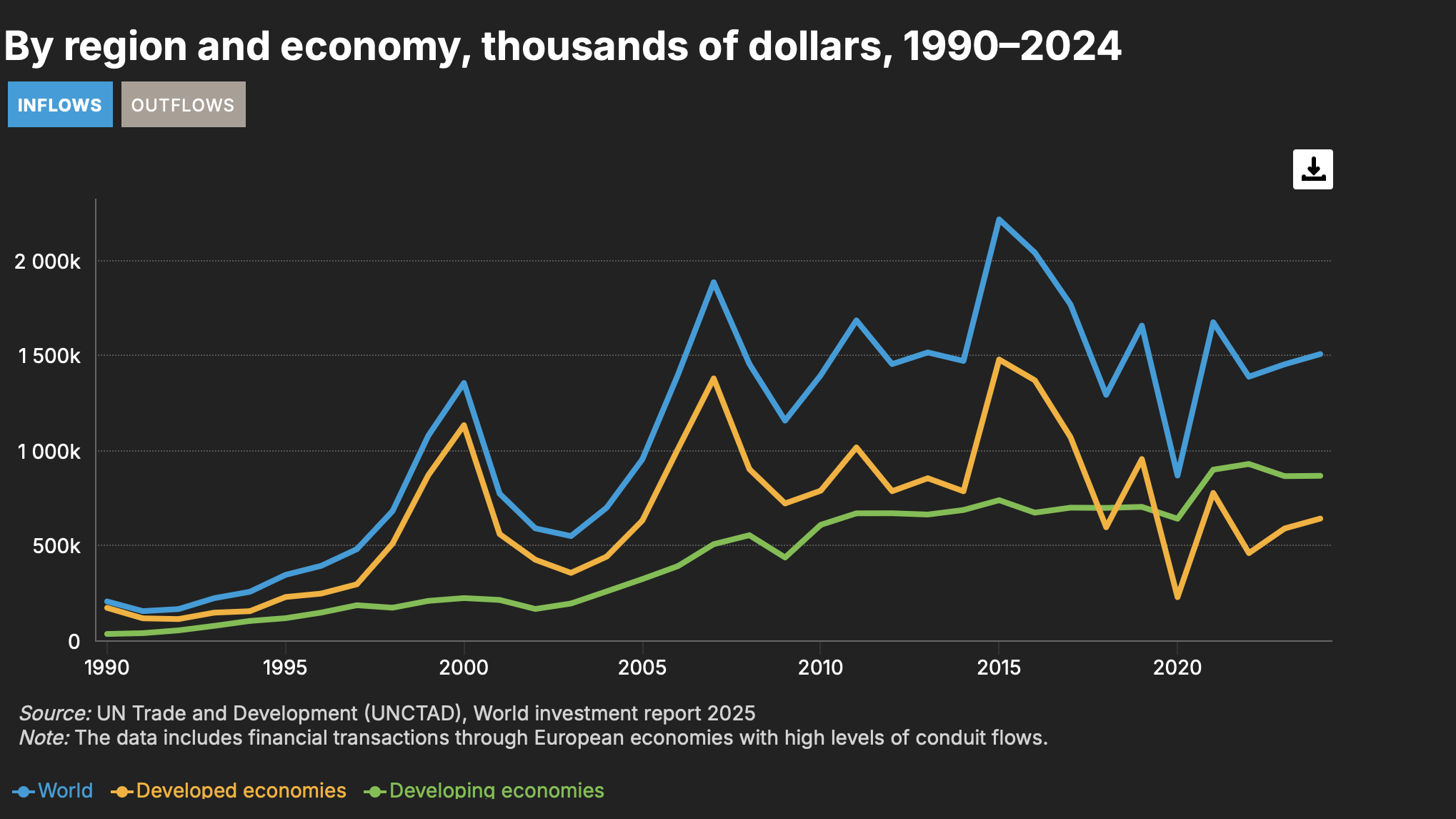
Image Foreign Direct Investment (FDI) by selected regions; from years 1990-2025 (See UNCTAD 2025 Report at UNCTAD PAGE)
“BRITISH NEO-IMPERIALISM”
Originally circa 1998
By Bill Bland for The Communist League (UK); in The Marxist-Leninist Research Bureau New Series REPORT 3 circa 1998.
Republished first as Alliance ML Number 52 circa 2003; This reprint 10 April, 2026
Editors Introduction MLRG.online April 2026
Bland wrote this article towards the end of his life in 1998. It is a re-examination of the fundamental Leninist proposition that Imperialism is marked by an export of capital to the colonial world. The article only considers British imperialist capital.
As always open to the adage that the world is constantly changing, Bland examined the effects of Britain’s enforced move to make its colonies into semi-colonial states, and then to neo-colonial states. Modern British capitalism had obviously deindustrialised its home base. What had happened to the direction of flow of capital? He showed that by 1998 (the year he published his work) the net flow of capital in the former British Empire – now the Commonwealth – was from the periphery to the British home base.
Of course unlike some modern day revisionists Bland did not say imperialism no longer existed. Instead he adopted the term ’neo-imperialism’ for the modern forms of imperialism. One variant of modern revisionism – that of David Harvey – even denies that imperialism exists without direct military presence on the putative subjugated countries. To argue this ignores the manifest other forms of coercive power that the imperialists can wield.
Bland’s data of course remains relevant today. Again however, it needs to be brought up to date. The figure above from UNCTAD shows that since 1990 a very slow upward increment of FDI into the former colonial to neo-colonial worlds has been occurring. The new forms of “fictitious” capital as Marx and Engels termed it had dramatically accelerated.
Alliance LM had detailed the growth of the financial sector of international capitalism in some detail up to the first Trump Presidency (Hari Kumar; “What is Behind Trump – Is There Method Behind His Madness? Finance Capital and Industrial Capital – An Evolutionary History” August 18, 2019 at ML Currents ). The explosion of capital surpluses that drove the Eurobond and Petrodollar surpluses was traced up to the derivatives crash of 2008. The computer technology enabling this repetitive re-cycling of money and debts into new forms of profiteering has of course expanded enormously. It now is exacerbated by ‘Artificial Intelligence’.
As part of the underlying thrusts of imperialism to re-divide the world, we will be bring the 2019 analysis up to date. That updating has been only recently shown to be urgent by the USA and Israel attack on the state of Iran. On this see “USA and Israel Warmongers Launch Their Imperialist War on Iran at March 2 2026; MLRG.online. That is being updated currently.
For now however we re-publish this piece by Bland.
Editors April 10 2026.
“BRITISH NEO-IMPERIALISM”
Table Contents
1) The Export of Capital
2) The Import of Capital
3) International Combines
4) The Question of the Inevitability of War under Imperialism
5) Colonialism
6) Imperial Expansion
7) Decolonisation : Dominion Status
8) Neocolonialism
9) The Partition and Decolonisation of India
10) The Post-World War II Decolonisation of the British Empire
11) The UN and Decolonisation
12) “Aid”
13) The Relative Decline of British Industry
14) The Parasitic Nature of Neo-imperialism
15) The Development of Export Platforms
16) Migration under Imperialism
Conclusion
BIBLIOGRAPHY
1) The Export of Capital
In his classic analysis ‘Imperialism, the Highest Stage of Capitalism’, Lenin characterises the export of capital as imperialism’s most typical feature:
“Under the old type of capitalism, when free competition prevailed, the export of goods was the most typical feature. Under modern capitalism, when monopolies prevail, the export of capital has become the typical feature”.
(Vladimir I. Lenin: ‘Imperialism, the Highest Stage of Capitalism’, in: ‘Selected Works’, Volume 5; London; 1935; p. 56).
By ‘exported capital’, Lenin means primarily
“if . . . capital invested abroad”,
(Vladimir I. Lenin: ibid.; p. 57).
above all to under-developed countries, where higher profits are obtainable:
“Surplus capital . . . will be used for the purpose of increasing . . . profits by exporting capital abroad to the backward countries. In these backward countries, profits usually are high”. (Vladimir I. Lenin: ibid.; p. 57).
Lenin calls profits from such foreign investment as super-profits:
“Capital exports produce . . . enormous super-profits. . . They are obtained over and above the profits which capitalists squeeze out of the workers of their ‘home’ country”.
(Vladimir I. Lenin: Preface to the French and German Editions: ibid.; p. 12).
At the beginning of the 19th century, it was above all Britain which had most capital available for export. In the words of the British economist Charles Hobson, whom Lenin frequently quotes, by 1815
“…Britain stood, in contrast with Western Europe and the Eastern States of the American Union, fully a generation ahead in industrial development, and was possessed of far greater productive resources and capital for investment”.
(Charles K. Hobson: ‘The Export of Capital’; London; 1914; p. 96).
Hobson gives the following figures for the export of capital from Britain in the 19th and early 20th century:
1870: PS 31.7 million Pounds Sterling
1890: PS 82.6 million
1912: PS 226.0 million
(Charles K. Hobson: ibid.; p. 223).
The export of capital from Britain continued to grow in the 20th century, as is shown by the following official figures:
1982: PS 11.6 thousand million
1986: PS 33.9 thousand million
1996: PS 89.3 thousand million
(‘Annual Abstract of Statistics: 1994’; London; 1994; p. 234; ‘Annual Abstract of Statistics: 1998’; London; 1998; p. 275).
2) The Import of Capital
However, by this time so much British capital had been invested abroad, that the income from these investments exceeded the amount of new capital being exported:
1982: PS 44.4 thousand million
1986: PS 47.3 thousand million
1996: PS 96.1 thousand million
(‘United Kingdom Balance of Payments: 1993’; London; 1993; p. 42;
‘United Kingdom Balance of Payments: 1997’; London; 1997; p. 43).
In other words, the export of capital had given way to the import of capital;
“Capital is now flowing out of the Third World, mainly to service debt, on an increasing scale”.
(Teresa Hayter: ‘Exploited Earth: Britain’s Aid and the Environment’ (hereafter listed as ‘Teresa Hayter (1989a); London; 1989; p. 10).
3) International Combines
A sphere of influence is a region
“. . . within which a particular nation claims, or is admitted, to have a special interest for a political or economic purpose”.
(‘Oxford English Dictionary’, Volume 16; Oxford; 1989; p. 206).
Just as capitalists try to form combines within a country to limit competition and so increase their profits, so, where appropriate, they try for the same reasons to form international combines.
“Monopolist capitalist combines — cartels, trusts, syndicates -divide among themselves, first of all, the whole internal market of a country, and impose their control, more or less completely, upon the industry of that country. But under capitalism the home market is inevitably bound up with the foreign market. Capitalism long ago created a world market. As the export of capital increased, and as . . . the ‘spheres of influence’ of the big monopolist combines expanded, things tended ‘naturally’ towards an international agreement among these combines and towards the formation of international cartels”.
(Vladimir I. Lenin: op. cit.; p. 60).
Thus, there ensues an:
” . . . imperialist struggle between the big monopolists for the division of the world” economically.
(Vladimir I. Lenin: ibid.; p. 66).
International cartels:
“. . . show to what point capitalist monopolies have developed. . .
Certain relations are established between capitalist alliances, based on the economic partition of the world”.
(Vladimir I. Lenin: ibid.; p. 67, 68).
and they have continued to be formed in the second half of the 20th century. For example, the International Tin Council was established:
“. . . in 1931 by Malaya, Nigeria, the Netherlands East Indies, and Bolivia, when overproduction and the great depression resulted in the collapse of tin prices. Production cutbacks did lead to increased prices”.
(Latin American Bureau: ‘The Great Tin Crash: Bolivia and the World Tin Market’; London; 1987; p. 46).
Such international cartels divide the world economically on the basis of the economic strength of those taking part in them:
“The capitalists divide the world . . . in proportion to capital, in proportion to ‘strength’, because there cannot be any other system of division under . . . capitalism”.
(Vladimir I. Lenin: op. cit.; p. 68).
But such economic divisions of the world can only be temporary, because there is, under capitalism,
” . . . extreme disparity in the rate of development of the various countries”.
(Vladimir I. Lenin: op. cit.; p. 88).
and this disparity is increased under monopoly capitalism:
“Finance capital and the trusts are aggravating instead of diminishing, the differences in the rate of development of the various parts of world economy”.
(Vladimir I. Lenin: op. cit.; p. 89).
This disparity in the rates of development continues to the present day, as is demonstrated by the following figures showing the change in industrial production for various countries in the period 1980 to 1994:
Philippines: +517%
South Korea: +306%
Malaysia: +249%
Bangladesh: +167%
Singapore: +162%
Ireland: +146%
Pakistan: +145%
India: +140%
Turkey: +131%
Syria: +125%
Jordan: +104%
Sri Lanka: +100%
Norway: +90%
Israel: +75%
Chile: +73%
Ecuador: +72%
Trinidad & Tobago: +62%
Fiji: +60%
Hondura: +57%
Cyprus: +56%
Portugal: +53%
Colombia: +51%
Morocco: +50%
Nigeria: +50%
Denmark: +48%
Algeria: +46%
Australia: +46
Luxembourg: +46%
Finland: +43%
USA: +40%
Egypt: +40%
Japan: +36%
Austria: +36%
Canada: +35%
Mexico: +35%
Zimbabwe: +29%
Japan: +36%
Switzerland: +31 %
New Zealand: +28%
Sweden: +27%
Britain: +27%
El Salvador: +26 %
Malawi: +23%
Tunisia: +22%
Netherlands: +19 %
Spain: +18%
Italy: +16%
Belgium: +15%
France: +15%
Ivory Coast: +10 %
Brazil: +9%
Bolivia: +8%
South Africa: +7 %
Greece: +6%
Senegal: +5%
Barbados: +4%
Peru: +4%
Indonesia: -2 %
Germany: -6%
Poland: -8%
Uruguay: -14%
Hungary: -16%
Paraguay: -20%
Bulgaria: -22%
Zambia: -22%
Romania: -59%
(United Nations: ‘Statistical Year Book: 1994’: New York;1996; p.204-41)
Because of the uneven development of capitalist economies, international cartel agreements can only be temporary. After a time, such an agreement becomes unacceptable to certain of its parties and these organise for its replacement by a new agreement which will more accurately reflect the changed economic position. Often such a changed agreement can only be obtained by war. There is, in other words, a:
“transition from peaceful division to violent division. . .
When the relation of forces is changed, how else under capitalism, can the solution for contradictions be found, except by resorting to violence?”
(Vladimir I. Lenin: op. cit.; p. 88, 89).
4) The Question of the Inevitability of War under Imperialism
Lenin concluded from his analysis of imperialism that under it, wars for the redivision of the world were inevitable:
“We ask, is there under capitalism, any means of remedying the disparity between the development of productive forces and the accumulation of capital on the one side, and the division of . . . ‘spheres of influence’ by finance capital on the other side — other than by resorting to war?”
(Vladimir I. Lenin: ibid.; p. 90).
Lenin’s view that war was inevitable under imperialism was accepted in November 1939 by the General Secretary of the Communist International, Georgi Dimitrov:
“Wars are the inevitable accompaniment of imperialism”.
(Georgi Dimitrov: ‘The Tasks of the Working Class in the War’, in: Jane Degras (Ed.): ‘The Communist International: 1919-1943: Documents’, Volume 3; London; 1965; p. 449).
By April 1948, however, Dimitrov was asserting that, as a result of ‘new international conditions’,
” . a new world war today is neither inevitable nor imminent”.
(Georgi Dimitrov: ‘A New World War today is neither Inevitable nor Imminent’, in: ‘Selected Works’, Volume 3; Sofia; 1972; p. 227).
In February 1952, Stalin refuted Dimitrov’s revisionist view on war under imperialism in his classic ‘Economic Problems of Socialism in the USSR’:
“Some comrades hold that, owing to the development of new international conditions since the Second World War. wars between capitalist countries have ceased to be inevitable. These comrades are mistaken. . . To eliminate the inevitability of war it is necessary to abolish imperialism”.
(Josef V. Stalin: ‘Economic Problems of Socialism in the USSR’, in: ‘Works’, Volume 16; London; 1986; p. 326, 332).
After Stalin’s death, however, Dimitrov’s revisionist thesis that war was no longer inevitable under imperialism was revived by Nikita Khrushchev in his report to the 20th Congress of the CPSU in February 1956:
“At the present time, . . . the situation has radically changed. War is not fatalistically inevitable”.
(Nikita Khrushchev: Report of Central Committee to 20th Congress of CPSU, in: ‘Keesing’s Contemporary Archives’, Volume 10; p. 14,746).
5) Colonialism
A colony is:
“. . . a subject territory occupied by a settlement from the ruling state”.
(‘Collins English Dictionary’; Glasgow; 1995; p. 311).
The term ‘semi-colony’ does not appear in the 20-volume ‘Oxford English Dictionary‘, but the prefix ‘semi-‘ is defined as
“. . . partially”,
(‘Oxford English Dictionary’, Volume 14; Oxford; 1987; p. 944).
leading to the view that a semi-colony is a country which is partially a colony. However, Lenin defines ‘semi-colonies’ more precisely as countries
“. . . which, formally, are politically independent, but which are, in fact, enmeshed in the net of financial and diplomatic dependence”.
(Vladimir I. Lenin: op. cit.; p. 78).
Lenin was insistent that semi-colonial status was less advantageous to the dominating power than full colonial status:
“Naturally, finance capital . . . is able to extract the greatest profit from a subordination which involves the loss of political independence of the subjected countries. . . .
Colonial possession alone gives complete guarantee of success to the monopolies against all the risks of the struggle with competitors, including the risk that the latter will defend themselves by means of a law establishing a state monopoly”.
(Vladimir I. Lenin: ibid.; p. 75, 74).
Writing in the second decade of the 20th century, therefore, Lenin saw semi-colonial status as a transitional stage on the route to full colonial status:
“The semi-colonial states provide an example of the transitional forms which are to be found. . . . Semi-colonial countries provide a typical example of the ‘middle stage”‘.
(Vladimir I. Lenin: ibid.; p. 74).
6) Imperial Expansion
An empire is:
“. . . an aggregate of subject territories ruled over by a sovereign state”.
(‘Oxford English Dictionary’, Volume 5; Oxford; 1987; p. 187).
As the first capitalist country to become industrialised, Britain went through a process of unprecedented imperial expansion during the 19th century:
“For Great Britain, the period of the enormous expansion of colonial conquests is that between 1860 and 1880, and it was also very considerable in the last twenty years of the 19th century”.
(Vladimir I. Lenin: op. cit.; p. 70).
and Lenin gives figures for the expansion of the British Empire during the 19th century:
Year Area (million sq. miles) Population (millions)
1860: 2.5 145.1
1880: 7.7 267.9
1899: 9.3 309.0
(Vladimir I. Lenin: ibid.; p. 70).
Later, other capitalist countries became industrialised and proceeded to follow a similar course of imperial expansion:
“For France and Germany this period (of imperial expansion — Ed.) falls precisely in these last twenty years (1880-1900 — Ed.)”.
(Vladimir I. Lenin: ibid.; p. 70).
Thus, by 1916, when Lenin wrote his ‘Imperialism’, virtually the whole world was occupied by one empire or another.
“For the first time the world is completely shared out, so that in the future only re-division is possible; territories can only pass from one ‘owner’ to another. . . .
Imperialism is capitalism in that stage of development in which the partition of all the territories of the globe among the great capitalist powers has been completed”.
(Vladimir I. Lenin: ibid.; p. 69, 81).
7) Decolonisation : Dominion Status
The victory of the American War of Independence in the late 18th century was followed in 1839 by:
” . . . rebellions among both French and English colonists. . . . Both risings were soon crushed, but they caused much alarm to the British Government, which feared Canada was about to go the same way as the United States. The result was . . . a report which advised the granting of Dominion Home Rule to Canada”.
(Arthur L. Morton: ‘A People’s History of England’; London; 1979; p. 471). Editor’s note: Bland had mistaken the first name as Andrew – April 2026)
Dominion Home Rule was granted to Canada in July 1867. The term ‘Dominion’ derived from the Latin meaning ‘under rule’, was:
“. . . introduced for the first time by Great Britain, 1867, in the constitution given to Canada to define its autonomous status”.
(Edmund J. Osmanczyk: ‘The Encyclopedia of the United Nations and International Relations’; New York; 1990; p, 241).
In the first three decades of the 20th century, Dominion status was, for the same reasons, accorded to other British colonies regarded, despite the presence of black minorities (or even majorities), as ‘white’:
Australia: January 1901
New Zealand: September 1907
South Africa: December 1931
(‘The Statesman’s Year-Book: 1997-981; London; 1997; p. 30).
The British colonies, which became Dominions, were in fact promoted to the position of junior partners in British imperialism.
At an Imperial Conference in 1926, the Dominions were distinguished from the rest of the British Empire as forming the British Commonwealth, defined as
“. . . autonomous communities within the British Empire . . . united by a common allegiance to the Crown, and freely associated as members of the British Commonwealth of Nations”. (Edmund J. Osmanczyk: op. cit.; P. 180).
By 1931, the term ‘Empire’ had become ‘politically incorrect’ even in British imperialist circles, and the term ‘British Commonwealth was enlarged to include those countries remaining British colonies, so that the term ‘British Commonwealth’ replaced the term:
“…’British Empire’ formally in the Westminster Statute 1931”.
(Edmund J. Osmanczyk: ibid.; p. 180).
In April 1949,
“The qualifying adjective ‘British’ was omitted for the first time in the Declaration of London . . . which was issued by a meeting of the British Commonwealth Prime Ministers”.
(Edmund J. Osmanczyk: ibid.; p. 160).
8) Neocolonialism
Neo-colonialism is the
“. . . retention of influence over . . . one’s former colonies . . . by economic or political measures”.
(‘Oxford English Dictionary’, Volume 10; Oxford; 1987; p. 317).
After the Second World War, the rise of liberation movements throughout the world made a continuation of the old colonialism in the long run impracticable.
But in a colonial-type country, we find certain social classes the continuation of whose social position as exploiters is dependent upon the dominating foreign imperialists, namely the comprador bourgeoisie and landlord classes:
“Where the ruling imperialism is in need of a social support in the colonies, it first allies itself with the ruling strata of the previous social structure, the feudal lords and the trading and money-lending bourgeoisie, against the majority of the people”.
(Theses on the Revolutionary Movement in Colonial and Semi-Colonial Countries, 6th Congress of Comintern, in: Jane Degras (Ed.): op. cit., Volume 2; London; 1971; p. 533).
Accordingly, colonial powers adopted the strategy of warding off genuine liberation movements by:
1) seeking to weaken such movements by splitting them along religious or ethnic lines;
2) negotiating with pro-imperialist political forces within the colonies — landlords and comprador capitalists — to transform the colonies into neocolonies, which are nominally independent but in reality dependent.
This strategy can be observed clearly, for example, in the negotiated ‘independence’ of India.
9) The Partition and Decolonisation of India
In his book ‘India Today’, published in 1940, Rajani Palme Dutt describes India as:
“. . . the pivot of modern imperialism. . .
The 370 millions of India constitute . . . nearly nine-tenths of the subject colonial population of the British Empire”.
(Rajani Palme Dutt: ‘India Today’; London; 1940; p. 17, 19).
On the principle of ‘Divide and Rule’, the British imperialists:
“‘divided India into unequal segments — British India and the so-called ‘Indian States’. . . . There are 563 States with a total area of 712,000 square miles and a population of 81 million (in the 1931 census) or nearly one-quarter (24%) of the Indian population”.
(Rajani Palme Dutt: ibid.; p. 391).
As Marx wrote in July 1853,
“The leading princes are the most servile tools of English despotism. The native princes are the stronghold of the present abominable English system”.
(Karl Marx: ‘The East Indian Question’, in: Karl Marx & Friedrich Engels: ‘Collected Works’, Volume 12; London; 1979; p. 198).
As the Indian liberation movement in strength,
” . . . so imperialism has increasingly thrown the weight of its policy on the alliance with the Princes, and sought to make the Princes its counter-force”.
(Rajani Palme Dutt: ibid.; p. 400).
The Indian people were further divided into
” . . . the Hindus, representing a little over two-thirds of the population, the Muslims, representing just over one-fifth of the population, and other minor religious groupings, totalling one-tenth population”.
(Rajani Palme Dutt: ibid.; p. 404).
Prior to the British conquest there was
” . . . no trace of the type of Hindu-Muslim conflicts associated with British rule”.
(Rajani Palme Dutt: ibid.; p. 405).
But, as the British civil servant Sir John Strachey wrote in 1888,
“the truth plainly is that the existence side by side of these hostile creeds is one of the strong points in our political position in India. The better classes of Mohammedans are already a source to us of strength and not of weakness. . . . They constitute a small but energetic minority of the population, whose political interests are identical with ours.”
(John Strachey: ‘India’; London; 1888; p. 225).
In furtherance of this policy of ‘Divide and Rule’, in December 1906 the All-India Muslim League was formed as a counter to the Indian National Congress. The British social-democratic politician Ramsay Macdonald reveals that in this step:
“. . . the Mohammedan leaders were inspired by certain Anglo-Indian officials, and that these officials pulled wires at Simla and in London and of malice aforethought sowed discord between the Hindu and the Mohammedan communities”.
(James Ramsay MacDonald: ‘The Awakening of India’; London; 1910; p. 284).
However, the provincial elections of 1937:
” . . . provided Congress with an overwhelming victory. . . . The Muslim League did, in comparison, very badly, winning a comparatively small proportion of the Muslim vote”.
(Denis Judd: ‘Jawaharlal Nehru’; Cardiff; 1993; p. 27).
In the light of these results, the leader of the Muslim League, Mohammed Ali Jinnah decided that
“. . . the League should strengthen its attraction to Muslim voters by an appeal to Islamic anxieties”.
(Denis Judd: ibid.; p. 27).
In March 1942, as the Japanese imperialist armies approached the borders of India, the British government despatched Sir Stafford Cripps on a mission:
“to attempt to achieve a reconciliation between the Raj and its Indian opponents”.
(Denis Judd: ibid.; p. 35).
Cripps proposed that
“. . . after the war, a constituent assembly, elected in a system of proportional representation by new provincial assemblies, would determine the constitution . . .” of a Dominion of India.
(Denis Judd: ibid.; p. 36).
The scheme contained:
“. . . an important concession to Muslim separatism in the proposal that any province would have the right to remain outside of the new Dominion”.
(Denis Judd: ibid.; p. 36).
In August 1942, ‘Quit India’
” became the official policy of Congress”,
(Denis Judd: ibid.; p. 38).
The British government struck back, and
“the whole of the Working Committee of Congress and a number of other party leaders were arrested”.
(Denis Judd: ibid.; p. 38).
Congress:
” . . . was declared an illegal organisation and its assets and records were confiscated, curfews were imposed and assemblies of more than five people were banned; there were mass arrests”.
(Denis Judd: ibid.; p. 38).
The Viceroy, Viscount Wavell, gave
” . . . unabashed support for Jinnah and the Muslim League”.
(Denis Judd: ibid.; p. 40).
and
“. . . when the British authorities were obliged, as they inevitably were, to reopen negotiations about India’s future independence, the Muslim League had made so much progress among India’s Islamic community that it could claim almost equal standing with Congress”.
(Denis Judd: ibid.; p. 39).
and Jinnah could claim that
“. . . the Muslim League was the true, indeed the only, voice of Islam in India”.
(Denis Judd: ibid.; p. 44-45).
In February 1947, the new Labour Prime Minister, Clement Attlee,
” . . . announced in the House of Commons that the British would withdraw from India not later than June 1948″.
(Denis Judd: ibid.; p. 49).
and in March 1947 Lord Mountbatten was sworn in as the last Viceroy of India, charged with bringing about
” . a transfer of power”.
(Denis Judd: ibid.; p. 50).
to
” . . . ‘responsible’ hands”.
(‘New Encyclopaedia Britannica’, Volume 21; p. 109).
In May 1947 Mountbatten showed Nehru a ‘secret’ British plan, called significantly ‘Plan Balkan’, which
” . . . devolved power to the provinces, including the princely states”.
(Denis Judd: ibid.; p. 52).
Nehru denounced the plan as producing
“fragmentation and conflict and disorder”.
(Jawaharlal Nehru: Letter to Mountbatten, May 1947, in: Denis Judd: ibid.; p. 52).
and the British authorities were pleased to amend their proposals to allow for
“the concept of an Indian state as a continuing entity”,
(Denis Judd: ibid.; p. 52).
although this would be a partitioned state, in which the predominantly Muslim areas would be permitted to secede and form the new Dominion of Pakistan.
In August 1947, the
“the British Raj came to an end”.
(Denis Judd: ibid.; p. 54).
and power was nominally transferred to rival Dominions headed by Nehru and Jinnah. Nehru came from a family of Anglicised Indians, His father, Motilal Nehru, was
” . a wealthy lawyer from the state of Kashmir. Both he and Nehru’s mother . . . were Brahmans, the highest caste in India”.
(‘Encylopedia Americana’, Volume 20; New York; 1977; p. 83).
and Nehru himself was educated at Harrow and Cambridge. In short,
“The United Kingdom’s Indian Empire was partitioned, broadly on a religious basis, between India and Pakistan. . . . The Congress leader, Jawaharlal Nehru, became India’s first Prime Minister. Sectarian violence, the movement of 12 million refugees, the integration of the former princely states into the Indian federal structure, and a territorial dispute with Pakistan over Kashmir”, all served to limit the independence of both India and Pakistan.
(‘Europa World Year Book: 1997’, Volume 1; London; 1997; p. 1,591).
10) The Post-World War II Decolonisation of the British Empire
Since the Second World War, the decolonisation of the British Empire has proceeded apace. The following countries which were formerly British colonies have become formally independent, but have remained within the sphere of influence of British imperialism as member-states of the ‘Commonwealth‘:
Country Date of Nominal Independence
India: August 1947
Pakistan: August 1947
Sri Lanka: February 1948
Ghana: March 1957
Malaysia: August 1957
Cyprus: August 1960
Nigeria: October 1960
Sierra Leone: April 1961
Tanzania: December 1961
Western Samoa: January 1962
Jamaica: August 1962
Trinidad & Tobago: August 1962
Uganda: October 1962
Singapore: September 1963
Kenya: December 1963
Malawi: July 1964
Malta: September 1964
Zambia: October 1964
The Gambia: February 1965
Maldives: July 1965
Guyana: May 1966
Botswana: September 1966
Lesotho: October 1966
Barbados: November 1966
Nauru: January 1968
Mauritius: March 1968
Swaziland: September 1968
Tonga: June 1970
Bangladesh: December 1971
Bahamas: July 1973
Grenada: February 1974
Papua New Guinea: September 1975
Seychelles: June 1976
Solomon Islands: July 1978
Tuvalu: October 1978
Dominica: November 1978
St. Lucia: February 1979
Kiribati: July 1979
St. Vincent & the Grenadines: October 1979
Zimbabwe: April 1980
Vanuatu: July 1980
Belize: September 1981
Antigua & Barbuda: November 1981
St. Kitts & Nevis: September,1983
Brunei: January 1984
Namibia: March 1990
Cameroon: November 1995
(‘Statesman’s Year-Book: 1997-981; op cit. p.30)
In November 1995 the former Portuguese colony of Mozambique joined the Commonwealth.
(‘Statesman’s Year-Book: 1997-98’; op. cit. p. 30).
Today, Britain’s colonies have been reduced to the following:
Country Area (sq. miles) Population (thousands)
Anguilla: 60 11
Bermuda: 21 60
British Antarctic Territory: 660,000 –
British Indian Ocean Territory: 23 –
British Virgin Islands: 59 17
Cayman Islands: 100 32
Falkland Islands: 4,700 3
Gibraltar: 3 27
Montserrat: 39 8
Northern Ireland: 5,840 1,570
Pitcairn Island: 2 –
St. Helena: 47 6
South Georgia &
South Sandwich Islands: 1,580 –
Turks & Caicos Islands: 192 14
Total: 612,466 1,826
(‘Statesman’s Year-Book’ 1997-98); London; 1997; p. 1,355; 1,368-78).
The following countries which were formerly British colonies have remained nominally independent and have not joined the Commonwealth:
Country Date of Nominal Independence
Egypt: February 1922
Iraq: October 1932
Jordan: March 1946
Burma: October 1947
Palestine: May 1948
Sudan: January 1956
British Somaliland: May 1991
Aden: June 1994
(‘Statesman’s Year-Book: 1997-98’; London. 1997; p. 261, 274, 451, 722, 743, 775, 1,154, 1,195, 1,603).
The Republic of Ireland:
“left the Commonwealth in 1948”.
(‘Statesman’s Year-Book: 1997-98); London; 1997; p. 29).
and Fiji’ s membership of the Commonwealth
” . . lapsed . . . in 1987″.
(‘Statesman’s Year-Book: 1997-98); London; 1997; p. 29).
11) The UN and Decolonisation
In December 1960, the UN General Assembly adopted by 89 votes for, none against, and 9 abstentions (Australia, Belgium, Britain, Denmark, France, Portugal, South Africa, Spain and the United States),
” . a ‘Declaration on the Granting of Independence to Colonial Countries and Peoples”‘.
(Edmund J, Osmanczyk: op. cit.; p. 217).
One year later, in November 1961,
“. . . the ‘Special Committee for the Realisation of the Declaration on the Granting of Independence to Colonial Countries and Peoples’, commonly known as the ‘Committee on Decolonisation’ was established by the UN General Assembly”.
(Edmund J, Osmanczyk: ibid.; p. 217).
In November 1972, the UN General Assembly passed by 99 votes to 5 (Britain, France, Portugal, South Africa and the USA) a resolution asserting that
“. . . the further retention of colonialism constitutes a threat to peace and security”.
(Edmund J, Osmanczyk: ibid.; p. 217).
In December 1980, the UN General Assembly
” . . . adopted an ‘Action Plan for Full Elimination of Colonialism’.”
(Edmund J, Osmanczyk: ibid.; p. 217).
12) “Aid”
The standard dictionary definition of ‘aid’ is that it is
“. . . material help given by one country to another, esp. economic assistance or material help given by a rich to a poor or under-developed country”.
(‘Oxford English Dictionary’, Volume 1; Oxford; 1987; p. 273).
In speaking of ‘aid’, we do not refer to the work of charitable organisations such as ‘Oxfam’ and ‘Doctors without Frontiers’, but to official aid, to aid between governments.
In 1996, total British official ‘aid’ was Pounds Sterling 2.5 thousand million, made up of Pounds sterling 1.4 thousand million of bilateral aid and Pounds Sterling 1.1 thousand million of multilateral ‘aid’. (‘Annual Abstract of Statistics: 19981; London; 1998; p. 277).
Firstly, we must say that the idea that ‘aid’ goes to the world’s poor is very largely a myth:
“The overwhelming majority of British aid failed to reach the poor”.
(Independent Group on British Aid: ‘Aid is not enough: Britain’s Policies to the World’s Poor’; London; 1984; p. 47).
In fact, as ‘aid’ to under-developed countries has grown,
” . . . poverty in the Third World continues to get worse.
There are now something like a billion people in different parts of the Third World who are living in ‘absolute poverty’, that is, without adequate food, adequate water, adequate clothing, adequate shelter or adequate sanitation. . . .
Some (aid — Ed.) schemes can actually leave the poor worse off”.
(Independent Group on British Aid: ibid.; p. 3, 34).
and, indeed, the overall effect of ‘aid’ has been that:
“. . . the gulf between rich and poor is getting wider. The share of the poorest 20% of of the world’s people in global income stands at a paltry 1.1%, down from 1.4% in 1991 and 2.3% in 1960”.
(‘Guardian’, 11 May 1998; p. 6).
In this connection, it must be remembered that what constitutes ‘aid’ to the donor is debt to the recipient, and the mountain of debt owed by recipients of ‘aid’ has now become so huge that many are unable to meet even the interest payments. Today, under-developed countries owe
“. . . the rest of the world . . . $2.2 trillion”.
(‘Guardian’, 11 May 19971 p, 6).
where a trillion is a million millions. (‘Oxford English Dictionary’. Volume 18 Oxford; 1987; p. 532).
In fact, they:
” . . . owe foreign creditors so much money that just paying the interest means that their governments can’t afford basic infrastructure or proper education and health systems. In the worst cases, they don’t earn enough foreign currency from exports to pay the annual interest and repayments due on their debts”.
(‘Guardian’, 11 May 1998; p. 6).
In this situation, the banks have usually
“. . . agreed to reschedule their debts, usually on payment of fat rescheduling fees and at even higher rates of interest. Their profits actually increased during this period. . . .This system has meant that the debt of Third World governments, rather than declining has actually been growing”.
(Teresa Hayter (1982): op. cit.; p. 9, 10).
Despite this,
“. . . no country has repudiated its debts. …… Brazil briefly called a unilateral moratorium on interest payments. . . . But in general governments, including those which bear no responsibility for incurring the . . . debts, continue to pay”.
(Teresa Hayter (1989): op. cit.; p. 11-12).
The end-result of this situation has been
“. . . that wealth has flowed, and still flows, from the Third World to Europe, the United States, Japan and a few other countries”.
(Teresa Hayter (1989): op. cit.; p. 1).
And so,
“. . . incredible as it may seem, the poor countries have been an indispensable source of finance capital for the world-wide expansion of global corporations”.
(Richard J. Barnet & Ronald E. Muller: ‘Global Reach: The Power of the Multinational Corporations’; London; 1975; p. 125).
In fact, ‘aid’ is
” . . . an ‘instrument of foreign policy”‘.
(Andrew F. Westwood: ‘Foreign Aid in a Foreign Policy Framework’; Washington;1966; p. i).
of the aid-giving Powers, and its purpose is:
” . . . to lure the developing country into a position of complete subservience to the aid-giving country”.
(Naved Hamid: ‘Foreign Aid: A Trap?’; Lahore; 1974; p. ii).
This was admitted by US President John Kennedy in 1961:
“Foreign aid is a method by which the United States maintains a position of influence and control around the world”.
(John Kennedy, in: Teresa Hayter: ‘The Creation of World Poverty’ (hereafter listed as ‘Teresa Hayter (1982)’: London; 1982; p. 83).
and by US President Richard Nixon in 1968:
“Let us remember that the main purpose of American aid is not to help other nations, but to help ourselves”.
(Richard Nixon, in: Teresa Hayter (1982): ibid.; p. 63-84).
The whole ‘aid’-giving process
” . . . establishes dependency, destroys self-reliance”.
(Gerald Holtham & Arthur Hazlewood: ‘Aid and Inequality in Kenya: British Development Assistance to Kenya’; London; 1976; p. 254).
“The offer to grant development aid, the granting of aid, the maintenance of aid, the threat to withdraw aid, and the withdrawal of aid, each offer the potential to exert political influence”.
(Peter Byrd: ‘Foreign Policy and Foreign Aid’, in: Anuradha Bose & Peter Burnell (Eds.): ‘Britain’s Overseas Aid since 1979: Between Idealism and Self-Interest’; Manchester; 1991; p. 53).
‘Aid’ is
” . . . useful for prompting a recipient to opt for political and economic solutions to its problems in a manner most consistent with what the donor feels to be advantageous”.
(Robert S. Walters: ‘American and Soviet Aid: A Comparative Analysis’; Pittsburgh; 1970; p. 245).
This analysis is borne out by studies of ‘aid’ to individual countries. For example, R. Andrew Nickson, in his book on British ‘aid’ to Nepal, concludes that:
“. . . the development impact of British aid to Nepal has been very low. . . . This poor performance can only be understood only by reference to the subordination of development objectives to wider foreign policy objectives in the British aid programme”.
(R. Andrew Nickson: ‘Foreign Aid and Foreign Policy: The Case of British Aid to Nepal’; Birmingham; 1992; p. 1).
and that this was because:
“. . . the overriding political objective of the British government in Nepal. . . was to maintain excellent relations with the Nepalese monarchy , thereby ensuring continued access to Gurkha recruits for the British army”.
(R. Andrew Nickson: ibid.; p. 34),
Indeed, most ‘aid’ is tied to conditions designed to benefit the capitalists of the donor countries:
“Nearly two-thirds of our bilateral aid programme is . . . tied to the export of British goods. And there are disturbing hints that the government intends that in the future still greater weight than before should be attached to Britain’s own industrial and commercial needs in the formulation of our aid policy”.
(Independent Group on British Aid: op. cit.; p. 47).
“Near the end of the 1950s, ‘Buy-American’ strings were administratively tied to all (US — Ed.) foreign aid procurements”.
(John D. Montgomery: ‘Foreign Aid in International Politics’; Englewood Cliffs (USA); 1967; p. 20).
‘Aid’ is of particular benefit to arms manufacturers:
“Debt is fuelled by arms: Pakistan and India between them spend more than . . . Pounds Sterling 6 billion a year on arms imports. . . .
Britain is at the centre of this trade, with a $5 billion defence export industry directly employing more than 150,000 people. In 1996, Indonesia alone spent Pounds Sterling 438 million on British-produced weapons”.
(‘Guardian’, 15 May 1998; p. 6).
These considerations apply not only to imperialist governments, but to international financial organisations such as the World Bank and the International Monetary Fund, the policies of which form:
” . . . an integral part of the foreign policies of Western capitalist nations towards under-developed countries”.
(R. B. Sutcliffe: Foreword to Teresa Hayter: ‘Aid as Imperialism’; Harmondsworth; 1971; p. 6).
‘Aid’ must, therefore, be seen as a means of replacing the shackles of the old colonialism with new chains of debt. As the Russian economist Mailakovlevich Volkov expresses it:
“Although the imperialists have lost their colonies, they are as avid as ever to fleece other people, if they can. To do so in the changed circumstances, they are building a new system of exploitation in place of the shattered colonial system, using new methods towards the same end, which is to keep the now independent peoples under their own economic control”.
(Mailakovlevich Volkov: ‘The Strategy of Neocolonialism Today’; Moscow; 1976; p. 6).
A key role in this neo-colonialism, which the ‘Guardian’ calls
” . . . New Slavery“,
(‘Guardian’, 11 May 1998; p. 1).
is played by ‘aid’. It is not accidental, therefore, that ‘aid’
“is of very recent origin”.
(John A. White: ‘The Politics of Foreign Aid’; London; 1974; p. 198).
and that it
“dates from the end of the 1950s”.
(Peter Burnell Introduction to: Anuradha Bose & Peter Burnel (Eds.): op. cit.; p. 2).
that is, it came into being as colonialism gave way to neo-colonialism, providing a mechanism to maintain in the new world situation the dominance of the imperialist powers over colonial-type countries.
In this respect, it is significant that
” . . . the Commonwealth continues to dominate Britain’s aid programme”,
(Peter Byrd: ‘Foreign Policy and Overseas Aid’, in: Anuradha Bose & Peter Burnell (Eds.): ibid.; p. 62).
The top ten recipients of British bilateral ‘aid’ in 1988-89 being:
Sterling Milion of “Aid”
India: 73
Bangladesh: 45
Tanzania: 34
Kenya: 33
Mozambique 28
Ghana: 28
Pakistan: 24
Uganda: 21
Sudan: 21
St. Helena: 19
(Peter Byrd: ‘Foreign Policy and Overseas Aid’, in: Anuradha Bose & Peter Burnell (Eds.): ibid.; p. 62).
Of course, ‘aid’ programmes were not confined to Western imperialist countries. After the death of Stalin and the restoration of an essentially capitalist economic system in the Soviet Union, that country embarked on a rival ‘aid’ programme to that of the USA, Soviet ‘aid’
“. . . was almost universally provided in the form of loans, on what would now be regarded as relatively hard terms”.
(John A. White: op. cit.; p. 205).
and in the period 1955-65
“. . . amounted to an annual average of approximately $450 million, compared with the US annual average commitments of approximately $1,750 million, . . .
Afghanistan, India and Indonesia in Asia, and the United Arab Republic (Egypt) and Iran in the Middle East . . . accounted for more than 66% of cumulative Soviet aid commitments up to 1968”.
(John A. White: op, cit.; p. 204. 205).
13) The Relative Decline of British Industry
In the 19th century,
“Britain was the world’s predominant industrial power”.
(Bernard Elbaum & William Lazonick (Eds.): Preface to: ‘The Decline of the British Economy’; Oxford; 1986; p. v).
In 1815,
“Britain stood, in contrast with Western Europe and the Eastern States of the American Union, fully a generation ahead in industrial development”.
(Charles K. Hobson: op. cit.; p. 96).
For example, according to the 1907 Census of Production, the largest of Britain’s staple industries:
“. . . coal, iron and steel, . . . textiles and shipbuilding — alone made up roughly 50% of the total net domestic industrial production and 70% of British exports”.
(Bernard Elbaum & William Lazonick (Eds.): ‘An Institutional Perspective on British Decline’, in: op. cit.; p. 9).
However, since the 1880s other later developing capitalist countries had become industrialised. And in the USA, Germany and Japan this industrialisation
” . . was based on mass production methods and corporate forms of managerial coordination”.
(Bernard Elbaum & William Lazonick: ibid.; p. 2).
Britain was held back
“. . from adopting these modern technological and organisational innovations by the institutional legacy associated with atomistic 19th century economic organisation”.
(Bernard Elbaum. & William Lazonick: ibid.; p. 2).
For example,
“British industrialists clung to family control of their firms”.
(Bernard Elbaum & William Lazonick: ibid.; p. 5).
Unwilling to spend large sums of money on technological modernisation, and so
” . . . forced to retreat from competition with mass production methods, British firms sought refuge in higher quality and more specialised product lines”.
(Bernard Elbaum & William Lazonick: ibid.; p. 7).
Thus, for example, in the United States textile industry
” . . . ring-spindles comprised 62% of all spindles by 1890 and 87% by 1913. . . In Britain only 19% of all spindles were ring-spindles in 1913″.
(William Lazonick: ‘The Cotton Industry’, in: Bernard Elbaum & William Lazonick (Eds.): op. cit.; p. 18).
Similarly,
” . . . automatic looms made up only 1-2% of all cotton looms in Britain in 1914. . . . In that year, automatic looms made up 40% of all cotton looms in the United States”.
(William Lazonick: ibid.; p. 19).
and even in 1955:
“. . . only 12% of British looms were automatic”.
(William Lazonick: ibid.;p. 20).
Similarly, Britain’s share of world steel production fell from 7.2% in 1960 to 2.2% in 1981.
(Heldrun Abromeit: ‘British Steel:, An Industry between the State and the Private Sector’; Leamington Spa; 1986; p. 314).
Again, during the inter-war years,
” . . Britain remained the world’s foremost producer of ships, accounting on average for 40% of the world output”.
(Edward Lorenz & Frank Wilkinson: ‘The Shipbuilding Industry: 18801965’ in: Bernard Elbaum & William Lazonick (Eds.): op. cit.; p. 18).; p. 116).
By 1961-65, however, only 4.5% of tonnage launched was British, compared with 38.8% Japanese. (Edward Lorenz & Frank Wilkinson: ibid.; p. 116).
and
“. . . by 1990 Britain had ceased to have any effective merchant shipbuilding industry”.
(L. A. Ritchie (Ed.): ‘The Shipbuilding Industry: A Guide to Historical Records’; Manchester; 1992; p. 22).
Similarly, Britain’s share of European car production fell from 26.2% in 1960 to 9.1% in 1982.
(David Clutterbuck & Stuart Crainer: ‘The Decline and Rise of British Industry’; London; 1988; p. 10).
Since this time:
“Britain has lagged behind other advanced nations in productivity growth and has consequently suffered continuous decline in industrial competitiveness”.
(Bernard Elbaum & William Lazonick: ‘An Institutional Perspective on British Decline’, in: Bernard Elbaum & William Lazonick (Eds.): op. cit.; p. 1).
Since Britain’s industries
“have been characterised by low levels of investment”,
(Bernard Elbaum & William Lazonick (Eds.): ibid.; p. 266).
as a result of the unequal development of capitalism, from about 1880 the British economy underwent a decline.
However, this decline was not absolute. For example, between 1982 and 1996, Britain’s Gross Domestic Product (GDP) grew as follows: [In Pounds sterling PS]
1982: PS 238 thousand million
1986: PS 328 thousand million
1992: PS 515 thousand million
1996: PS 643 thousand million
(‘Annual Abstract of Statistics: 1994’; London; p.240);
(‘Annual Abstract of Statistics: 1998’ ; London; p.283).
It was a
” . . . relative economic decline, that is to say, a decline in comparison with other economies.”
(David Edgerton: ‘Science, Technology and the British Industrial ‘Decline’: 1870-1970′; Cambridge; 1990; p. 4).
Its consequence:
“. . . was that Britain’s share of world production and exports . fell, even as its absolute level of production and exports increased”.
(David Edgerton: ibid.; p. 4).
In other words, the British economy has
“. . . grown more slowly than the world economy. The consequence was that Britain’s share of world production and exports . . . fell, even as its absolute level of production and exports increased”.
(David Edgerton: ibid.; p. 4).
14) The Parasitic Nature of Neo-imperialism
Parasitism is
“the practice of living on or at the expense of another”.
(‘Oxford English Dictionary’, Volume 11; Oxford; 1989; p. 208).
Already in 1916, in his ‘Imperialism, the Highest Stage of Capitalism’, Lenin described the increasingly parasitic nature of imperialism. He drew attention to
“. . . the extraordinary growth of . . . the category of bondholders (rentiers), people who live by clipping coupons, who take no part, whatever in production, whose profession is idleness. The export of capital, one of the essential economic bases of imperialism, still more completely isolates the rentiers from production and sets the seal of parasitism on the whole country that lives by the exploitation of several overseas countries”.
(Vladimir I. Lenin: op. cit.; p. 92).
Already at this time Lenin could say that
“. . . the revenue of the bondholders is five times greater than the revenue obtained from the foreign trade of the greatest trading country in the world (Britain — Ed.). This is the essence of imperialism and imperialist parasitism.
For that reason the term ‘bondholder state’ (Rentierstaat), or usurer state, is passing into current use in the economic literature that deals with imperialism. The world has become divided into a handful of moneylending states on the one side, and a vast majority of debtor states on the other. . . .
The rentier state is a state of parasitic decaying capitalism”.
(Vladimir I. Lenin: ibid.; p. 92-93).
He quotes with approval the prophetic characterisation of the future ‘European Community‘ made in 1902 by the British economist John Hobson:
“We have foreshadowed the possibility of even a larger alliance of Western States, a European federation of great Powers which . . . might introduce the gigantic peril of a Western parasitism, a group of advanced industrial nations, whose upper classes draw vast tribute from Asia and Africa, with which they supported great tame masses of retainers, no longer engaged in the staple industries of agriculture and manufacture, but kept in the performance of personal or minor industrial services under the control of a new financial aristocracy. . . . The influences which govern the Imperialism of Western Europe today are moving in this direction”.
(John A. Hobson: ‘Imperialism: A Study’; London; 1902; p. 385-86).
On which Lenin comments:
“Hobson is quite right. Unless the forces of imperialism are counteracted they will lead to what he has described”.
(Vladimir I. Lenin: op. cit.; p. 98).
Lenin cites figures showing that in Britain
” . . . the percentage of producers among the total population is becoming smaller:
Year % of Workers employed in Basic Industries
1851: 23%
1901: 15%
(Vladimir I. Lenin: ibid.; p. 96).
This process has continued. The employed labour force in Britain changed between 1979 and 1986 as follows:
June 1979 June 1986
Change Manufacturing: 7.1 million to 5.2 million -28%
Services: 13.2 million to 14.1 million +7%
Other: 2.2 million 1.8 million -19%
TOTAL 22.5 million 21.1 million =7%
(David Clutterbuck & Stuart Crainer: op. cit.; p. 17).
The interests of the financial/services sectors of British capital, but not those of the manufacturing sectors, were reflected in the policies of the Conservative government in Britain in 1979-87:
“The Thatcher government’s comparative unconcern with technical change and its impact on economic performance, are important themes. . . . Britain’s innovative performance continued to decline relative to its major competitors. One is struck by the Thatcher government’s economic daring, or foolhardiness, depending on how one sees it. Here was a medium-sized industrial nation liberalising its markets from a position of industrial weakness, and during a technological revolution in which it played only a minor part. The mid-19th century policies of laissez-faire and free trade were fine when Britain was the undisputed industrial leader. To apply them in the 1980s was decidedly risky”.
(Margaret Sharp & William Walker: ‘Thatcherism and Technical Advance: Reform without Progress?’, in: Tony Buxton, Paul Chapman & Paul Temple: ‘Britain’s Economic Performance’; London; 1994; p. 398).
To sum up,
“. . . the rentier state is a state of parasitic decaying capitalism”.
(Vladimir I. Lenin: op. cit.; p. 93).
and, further, imperialism is
” . . . moribund capitalism”.
(Vladimir I. Lenin: ibid.; p. 117).
that is, capitalism:
“in a dying state”.
(Vladimir I. Lenin: ibid.; p. 117). (‘Oxford English Dictionary’, Volume 9; Oxford; 1987; p. 1,082).
15) The Development of Export Platforms
Up to approximately the 1970s, the ‘development‘ of under-developed countries, which was said to be the aim of ‘aid’ programmes, was directed towards development of infra-structures which would facilitate their colonial-type exploitation – e.g., the building of roads, port facilities and railways. Industrialistion which would run counter to this programme was discouraged.
The Chinese-born British researcher Teresa Hayter writes:
“Industrialisation in the dependent areas has been, at least until recently, systematically discouraged by the industrialised countries and their agencies”.
(Teresa Hayter (1982): op. cit.; p. 96).
The metropolitan powers
” . . . continued to ensure that industrialisation, which might compete with their industries and deprive them of markets, did not take place”.
(Teresa Hayter (1982): ibid.; p. 96).
The governments of under-developed countries were strongly advised
“. . . to the effect that they should concentrate on what they are supposed to be good at: the production of raw materials and primary commodities”.
(Teresa Hayter (1982): ibid.; p. 96).
and imperialist policy in general was to
“. . . import cheaper labour into Europe from the Mediterranean, the Caribbean and Asia, and into the United States from Mexico”.
(Teresa Hayter (1982): ibid.; p. 98).
However, since the 1960s in particular,
” . . . a new category of country, the NICs, or Newly Industrialising Countries“.
(Teresa Hayter (1982): ibid.; p. 97).
has emerged.
Companies which operate in more than one country are often called ‘multi-national companies‘. However, this term
“. . suggests a degree of internationalisation of management, to say nothing of stock ownership, which is not accurate”.
(Richard J. Barnet & Ronald E. Muller: op. cit.; p. 17).
For example,
“. . . a study of the 1,851 top managers of the leading US companies with large overseas payrolls and foreign sales, . . . reveals that only 1.6% of these high-level executives were non-Americans”.
(Richard J. Barnet & Ronald E. Muller: ibid.; p. 17).
A more correct term is, therefore, trans-national companies the term ‘trans-‘ being a prefix
” . . . with the sense of ‘across, through”‘.
(‘Oxford English Dictionary’, Volume 18; Oxford; 1989; p. 385).
In recent years, trans-national companies
“. . . have become interested in locating the more labour-intensive parts of their manufacturing processes in under-developed countries in order to take advantage of the extreme cheapness of labour there”.
(Teresa Hayter (1982): op. cit.; p. 98).
Thus, for example,
“. . . the annual growth rate of industrial exports between 1960 and 1971 was 30% for Brazil, 18% for Hong Kong, 21% for Mexico, 60% for South Korea and 35% for Taiwan”.
(Teresa Hayter (1982): ibid.; p. 98).
There are additional advantages for these trans-national companies in this process, which is known as establishing
“. . . ‘export-platform’ investments in cheap-labour countries”.
(Mark Casson: Introduction to: ‘Multinationals and World Trade: Vertical Integration and the Division of Labour in World Industries’; London; 1986; p. 3).
these advantages including
“. . . less strict controls on pollution levels, fewer safety regulations, longer hours worked, better ‘labour discipline’ or in other words, more repression and, above all, less protection for the workers from trade unions”.
(Teresa Hayter (1982): op. cit.; p. 99).
In other words, imperialist countries have increasingly opted
” . . . for the labour of the peoples of under-developed countries to be used overseas. . . . Some of the textile products which were previously made mainly by Asians in sweat shops in Bradford are now being imported directly from India, Hong Kong, Singapore and other Asian countries”.
(Teresa Hayter (1982): ibid.; p. 98).
At first, the trans-national company may have purely contractual arrangements with firms in the developing country, but this tends to give way to the purchase of an interest in the contracting company, so that contractual relations
” . . . are coordinated through managerial control in an internal market”.
(Mark Casson: op. cit.; p. 104).
This process is known as
” . . . vertical integration“.
(Mark Casson: ibid.; p. 11).
16) Migration under Imperialism
Migration is
“. . . the action of moving from one country to settle in another”.
(‘Oxford English Dictionary’, Volume 9; Oxford; 1987; p. 758).
Emigration is outward migration, that is,
“the departure of persons from one country. . . . usually their native land, to settle permanently in another”.
(‘Oxford English Dictionary’, Volume 5; Oxford; 1987; p. 178).
and immigration is inward migration, that is,
” . . . entrance into a country for the purpose of settling there”.
(‘Oxford English Dictionary’, Volume 7; Oxford; 1987; p. 685).
Lenin states that
“‘ another special feature of imperialism . . . is the decline in emigration from imperialist countries, and the increase in immigration to those countries from the backward countries where low wages are paid”.
(Vladimir I. Lenin: op. cit.; p. 97).
Since Lenin wrote these words, emigration from Britain has largely ceased to decline:
1950: 130 thousand
1968: 278 thousand
1978: 192 thousand
1985: 174 thousand
1995: 192 thousand
(‘Annual Abstract of Statistics: 1952’; London; 1952; p. 36;
‘Annual Abstract of Statistics: 19801; London; 1980; p. 26;
‘Annual Abstract of Statistics: 1998’; London; 1998; p. 17)
An important factor in this change has been assisted emigration schemes from Britain to certain Commonwealth countries, such as Australia and New Zealand:
“A. . . million or more British migrants accepted Australia’s offer to migrate for only Pounds Sterling 10 over thirty years or so”.
(Norman Hoffman: Introduction to: Betka Zamoyska: ‘The Ten Pound Fare: Experiences of British People who emigrated to Australia in the 1950s’; London; 1988; p. xxi).
“The Assisted Passage Scheme . . . provided passages for British migrants until the early 1970s”.
(Betka Zamoyska: ibid.; p. 15).
“The New Zealand Government operates from the United Kingdom and Eire two immigration schemes — the ‘Assisted Passage Scheme’ and the ‘Subsidy Scheme”‘.
(‘Prospects in New Zealand: Information for Intending Migrants;’; London; 1974; p. 9).
While the number of intending immigrants into Britain has increased, in recent years the actual increase has been small:
1950: 66 thousand
1968: 222 thousand
1978: 187 thousand
1985: 232 thousand
1995: 245 thousand
(‘Annual Abstract of Statistics: 1952’; London; 1952; p. 36;
‘Annual Abstract of Statistics: 1980’; London; 1980; p. 26).
‘Annual Abstract of Statistics: 1998;; London; 1988; p. 17).
Prior to the Second World War, immigration into Britain had been relatively free. Up to this time,
“. . . Britain had provided a home for people who had to leave their own countries”.
(Philip Page & Heather Newman: ‘They came to Britain: The History of a Multicultural Nation’; London; 1985; p. 43).
But, particularly since the Second World War, Britain has seen the enactment of increasingly strict visa requirements and immigration controls. There has been
” a remarkable increase in visa requirements”.
(Patricia Tuitt: ‘False Images: Law’s Construction of the Refugee’; London; 1996; p. 70).
And the purpose of the 1968 Commonwealth Immigration Act
“. . . was simple: to keep out non-white colonial citizens, while simultaneously making it possible for white colonials to return ‘home’ if they wished”.
(James Walvin: ‘Passage to Britain: Immigration in British History’; Harmondsworth; 1984; p. 119).
wWhile the British Nationality Act of 1981
” . . . effectively closed the door to non-whites, yet kept open another legal door for 6 million patrials and 200 million in the EEC”.
(James Walvin: ibid.; p. 217).
The true situation is clearly reflected in the giant increase in applications for asylum, despite the fact that under British law refugees have been
” . . . progressively criminalised”.
(Patricia Tuitt: op. cit.; p. 19).
Applications for asylum in Britain have increased as follows:
1988: 4.9 thousand
1995:29.6 thousand
(‘Annual Abstract of Statistics: 1998’; London 1998; p.21)
Conclusion
Just as the difference between the colonialism of Lenin’s day and the colonial-type domination which is typical today are sufficient to be reflected in the term ‘neo-colonialism‘, so it would seem the difference between the imperialism of Lenin’s day and contemporary imperialism are sufficient to be reflected in the term ‘neo-imperialism’.
BIBLIOGRAPHY
ABROMEIT, Heldrun: ‘British Steel: An Industry between the State and the Private Sector’; Leamington Spa; 1986.
BARNET, Richard J. & Muller, Ronald E.: ‘Global Reach: The Power of the Multinational Corporations’; London; 1975.
BOSE, Anuradha & BURNELL, Peter (Eds.): ‘Britain’s Overseas Aid since 1979: Between Idealism and Self-Interest’; Manchester; 1991.
BUXTON, Tony, CHAPMAN, Paul & TEMPLE, Paul: ‘Britain’s Economic Performance? London; 1994.CASSOB, Mark: ‘Multinationals and World Trade: Vertical Integration and the Division of Labour in World Industries’; London; 1986.CLUTTERBUCK, David & CRAINER, Stuart: ‘The Decline and Rise of British
Industry’; London; 1988, DEGRAS, Jane (Ed.): ‘The Communist International: 1919-1943: Documents’,
Volume 2; London; 1971; Volume 3; London; 1965.
DIMITROV, Georgi: ‘Selected Works’, Volume 3; Sofia; 1972.
DUTT, Rajani Palme: ‘India Today; London; 1940.
EDGERTON, ‘Science, Technology and the British Industrial ‘Decline’: 1870-1970′ Cambridge; 1990.
ELBAUM, Bernard & LAZONICK, William (Eds.): ‘The Decline of the British Economy’; Oxford; 1986.
HAMID, Naved: ‘Foreign Aid: A Trap?’; Lahore; 1974.
HAYTER, Teresa: ‘Aid as Imperialism’; Harmondsworth; 1971.
HAYTER, Teresa: ‘Exploited Earth: Britain’s Aid and the Environment;’ London; 1989,
HAYTER, Teresa: ‘The Creation of World Poverty’; London; 1982.
HOBSON, Charles K. ‘The Export of Capital’; London; 1914.
HOBSON, John A.: ‘Imperialism: A Study’; London; 1902.
HOLTHAM, Gerald & HAZLEWOOD, Arthur: ‘Aid and Inequality in Kenya; British Development Assistance to Kenya’; London; 1976.
INDEPENDENT GROUP ON BRITISH AID: ‘Aid is not enough; Britain’s Policies to the World’s Poor’; London; 1984,
JUDD, Denis: ‘Jawaharlal Nehru’; Cardiff; 1993.
LATIN AMERICAN BUREAU: ‘The Great Tin Crash: Bolivia and the World Tin Market’; London; 1987.
LENIN, Vladimir I.: ‘Selected Works;’, Volume 5; London, 1935.
MACDONALD, James R.: ‘The Awakening of India; London; 1910.
MARX, Karl & ENGELS, Friedrich: ‘Collected Works’, Volume 12; London; 1979.
MONTGOMERY, John D.: ‘Foreign Aid in International Politics’ Englewood Cliff (USA); 1967.
MORTON, Arthur L.: ‘A People’s History of England’ London; 1979.
NICKSON, R. Andrew: ‘Foreign Aid and Foreign Policy: The Case of British Aid to Nepal’; Birmingham; 1992.
OSMANCZYK, Edmund J.: ‘The Encyclopedia of the United Nations and International Relations’; New York; 1990.
PAGE, Philip & NEWMAN, Heather: ‘They Came to Britain: The History of a Multicultural Nation’; London; 1975.
RITCHIE, L. A. (Ed.): ‘The Shipbuilding Industry: A Guide to Historical Records’; Manchester; 1992.
STALIN, Josef V.: ‘Works’, Volume 16; London; 1986.
STRACHEY, John: ‘India’; London; 1888.
TUITT, Patricia: ‘False Images: Law’s Conception of the Refugee’; London; 1996.
UNITED NATIONS: ‘Statistical Year Book: 1994; New York; 1996.
VOLKOV, Mailakovlevich: The Strategy of Neocolonialism Today; Moscow; 1976.
WALTERS, Robert S.: ‘American and Soviet Aid: A Comparative Analysis’; Pittsburgh; 1970.
WALVIN, James: ‘Passage to Britain: Immigration in British History’; Harmondsworth; 1984.
WESTWOOD, Andrew F.: ‘Foreign Aid in a Foreign Policy Framework’; Washington; 1966.
WHITE, John A.: ‘The Politics of Foreign Aid’; London; 1974.
ZAMOYSKA, Betka: ‘The Ten Pound Fare: Experiences of British People who emigrated to Australia in the 1950s’; London; 1988,
‘Annual Abstract of Statistics: 1952’; London; 1952.
‘Annual Abstract of Statistics: 1994; London; 1994.
‘Annual Abstract of Statistics: 1998; London; 1998.
‘Collins English Dictionary’; Glasgow; 1995.
‘Encyclopedia Americana’, Volume 20; New York; 1977.
‘Europa World Year Book: 1997’; London; 1997.
‘Guardian’.
‘Keesing’s Contemporary Archives’.
‘New Encylopaedia Britannica’, Volume 21;
‘Oxford English Dictionary’; Oxford; 1989.
‘Prospects in New Zealand: Information for Intending Migrants’; London; 1974.
‘Statesman’s Year-Book: 1997-98’; London; 1997.
‘United Kingdom Balance of Payments: 1993’; London; 1993.
‘United Kingdom Balance of Payments: 1997’; London; 1997.