The Capture of Nicolaus Maduro and the current strategy of USA imperialism
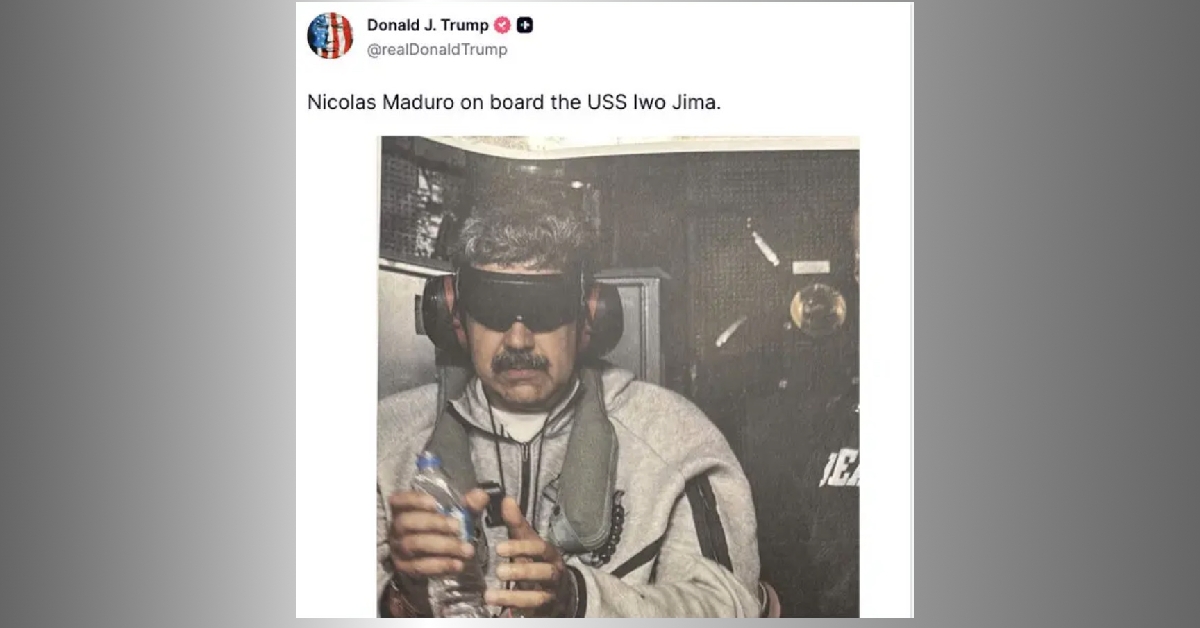
President Trump’s released picture of a handcuffed, blindfolded, aurally incompetent Maduro; at New York Times 4 January 2025
“Maduro. . . “I have a foolproof bunker: almighty God,” he replied. “I have entrusted Venezuela to our Lord Jesus Christ, the King of Kings.”
Tom Philipps; “Maduro urges Trump to abandon ‘illegal warmongering’ and start ‘serious talks’”; Guardian 2 January, 2026 here
THE CAPTURE OF NICOLAS MADURO and the current strategy of USA imperialism; 4 January 2026.
Introduction:
As the decadence of capitalism world-wide rises and makes it decline further, it can provide no answers for the problems of the world’s poor and toilers. Whether they are of working class or still peasant-based toils, all workers face huge falls in living standards, rising unemployment, and immensely reduced social services. Capitalism, and its current form of imperialism – leaves the poor with increasingly no option but to rise. How long this situation continues is difficult to be sure of, especially given the lack of mass Marxist-Leninist communist parties around the world.
As the capitalist crisis worldwide rises, there has been a rapid sharpening of inter-imperial conflicts. These point increasingly to a new inter-imperialist world war. As with many other Marxists, we have previously pointed to the rising tensions making for a new world war. Even bourgeois commentators recognise this as a major explanation of the current world dynamics. It also explains why the USA leadership has chosen this most naked demonstration of its power in Venezuela.
As is increasingly obvious, the main antagonists are the USA and China. Both sets of capitalists – private and state forms of capital – have no way out of their crisis except by trying to grab new markets for themselves. Just as the saying used to be that “All roads lead to Rome” – today all roads lead to the intensification of world war preparations.
It is only through this lens that we can make sense of the totally old-fashioned imperialist way in which the USA has dealt with the Venezuelan state and its leaders. Whether this treatment is legal or otherwise is of course completely irrelevant to the dynamics of power and imperialism.
We have previously argued that both Hugo Chavez and the current seized President Maduro of Venezuela – notwithstanding his abduction into jail by the USA CIA – were not socialists. However we also argued strongly against the USA manipulations, slanders, and open attacks, and threats of war.
As the opening quote from Maduro indicates, his government had – contrary to proletarian class party principles – left the working class and toilers of Venezuela completely open to attack. Continuing a reliance on a one-commodity economy of oil, he did not develop heavy industry and thereby independence. Instead, he aided the national bourgeoisie to continue and intensify the exploitation of the country’s toilers. But this USA attack on Venezuela which has culminated in the abduction of its president, must be condemned by all working people worldwide.
We place the recent events into the historical significance, and the current strategic aims of the USA. While the latter is a faltering and crisis-ridden imperialist hegemony, it also remains the strongest. It is fervently moving to consolidate its lead. It is, in effect, violently endorsing the Monroe Doctrine. This is evident in the recent proclamation of the National Security Strategy:
“‘After years of neglect, the United States will reassert and enforce the Monroe Doctrine to restore American preeminence in the Western Hemisphere, and to protect our homeland and our access to key geographies throughout the region,’ the document states.”
Laura Kelley; “ Trump’s new national security strategy: 5 key takeaways”; The Hill at 12/05/25; at
The Hill
The actual document is quite clear that:
“In other words, we will assert and enforce a “Trump Corollary” to the Monroe Doctrine”
National Security Strategy of the United States of America November 2025, p.5; at NSS
We examine below these sub-headings.
1. The overall strategic themes underlying USA strive to reinvigorate its hegemony – war against China, and denying them access to oil
2. The long battle of USA imperialism to seize the oil of Venezuela
3. Short summary of the two core background themes behind the current USA attack upon Venezuela
4. The rising attacks upon Venezuela in 2025
5. A brief chronology of the increasing pressure on Maduro and Venezuela
6. As the endgame was played out Madura is captured
7. Conclusions
Appendix – a more detailed time line
1. The overall strategic themes underlying USA strive to reinvigorate its hegemony – war against China, and denying them access to oil
Trump came to power with the overall blessings of the financial, Information technology and industrial barons of today. As we pointed out previously, the older forms of the Democratic Party had lost its utility for the major capitalists:
“…there is a core unity of the USA ruling class who enabled Trump to come to power. This unity is one that does not resist the onslaught on the working class and the notions of dissent and free speech. Despite the repugnance of some of the ruling class for him, the ruling class wants a serious restructure of the state. .
For the ruling class of the USA is united on their need to secure their profit base. In this, it is necessary that it prepare for a coming battle with its major international opponent – the Chinese state. The European Union (EU) is another opponent – but one of less urgency than that of China. . . the goals of the ruling class of the USA now are to re-structure its state to ensure its hegemony against its main rivals, the People’s Republic of China (PRC) and the European Union.
That is why the Trump Tariff War is especially targeting the PRC.”
(See MLRG.online ). Theses on Trump 2 and the USA Ruling Class: A re-set to a new imperialist order”; 13 April 2025; at MLRG.online April 2025
One clear mandate given to Trump was to force measures against China. While the Democratic Party leaders of Obama and much more so, Biden – had begun this movement – Trump raised it a new high level of sharpened conflict with the tariff war (“The Goals of Trump’s New Tariff Wars”; March 14, 2025; at MLRG.online March 2025 ).
However, this move was effectively countered by the carefully carved out monopoly on so-called ‘rare earths’ that Chinese Capital had managed to create. China therefor,e retaliated by withholding these. This created a stalemate.
The challenges to USA hegemony from China have only grown. It is no surprise that the Editorial Board of the nominally ‘progressive liberal’ New York Times (NYT) urge Trump on to more ambitious goals aimed at breaking China’s monopoly of ‘rare earth’:
“China has powerful leverage over the United States through rare earths. The country has built an effective monopoly over these metallic elements, which are difficult to mine and process. They are also critical to the U.S. economy and military — used to make magnets essential to a wide range of electronics, including cars, fighter jets, drones, smartphones, computers and M.R.I. machines. After Mr. Trump imposed tariffs on China, it retaliated in April with export controls on rare earths that restricted U.S. access, and it tightened those controls in October. Weeks later he folded, sharply reducing his tariffs.
Now that China has successfully squeezed the Trump administration, similar tactics in other realms are easy to imagine. China could use its chokehold on rare earths to discourage weapons sales to Taiwan, gain access to advanced Western technologies or reject American entreaties to protect intellectual property or crack down on exports of fentanyl ingredients.
Breaking China’s monopoly is crucial for America’s national security. The United States needs to develop reliable alternative sources of rare earths so that our ability to make weapons does not depend on the good will of a potential adversary. America also needs to reduce its reliance so that even in peacetime, China cannot wield its monopoly as a trump card to be played whenever…
Mr. Trump is not to blame for most of the problem. Yes, his trade war was reckless. But China started to build its rare earth dominance decades ago, long before Mr. Trump became president.”
The Editorial Board; “The U.S. Must Break China’s Chokehold on Our Economy; Dec. 22, 2025
So as seen above, the NYT exculpates Trump for “most of the problem” of China-USA relations. Even the attempt to withhold the more sophisticated chips and Artificial Intelligence (AI) capabilities of Nvidia, have been bypassed by the chief of Nvidia – apparently with the agreement of President Trump.
Therefore, to ensure new markets of dominance for themselves, the USA has focused on two main areas of the world in strategic planning. These are the Middle East, and South America. Both revolve around an axis of fossil fuel oil.
The war of genocide in the Middle East against Palestine, waged by the Israeli state Zionists, allied to the USA has effectively succeeded in ensuring their joint dominance. The trap into which the Hamas fell, led to an individual terrorist attack on Israeli citizens; and an Israeli state casus belli. This enabled a pre-planned vicious Israeli attack (See “October 7, 2023 to October, 2024 – and the Aftermath”: October 7, 2024; at MLRG.online October 2024).
As far as any Palestinian fighting forces – they have been almost completely decimated. Not to say that the Palestinian nation has been eradicated – yet. But certainly, there is no effective Palestinian fighting agency left. Moreover, all surrounding states have either been directly intimidated by war and terror launched by Israel (Lebanon, Qatar, Syria, Jordan, Yemen, Iran) have been silenced.
Other key states have been directly coopted such as Saudi Arabia – the dominant nation of the region. Indeed, the capitalists of the USA and Saudi Arabia have made numerous financial investments in each other’s countries. A rising holder of USA debt is Saudi capital.
Meanwhile, a targeted ‘regime change’ in Iran cannot be ruled out. Already, the Trump regime first enabled Israel to launch its attack on Iran (See Arbeit Zukunft – “ Stop the War on Iran!“; reprint at MLRG.online June 2025 ). Now it signals clearly to the dissatisfied masses in Iran that the USA will take aggressive action if the Iranian state retaliates against the masses again:
“Donald Trump has said that the US will come to the “rescue” of protesters in Iran if Tehran responds violently to the largest nationwide demonstrations the Islamic Republic has faced in years. In a post on Truth Social early on Friday, Trump said: “If Iran shats [sic – Ed.] and violently kills peaceful protesters, which is their custom, the United States of America will come to their rescue. We are locked and loaded and ready to go.”
Iranians have in recent days been protesting over the country’s dire economy, with frustration over soaring inflation and the collapse in living standards spilling out on to the streets. “
Financial Times Reporters; “Donald Trump warns Iran that US will ‘rescue’ protesters”; FT 3 January 2026;
To understand how long-standing the battle of the USA imperialists to gain control of the huge oil reserve of Venezuela has been, we must reprise some main elements from a prior publication (See MLRG.online Sep 11, 2024; “The struggle for control of Venezuela’s Oil – A short Marxist history to Venezuelan electoral crisis 2024”; at MLRG.online See 2024 ).
This reprise follows here, and its amended quotations makes up the entire section marked #2.
2. The long battle of USA imperialism to seize the oil of Venezuela
This goal has long eluded the USA after the slow rise of the national bourgeoisie of Venezuela following President Gomez’ tenure in the years 1908-1935.
Gomez was a latifundist who gradually transformed the economy from a latifundia-landed oligarchy into a fully comprador bourgeoisie over 30 odd years. We have dealt extensively with this history previously. To briefly recap the years from 1900 up to around 1939 saw the latifundia economy being transformed by an oil economy. The pathway that led to this was the development of a comprador transformation of the latifundists.
But this spawned in time a nationalist consciousness and class that wished to retain the profits for itself rather than enabling the USA to take them. As we wrote:
“President Gomez rapidly developed the oil economy…He did this by granting concessions to foreign companies and by waiving all duties on imports and exports.
First benefits went to John D Rockefeller’s New Jersey-based ‘Standard Oil’. But an early rival to the USA in South America was the Royal Dutch Shell…By 1939 Standard Oil and Shell would control 85% of oil extracted in Venezuela (Fernando Coronil, “The Magical State. Nature, money and modernity in Venezuela”; Chicago1997; p. 76).”
“Under the Mining Law of 1909, the companies were given unlimited access for a minimal tax of Bs 2 per ton of oil and Bs per hectare of land (Coronil, Ibid p. 78).
But while Venezuela’s comprador-landed oligarchy and foreign imperialists controlled the economy and the division of petro-profits, the working poor descended further and further into poverty, misery, and squalor.
Even in its earliest days, some sections of the Gomez government wished to challenge the companies. In 1917, Gumersindo Torres, as Minister of Development, began to point out how in the USA, rising land rents had enabled USA landowners to negotiate against the USA oil companies. “
Although Torres failed, the battle of the national bourgeoisie never disappeared, and it was re-joined in the period of the Second World War. Now, a strategy was employed by the USA presidency of Roosevelt to buy the bourgeois nationalists off with granting the Venezuelan state only 50% of the oil revenues – rather than the 100% the USA imperialists had feared. As we wrote:
“Romulo Betancourt and Romulo Gallegos for the Accion Democratica, (Democratic Action AD) launched a joint military-civilian coup in 1944…
Immediately after the war, the key oil event in Venezuela itself was the Petroleum Act of 12 November of 1948. This agreed to a 50-50 split of oil profits on the oil companies. Half of the profits would be go to the state. This is usually presented a great victory for the nationalists of Venezuela. However how this formula came about was not as various texts make out…
In sharp contrast however, this strategy was devised by USA government ‘consultants’. The Venezuelan government had been referred to them by the high authority of President Roosevelt and his Undersecretary of State Sumner Welles. It was they who engineered this agreement.”
(See MLRG.online Sep 11, 2024; “The struggle for control of Venezuela’s Oil – A short Marxist history to Venezuelan electoral crisis 2024”; at MLRG.online Sep 2024 ).
The ‘consultant ‘was Herbert Hoover Jr, the son of the ex-President of the USA Hoover. Romulo Betancourt for a while posed as a bourgeois nationalist. But when he became a leading partner with President Gallegos – he maintained that outright nationalisation of oil was not deemed possible:
“There was no talk at that time of applying in Venezuela the courageously nationalistic methods of Lazaro Cardenas who in 1938 had nationalized Mexico’s oil.”
Philip George Ibid; Ibid.
“The first full elections in 1947 led to the liberal writer – Romulo Gallegos – becoming President, in alliance with Romulo Betancourt…The Minister of Development, and later Minister of Oil – Juan Pablo Perez Alfonso committed to the prior “50:50” negotiations with the oil companies. Namely the ‘solution’ that had been suggested by the USA “consultant”. This was. . . Herbert Hoover Jr.”
(See MLRG.online Sep 11, 2024; “The struggle for control of Venezuela’s Oil – A short Marxist history to Venezuelan electoral crisis 2024”; at MLRG.online Sep 2024).
But looming in the background was an increasing class militancy of the oil-workers. Accordingly to buy the nationalists off, the 50% was raised to 65%.
Under the Presidency of Romulo Betancourt (1959-1964) Venezuela cemented further its ties to the USA. In August 1958, Eisenhower enthusiastically received the new Venezuelan government; and his ambassador, Christian Herter, committed Washington to “all of the public support we can give” to President Rómulo Betancourt. Relations became even closer under President John F. Kennedy.”
Steve Ellner; “Rethinking Venezuelan Politics”; Ibid; p.51
Betancourt sabotaged Fidel Castro’s participation at the Organization of American States (OAS) at the foreign ministers’ conference at Punta del Este in Uruguay in January 1962. Venezuela became Kennedy’s prime Latin American spearhead against President Fidel Castro of Cuba.
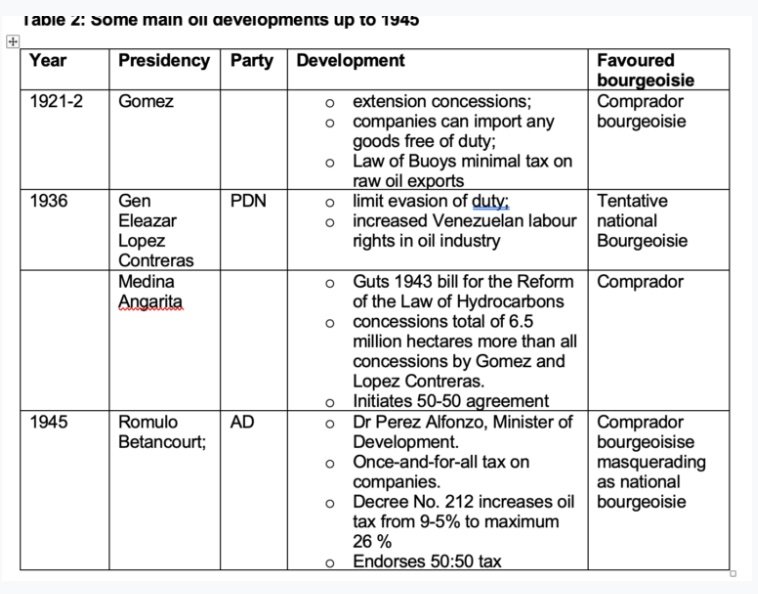
The shifting class character of the ruling class in Venezuela up to Betancourt’s Presidency is seen below, reprinted from Ibid.
In the first Government of Carlos Andrés Pérez (AD 1974–1979), a ‘left’ was made to calm the waters of class conflict. In 1973, he pledged to ‘nationalize’ the oil industry whose foreign concessions were due to expire in 1983. He did create a nationalized oil industry.
However generous compensations, including all marketing decisions was made to foreign companies. Moreover, Perez also began ‘inducing’ foreign capital to invest in ‘downstream’ sectors of the economy. But Perez backed down ultimately. The nationalisation was rendered toothless by the foreign companies.
The failure of the national bourgeoisie to effect the full seizure of oil from foreign imperialists especially the USA – was the backdrop to the Hugo Chavez Presidency.
With the IMF precipitated crisis in the years after 1980, Venezuela was in a ferment. Hence, the wildly successful mass mobilisations under Hugo Chavez, a professed follower of President Fidel Castro of Cuba. He developed the Fifth Republic Movement (MVR), as the modern-day descendants of Simon Bolivar.
Under his presidency, a domestic program included a new Constitution, and significant oil industry reforms; and the state expropriation of large landed estates and unproductive agricultural lands, which targeted the remaining Venezuelan landed oligarchy.
However, when Chavez took power, he was of course dealing with the long comprador legacy. He aimed initially to first restore state nationalisations, and defend and extend some of the steps that Perez had taken:
“…beginning in 2002, the government’s anti-neoliberal thrust led it to go beyond the original objectives of the 1976 nationalization of oil by consolidating the Ministry of Mines’ control over PDVSA and formulating new goals for the industry.”
Steve Ellner “Re-thinking Venezuelan Politics”; Ibid p. 85
In February 2002, Chavez tried to reorganize the nation’s oil industry by appointing a new board of directors to the state-run enterprise.
The Venezuelan state oil company, Petroleros de Venezuela (PDV) was publicly owned. But the computer system that runs and maintains the automated industry was not, being in the hands of a mixed public/private firm named Intesa. Its main branch was a multi-national computing consortium named the Science Application International Corporation(SAIC). The board of directors of SAIC included former CIA Directors John Deutsch and Robert Gates, former US Secretaries of Defense William Perry and Melvin Laird, ex-US National Security Council members Jasper Welch, Admiral Robert Ray Inman, and General Wayne Downing.
The incumbent oil executives had been appointed by Perez and baulked at Chavez’s proposed changes. They called for a ‘strike’ of oil industry managers. In reality, this was a lock-out, and not a strike, but even with an eight week lock-out, it was unsuccessful.
However Chavez failed to move Venezuela out of being an oil dependent economy. Indeed he believed this was not an issue, and he argued that a partnership with China offered enough to enable meaningful reforms:
““Chávez and key figures in PDVSA and the energy ministry began to argue that the whole notion of a ‘resource curse’ was a myth: how could it possibly be a curse to have such abundant commodity resources? They thought they could use OPEC to lift oil prices and keep them sustainably high. Nobody anticipated then the huge increase in us domestic energy capacity, which has made it effectively self-sufficient, or the slowdown in the Chinese economy.
Julia Buxton “Venezuela After Chávez”; New Left Review (NLR) 99; May- June 2016; p.11-12
“China and Russia were reaching out to new international trading partners; and left-leaning presidents began taking power elsewhere in Latin America – Lula in Brazil, Kirchner in Argentina, Morales in Bolivia, Correa in Ecuador. Chávez became far more active on the international stage…
(Chavez saw) possibilities, with the oil price, the grow¬ing relationship with China and the perceived decline of us power.”
Julia Buxton; “Venezuela After Chávez”; NLR 99; May 2016 p. 9; 11.
Developing closer economic relations with China became the avenue that Chavez took. It was not a road to socialism. As we cited Marta Hanecker and Julie Buxton:
“Given China’s growing need for raw materials and the fact that Latin America has plenty of them, relations between the two have become closer. China has become one of the main trading partners of countries such as Peru, Chile, and Brazil. It has begun to form strategic alliances with several countries in the region, especially with Venezuela.
According to a study by Diego Sánchez Ancochea, an economics professor at Saint Anthony’s College, Oxford, between 2004 and 2005 China signed close to one hundred agreements and public commitments with several South American countries, including a free trade agreement with Chile in November 2005.4 Brazil’s exports to China increased from $382 million in 1990 to $6,830 million in 2005. Argentina and Chile experienced similar increases, going from $241 million and $34 million in 1990 to $3,100 million and $3,200 million, respectively, in 2004. China has become one of the biggest trading partners, not only of the Southern Common Market (MERCOSUR) countries, but also of other South American countries.”
Marta Harnecker Latin America & Twenty-First Century Socialism: Inventing to Avoid Mistakes”: Chapter 1; Venezuela Analysis July 29, 2010
But this was not a socialist path of course. It simply re-drew the lines of dependency now centered on China. We have traced the failure to move beyond any national bourgeois democratic revolution into a socialist state power before. But Nicolas Maduro has been even more than Chavez – openly propping up a section of capitalists – who can be called a national bourgeoisie.
3. Hence a simple short summary of the two core background themes behind the current USA attack upon Venezuela is:
(i) To seize the oil reserves of Venezuela.
(ii) Restricting pro-Chinese developments in South America and furthering an anti-Chinese war
It is obvious how this there are closely related to the war in Venezuela, since a major part of the oil production of the Venezuelan state has been going to China.
Fossil fuel oil remains the chief source of energy for most capitalist industries. China has no major resources of oil. The USA has already disrupted China’s supply of oil from the Iranian state; and the sea transport routes around the Indian Ocean. Hence, the USA sponsored the apparently ‘spontaneous’ coup that forced Shaikha Hasina from power (we reviewed this episode on August 23, 2024, “Bay of Bengal – Naval Cauldron of China versus USA – Behind the drama of Sheikh Hasina’s flight from Dakka”; at MLRG.online August 2024).
4. The rising attacks upon Venezuela in 2025
As with many Marxist,s we have long pointed out that the USA was determined to seize Venezuelan oil and the state. We have written extensively on the backgrounds of both Hugo Chavez and Nicolas Maduro – repudiating them as socialists.
(See Hugo Chavez and Venezuela originally 2004; re-published MLRG.online August 2024 at MLRG.online August 2024); and:
See “The struggle for control of Venezuela’s Oil – A short Marxist history to Venezuelan electoral crisis 2024 (MLRG.online September 2024 ); and
Simon Bolivar – a non-Bolivarian view (MLRG.online September 2024 )
Most recently, in October we wrote:
“On October 3, 2025, American forces carried out a deadly strike against a non-military Venezuelan vessel. The strike reportedly killed four people, and is the fourth such action by Trump’s Administration against non-military Venezuelan vessels since September 2.
The United States government’s longstanding campaign of antagonism against Venezuela dates back to 2005 and the rise of the country’s late populist leader Hugo Chávez. But the Trump Administration has been spoiling for war with Venezuela since Trump’s January 2025 inauguration. Still, the progressive escalation from rhetoric to military action marks a new phase in America’s campaign of hostility against the South American country. Trump himself declared that the United States is in a state of “armed conflict” with Venezuela the day before the strike:
“President Trump has decided that the United States is engaged in a formal ‘armed conflict’ with drug cartels his team has labeled terrorist organizations and that suspected smugglers for such groups are “unlawful combatants,” the administration said in a confidential notice to Congress this week.”
“U.S. Against Venezuela: War By Any Other Name”; October 2025 at MLRG.online October 2025 ;
By November, we wrote again of the charade of killing individual fishermen while pretending they were drug runners. We also identified at least two reasons for which a delay by the USA administration in launching a full blown attack on Venezuela:
“As the USA President Trump has made clear the assaults on the small boats off-shore – likely ferrying only fisherfolk rather than ‘drug runners’ – is likely to be only a prelude. We wrote about this recently (“U.S. Against Venezuela: War By Any Other Name”, MLRG.online October 3, 2025 ). In the meantime the war drums sound progressively louder. As the New York Times comments on November 5th:
“Mr. Trump has issued a series of contradictory public messages about his intentions, and the goals and justification for any future military action. He has said in recent weeks that the attacks on speedboats in the Caribbean Sea and the Eastern Pacific — including another strike on Tuesday — that have killed at least 67 people would be expanded to land attacks.”
David E. Sanger,Tyler Pager, Helene Cooper, Eric Schmitt and Devlin Barrett; “Trump Weighs Options, and Risks, for Attacks on Venezuela”; New York Times (Hereafter NYT) November 5, 2025.
The real intent of this vicious charade of illegal killing of individual fisherfolk is transparent, even to the NYT journalist team:
“The Trump administration has developed a range of options for military action in Venezuela, including direct attacks on military units that protect President Nicolás Maduro and moves to seize control of the country’s oil fields, according to multiple U.S. officials. President Trump has yet to make a decision about how or even whether to proceed…
Asked whether Mr. Maduro’s days as president of Venezuela were numbered, he added, “I think so, yeah. The support for the more aggressive options is coming from Secretary of State Marco Rubio, who is also the acting national security adviser, and Stephen Miller, Mr. Trump’s deputy chief of staff and homeland security adviser. According to several U.S. officials, they have privately said they believe Mr. Maduro should be forced out.”
NYT Ibid November 5th.
Why has it not yet happened then? It appears there are two reasons.
Firstly, the USA President is simply awaiting legal guidance to evade a paper injunction that he needs to get clearance from the Congress:
“Mr. Trump’s aides have asked the Justice Department for additional guidance that could provide a legal basis for any military action beyond the current campaign of striking boats that the administration says are trafficking narcotics, without providing evidence. Such guidance could include a legal rationale for targeting Mr. Maduro without creating the need for congressional authorization for the use of military force, much less a declaration of war.”
NYT Ibid November 5, 2025
Secondly, the naval and troop buildup has to continue to critical levels. One large carrier arrives later this month, and frank hints about CIA covert operations have been dropped to ratchet up the “psychological pressure campaign.”
MLRG.online November 5th, 2025; Introduction to “Two republished articles on María Corina Machado’s Nobel Peace Prize”; Marina Corina Machado November 2025
5. A brief chronology of the increasing pressure on Maduro and Venezuela
From the period of Trump’s First presidency, the pressure has increased on the Venezuelan government. In the Appendix we give some key dates and events. We have drawn this and abstracted it from the larger original compilation carried in the New York Times (NYT) “Isabela Espadas Barros Leal and Genevieve Glatsky; Jan. 3, 2026”.
In brief, Trump’s first term saw an indictment of Maduro for “narco-terrorism and narco-trafficking”. While this is obviously a bogus charge, it has not been removed since. Then came the successive Biden administration sponsorship of Edmundo González – who was declared the victim of a fraudulent election, which Maduro claimed to have won. As we pointed out previously – Maduro’s government could have released various electoral documents, but refused to do so. It seems quite likely that by this time he had lost the support of the working class – having steadily embraced more pro-capitalist steps.
Thereafter came all the events, including the bombing of small boats – likely carrying fisherme,n not narco-smugglers as claimed by Trump – to the seizure of an oil tanker on October 20th, 2025. That followed a declaration that “Trump ordered a “complete blockade” of sanctioned oil tankers entering or leaving Venezuela.”
By October 15, Trump had already formally asked the C.I.A. to review and begin covert action in Venezuela, saying USA “certainly looking at land now, because we’ve got the sea very well under control.”
Steadily, the pressure was being mounted on Maduro. The arrogant Trump declared on Nov. 2 that Venezuela had treating the United States “very badly” and, when asked if Mr. Maduro’s days in office were numbered, said, “I would say yeah.”
In total, from September 2, 2025, to end December 2025 the tally of murdered fishermen in small boats was as follows:
No of air strikes against small boats – 35
Number of killed individuals -115
(Lazaro Gamio, Carol Rosenberg and Charlie Savage; “ Tracking U.S. Military
Killings in Boat Attacks “; NYT; Updated Jan. 1, 2026)
it seemed clear that a CIA-targeted assault was to be carried out, removing the immediate necessity for a full -scale land invasion. But first, in a ‘softening-up” the C.I.A. attacked in a drone strike on a port it seems on Dec. 24. This was revealed by Trump on Dec. 26, in a radio interview saying “the U.S. had destroyed “a big facility”.
At least for now, the military and political strategy has been instead to rely on a section of the now bribed leaders of the Venezuelan adminstration such as the hitherto former Vice President. We describe this below.
6. As the endgame was played out, Maduro is captured
By the end of the year 2025, the Venezuelan President’s power base was long exposed as shallow. As he pointed out that he had a “foolproof plan” – to rely on “almighty God” to whom “I have entrusted Venezuela to our Lord Jesus Christ, the King of Kings.“:
“The New York Times reported last month that Maduro had responded to Trump’s pressure campaign by regularly sleeping in different locations and switching mobile phones so as to avoid being captured by US special forces or killed in an aerial attack.
Asked what impact Trump’s pressure campaign was having on his physical and emotional state, however, Maduro struck a nonchalant tone. “I have a foolproof bunker: almighty God,” he replied. “I have entrusted Venezuela to our Lord Jesus Christ, the King of Kings.”
Tom Philipps; “Maduro urges Trump to abandon ‘illegal warmongering’ and start ‘serious talks’”; Guardian at 2 January, 2026
It seems Maduro realised he could place on reliance on a working class that had been deeply alienated by his pro-capitalist policies. The end came quite suddenly as Trump revealed the seizures of Maduro and his wife Cilia Flores:
“President Trump said on Saturday that the United States had captured the Venezuelan president, Nicolás Maduro, and was taking him to New York to face criminal charges, the stunning culmination of a monthslong campaign by his administration to oust the authoritarian leader. Attorney General Pam Bondi said on social media that Mr. Maduro and his wife, Cilia Flores, had been indicted on drug and weapons charges and “will soon face the full wrath of American justice…Mr. Maduro and Ms. Flores had been taken to the U.S.S. Iwo Jima, one of the American warships that have been prowling the Caribbean, and would be taken to New York.”
NYTimes 3 January, 2026; “Live Updates: U.S. Captures Venezuelan Leader, Trump Says“.
The mechanics of the seizure are still not fully revealed. However, it seems crystal clear that the CIA had ‘turned’, or made some high-level administrators their aides. No doubt the $50 million reward for information leading to the capture of Maduro helped…
“American special operations forces captured Mr. Maduro with the help of a C.I.A. source within the Venezuelan government who had monitored his location in recent days, according to people briefed on the operation.”
NYTimes 3 January, 2026; “Live Updates: U.S. Captures Venezuelan Leader, Trump Says
The role of other collaborators inside the Venezuelan government is also as yet unclear. But it is of note that Trump has refused – for now – to acknowledge Maria Corina Machado as becoming an installed President:
“In his Fox News interview, Mr. Trump declined to throw his support behind María Corina Machado, the Venezuelan opposition leader who recently won the Nobel Peace Prize.”
NYTimes 3 January, 2026; “Live Updates: U.S. Captures Venezuelan Leader, Trump Says“.
Meanwhile, the Vice-President to Maduro – Delcey Rodriguez – makes supportive noises about her prior president:
“Venezuela’s vice president, Delcy Rodríguez, appeared on a state-run television station after Mr. Trump’s announcement and asked Mr. Trump for proof that Mr. Maduro was still alive.”
NYTimes 3 January, 2026; “Live Updates: U.S. Captures Venezuelan Leader, Trump Says“.
In fact it appears that Vice-President Delcy Rodriguez – seems to be a preferable choice to the Trump administration and Secretary State Marco Rubio:
“Mr. Trump avoided fully embracing either Ms. Rodriguez or Ms. Machado. He said his secretary of state, Marco Rubio, had spoken to Ms. Rodriguez and “she’s essentially willing to do what we think is necessary to make Venezuela great again.” He also said Ms. Machado didn’t have the support or respect to lead the country.”
Anatoly Kurmanaev and Tyler Pager; “Maduro Arrives in N.Y.; Trump Says U.S. Will ‘Run’ Venezuela”; NYT 3rd January updated 4 Jan 2026.
“One thing Mr. Trump made clear was his desire to open up Venezuela’s vast state-controlled oil reserves to American oil companies. He spoke at length at the news conference about American oil companies rebuilding the country’s energy infrastructure and, presumably, regaining rights they once held to Venezuela’s vast oil reserves. “We are going to run the country right,″ Mr. Trump said. “It’s going to make a lot of money.” Past Venezuelan governments, he said, “stole our oil” – an apparent reference to the country’s nationalization of its oil industry.”
Anatoly Kurmanaev and Tyler Pager; “Maduro Arrives in N.Y.; Trump Says U.S. Will ‘Run’ Venezuela”; NYT 3rd January updated 4 Jan 2026.
7. Conclusion
The Venezuelan people will struggle against enormous odds. It remains uncertain if the remnants of the left outside the Maduro-controlled forces can rally the people or not.
How the USA moves now will depend upon that.
In the meantime, it is likely to impose its power to place a puppet into power. It is not yet clear who this will be, but very possibly it will be the turncoat of current Vice-President Rodriguez.
It seems very unlikely that Trump will simply turn Maduro into his ‘vassal’ comprador – and dismiss the court charges pending in New York, but even this cannot be ruled out.
What we have seen is a return to the oldest colonial power mentality. It is the same as that leading to the deposition of Muhammed Mussadiq in Ira,n leading to the Shah of Iran Pavlavai:
“…to the nationalist Muhammed Mussadiq (wanted) nationalisation of Anglo-Iranian Oil Company (AICO) later the Anglo-Persian Oil Company. Musaddiq believed that:|
“The Iranian must administer his own house.”
J.A.Bill ” The Eagle and the Lion – the tragedy of Iranian -American relations”. New York 1988 p.56.
. . . The British then persuaded the USA to participate in a putsch, termed Operation Boot by the British and Ajax by the US. The Chief British operative, Major C.M.Woodhouse was conscious of difficulties in getting the US to take part :
“Not wishing to be accused of trying to use the Americans to pull British chestnuts out of the fire, I decided to emphasis the Communist threat to Iran rather than to need to recover control of the off industry. . . he must be removed.”
J. A. Bill, Cited, Ibid. p.86.
Fully involved in the putsch was General Norman Schwarzkopf, former US adviser to the Iranian Gendarmerie ( J. A. Bill. Ibid, p. 90) – …the father of the US General of the same name, in the 1991 Gulf War of aggression.
The 1953 anti- Musaddiq coup resulted in the Shah of Iran being bought back to Iran.
(J.A.Bill Ibid p. 101)”.
Alliance Marxist-Leninist Issue 2: April 1992. Placed On Web October 2001; “The Gulf War – The Usa Imperialists Bid To Recapture World Supremacy”; Alliance-ML, 2001
The way forward for all progressive people has to be to resist the USA invasion, both in the ‘advanced’ imperialist nations that have been silent about this most recent show of USA renewed aggression. Of cours,e the Venezuelan people will resist to some extent at least, and we must support that.
But a prelude to the coming world war, should spur the working classes everywhere to form their Marxist-Leninist parties.
It is clear how the future is unfolding.
Hands off Venezuela!
Down with American imperialism!
Rise against the new war footing everywhere!
Appendix: More detailed time line of Trump and Venezuela
March 2020: In Trump’s first term, the Justice Department indicts Maduro in a “narco-terrorism and cocaine trafficking conspiracy”. Maduro condemned the charges, denying any drug trafficking.
July 2024: Maduro declared the winner of Venezuela’s 2024 presidential election. Independent monitors said that the opposition leader, Edmundo González, was its legitimate winner.
January 2025: The Biden administration recognized González, now in exile in Spain, as the legitimate leader of Venezuela.
July 2025: The Trump administration describes Cartel de los Soles – as a “Venezuela-based criminal group,” to the list of global terrorist groups and declared that Maduro was its leader. The Treasury Department said that Cartel de los Soles “provided material support” to Tren de Aragua, another cartel linked to Venezuela designated as a foreign terrorist organization. . .
Trump signed a secret order directing the American military to use force against Latin American drug cartels that his administration identified as terrorist organizations.
August: The Pentagon began dispatching warships, fighter jets and thousands of troops into the Caribbean near Venezuela, increasing tensions in the region.
Aug. 7: Attorney General Pam Bondi announced that the United States government had increased its reward for information leading to the arrest of Maduro to $50 million.
Sept. 2: Trump ordered a deadly strike on a Venezuelan boat that he claimed was carrying “terrorists” who were members of Tren de Aragua over international waters. Maduro later called the strike, which killed 11 people, a “heinous crime”.
This starts a series of air strikes on small boats.
Sept. 6: Maduro writes letter to Trump insisting that his country did not export drugs.
Oct. 2: Trump stops all diplomatic outreach to Venezuela. That also stops any deal with Maduro to secure U.S. companies’ access to Venezuelan oil.
Oct. 8: Republicans in the Senate rejected a resolution to bar Trump from using military force against boats in the Caribbean Sea.
Oct. 15: Trump acknowledges he authorized the C.I.A. to conduct covert action in Venezuela, saying USA “certainly looking at land now, because we’ve got the sea very well under control.” The Venezuelan government said it would raise the matter with the United Nations Security Council.
Oct. 23: Trump said at a news conference that he would not seek congressional approval for military strikes against drug cartels. “I don’t think we’re going to necessarily ask for a declaration of war,” Trump said, adding: “I think we are going to kill people that are bringing drugs into our country, OK?”
Oct. 24: The Pentagon sends aircraft carrier Gerald Ford and its accompanying warships and attack planes to waters near Latin America. Two Air Force B-1 bombers flew near Venezuela.
Nov. 2: Trump said in an interview on CBS News’s “60 Minutes” that he doubted the United States would go to war with Venezuela but would not fully rule out the possibility of land strikes. He accused Venezuela of treating the United States “very badly” and, when asked if Maduro’s days in office were numbered, said, “I would say yeah.”
Nov. 29: Trump said on social media that the airspace “above and surrounding Venezuela” was “closed in its entirety.”
Dec. 10: Trump announced that the U.S. had seized a sanctioned oil tanker off the coast of Venezuela.
Dec. 11: Ms. Machado appeared in Oslo hours after missing the ceremony for her Nobel Peace Prize. Also the US places new sanctions on Venezuela’s oil sector and Maduro’s relatives. while moving to block tens of millions of dollars’ worth of oil aboard the seized oil tanker.
Dec. 16: Trump orders “complete blockade” of sanctioned oil tankers entering or leaving Venezuela. Trump said Venezuela was “completely surrounded” by a growing U.S. naval presence.
Late December most likely the 24th: The first known U.S. operation inside Venezuela by the C.I.A. uses drones to strike on a port. On Dec. 26Trump said
hat the U.S. had destroyed “a big facility”.
Heavily based on Isabela Espadas Barros Leal and Genevieve Glatsky “A Timeline of Rising Tension Between the U.S. and Venezuela”; NYT; Jan. 3, 2026